Advertisement
 56:24
56:24
Transcript
0:01
(compelling music)
0:13
- So, we are starting back into Chapter 1.
0:16
The first seven pages are
a kind of a bombshell.
0:20
A lot is contained in them,
which will be unfolded later.
0:25
I want to mention that
the first few chapters
0:28
have a kind of hypothetical form,
0:34
hypothetical situation.
0:35
They take up simple commodity exchange
Advertisement
0:38
under the capital system.
0:39
That is, more or less,
0:40
if I go to you and try
to sell you something
0:42
and you come to me and try
to buy something from me.
0:45
This is not possible outside
of the whole capital system,
0:48
but he has to find a way in
0:50
and he wanted to find a way
in that is familiar to you.
0:53
I call this the entry point,
0:54
and I still, even though it's difficult,
0:56
don't think it's a bad way to start.
Advertisement
0:58
The entry point into the capital system
1:00
is through the commodity,
1:02
and it's very narrow,
1:04
and there's a lot of stuff
stuck in that entryway.
1:09
So, keep your eye on
the reduced situations
1:12
that Marx gives you,
1:13
like simple commodity
exchange between individuals,
1:18
exchanging particular commodities
1:20
from particular concrete
acts of production.
1:23
And when he talks about groups
1:28
and phenomena in general,
1:30
these are all different things
1:31
that have to get worked
out in their own analysis
1:33
because, ultimately,
1:34
the only way you can understand
1:36
any individual phenomena in this system
1:37
is by starting from the whole.
1:40
This is, of course, impossible to do.
1:44
Maybe the critical of
capital can see the whole.
1:49
Maybe Marx, after 30
years, could see the whole,
1:52
but it might not be the case.
1:55
He might not have gotten there.
1:58
So the first four chapters
has this heuristic situation,
2:03
simple individuals, concrete commodities,
2:06
and moving from there
to the genesis of value
2:11
and towards general questions
2:12
and universal questions in this system.
2:16
Anything universal, by the way,
2:18
is historically bounded
to the capital system.
2:20
It's universal, meaning it's necessary,
2:22
and applies in every
situation under capital.
2:25
That doesn't mean it's universal
in our historical moment
2:29
only where capital is touching it
2:31
because that is a quality
of the capital system
2:33
that it universalizes
2:35
and has moments of
absolute necessity in it.
2:40
We'll talk more about
that as we go through.
2:42
The guiding question
2:44
for our reading of the
first four chapters is:
2:45
What is value?
2:49
Where does it come from?
2:51
And what does it do?
2:52
Those are the ways he works
out the what-is question
2:56
because it has a source in the system
2:59
and it is an operation.
3:02
And also what is the apparatus
that value needs around it
3:06
in order to continue to exist?
3:10
It needs a system.
3:11
It isn't something that
works just on its own.
3:14
It calls into existence
a system around it.
3:19
His technique is the
phenomenology of the commodity,
3:23
this is the first four chapters,
3:24
which I'm calling the entry point.
3:28
It's the most familiar,
or at least he thought so,
3:31
even more familiar in a
certain sense than labor,
3:33
but he gets to labor right away.
3:36
And it is...
3:37
It's quite narrow
3:39
and you can't totalize the
system from the commodity.
3:42
So this is not a book about the commodity.
3:44
This is a book about capital,
3:45
and the way in is through the commodity.
3:48
Does that make sense?
3:49
Because as I said last time,
3:50
capital is not an elemental theory,
3:52
like chemistry, let's say.
3:55
Although chemistry is beautiful
3:56
because the compounds have
different emergent qualities
3:59
than the elements.
4:00
So you can't fully explain a
compound from its elements.
4:03
And capital is the same.
4:08
So, if you're in doubt,
4:10
I know this sounds like
a salesman's trick,
4:12
but if you're in doubt, read on.
4:15
Things don't fully make sense
4:16
from the perspective of the entry point.
4:19
Like, you can't see a
house from the foyer.
4:22
You need to go through the rooms first.
4:24
You get a sense of the whole layout.
4:25
And then, it will make sense
4:27
what the foyer does in the house.
4:28
It's an entry point.
4:33
You will go through a set
of perspective switches.
4:37
That's what Marx is gonna do for you
4:38
and that's the phenomenological
aspect of this book.
4:41
Phenomenology just means
the science of appearances
4:44
or the way you experience things.
4:47
Something always appears to someone else
4:51
and it has another form that
is the way it doesn't appear.
4:56
And in this phenomenology,
4:58
you will be asked to switch perspectives.
5:00
I'm just gonna give
you a little list here,
5:01
from objects to processes,
5:04
from things to ghostly
qualities that hang around them,
5:09
from singles to doubles,
5:13
and from elements to the whole.
5:15
These are the perspectives,
5:17
these are the perspective switches
5:18
you're going to be asked to
accomplish as you read the book.
5:22
So, it is a kind of
training for your psyche,
5:25
for your perceptual apparatus,
5:26
for your understanding apparatus.
5:29
Today, we have an objective,
5:31
which is part of our objective
is going to be to define use,
5:36
use value exchange, exchange value,
5:39
and the product of their
relationship, which is value.
5:45
You're gonna be introduced to a new term,
5:47
which is value form, it's a Marxian term,
5:50
and it's very important
5:52
for understanding how
the capital system works.
5:57
Let's start with value.
5:59
This is what the first
seven pages leap into
6:02
and the first four chapters
try to define for you.
6:05
You are witnessing the
birth of a fantasm value,
6:09
but more than a fantasm,
a necessary fantasm,
6:13
like freedom or democracy.
6:15
But those belong to other systems.
6:17
This is the fantasm that
belongs to the capital system.
6:21
Value is a fantasm born out
of the lopsided relationship
6:24
between use value and exchange value
6:26
or between use and exchange.
6:30
You're gonna hear how
it comes to be treated
6:33
as an independent quasi-natural substance,
6:36
something like a substance
in the philosophical sense.
6:41
Value is a unique quality of things
6:43
under the capital system.
6:46
You'll see that Marx uses
an analogy of weight,
6:48
like in a physical system.
6:51
The capital system has this
unique quality called value.
6:55
Value is the weight of the capital system.
6:57
Value is the substance that you can read
7:00
through things like...
7:02
You can read weight in a physical system.
7:08
And there's a whole set
of strange operations
7:10
that the capital system uses
7:12
that other social systems don't.
7:14
Reflection,
7:16
comparison, reduction, abstraction,
7:19
reification, or objectification.
7:22
These are all the processes
of the capital system.
7:25
This is Marx's discovery.
7:29
I'm gonna give you one definition of value
7:31
and then we'll come back
to it a number of times.
7:33
Value is a norm for comparing commodities
7:36
in order to find the right
ratio in which to exchange them.
7:42
Value is a norm for comparing commodities
7:46
in order to find the right
ratio in which to exchange them.
7:51
This doesn't quite get to the changes,
7:54
the transformation of value,
in under the capital system.
7:58
The way it compares commodities,
the way it comes to ratios,
8:03
is gonna be different in capital
8:04
than in simple non-capitalist exchange.
8:08
But if you wanna know what value is
8:10
in a non-capital setting,
8:11
it is something like what you need
8:14
when you're not producing
solely for yourself
8:18
and you don't live in paradise.
8:20
Or you could say if you don't live in hell
8:22
where desire is 100%
and the supply is zero,
8:28
and you don't live in paradise
8:29
where desire is at zero
and supply is at 100%.
8:35
You need value.
8:37
Value is what allows
you to trade your thing
8:39
for something else you
need with someone else.
8:42
It's the way you decide how
many of your thing you're giving
8:47
for how many of the other thing.
8:50
Under the capital system,
8:51
it isn't so much arrived at
according to desire or demand,
8:57
even in that case.
8:58
It's arrived at according to
reduction, hypothesization,
9:05
equalization, expression,
9:09
mirroring all of these weird processes
9:12
that Marx is gonna lay out for us,
9:14
as though the capital system
were really very different
9:16
than any other social system
9:17
because this processes were
totally different and abstract.
9:25
Abstraction being one of the processes.
9:29
So, about value,
9:30
Marx is not saying there
is something like value,
9:33
like there is a chair
in a room, we know this.
9:37
He is saying, however,
9:38
we act as though it's there
like a chair in a room.
9:42
It gets objectified.
9:44
It has what he calls ghostly objecthood.
9:47
A great translation by the
new translator, Paul Reitter.
9:50
It's true, ghostly objecthood.
9:52
It's a kind of objecthood
that you can't touch
9:55
and it can dissolve easily.
9:57
It goes through a lot of transformations.
10:00
Capital has its own ecology
and its own physics.
10:06
So, on one hand, value
has a subjective side.
10:08
We feel it to be there.
10:10
If someone comes up to you and say,
10:11
"I'll give you this
banana for your iPhone,"
10:12
you're like, "But that's
not worth my iPhone."
10:16
"How do you know?"
10:17
"Well, I feel the value of this.
10:18
I paid for it, or my parents paid for it,
10:20
or the school paid for it, right?"
10:22
You have a sense of its value,
but it's not only subjective,
10:25
it is an objective need of the system
10:27
for things to have value.
10:32
So, one thing to keep in mind
10:34
is you cannot do away with value
10:36
just by feeling differently.
10:40
Debunking value is not gonna help you
10:42
with the capital system directly,
10:45
although it will help you
make better decisions.
10:47
If you all decided to
give away all your stuff
10:49
as if it were valueless,
10:51
you would end up with no stuff,
10:53
but capital would go on happily,
10:54
especially in the people
who got it, your stuff.
10:58
Does that make sense?
10:59
We'll track a little bit the difficulties
11:01
in finding positions of
resistance to the capital system.
11:06
Debunking or refusing it
doesn't seem to be enough.
11:13
Okay, we're starting with value.
11:19
And you'll see, if you open the book,
11:25
we spent last time talking
about the vocabulary
11:28
of the opening paragraph.
11:33
He begins talking about
what he calls use value,
11:36
which is, by the way,
11:37
already something different than use.
11:39
Value is only in play if
you don't have the thing
11:43
or if you're not using it.
11:44
Once you're using a thing,
11:45
it has no value because you have it.
11:49
Once you have a thing,
11:50
it really doesn't have
the same kind of value.
11:52
Value is only if it's
threatened to be taken away
11:54
or you need to get it.
11:56
Value is a kind of
teletechnology, a way...
12:01
of relating to something that you need.
12:05
That thing has value
insofar as you need it.
12:08
That is the value insofar
as you need it for use,
12:11
he calls a use value.
12:14
This seems like the
easiest thing all around,
12:17
although value makes use
already in a system of exchange.
12:21
So really outside of an exchange system,
12:23
there's no use value.
12:24
Again, if you're in paradise,
12:25
you don't need to exchange everything.
12:27
Let's say all the smartphones
and all the updates
12:30
are all lying around on the ground.
12:32
They fell from the tree of smartphones.
12:34
They don't have any value for you.
12:37
So value again is part
of an exchange system.
12:40
Samuel?
12:42
- Can we have a personal sense of value?
12:46
Like, just how much we
want something, right?
12:49
If we're in paradise
12:50
and all the updates are
lying on the ground,
12:54
we might not need a sense of hierarchy.
12:57
We might not need to hierarchize them,
12:59
but we still couldn't do it, right?
13:01
It's not...
13:01
Doesn't seem like it's a product,
13:02
it's a really straight system.
13:05
- Well, it would be satisfied immediately.
13:06
So, you wouldn't need value.
13:09
Value is the delay of
that satisfaction, right?
13:12
Value is what comes into play
13:14
while you're waiting or
trying to get something
13:17
that would be use value,
13:18
insofar as it's valuable
to you because you need it.
13:21
But if it's right there,
13:23
there's no real value for
an infant until the feeder,
13:28
whoever that is, says,
13:30
"I'm tired, you're not gonna eat now."
13:32
And you're like, "Wow, milk, valuable."
13:37
Rudimentary value systems.
13:41
Use values satisfy a human
want or need of whatever kind.
13:45
They are multiple, they differ in quality,
13:51
and Marx is not interested in this.
13:53
So, if you're concerned about use things,
13:56
like some people are, who live their life.
13:58
You need a hammer, you
need to go get a hammer.
14:00
Marx is not gonna talk about that.
14:02
In the beginning,
14:03
he is setting aside the spheres
he's not going to go into,
14:07
and one of them is the infinite
world of useful things.
14:12
Anything can become useful,
14:14
and your tasks that you
use it for will change
14:18
according to what you imagine,
14:19
according to what someone
tells you you need,
14:21
according to what confronts
you at any moment.
14:27
This is on page 14.
14:29
The usefulness of a thing
makes it into a use value.
14:32
Again, I think it's a little
bit more complicated than that,
14:36
but this is very important
14:37
'cause he's going to contrast
it with exchange value.
14:40
Usefulness, in this sense,
14:42
doesn't hover above us in the air.
14:43
It's determined by the
properties of a commodity's body.
14:49
Just so we know, that does
not have to be physical.
14:53
It can be a word document.
14:56
That's not physical; it has
a physical manifestation.
14:59
It can be a dream if you're...
15:02
Whatever you're doing with
that dream is useful to you,
15:04
doing psychoanalysis,
15:07
whatever those qualities are.
15:08
It can be a service, which is
not a physical object, right?
15:12
A service can be commodified.
15:14
I sew your shirt for you,
let's say, your shirt is fine.
15:19
Nice shirt, by the way.
15:22
And you pay me for it, that
act has a delimited contours,
15:30
you know when it starts,
you know when it's done,
15:31
you know how long it takes.
15:33
It has a use value to the shirt owner,
15:37
and that is perfectly well commodifiable.
15:39
There's no difference
15:40
between physical commodities and services.
15:44
So, if they tell you the service economy
15:46
is fundamentally different,
15:47
it is not fundamentally different.
15:49
It certainly changes the way people live,
15:51
what kind of concrete jobs you do.
15:53
But in terms of value,
15:54
the value moves around exactly the same.
16:00
This is the province of what
he calls commodity studies,
16:03
which I'm not sure exists,
16:05
but that's not what he's gonna do.
16:09
Okay, so use value is the property
16:10
of being able to satisfy
a human want or need.
16:15
It involves actually
doing this as a practice
16:18
and activity use.
16:22
So, we know that use value
is already abstracted.
16:27
It's potential,
16:30
it means it can be used;
16:32
and it's abstracted in the sense
16:34
that in any of the concrete situations
16:37
in which you use something,
16:38
this is called use.
16:42
Value is realized, use
value is realized, when?
16:45
When a thing is used, right?
16:48
And the thing is, in a sense,
16:50
has a use value used up
when you're done using it.
16:53
You may actually use up the
usefulness of the thing, too,
16:56
if it's, let's say, a banana.
16:59
When you eat it, it's no longer useful.
17:01
The peel is not useful.
17:02
And incidentally, the
value body of a commodity,
17:07
very different than the
use body of a commodity.
17:10
Well, it's related to the
use body of the commodity.
17:12
The peel is not really part of the value.
17:14
Well, it is kind of,
17:16
say it's part of the value in
that it protects the fruit.
17:20
But there's many physical
qualities of a body
17:22
that are not related to
the use or the exchange.
17:26
So, for example, a banana can
be green, it can be yellow,
17:29
it can be slightly brown, it
can be small, it can be big,
17:32
it can be like cardboard,
it can be like sugar.
17:37
And in all of those cases,
17:38
in fact, the exchange value remains.
17:42
What's required is that there's
the usable part is usable.
17:48
Now, it could be that
cardboard bananas end up...
17:52
You end up not buying that brand anymore.
17:55
So, the usable,
17:56
that is a quality that
relates to its use value.
17:59
You have a question?
- Is it...
18:00
Or what, like humans value (indistinct)?
18:04
- Humans value this
particular thing socially.
18:07
- Socially.
18:08
- We'll talk a little
bit about what that is.
18:12
The kinds of things that
have use values, again,
18:14
are physical objects, services,
intellectual objects, media,
18:20
processes like education or defense.
18:23
They can all have use value.
18:24
So, under capitalism,
18:25
they can all have exchange
value potentially.
18:29
There is a world of useful things here:
18:31
food, energy, clothing, tools,
18:33
we can think of many of
them that you could study.
18:37
And think about a kind of
anthropology of human activities.
18:43
Anthropology had to change
under capital, though,
18:45
to be an anthropology of
the way human activities
18:49
are used by the system to produce value.
18:55
Let's talk about exchange value.
18:59
So, we need to talk about...
19:01
It's a very peculiar phenomenon.
19:11
It seems like this is the
double in the commodity,
19:14
use value and exchange value.
19:16
But really, the double is this.
19:20
That's the double
19:21
'cause exchange value
really only appears briefly.
19:27
This is a longstanding
misunderstanding of the text,
19:29
and Marx is not so clear about it.
19:35
Exchange value is also
potential and abstract.
19:40
Something has value
when it still has a use,
19:46
but it has to be able to do
something else beyond its use
19:49
in the capital system.
19:51
So, again, exchange value
is not just a quality
19:55
that resides in the thing,
19:56
it's a quality that
tends toward an activity,
19:59
a capitalist activity, which is exchange.
20:01
Does that make sense?
20:02
It doesn't just sit there, it happens,
20:06
and it's called up when you're exchanging.
20:09
- Would you mind explaining,
like, that (indistinct)?
20:13
- Yeah, I'm gonna do
that in just a second.
20:20
Value is potential use and exchange,
20:22
but it is also a ghostly substance
20:24
that persists through all changes of form
20:29
in commodities and labor.
20:31
Labor can go from being
reserve to being active.
20:35
A commodity can go from being used,
20:38
that is to say when it's
being worked in labor
20:44
to being exchanged, to being
used, to being exchanged,
20:47
to being totally consumed
and turning into waste.
20:52
The value is conserved,
20:53
even when something is totally consumed.
20:55
Because if you eat food,
where does the value go?
20:58
Yeah, you become the value,
21:01
the value goes into you as a laborer.
21:04
So, you will notice
21:05
that value goes through
a set of transformations
21:08
that is a circuit.
21:09
As a closed circuit.
21:11
It comes back around, you go
back to labor the next day,
21:13
or you go back to your class
the next day with the energy.
21:18
Again, energy and value seem to be
21:22
in a kind of E equals mc
squared relationship here.
21:25
They can neither be created
nor destroyed in this system.
21:34
Value is potential use in exchange,
21:35
but it's also a substance
21:39
that changes form from material,
21:41
to immaterial, to material, to immaterial,
21:43
from commodity, to money, to commodity.
21:46
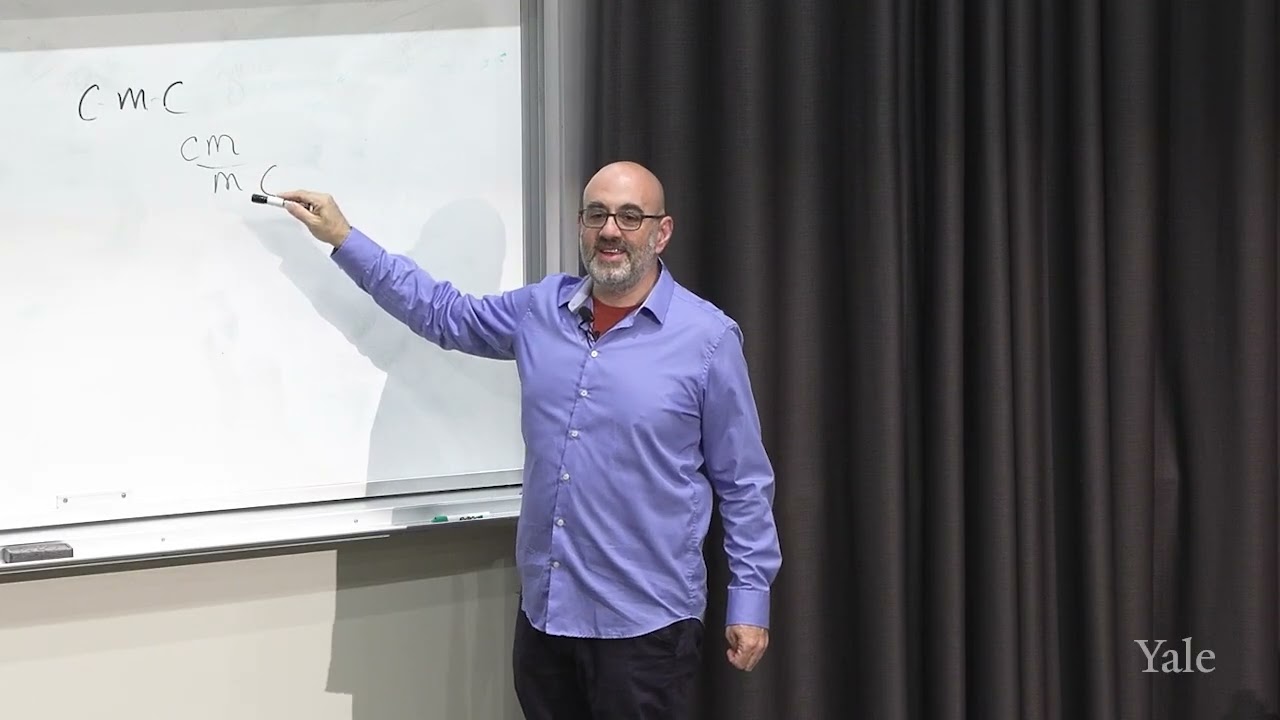
That's one of Marx's
famous formula, C-M-C.
21:49
And you can also use it the
other way around, M-C-M.
21:52
Value is conserved.
21:54
Love the conservation of value.
21:58
The odd thing about the capital mode,
22:00
which we're gonna get to the operation
22:02
that this is all about,
22:03
is that value is conserved and augmented.
22:07
That's where the capital
system perverts physics.
22:14
It doesn't, Marx will say,
22:16
ultimately because you get
it out of the laborers.
22:22
But it looks like it perverts physics.
22:23
It looks like you put the
money into an investment
22:26
and you get back 10% more, right?
22:30
What's the rate now of return?
22:32
I don't know, 7% more.
22:33
To me, it's always like
going down in my mind.
22:38
I guess it's the privilege of a Marxian
22:42
to not really understand where
their investments are going.
22:48
The oddity of this is that it
only becomes exchange value
22:53
when it's not being used,
22:58
and it only becomes use value
when it's not being exchanged.
23:03
When it's being exchanged,
23:04
it holds the use value in reserve.
23:06
It depends on it, it can't go away.
23:09
But it's not being exercised.
23:10
So only one can be activated at a time,
23:13
and this is what Marx
calls a contradiction.
23:18
And we get back to the
question about doubles.
23:23
Before we get to doubles,
23:24
you can see here is a different world
23:26
from the world of use values,
23:28
it's a world of exchangeables.
23:30
You could talk about what they are,
23:31
but they're not the
same thing as use values
23:33
'cause things can be exchanged
23:34
that have very little use value,
23:36
like junk plastic toys that
you get in a goodie bag
23:41
at a birthday party.
23:43
Barely, you barely have any use value.
23:45
The use value is like, "Oh, that's it."
23:48
Then they go right in the garbage.
23:50
It's a brilliant, it's a
stroke of genius plastic,
23:55
and an evil.
23:57
So here, you would plug in a picture.
23:59
I'm so bad at PowerPoint,
24:00
so you're just gonna have
to listen to this discourse
24:04
because I was gonna, like,
24:05
"Wouldn't it be nice to show
all the crazy commodities?"
24:08
But,
24:10
I'm not a visual guy.
24:14
So, these doubles are in
attention with one another,
24:18
which Marx sometimes
calls a contradiction,
24:23
and a single thing like a commodity
24:25
is a strange and strained
unity of contradictories.
24:31
But we have to understand
what this relationship is.
24:34
Obviously, use value and exchange value
24:37
are not logical opposites.
24:40
It is true that like Aristotle's
idea of a logical opposite,
24:44
they cannot exist in the...
24:45
They cannot be active in the same thing,
24:47
in the same respect, at the same time.
24:50
So, that's why he uses
this Aristotelian figure,
24:52
logical figure contradiction.
24:54
Does that make sense?
24:56
Exchange value means it's not being used.
24:59
Using means it's not being exchanged,
25:01
but they have to both be in there.
25:07
Now, you can make something
for use that isn't exchanged,
25:10
but that's outside of the
capital system for him.
25:12
You can make something for yourself
25:15
or you can use something
that's not exchangeable
25:17
because it's common to everybody.
25:19
This is why the enclosure of the commons
25:21
was very important for capital.
25:23
If they start to enclose air and water
25:26
more than they already do,
25:27
they will become commodified, too.
25:29
Water is already on the way,
25:31
but air, so far, is not,
this is Marx's example.
25:38
So obviously, they're not
opposites, they're just different.
25:41
And they could be complementary
under some systems,
25:44
but in this system, they're
antagonistic to one another.
25:48
Exchange value and use value.
25:49
Okay, I'm spending a bunch of time on this
25:51
because these sorts of strange,
25:55
and strained unities are
gonna come up over and over
25:59
in the capital system.
26:01
Yeah?
- Does Marx argue
26:03
that these two concepts use exchange value
26:06
exists within all systems of production?
26:09
- Mm-mm.
26:11
Nope.
26:13
They don't.
26:14
In any society bigger than one,
26:17
you're likely to have use and exchange.
26:21
But again, remember that
these terms, these concepts,
26:26
this is a very important Marxian thought.
26:28
It's a Hegelian thought,
26:29
but Marx brings it back
to real living history.
26:32
These terms are only necessary
26:34
when society gets into a shape
where it needs those terms.
26:38
So, again, if you're in paradise,
26:40
you don't need the term
use or exchange because...
26:44
Or think of an infant.
26:45
You're just kind of eating,
26:46
and pooping, and wandering around,
26:48
and you don't have to
distinguish your activities
26:52
because you're never
in a situation of lack.
26:57
Yeah.
26:58
- And (indistinct) is about
the idea of work (indistinct)
27:02
being somewhat separate from the strength,
27:04
in the sense that like our commodities
27:07
are still part of us,
27:08
like many people have through
commodities or art occlusion,
27:12
then this is the cell.
27:14
(indistinct)
27:17
- Well, humans separate from the system
27:20
is gonna be hard to justify as we go on.
27:25
So, let's just...
27:25
Let's take the system in itself.
27:27
It feels a little bit cold and distant,
27:29
but Marx will argue that humans
27:31
are in service of commodities,
27:33
and that's the big difference.
27:35
So, it's dehumanizing, for sure.
27:41
So, let's hold that question. Yeah.
27:43
- Marx says that something is a use value
27:46
or is exchange value.
27:47
Why does he say is
relevant, has this value,
27:50
or have a value?
- Uh-huh.
27:52
That's a great question.
27:54
Did you hear that question?
27:55
Marx says that things are use values
27:58
and are exchange values,
27:59
not that they have them.
28:01
Because that is the being of the thing.
28:03
The being of the thing is not
some independent, God-given,
28:08
or nature-given set of qualities.
28:12
When in a social setting,
28:13
which is all we're talking about here,
28:15
you have a thing for use,
its qualities are the thing.
28:20
When you encounter a hammer,
you could have an aesthetic,
28:25
now we're getting into the
precincts of German philosophy.
28:28
You could have an aesthetic
relationship to that hammer
28:31
and be like, "What a beautiful hammer."
28:33
But let's put that aside for now.
28:35
I think that's fairly artificial.
28:39
The hammer is weight, shape,
28:43
the useful qualities for hammering a nail.
28:47
And you don't really
see a hammer otherwise,
28:49
unless you go to the
market, or Home Depot,
28:53
and you're like, "How much
does this hammer cost?"
28:57
And you're negotiating between cost
28:58
and the kinds of qualities
28:59
that will get your particular job done.
29:01
So for him, things are double,
29:04
so much so that you have
a double consciousness.
29:07
The double consciousness is,
29:09
"Oh, my gosh, I can get
$5 for this hammer."
29:11
Or, "Oh, my gosh,
29:12
I can hammer in 20 nails
with this hammer in today.
29:16
I can hammer just the kind of nail in
29:18
that will hang my picture
or frame my barn."
29:22
Does that make sense?
29:22
And the thing is only that.
29:26
There's nothing subsisting
outside of the capital system
29:29
that is a thing in itself.
29:33
Yeah.
29:37
- So, if, like...
29:40
Just like on the point
on like the contradiction
29:42
between something having use value
29:45
and exchange value at the same
time, like surely that's...
29:50
I'm just not sure why like
they're applying to...
29:53
Or those two concepts can
apply to like the same object
29:56
because surely, like,
say I have like an apple,
30:00
but that presents use value
or that has use value,
30:03
insofar as the apple is
like an object of mine,
30:06
desire to eat the apple.
30:07
So, it's like a property of the apple.
30:11
But then like the exchange
value is, surely then, not...
30:16
It's not just like a
property of the apple,
30:18
it's like a relation between the apple
30:21
and say, like, an arm.
30:22
So it's not like-
- Well, both in that case...
30:24
It's a good question.
30:25
In both of those cases,
the apple has a use value
30:28
and the apple has an exchange value.
30:30
They are relational
characteristics of the apple.
30:34
The apple is useful to you.
30:37
So apples in themselves
belong to, I don't know,
30:41
some alien observer from
an asteroid passing by.
30:44
They're like, "Apple."
30:47
But they wouldn't point it out
30:48
because it's of no use to
them one way or the other.
30:52
So, both are social qualities.
30:54
That is to say they are
related to you as a desirer,
30:59
and you desire apples
because in your culture,
31:01
apples are things that get eaten,
31:03
as opposed to using them
31:05
to build a house or something like that.
31:07
So there are two different
kinds of social characteristics,
31:12
and you can tell immediately
31:15
that these two things go together
31:17
in a strange and strained way.
31:19
They're always both there.
31:22
One comes forward in exchange
and one comes forward in use.
31:27
When you go to the supermarket,
31:28
if you just shove your
face into the apple,
31:30
someone's gonna be like,
31:31
"Wait, this is an exchange
place, we're not doing that here.
31:35
You take that out, you pay for it, right?"
31:38
And you always feel bad
when you eat the apple
31:40
and then you're gonna pay
for it up at the register.
31:42
Like, "I was just so hungry."
31:44
(Paul laughing)
31:45
In fact, it has to be an
exchange first under capital.
31:51
Just like you give your labor
first before you get paid,
31:55
the thing is exchange,
31:56
and Marx is going to show
31:57
that not only are these things
strange and strained doubles,
32:02
but they are reversed from
what you imagine them to be
32:05
in your humanistic way of thinking
32:09
and from what they are in other systems.
32:13
You don't look convinced,
but let's keep going.
32:15
We have a lot to get through
and we barely started.
32:18
(Paul clears throat)
32:22
Okay, what we know about
things as use values, right?
32:26
The thing is a use value.
32:28
It's a use value
32:29
because someone put concrete
characteristics in it
32:31
through their concrete labor, right?
32:35
Somebody put the
characteristics into an apple.
32:38
They're not just born there.
32:39
They've been refining
these trees for years,
32:42
for decades, for centuries.
32:44
And putting in the fertilizer
and putting in the work,
32:47
and picking them right,
and polishing them,
32:49
and all that kind of stuff.
32:52
A skilled person uses
qualitatively specific activities
32:56
to make something that
satisfies a human want or need.
33:00
This is called production, by the way.
33:03
This is called product production.
33:07
At a later point, a thing
gets taken for exchange.
33:11
Temporally, production of a use value
33:15
comes before production
of an exchange value.
33:17
But logically, in the capital system,
33:19
production of exchange value
33:21
comes before production of use value.
33:25
The way the contradictions
can exist in capital
33:28
is that they get spread out in time,
33:31
they get unfolded in time.
33:35
And we will talk about
why exchange comes first.
33:38
Again, in a capital system,
33:41
commodities are things that
are produced for exchange.
33:44
So, before they get
thought of as use values,
33:48
no, that's not exactly right.
33:50
They're both thought of as use values
33:51
and exchange values at the same time.
33:54
But exchange is the original
impetus for producing them
33:59
in a capital system.
34:02
Okay.
34:08
I think we're doing good.
34:09
You are totally confused.
34:25
Let's take a look at page 15 to 16.
34:31
Here.
34:34
At the very bottom of 15, as use values,
34:37
commodities differ above all,
34:40
with respect to quality.
34:42
As exchange values,
34:43
they can differ only
with respect to quantity,
34:46
and they contain not even
an atom of use value.
34:49
That's why these are so peculiar, Samuel.
34:52
- It seems that this taking
exchange values to be constant,
35:00
which is what he says at the top of that.
35:02
And at the bottom,
35:03
he said they're for only
relative (indistinct).
35:08
Can't an object have exchange
values to each person?
35:12
- Not to each person,
but to each commodity.
35:16
Exchange values do not have
any relations to people
35:20
until they have relations
to other commodities.
35:23
- So it could have simultaneously, say,
35:26
Saraiya is willing to pay the
victim bananas for an iPhone
35:29
and I'm willing to pay,
35:29
to exchange 10 bananas for an iPhone.
35:32
- Unrelated to what you're willing to pay.
35:34
It's only related to what
socially a thing is worth
35:39
compared to other commodities.
35:44
- We're not talking about price
as we know it around that.
35:46
- We're not talking about price,
35:49
we're talking about value and
the way value gets set up.
35:52
The way you know that value
and price are different
35:55
is that if something is
trading for above its value,
36:00
people invest in that.
36:02
And if something is trading
for below its value,
36:04
people don't invest in that.
36:06
And in fact, those firms
can go out of business
36:09
because they're not
making back what they need
36:11
to make back to cover their costs
36:12
and to prepare for the
following year, et cetera.
36:16
So, price and value are
absolutely different.
36:20
The relationship between value and price
36:22
is a controversial topic
in Marxian studies.
36:27
It goes back to the infamous cliche,
36:30
the transformation problem.
36:33
And I don't think it's
worth talking about here
36:35
because we are interested
36:36
in the social outcome of abstraction,
36:42
and we have to get there.
36:46
For those people who try
to make economics work out
36:49
so they can predict what prices will be,
36:52
it's a question of the
relation of value to price,
36:55
and different economic theories
36:57
settle this question in different ways.
36:59
And Marx was famously unable to settle it,
37:02
but it doesn't touch the basic insight,
37:05
which is that exchange value,
value, rules our lives,
37:12
determines the quality of our labor,
37:15
determines the amount
of leisure time we have,
37:17
determines the way we
relate to one another.
37:24
Yeah.
37:24
- Can you think of price and value
37:27
as kind of one of those weird doubles,
37:30
where one losing into the other, right?
37:32
You question kind of like
why a price is this way
37:36
and that's the phenomenology of it.
37:38
And then, (indistinct).
37:41
- There's a lot to be said about price.
37:43
Maybe we set aside,
37:44
once we understand these
things down the line,
37:46
half of a session to talk about price.
37:49
It's worth thinking about Adam Smith
37:52
and David Ricardo who
thought about this a lot.
37:54
And they also recognized
37:56
that one thing that's
characteristic of prices,
37:59
which is not characteristic of value,
38:01
is that they fluctuate wildly
day to day, minute to minute.
38:07
But they fluctuate around a center,
38:09
Smith called this a natural
price, around a center,
38:13
which is thought to be
something like the value
38:15
is not gonna get too crazy.
38:17
Like, you will never have an
iPhone selling for 25 cents.
38:22
And you can see when
you compare commodities,
38:25
that value is real.
38:27
You see, you might have a
banana selling for 25 cents,
38:29
you'll never have it selling for $1,000,
38:31
unless things go really haywire.
38:35
And the opposite is also true.
38:37
You'll never trade a banana for an iPhone.
38:41
Yeah.
38:43
- So, you said that use value
strictly relates to quality.
38:46
Is it the quality of the total actions
38:49
that encourage people
to use that commodity?
38:53
- Let's look at the sentence again.
38:54
I love it when we do philological work.
38:57
As use values,
38:58
commodities differ above
all with respect to quality,
39:01
that is in their qualities.
39:04
So that as a banana is peelable
39:05
and an iPhone is not peelable, et cetera.
39:11
A banana is nutritious,
39:12
and this is what Marx is thinking of.
39:14
In one sense, he has a kind
of Spinozistic ontology.
39:18
Things have qualities.
39:20
Yeah.
39:20
- So there's a lot of different
value terms going around.
39:26
And sometimes,
39:27
I'll hear you talk about, say,
exchange value or use value,
39:30
and then you'll just dive into the topic
39:33
with the shorthand of value.
39:35
Just for my comprehension going-
39:37
- Oh, yeah.
- Or whenever you say value,
39:39
maybe with a capital V,
39:41
are you talking about that sort of value
39:44
that's derived from abstract labor?
39:53
- Use value, you understand it,
39:55
is something that corresponds
to your wants and needs.
40:00
Exchange value, you understand it,
40:02
is how much you can get for your thing,
40:06
how much you can get by exchanging it.
40:08
So, he uses coats and linen.
40:10
It's 19th century, it's
Germany or he was in London.
40:15
It's cold, you need a coat.
40:17
The coats are not made of linen.
40:19
For a long time, I was confused by that.
40:21
Coats are wool, the linen
is a separate thing.
40:24
It's like we have these
things that are different,
40:26
and he is very clear.
40:27
You can't exchange linen for linen.
40:29
The same amount of linen for
the same amount of linen.
40:31
This is how you know
there's something like value
40:34
and how it's parasitic on use value
40:37
because you already have the linen.
40:39
If you have it, you don't
need it unless you need more.
40:42
But then you'd have to
exchange something else, right?
40:45
There is no market of exchanging
the same for the same.
40:47
You need to exchange things
with different qualities.
40:50
One second.
40:52
So, use value as a kind of
basis is a sufficient...
40:56
Is a necessary, but not sufficient,
41:00
characteristic of a commodity.
41:01
It must have the use value
41:03
'cause no one will buy it otherwise.
41:05
But when it comes to exchanging,
41:06
it only matters how much it
exchanges for of another thing.
41:12
Out of these two comes a phantom.
41:21
Because when you exchange
it for something else,
41:24
you think it has this
thing intrinsic to it
41:27
that is of value.
41:29
The value appears in the thing
41:31
as something it seems to carry with it
41:33
and have with it everywhere it goes.
41:36
So, value as a product
41:38
is the unity of exchange
value and use value.
41:43
You say that is worth X, Y, and Z
41:47
because it has this ghostly
quality that adheres to it.
41:53
You could say, if you want,
41:55
that this is the antithesis
and this is the synthesis,
41:58
but Marx is not so clear about that, okay?
42:02
He will not talk about exchange value
42:04
as a separate and
interesting thing after this.
42:06
He's just gonna talk
about use value and value
42:09
because it's value that will
end up making capital work.
42:15
Value is...
42:19
based in use value and
realized in exchange value,
42:23
and it looks like an independent thing
42:26
that you could trade on a market.
42:28
And it comes to be represented
through one of the processes,
42:33
representation, or expression
of capital in what form?
42:40
Value is represented
independently as money.
42:43
It's as though you took
it out of the thing
42:46
and value started living on its own.
42:49
And I said, "I'll give you this money,
42:50
which is equal in value
to what you're having
42:52
because that thing has
intrinsically, in it, value."
42:55
Does that make sense?
42:58
- There were some questions.
43:03
- Yeah.
43:04
- So this value,
43:05
because I think you
mentioned that this so thing
43:08
of you starting it...
43:10
(indistinct)
43:15
- Ultimately, we'll talk about value,
43:16
but this is the genesis of value.
43:19
You have something that's
useful, socially useful.
43:22
People use it in our culture, right?
43:24
Something that's totally outside
43:27
of what other people recognize as useful
43:30
might be useful to you individually,
43:32
but it doesn't have a use value.
43:35
And you have exchange value,
43:36
which is what you get for it on a market
43:42
related to an equivalent.
43:44
And these two together
43:46
make it seem as though
there's this special substance
43:50
that adheres to all commodities,
43:52
just in different quantities.
43:57
And it's not purely
psychological, it is ontological.
44:01
You live in a world as
though this was real.
44:04
And so it's real.
44:06
Value is real under capital.
44:10
As I say, give away all your things,
44:12
and you'll just have no things.
44:14
But value will go on happily.
44:15
And if you wanna get them back,
44:17
you'll have to concede
the reality of value.
44:23
Okay.
44:25
Wow, you're really pushing me.
44:27
This is good.
44:30
What else do we need to talk about?
44:31
We need to talk about the
double character of labor.
44:33
So,
44:35
actually, a commodity has
this double character,
44:38
use value and value,
44:46
and labor has a double...
44:49
double character, too.
44:59
Useful labor makes useful things.
45:02
That is a qualitative act that
requires skill and knowledge.
45:07
As machines tape go over that,
45:10
you can put less skill into it,
45:14
but nonetheless it requires some skill.
45:19
From the perspective of a useful object,
45:21
labor is useful labor.
45:24
So, the question is:
45:25
What is labor from the
perspective of value?
45:29
It is a bare gelatinous blob.
45:32
Don't you love this translation?
45:34
It's a translation by
a writer whom I admire
45:37
of a German word gallerte,
45:39
which is something like sue it.
45:41
It's when you took
everything that was left over
45:43
and you boiled it down
into a gelatinous blob.
45:48
We thought of using sue it,
45:49
but we didn't think anyone
would know really what that was.
45:52
So we put a bare gelatinous blob.
45:54
It's everything kind of mixed together
45:55
until all of its qualitative
characteristics disappear
45:59
and you just have a kind
of quantity of stuff.
46:03
That's the second characteristic of labor,
46:06
which he calls abstract labor.
46:09
So you have concrete labor
46:14
and abstract labor.
46:18
Clearly, abstract labor makes value
46:20
and concrete labor makes use values.
46:25
In capital,
46:31
these get inverted so that
you do concrete labor,
46:37
so that you can get abstract labor
46:39
and you'd make useful things,
46:40
so that you can get value out of it.
46:45
I'm jumping ahead.
46:46
That's like the climax
of the first project.
46:50
We will go from commodity production
46:52
or production of products
to production of value.
46:56
Commodity production
to production of value.
47:01
You don't get the second type of labor
47:04
from concrete differentiated labor.
47:07
If you look at the world of useful things,
47:10
you see all these different qualities.
47:12
They're edible, they're
sweet, they're sour,
47:15
they're tools to make other
things, they're entertainment.
47:18
Whatever it does for you, it does for you.
47:21
The same thing with the
labor that goes into it,
47:22
it's absolutely an infinite,
47:25
potentially infinitely differentiated.
47:28
That's why if someone plays the trumpet
47:30
and I play the guitar,
47:32
that doesn't mean I can play the trumpet
47:34
and they can play the guitar.
47:34
Although musicians are pretty good
47:36
at different things like that, right?
47:38
But this divides us as people.
47:39
So we have a social division
of labor, as Marx calls it.
47:44
But when it comes down to the
labor that makes up value,
47:48
it is undifferentiated, homogenized,
47:51
reduced to one particular quality,
47:54
which is, according to Marx,
how long it took to do.
47:58
How long it took to do
according to the average
48:01
that it takes to do that in the society.
48:08
Okay, let's say a couple of other things.
48:10
We need like a four-hour lecture,
48:12
but you're probably happy
you don't have that.
48:16
Let's talk about socially
necessary average labor time.
48:22
Socially necessary average labor time
48:24
is what distinguishes
Marxist theory of value
48:27
from Ricardo's theory of value
or Smith's theory of value.
48:32
Value is not just what
the worker put into it
48:34
in producing a useful product.
48:40
Value goes through this
homogenizing process,
48:44
and you can tell the magnitude of value
48:50
by the socially necessary
average labor time
48:53
that went into it.
48:55
Because labor goes through
its homogenizing process, too.
48:59
And you are being compared
49:00
to everyone else on the labor market,
49:02
so that when you go to
work, they don't say,
49:04
"Take your time, you do it in five days.
49:07
Do it in five days."
49:09
No, they say, "Well, the
average for this is two hours,
49:12
so you've got two hours to do this."
49:14
If not, (Paul mimicking air whooshing)
49:15
you're out.
49:17
Right?
49:19
This is the way it
works 'cause if one firm
49:21
is working much more
slowly than another firm,
49:24
they won't last very long.
49:26
Here is where competitive
pressures come in.
49:28
You don't actually get those
very much in this volume.
49:31
You get them much more in Volume 3.
49:33
But you have to keep in mind
49:34
that we're looking for the whole system.
49:36
So ultimately, competitive pressures
49:39
push these things in a
particular direction.
49:41
We'll see this a bit later in this book.
49:44
Socially necessary labor time.
49:46
The labor time necessary in this society
49:48
to make a certain thing.
49:50
Marx is gonna use the prefix social a lot.
49:53
What does social mean?
49:54
It has three opposites:
natural, individual, and ideal.
50:01
In this way,
50:02
he gets rid of a kind of
by a logistic anthropology.
50:06
He gets rid of the Hegelian
50:09
or liberal concentration on an individual,
50:12
and he gets rid of German idealism.
50:15
Social is not natural.
50:17
It means something that was made,
50:21
something historically
specific to a given society
50:25
to a certain way of living,
50:27
which has institutions,
50:29
although he will say often
50:31
that the social is
natural for human beings.
50:35
Don't be confused.
50:36
The social is quite different than nature.
50:38
Although Marx understood that
nature had its own history,
50:42
at that time, he read
the "Origin of Species"
50:45
and was really keen about it.
50:49
The social is its own category.
50:52
It also means not individual,
50:54
that is, it's something that
applies to the whole society
51:00
and emerges from the
interactions of individuals,
51:06
the individuals in the largest collective
51:08
that shares a way of living.
51:11
And social is also not ideal,
51:13
that is to say it's not a prescription
51:16
or a description of some abstract truth,
51:19
but a set of practices.
51:23
Practices that make sense for a group
51:25
under certain pressures.
51:28
A group whose members are
completely interdependent,
51:33
for whom an individual is a falsification
51:37
of their real way of living
51:39
because they collaborate on everything
51:43
through a division of labor.
51:47
Social or societal names,
51:49
the interdependent group
that cannot be reduced
51:51
to an individual free will,
51:53
to individual inclinations,
or individual drives.
51:57
So, the social is a ground zero
51:58
for all of Marx's reflection.
52:00
That's what makes him useful
52:02
and the course is called
Foundations of Social Thought.
52:05
Yeah, Samuel.
52:08
- Yeah, Marx is living in a Kingdom.
52:10
They are true, right?
52:12
Like, living in pressure,
right, which he was-
52:13
- Well, he is living
in London at this time.
52:16
- But he dropped in
(indistinct), which is a kingdom.
52:18
And arguably, a lot of societal pressures
52:22
are coming from the whims of
the leader of that society.
52:26
But how do we work that?
52:28
- Well, he is not talking
about political forms
52:33
or government.
52:34
He is talking about the way people
52:37
have to collaborate on their social life
52:42
to make their means of subsistence,
52:44
which he saw as quite independent
52:46
of the whims of the Prussian leaders,
52:49
although they could infringe on it.
52:53
But people tended to do that on their own,
52:56
they could benefit from it,
52:57
but the people tended to
do that on their own, yeah.
53:00
- What is he describing as society?
53:02
Is it particularly London
Revolution or IWA Society?
53:07
- Capitalist Society.
53:09
Society under the domination of capital.
53:15
Okay, we're coming up
to the end of our time.
53:19
Let me see if there's any questions.
53:21
We're crawling along, but it's
gonna get faster, I promise.
53:29
(indistinct)
53:31
- So, capitalism is
neither a political system
53:34
nor (indistinct) for a social sector?
53:38
And the key, does he need practical?
53:42
- Oh, yeah, the last chapter
is about colonialism.
53:44
Uh-huh, he links it to colonialism
53:46
and the types of colonial-type
activities in Europe
53:53
in which people were
dispossessed of their land
53:56
and forced into factories.
54:00
Yeah.
54:02
Very loud.
54:03
- This might be too big a question to ask,
54:04
and we're at the end,
54:05
but how much of the rest
of Marx's economic analysis
54:09
depends on his labor theory of value?
54:13
- He does not have a
labor theory of value.
54:15
He has an abstraction theory of value
54:18
or something people have
called a value theory of labor.
54:24
I think it's a good turn
54:25
because he's really interested
54:26
in what being forced to produce
value first does to labor.
54:31
He is not interested
54:33
in working out how we can
get the most out of a market.
54:37
And so his goal is very different
54:38
than mainstream economists.
54:42
But, we can talk more about that.
54:44
It's the last minute where a
bone of contention has come up.
54:48
Other questions before we cut?
54:51
Yeah.
54:52
- (indistinct) together, like
exchange value, used value,
54:57
and how value is
determined by (indistinct)?
55:04
- The only thing about value
that's determined by...
55:06
Value is determined by exchange,
55:09
and its magnitude is determined
by the abstraction of labor
55:13
such that those things become comparable.
55:16
It's complicated.
55:17
He says, "When you take all these things
55:19
of totally different
qualitative characteristics
55:22
that are used for totally different things
55:24
by different people,
55:25
incidentally, not everyone
wants a hammer, right?"
55:29
We are not philosophizing with a hammer,
55:31
we're philosophizing with a MacBook.
55:37
How do they become comparable?
55:39
They become comparable through exchange.
55:42
Where do they get their magnitude?
55:44
They get their magnitude
55:45
from the socially necessary
average labor time used in them
55:48
because that's the only thing
55:49
that differentiates different commodities
55:52
in their magnitude of value.
55:53
Says Marx.
55:55
Not the only way to look at
it, but it's fairly logical.
55:58
The only thing that's
different between a banana,
56:01
aside from its qualitative
characteristics,
56:03
and an iPhone is how much
average labor it takes
56:07
to go into it.
56:09
Does that make sense?
56:11
For Marx.
56:14
See you next time.
56:16
(uplifting music)
— end of transcript —
Advertisement