Advertisement
 50:04
50:04
Transcript
0:00
(intense violin music)
0:13
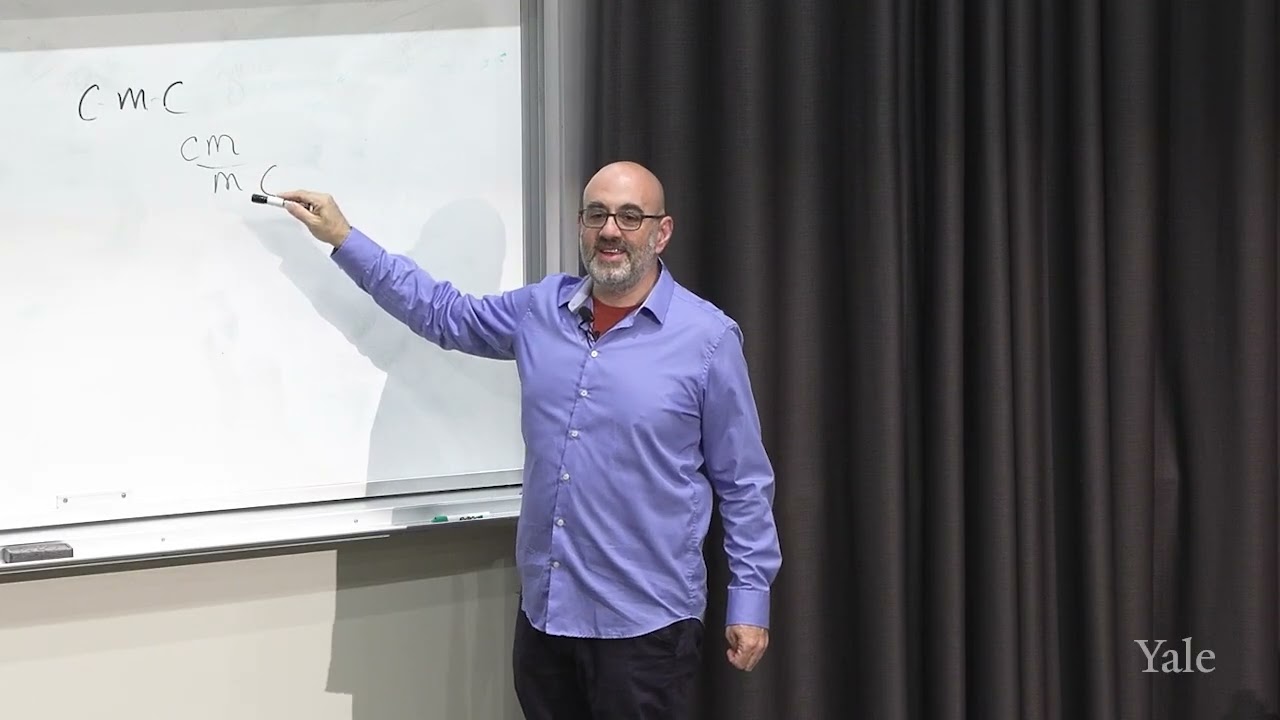
- Page 19, the double character
0:15
of the labor represented in commodities.
0:17
First, the commodity
presented itself to us
0:20
as a double-something,
0:21
both use value and exchange value,
0:24
or, I would say, use and value,
0:27
that's a better way to put it,
Advertisement
0:30
more precise,
0:32
or use value and value.
0:35
We then saw that labor too,
0:36
when it was expressed as value
0:38
and it is expressed as value,
0:40
loses the particular qualities it has
0:42
as that which produces use values.
0:45
When you're producing
something for exchange,
0:47
your labor changes.
0:49
Interestingly, it doesn't
change in content,
Advertisement
0:51
at least at the beginning,
0:53
until capitalism is well-developed,
0:57
industrialized, expanded,
1:01
then it starts to change the
quality of concrete labor.
1:05
But in this hypothetical, this heuristic,
1:09
simple heuristic at the
beginning of the book,
1:12
which is, by the way, a
theoretical heuristic,
1:14
not a historical heuristic.
1:17
It wasn't like we started
with the commodity in AD 1,
1:22
not true, we're starting
with the commodity
1:24
for the analytic, for
analyzing capitalism,
1:28
starting with its its cell form,
1:31
what Marx calls its cell form,
1:33
because he thought this would be easier.
1:34
Hah, you know?
1:37
But I don't think there is an easy way in,
1:39
so we're taking this as our entry point.
1:43
We saw then that labor too,
when it's expressed as value,
1:46
loses the particular qualities it has
1:48
as that which produces use values.
1:51
So briefly, we have to talk about
1:52
the double character of labor,
1:55
useful labor, and labor towards
value or abstract labor,
2:00
socially necessary average labor time,
2:02
which is the measure of its magnitude.
2:09
You can see the difference on page 23
2:11
in a really clear formulation,
2:13
"In and for itself a greater
quantity of use value
2:18
amounts to greater material wealth."
2:19
This is like the third
full paragraph on page 23.
2:24
Two coats amount to more than one.
2:26
If two people need coats,
you need two coats.
2:30
And the use value of two coats
2:32
is two coats worth of use value.
2:34
That make sense?
2:36
But two coats of value
2:38
might not be the value
of what one coat was
2:40
half an hour ago if exchange
conditions change, he says.
2:46
Two coats can clothe two people,
2:47
one coat just one person,
2:48
yet when the quantity of
material wealth increases,
2:51
this can correspond to a
simultaneous drop in its values.
2:56
If, for example, you
can suddenly make coats
2:59
much more quickly, with
much less labor input,
3:03
then the value drops.
3:05
This would happen for all
coats already on the market,
3:07
even though they took
3:10
a much higher socially
necessary average labor time.
3:12
Does that make sense?
3:14
So value means something
totally differently,
3:16
this, we just need to put
out of our minds right away,
3:18
value is not the worth of
something for me in my life,
3:24
but the number of things
something can be exchanged for
3:27
on the market.
3:30
There are two different systems,
3:33
and as we'll start to see,
3:34
there's what I call an eversion,
3:36
it's an inversion with a change of values,
3:41
use value and value evert.
3:44
Value is number one, comes
first, and is more important
3:49
and subordinates use value to it.
3:52
So you get useful things as a byproduct
3:55
from the exchange process.
4:00
Okay, today, we're gonna talk
about a number of operations.
4:02
We might get through chapter one,
4:04
but if not, we'll leak over
a little bit to Monday.
4:07
This is the third week,
4:08
and we're gonna be talking about
4:11
one operation in particular, reflection.
4:16
In exchange, you have
this Hegelian operation.
4:20
And these are not operations
that the economist carries out,
4:23
they are not operations that
happen in your consciousness,
4:26
they happen in actual
exchange on a market.
4:30
They're anticipated by production.
4:33
You get the reflective determination
4:35
of the value of one thing
4:37
through another thing.
4:40
You will have read the
forms of value section.
4:44
And then we're moving on to the best part,
4:47
the fetish section,
4:48
in which you get something
like a distorting reflection.
4:51
There's a lot of mirrors
in these sections.
4:53
So to make it clearer, let's
stick with the mirror figure,
4:58
the mirror image.
4:59
We're still working on the cell
form of the capital system,
5:02
which is the commodity.
5:06
What Marx does is gives
us a set of categories
5:09
which are operations,
5:10
especially in these first four chapters.
5:13
These are the operations
that make commodities happen,
5:17
so they aren't simply
things that float around
5:19
or that have qualities inherent to them.
5:22
Those are, just to give
you a list of them,
5:24
reflection, eversion, abstraction,
5:28
reification, or objectification,
5:30
concentration, transformation,
expression, fetishization.
5:35
You see all these operations are going on,
5:36
and this is Marx's unique
contribution to the discussion,
5:40
these operations
5:42
that are societal operations,
they're not individual.
5:45
They happen in a social setting
5:48
where certain things need to be done
5:52
in order to preserve,
maintain the society.
6:01
His goal in this volume, we'll remember,
6:03
is to show the perversion of our sociality
6:07
by analyzing the workings of production.
6:10
Sociality under capital is perverse,
6:13
is a word he uses sometimes,
6:15
and the verso words
indicate the turnaround
6:20
that capitalism enacts on history.
6:24
It isn't just a continuation,
it's a sharp verso,
6:30
it's a turnaround
6:33
that might produce vertigo
if you knew about it.
6:36
That's why, for example,
economists and everyone else
6:39
projected back across all history,
6:41
because it was really vertiginous change
6:43
that happened over a couple hundred years.
6:48
To do this, he starts with the nearest,
6:49
and most familiar, and most obscure.
6:52
He does a phenomenology,
6:53
I'm just reminding you what we're doing,
6:57
which I'm calling the entry point,
6:58
the narrow way and the commodity.
7:00
The commodity necessarily
brings labor into view.
7:05
The commodity is nothing without labor.
7:08
And both are double.
7:10
And each of the pairs gets everted.
7:13
Use value gets subordinated
7:15
and mated, put into a second position,
7:20
vis-a-vis value.
7:23
And abstract labor gets super-ordinated
7:27
over useful, concrete labor.
7:31
If you wanna know how big a commodity is,
7:32
we know a commodity is a side of labor,
7:35
if you wanna know how big a commodity is,
7:37
it's the socially necessary
average labor time
7:40
involved in doing it.
7:41
That's all, really, socially
necessary average labor time
7:43
tells you, is how big it is,
7:44
because it's the one thing that's standard
7:46
among all the commodities,
7:47
they all have some amount
of time it takes to do it
7:51
that the society says this is,
7:53
usually it's close to the minimum,
7:57
with some adjustments for anomalies.
8:03
It certainly wouldn't be the maximum,
8:04
that would not be a capitalist society.
8:09
So the magnitude of value is measured
8:11
by the socially necessary
average labor time
8:13
it takes to produce it.
8:17
And value is something that
8:19
you could say hovers around the commodity,
8:21
it's a strange metaphysical,
quasi-metaphysical,
8:25
quasi-physical thing, a phantasm
that the system puts up.
8:31
But it's also social,
8:34
and this is what we're gonna
talk about a little bit
8:35
today as well.
8:37
Value organizes social life
under a capitalistic economy.
8:43
It is not just a thing that hovers there,
8:44
it is the measure of everything we do,
8:47
it's the impetus of everything we do,
8:49
it's in the impetus of everything we do,
8:52
even if we have other impeti.
8:55
It organizes economic life,
8:57
and it also organizes social life
8:59
because the social is
subordinated to the economic.
9:03
So the social or the societal
9:05
is ground zero for Marx's interpretation,
9:09
and for all reflection.
9:12
The economy is not,
9:14
politics is not,
9:15
nature is not,
9:17
God is not.
9:18
It is what he calls the social,
9:20
or (speaks German),
9:22
which I would translate as "societal."
9:24
Social is very confusing when he uses it,
9:26
I don't know if you found it odd
9:28
when he says things have a social life.
9:31
It's not that they go to dances,
9:34
it's that they are making society go.
9:39
Society is a grouping principle,
9:42
a name for a grouping principle
9:43
in which people are
independent on one another.
9:46
So society will always be both
our lowest common denominator
9:49
when we're reading capital,
9:51
that's what makes everything go.
9:53
Human being is a social
being, a societal being.
9:56
Can't live outside of society,
9:57
that's why he has these
tirades about Robinson Crusoe,
10:00
this fictional individual
10:03
who brings his whole society with him
10:05
and acts as though he's
still in the middle of London
10:08
with his lists of things to do,
10:09
and his religion,
10:11
and his slave.
10:14
(Paul chuckling)
10:16
And it's also the highest
goal, the societal.
10:20
The answer will be societal,
10:22
be making society much more important,
10:25
we'll be desubordinating
it to the economy,
10:28
or making a free association of producers
10:31
who are in control of production,
10:34
Marx's minimal idea of socialism here.
10:38
That is, you strengthen this ground zero,
10:40
you bring it back to the front.
10:42
How to do that?
10:44
I'll let you tell me
10:45
as you ruminate over this
for the next 10 years.
10:50
But we learn in this section also
10:52
that use value is not
only something that comes
10:56
at the end of production,
exchange, circulation,
11:01
et cetera, et cetera,
11:02
when you finally get the
thing home and you use it,
11:04
or use it up.
11:05
Use value is something that
also structures the society,
11:09
it structures the society as
a social division of labor.
11:14
So remember, we're talking
about a big enough society
11:17
where no individual can produce
11:20
everything they need themselves
11:21
and no family really either, as a unit.
11:25
You need the whole society,
11:27
and so the production of
use values is spread out.
11:31
This is of course why you need exchange,
11:33
exchange of raw materials,
11:34
you need to get the rock over here
11:36
for the whatever over there.
11:38
Right?
11:39
So we're imagining this zone
in an ever-widening image
11:45
from an individual act of exchange
11:47
to, ultimately, the totality of society
11:50
whose exchanges are contingent,
11:55
can be affected by random events,
11:57
but ultimately work out
according to the system's laws.
12:00
That's all about concrete
labor and who needs what when
12:03
and who can make what when.
12:05
But the social division of
labor is one of the tools,
12:07
one of the instruments
of the capital system.
12:10
It can use that.
12:11
It can divide it more, beyond
what use value dictates.
12:16
It can divide labor even within a factory.
12:19
Take Adam Smith's example
of the pin factory,
12:22
where it used to be that someone
hammered out a little pin
12:24
with a tiny hammer,
12:26
and eventually there was someone
12:28
who made the head of the pin,
12:29
someone who extruded the metal,
12:32
someone who sharpened the pin,
12:33
someone who polished the pin.
12:34
And labor can be divided
even in an individual,
12:37
where I am now no longer
making a whole object.
12:40
This is a capitalist use of
the social division of labor,
12:44
it's still social,
12:45
because I depend on someone
else to sharpen my pin.
12:48
That sounds vaguely obscene.
12:57
Use value produces a vast differential
13:01
of who makes what, when, and how,
13:03
and where it gets traded, et cetera.
13:11
But you can see also how it contributes
13:13
to the abstraction of labor
in so far as labor is now
13:17
a function of exchange,
13:20
labor is now a something that, itself,
13:24
can be an adjustable lever
in the capital system.
13:27
You can do much less or much more.
13:30
How can I even tell what labor
is if I'm sharpening pins?
13:33
There has to be some average
13:34
that makes it equal to
someone knitting a sweater.
13:39
Who knows the sweater,
13:40
in Aristotle's sense,
13:41
it's an image of the
sweater before they start,
13:43
they know how to use the
tools, they have know-how,
13:45
and they have an image of the sweater,
13:46
and they take that image
out of their consciousness
13:49
into yarn.
13:54
The idea is that as you make commodities
13:58
that have to be exchanged,
14:00
the pressure to make commodities
14:02
makes you work the average amount of time.
14:07
If you work more, you are just
cutting into your own wages.
14:13
If you work less, you're increasing them,
14:15
so there is a kind of pressure to speed up
14:18
to increase productivity.
14:21
Okay, just to say how labor gets abstract,
14:24
it goes through an operation
which I didn't mention,
14:27
which is reduction.
14:28
Marx says in this section
14:30
that it gets reduced to
a simple from a complex,
14:34
it gets reduced to one
quality, value, or labor power,
14:39
socially necessary average labor time.
14:43
It gets homogenized,
14:45
it gets all the other
qualities stripped off it,
14:47
it becomes bare.
14:50
These are not the only forces on value,
14:53
you will see, in fact,
that we're starting with
14:54
a very simplistic view of the economy.
14:57
And later, when we get to volume three,
15:00
we're not doing volume three,
15:01
but you all can read on to volume three,
15:04
when you get to volume three,
15:05
you have to see these all
things in a different way
15:07
when the pressures of competition
15:09
between different sectors of the economy
15:11
change the way value is made.
15:13
So, for now, these are provisional ways
15:14
to understand the inputs to value.
15:19
Once it's been reduced,
15:20
like these values have what
he calls value objecthood,
15:24
which is ghostly.
15:25
Every time you have a
thing like this thing,
15:28
it has its physical and use objecthood,
15:31
but it also has a value objecthood.
15:33
Whereas if this were, I don't know,
15:35
something cheap, I might drop it.
15:37
But since it isn't,
15:40
I respect, preserve its valuehood,
15:45
which is here in a contained form,
15:48
though you can't see it,
15:48
it's not exactly equivalent to
its physical characteristics.
15:52
Okay.
15:57
You can see how the use side of labor
16:02
gets used by the value
or abstract side of labor
16:06
in the capital system.
16:08
You have questions about that section too?
16:14
Isn't it good to read a book very slowly?
16:16
I just love it, it's my favorite thing.
16:18
I always get anxious about
large amounts of text.
16:22
Yeah?
16:23
- Just really quick.
16:24
The last time,
16:25
you just mentioned like value
object perfect something.
16:28
Is that the same as exchange value?
16:32
- No exchange value really is,
16:35
we're about to see that in more detail.
16:37
Again, use value and exchange value
16:41
live in a kind of contradiction
16:43
whose odd and tense solution is value.
16:49
So really, Marx wants you to
focus on use value and value.
16:53
Exchange value is like the
technical number of things
16:56
you can get for this thing.
16:58
What it seems to contain,
17:00
what it appears, in the
real appearance, to contain
17:04
is value.
17:06
I'm not thinking about how much,
17:07
when I hold onto this and protect it,
17:08
this is a very psychologistic
way of putting it,
17:10
but when I hold onto this and protect it,
17:12
I'm not thinking because I can get,
17:15
you know, 1/10th of a car for this,
17:16
or 1/20th of a car for this.
17:19
Right? I'm not thinking about that.
17:21
But the whole exchange market,
17:22
the whole exchange
phantasmagoria has conditioned me
17:28
such that I know this
is a container of value.
17:31
And I know this is a container of value
17:34
much higher than this, oddly.
17:39
Yeah?
17:41
- Is this value objecthood a
feature of the capital system?
17:46
- No other system has value objecthood.
17:49
It's a total perversion
of ontology under capital.
17:54
Does that?
- I'm not convinced.
17:56
(student speaking faintly)
17:57
- Okay.
17:59
I mean, there's no...
18:01
What could?
18:03
Convincing?
18:05
I think it's better to
understand the system.
18:07
We could have an argument
about that, which I would win.
18:11
It would take up a lot of time, yeah.
18:14
Sorry, wait, David behind you first.
18:16
- What's the pedagogy
that like Marx has opined,
18:20
like you earn the obvious value,
18:22
or is it just assumed to us?
18:24
(student speaking faintly)
18:27
- It's all objective.
18:29
The question was, what is the
pedagogy of object valuehood?
18:33
When do we learn it?
18:35
And I'm talking about it
in psychologistic terms,
18:39
but really, it's purely objective.
18:41
If you don't treat these things
as though they have value,
18:44
you'll lose out.
18:46
If you don't treat your
car as though it had value,
18:48
which is the way I've
beat up a number of cars,
18:53
you lose out, you don't get
to sell it for anything,
18:55
and you know this is the
case when you're doing it,
18:57
that's why, as a teenager,
18:59
I rebelled and beat up
a lot of cars, right?
19:03
It's just, it's a matter of conditioning.
19:05
And you could choose differently,
19:07
but you can't do any differently,
19:09
you'll just be stuck.
19:11
Samuel, and then David.
19:13
- So if I understand
what we're talking about,
19:18
we have use value and exchange value,
19:22
which together kind of like synthesize
19:27
into this notion of value
which we project onto things.
19:30
So into this notion of
value goes use value,
19:32
which depends on the body of the object,
19:35
and exchange value,
19:36
which depends on the
socially average labor time
19:38
that goes into to its creation.
19:40
And then from value, we
get to value objecthood,
19:43
which I assume is sort of
a property of an object
19:46
we project onto it somehow?
19:48
But then he says the body
19:50
doesn't play a role in this at all.
19:52
- The physical body does not
play a role. That's right.
19:54
- The physical body, through use value,
19:56
plays a role in value?
19:58
- Well, not every commodity
has a physical body.
20:01
But let's talk about bodies,
20:03
the funny body theory, this one.
20:05
Commodity, let's say it's
a physical commodity,
20:07
has a physical body,
20:08
but its value body, which
adheres to its physical body,
20:12
and in fact it's the other way around,
20:13
the physical body only moves around
20:15
because it has a value body,
20:16
it's only made because
it's making a value body
20:19
at the same time,
20:20
it's only traded because
it has a value body,
20:22
the value body you can't see.
20:24
But you understand Marx is using
20:26
a kind of idealist vocabulary here
20:29
to demonstrate to you that
capitalism is a religion.
20:33
Something like a religion.
20:35
It has these phantasms
20:37
that are absolutely real in the system,
20:39
you can't live without them,
20:42
and they can't be wished
away psychologically.
20:48
- I guess I'm kind of stuck,
20:49
that if the body plays
a role, a use value,
20:52
which plays a use in value,
20:54
which plays a role in value objecthood,
20:57
how does the body not
play a role within loss?
21:00
And second, a kind of circular thing.
21:02
- Right, well, it is just subordinated.
21:06
- Okay.
21:07
- You know, let's say a digital object,
21:09
it doesn't have a physical body.
21:12
It's related to some
physical residing place
21:14
which uses a ton of
electricity, but let's just say.
21:19
It has some sort of distinct
boundaries as a use item.
21:23
Right? This PDF.
21:25
Distinct boundaries as a use item.
21:28
All that value requires
21:29
is that it has distinct
boundaries as a use item
21:32
and that someone needs
to use it for something.
21:36
But that gets completely subordinated.
21:37
In fact, in the end,
21:39
the things are made only
because of their value body.
21:42
So it gets subordinated
21:44
from the very cause of their
existence later down the line.
21:48
It isn't that value is
added on in capitalism,
21:51
this is a mistake that some
mainstream economists make
21:56
that he wants to avoid.
21:58
Value is not added on.
21:59
The whole system will work
such that value comes first,
22:03
and in fact, it's only because
there's going to be value
22:06
that you decide between a physical body.
22:08
Imagine, you're gonna make a business.
22:09
Am I gonna make water bottles?
22:11
Sneakers? Digital objects?
22:14
Bitcoin? What am I gonna make?
22:17
It's all determined by
value to some degree.
22:21
Even if you're like,
22:22
how I really like to make big,
metal, ugly electric trucks
22:28
that never come off the assembly lines.
22:31
You might think this is
like a designer's dream,
22:34
but no, there had to be a
market for it to begin with.
22:36
The market figures into
the decision-making.
22:39
So the idea of capital
22:40
is that it turns those relations around.
22:44
We have to talk about value form.
22:45
David, quickly.
22:46
- Yeah, could you talk a bit more
22:48
about why it's use value
and not exchange value
22:50
that performs a function of
differentiation in labor?
22:54
Because I take it,
22:55
and maybe this is what
Marx goes to in Volume 3,
22:58
but it seems to me the capitalist logic
23:00
and the competition that it entails
23:02
actually forces firms and producers
23:05
to try to minimize their exchange value,
23:07
and that's what's determining
the social division of labor.
23:11
- So the question is,
23:12
why does use value determine
the social division of labor?
23:15
And that is,
23:21
let's say for now,
23:23
we'll say only in production,
23:26
and only because use value is a necessary
23:30
but insufficient cause for value.
23:35
And I guess because of a
practical consideration,
23:38
I think this is the best
way to think about it,
23:41
in Marxian terms,
23:42
use value becomes the content of value,
23:46
and value becomes the form.
23:47
So value carries around this use value.
23:49
It can't do without it,
23:50
because if no one ends
up using it in the end,
23:54
the value disappears.
23:55
But it is at the behest of
value that it moves around.
24:01
And ultimately too, value
depends in part on use value,
24:06
but much more in the capital system
24:08
does use value depend on value.
24:11
That's what we call innovation,
24:14
entrepreneurship and innovation.
24:17
That's where value,
24:18
like, where could we find the most value?
24:20
Let's invent this crap,
24:23
this giant pile of crap, like AI.
24:26
Let's invent this.
24:27
Let's give $150 million
to support this here,
24:31
because value's gonna come
out of it, we can't not do it.
24:33
You can't not do it, you'll fall behind,
24:37
you'll become like a
small liberal arts college
24:39
with no research.
24:45
You better cut this out of the video.
24:47
(students laughing)
24:50
So the system depends on,
24:56
but takes completely under its control,
24:59
a variety of qualitatively
different things.
25:01
So it requires this as,
we'll call it a basis,
25:05
a use value basis,
25:06
and that's what determines
the social division of labor.
25:10
There's other divisions
in the labor field,
25:13
like merchants and truck drivers,
25:15
and other people
25:17
who are not directly
involved in production.
25:19
There's a division of labor there too
25:20
that has to do with circulation.
25:22
But for now, we're not talking about this,
25:23
we're talking about
how a socialist economy
25:26
where everybody's making something,
25:28
and they exchange it without
exploiting one another,
25:32
and they're in control so they can say,
25:33
"Hey, that's exploitation,"
25:37
is the beginning and
the end of capitalism.
25:40
It's in there, we actually are socialists.
25:43
When you get to the
chapter on cooperation,
25:45
you'll discover that we
already are socialists.
25:50
Okay, section three, the
value form or exchange value.
26:04
This is a complicated section, confusing.
26:07
It is developmental,
26:09
so you can see that you go from
26:12
simple or individual value form,
26:14
to total or expanded value form,
26:16
to the general value form, to money.
26:21
Money's the big one, the biggest fetish,
26:23
that without which the
sine qua non of capitalism,
26:28
for a number of reasons,
26:29
you can see that Marx is
a pragmatist in this way,
26:32
he doesn't want to tell you,
26:34
he doesn't wanna define capitalism,
26:35
give you some sort of lofty,
theoretical explanation,
26:38
he wants to tell you how it works.
26:40
These are the operations,
26:42
as if it were like
26:43
a kind of quasi-ideal,
quasi-material factory, capital,
26:50
that equates things, that reflects things,
26:54
that reifies things,
that transforms value.
26:58
So it's absolutely crucial
26:59
for everything that comes after
27:01
to know that value transforms,
comes in different forms.
27:05
Two of its main forms,
27:06
which we'll get to I think for next week,
27:08
are the commodity,
27:10
and money, which is a
special type of commodity
27:12
that takes on a life of its own.
27:16
But before we get there,
27:17
he's gonna derive these theoretically,
27:19
analytically in steps.
27:22
Value takes different forms.
27:28
And it does this through and for exchange.
27:35
Now our entry point is widening out,
27:37
as you go deeper into the commodity,
27:39
it opens up a whole vista for you
27:42
within the commodity
and among commodities.
27:44
It turns out that a
commodity is not a commodity
27:46
if there isn't another commodity
27:48
through which it reflects itself to say,
27:50
"I am a commodity.
27:51
I'm this commodity, and
this is how much I'm worth."
28:00
Value has to have a number of forms
28:03
and a constant cycle of
transformations through those forms
28:06
as if it were the kind of
work of the capital system
28:09
to be putting these
things through its form.
28:11
You cannot do capital, which
we haven't brought up yet,
28:15
which is value that makes more
value out of the same value.
28:22
That's the mystified account of capital,
28:26
let's stick with that for a minute,
28:27
value that makes more value
out of the same value.
28:30
You can't have capital
28:31
unless you can transform
a commodity into money.
28:34
We call that a sale.
28:36
We also call it a purchase,
so that's confusing.
28:39
There are perspectives involved in this
28:40
in which things look different
than from other perspectives.
28:46
This cycle of value forms,
28:48
which is crucial to the capital system,
28:49
depends on money as its lubricant,
28:53
as it's representative,
28:55
as a mode of delay, right?
29:01
If I need to, how does it delay?
29:06
I give you money, and you have that money,
29:08
and it gives you time to go and buy
29:11
whatever the next thing you wanna buy is.
29:14
You don't have to do it
immediately as in a barter system,
29:17
I guess you could barter around a lot,
29:19
but that's very time-consuming.
29:22
Okay so, as usual,
29:23
he starts with the simple
or individual value form.
29:27
This, again, is a conceptual heuristic,
29:30
it's an analytic construction,
but it is powerful,
29:32
So, let's look at page 25,
29:35
simple or individual value form.
29:39
He says, "The entire
mystery of the value form
29:41
lies hidden in this simple value form,
29:44
to analyze this form is
therefore our real challenge."
29:47
This is the bottom of page 25.
29:49
He likes to make grand statements.
29:53
"Here are two different commodities,
29:54
A and B, the linen and the coat.
29:56
They play two distinctively
different roles, as we can see.
29:59
The linen expresses its
value through the coat,
30:01
the coat serves as the material
30:03
for expressing the linen's value."
30:06
So you can see that one becomes the form
30:08
and one becomes the content,
30:10
or one becomes the expression
30:12
and the other becomes the expressed.
30:14
One becomes the representation,
30:16
the other becomes the represented.
30:18
Or one is a mirror that reflects
30:21
only the value quality of the
thing that is reflected in it.
30:25
This is Marx's image,
and it's a very good one.
30:28
It's a peculiar mirror.
30:30
It's not the distorting mirror,
30:31
it gives a reflective determination.
30:33
This is a Hegelian term from the Logic.
30:36
It's a funny way to think
about how things come to be.
30:39
I come to be because, next
to you, I look like this.
30:45
Like, if I'm standing next to
a tree, I look like a human.
30:49
If I'm standing next to a child
human, I look like an adult.
30:53
My being is reflected
through that other being
30:55
and gets its specific determinations
30:57
by the relationship between the two.
31:00
Do you have a question, Zoe?
31:01
- Yeah.
31:03
Why is value becoming the
form and not the content?
31:08
- Why is value then becoming
the form and not the content?
31:13
That's a good question.
31:21
Value forms.
31:23
What is, what content?
31:25
I think the content is value,
but it takes different forms.
31:30
There's no other content
but value here either,
31:32
so maybe the form content distinction
31:36
is not so important here
as the transformation,
31:39
the metamorphosis of
one thing into the next.
31:42
That's a term that he uses a
lot as well, metamorphosis.
31:46
Let's talk about it and see if
we can answer your question.
31:54
The linen expresses its
value through the coat.
31:57
No thing can express its value itself.
31:59
It'd be like my saying,
32:01
Leland, I'll trade you your white shirt
32:03
for your white shirt.
32:05
You're like, "Huh?"
32:07
That's not getting me anywhere,
32:08
in terms of use value or value.
32:10
From that idea,
32:11
you can derive the whole
capital system as well
32:13
if you want to.
32:14
It has to be qualitatively
different things,
32:16
they have to be useful to someone
32:19
and then you trade them.
32:20
Value arises when you put together
32:22
qualitatively different things.
32:23
Because why else would I say
32:25
I'm trading you a book for a shirt?
32:30
How would you possibly
know that was a good trade?
32:39
The first commodity plays an active role,
32:41
the second plays a passive one.
32:42
The value of the first commodity
32:44
is represented as relative value,
32:46
the commodity is in the
relative value form.
32:49
The second commodity
acts as the equivalent,
32:51
it is in the equivalent form.
32:55
As you saw when you moved to
the second section of this,
32:59
an equivalent form
33:00
can have many, many, many, many relatives,
33:02
can have infinite relatives.
33:04
If we didn't have that, we
wouldn't be able to have money.
33:07
Money is the universal equivalent
33:11
to which anything that has
value can become the relative.
33:14
They're all relative to money,
33:16
that's another way to say,
33:20
to say the difference that
the capital system makes,
33:24
every commodity is relative to money.
33:26
But he shows you how money takes over,
33:30
and this is true historically too,
33:31
from a specific commodity
that had a certain value
33:34
and maybe had certain qualities
33:35
that made it easy to cut
up in pieces or weigh.
33:40
He will say, in the money section,
33:42
it's interesting that most
money names are weight names
33:45
for the metals that represented money
33:48
so it's easy to quantify them.
33:49
Easy to quantify, right?
33:51
Coats, eh, you know,
33:53
like, "Here, have a piece of gum.
33:55
Okay, I'll give you 1/100th of my coat."
33:58
Makes it a little bit difficult.
34:00
Again, these are practical considerations,
34:02
how can exchanges be made?
34:04
And the forms take off from
the practical considerations.
34:08
Okay, in value formation,
34:09
there are at least three operations.
34:14
Expression or reflection,
which are the same thing,
34:16
reflection is the form of expression here.
34:19
Equivalence and objectification.
34:23
Only if I reflect my
value in the other thing,
34:26
can I have an equivalence,
34:28
'cause I know how many of
that thing is worth anything,
34:31
and it has to be objectified in a thing
34:34
so it has a bounded limit,
and I can count them.
34:38
Does that make sense?
34:47
Remembering that the value object
34:49
is not continuous with
the physical object,
34:53
because there may be many
qualities in the physical object,
34:56
or non-physical object, that
don't contribute to its value
34:59
and that don't take away from its value.
35:02
You could see a seat can be any color,
35:05
even the most hideous possible fabric.
35:08
Okay, we've added
something to our question
35:10
about what value is.
35:12
Value is something that is
always in a particular form,
35:15
relative form, equivalent
form, simple forms,
35:19
complex forms, expanded forms,
35:22
as a commodity, as money,
35:26
as labor, which is a commodity too.
35:31
But it only exists in relations.
35:34
You can take something out of
the market for a little while,
35:37
but if you took it
completely out of the market,
35:39
it would be valueless,
35:40
if you separated it
totally from the market.
35:45
Okay.
35:54
It is in this exchange of reflection
35:57
that things get homogenized.
36:00
A commodity becomes a
gelatinous blob of value.
36:04
A bare, gelatinous blob,
36:05
it's coming to be a
very unappetizing thing,
36:08
a bare gelatinous blob of value
36:11
when it reflects through
this mirror that says
36:15
you're worth one of me,
you're worth two of me.
36:22
It is headed for that since production,
36:26
the owners, the managers,
36:27
the efficiency coordinators,
the supervisors,
36:30
even the workers who
have internalized this,
36:34
they know that they better get the value
36:36
in its gelatinous blob in there,
36:39
you know, whatever it is,
36:42
however much it is.
36:45
But it doesn't show up, it
doesn't identify itself,
36:48
it shows itself in exchange.
36:51
And simple exchange is
the the heuristic form
36:55
in which he can show you
how value shows itself.
36:57
It says, "Oh, I'm a coat,"
when it is not a coat.
37:00
Or, "I'm money."
37:03
This is, if you want to know,
an ontology of equivalence,
37:07
this is where the is means equals.
37:13
Which is another way to say
37:14
what economism does to
sociality, is means equals.
37:19
These things, for the purpose
of value, are equivalent.
37:23
Nothing is equivalent to itself,
37:25
so that's why it needs
the panoply of use values
37:27
and the social division
of labor to keep that up.
37:30
You couldn't trade, right,
37:32
imagine we all started
making the same widget.
37:36
This would be like a funny movie,
37:38
or a tragedy depending on
how you think about it.
37:42
There's no value if
there's only one thing.
37:48
And equivalence is an operation
37:50
for making unlike things exchangeable.
37:57
You can see that equivalence
in the equivalent form
38:00
is where the socially
necessary average labor time
38:06
meets the road.
38:17
He says on 28, towards the top,
38:20
"Equating it, tailoring with weaving,
38:23
does in fact reduce the tailoring
38:25
to what is actually the same
and both forms of labor,
38:28
to their common character as human labor."
38:30
Philosophically, this is very interesting,
38:32
because nothing has to
go on in anyone's mind,
38:35
nothing has to go on in any kind of logic,
38:37
you don't need a metaphysics for this.
38:39
This is what happens when you
put these things together.
38:43
It conjures up something
that must be the same
38:45
in both of them.
38:49
And it brings into view
38:50
the specific character of
value generating labor,
38:53
and it does that
38:54
by actually reducing the
different forms of labor
38:56
embedded in the different
kinds of commodities
38:58
to their common something,
human labor as such.
39:01
These are very important foundations
39:03
for understanding this market
sociality that we live in.
39:17
It requires the operation
of expressing your value
39:20
through something else,
39:21
of reflecting your being
into something else.
39:24
And eventually, the entire
commodity phantasmagorium,
39:29
the entire world of
commodities has to exist
39:32
and be constantly
interacting with one another
39:34
as potential relatives and equivalents
39:38
to make anything have its own value.
39:40
So you really need capitalism
developed in its full extent.
39:44
Even if it's not geographically
taken over the world,
39:47
it has to be a full capital system
39:49
for any bit of value to exist.
39:52
Again, so this is a
theoretical abstraction
39:56
talking about just a simple form.
39:58
Yeah?
39:59
- Is there also a way in which we just,
40:01
(student speaking faintly)
40:02
in homogenized labors,
40:02
saying like this person's,
you know, labor is worth $18.
40:07
Say like I'm a proofreader or whatever,
40:09
and I'm making $18 an hour,
40:11
someone working as tailor,
40:12
they're also making $18 an hour, right?
40:14
Does that equivalence of value,
40:17
to be ascribed to a standard
labor, also do this?
40:19
- Labor is a commodity, but
it is the strangest commodity,
40:24
and its value is determined
40:26
by the amount you need to pay someone
40:28
for them to reproduce their labor power.
40:32
So that's different than a commodity,
40:33
it doesn't have to reproduce itself,
40:34
it can be totally consumed,
but labor cannot be.
40:38
And the value of labor is also a lie,
40:43
a very pernicious fetish,
40:45
because it conceals the exploitation,
40:50
the production of surplus value,
40:54
the extraction of free labor.
40:57
We're getting there.
40:58
Yes?
41:00
- I'm just getting confused about like,
41:02
us moving between capitalism as law
41:04
and capitalism as religion.
41:06
Like, how is capitalism both
like this mechanistic system
41:09
of shifting gears and also
a very spectacular system,
41:13
or why?
41:14
- Great question.
41:16
The question was,
41:17
how is capitalism like a law,
or a mechanism, or a system,
41:21
and how is it like a religion
both at the same time?
41:24
Well, I don't know.
41:25
You know, he made this up,
41:26
he was trying to get a handle on it,
41:28
and he was using what he
could to understand it.
41:31
For Marx, I would say,
41:33
this is an interesting fact that the,
41:38
how do I wanna say this?
41:43
The images that capital
throws up are systematic,
41:47
are systemic.
41:50
These operations are
absolutely part of the system.
41:53
They aren't religious
in the sense of belief,
41:55
you don't have to believe at all
41:57
that money will buy you love,
42:00
but it will.
42:07
I've got a few good lines
myself occasionally.
42:12
Okay.
42:15
When you get to the total
or expanded value form,
42:17
you see the world explode
into all its commodities,
42:21
and it becomes crazy,
42:23
anything could be exchanged
for anything else.
42:25
The question is just how
to do that efficiently,
42:27
and the answer is one
commodity steps out and says,
42:30
because of certain qualities I have,
42:33
imagine it to be linen, or wampum,
42:35
or in one society, bat wings.
42:38
Don't ask me, it's true.
42:42
Or gold.
42:43
I will devote all of my,
42:45
although I could be
used for something else,
42:47
I'll devote all of my energies
to being the equivalent.
42:51
It's much more efficient.
42:53
It'd be very hard for us
42:54
to have a full-fledged capital system,
42:56
including bankers who invest,
42:58
if the standard of value
is always changing.
43:01
If I was like, "Well, I
trade things in bananas,"
43:03
and he was like, "Well, I trade
things in hair clippings."
43:07
Clearly, I lost out on that deal.
43:13
That's the expanded form,
43:14
we don't have to talk about it too much
43:15
unless you have questions.
43:18
Again, he's building this
up conceptually for you,
43:20
which is something a
lot of people don't do.
43:22
Marx got that from Hegel.
43:24
It's a beautiful talent
to break down a concept
43:29
into the parts that make it make sense.
43:38
There is a peculiarity of the
equivalent for him though.
43:42
So we know the equivalent
does the reducing,
43:45
it does the homogenizing, right?
43:48
It is an abstracting, homogenizing,
43:50
reducing, averaging mirror.
43:52
It says, you know,
43:53
"Your labor is worth to
me 16 bushels of corn."
44:00
Do you notice by the way, that,
44:02
well, has anyone read the
Penguin edition before?
44:05
Just bringing that up.
44:06
Well, they translate the
German word corn as corn,
44:09
so everyone thought the opening of this
44:11
was all about trading corn for iron,
44:13
but corn in German means
grain used for making bread,
44:17
so we translated it as wheat.
44:19
We're getting a lot of flack
about the corn problem.
44:22
- Yeah, I guess before
we sort of fully skip,
44:26
and this is a question
44:27
that I could read just a
little bit in this section,
44:30
why is Marx spending
like seven, eight pages
44:35
on the simple value form?
44:37
Whereas it seems like.
44:38
(student speaking faintly)
44:39
- Yes, why is Marx spending so much time
44:41
on the simple value form?
44:42
He says a number of times in here
44:45
that it is like a monad
of the whole system,
44:50
it contains the whole system in miniature.
44:53
That's what he thinks,
the simple value form.
44:55
The relation between the
equivalent and the relative
44:58
is value in miniature.
45:00
This is how it works, practically,
45:01
so that's why he spends
so much time there.
45:05
The expanded value form
45:06
just shows you that, with
a world of commodities,
45:09
it's not, not only,
45:11
well, it's not efficient
I guess I would say,
45:13
it's not even practical to
have multiple standards,
45:18
so money emerges.
45:21
A commodity looks in the equivalent form
45:23
and sees itself as value.
45:25
Okay?
45:30
So first, you have concrete
labor that makes a useful thing,
45:35
but then it sees itself,
45:37
and he uses these, again,
personifying terms,
45:40
to show you how capital works.
45:42
Depersonalizing, de-socializing.
45:48
The thing sees that
it's just an expression
45:50
of the abstract labor
45:51
that society deems average for making it,
45:54
and which becomes comparable
to all other labors
45:57
in order to be exchanged.
45:59
That's what the coat
says back to the linen.
46:02
"Well, you're just as much labor time
46:05
that was socially necessary to make you
46:07
as it was to make three of me.
46:12
And look what you can
do with all of this."
46:17
Marx says, and this is important,
in the equivalent form,
46:21
labor transforms from private
labor to social labor.
46:25
Any individual thing
that was made by someone,
46:28
this is why the simple form is important,
46:30
because you can see it
in an exploded view,
46:34
goes up against something else
46:35
and realizes that it's related
to all other commodities,
46:39
and its labor is averaged
46:41
because everyone else is working too.
46:46
Labor is not private, it
is social, or societal.
46:51
Or value is the social form of labor
46:54
in a capitalist society.
46:57
Value is the social or
societal form of labor
46:59
in a capitalist society.
47:02
So you can see that the relative forms
47:06
are just kind of wandering
around, looking to become value,
47:08
but the equivalent form
does a lot of work.
47:11
And when it becomes the
universal equivalent, money,
47:13
you can see, it is kind of an operation.
47:15
Money is an operation in itself.
47:18
It takes an internal issue value,
47:20
and externalizes it into something else.
47:23
Capital system would not work
47:25
without the externalized value object
47:30
that becomes the universal equivalent.
47:32
It takes a private
issue and socializes it.
47:36
It takes a concrete
thing and abstracts it.
47:39
This is why he spends so much
time on the simple value form.
47:43
And this is where we could
take a couple of questions
47:46
and then stop on time.
47:48
Yes?
47:49
- Yeah, I guess I'm still confused
47:51
as to how Marx makes the jump from,
47:53
and in quite a few pages
47:55
he seems to be saying
that the external value
47:58
is the form of value itself, right?
48:01
But in one of its peculiarities
48:02
and mentions about the appearance,
48:04
that the use value becomes the
appearance of value itself.
48:08
So how does he make that jump from saying,
48:11
that exchange value becomes
the appearance value,
48:14
now he's saying use value
is that from our theory?
48:17
- Yeah, I'd have to look back
48:19
and understand when he says that use value
48:21
is the form of appearance.
48:23
But exchange value is
the form of appearance,
48:24
you can see it right here
in the simple value form.
48:27
When you go to exchange linen for a coat,
48:31
the value in the coat shows
up as its exchange value for,
48:36
sorry, the value in the linen
48:37
shows up as its exchange
value for the coat.
48:41
It's a very subtle difference,
48:42
it becomes very important later.
48:43
Value is something
48:44
that is supposedly contained in the linen.
48:46
The linen is value, is a value,
48:51
but it only shows up
48:51
when put up against the thing
it's gonna be exchanged for.
48:54
That's what he means.
48:57
We act, and we're forced to live,
49:00
as though things have
value or are values, right?
49:05
Think of a warehouse full
of things to be sold.
49:07
That's value, those are commodities,
49:09
they are value.
49:12
But the value only shows up
49:13
when it's put up against money.
49:16
Yeah?
49:17
- Is Marx invoking Spinoza
by saying that the values.
49:21
(student speaking faintly)
49:24
- You could say, people
have written about this,
49:26
Althusser, to begin with,
49:28
Jacques Lezra also,
49:30
there is a nod to Spinoza here
49:33
that value is substance,
49:37
and all of the different commodities
49:39
are just kind of attributes of value.
49:42
You could think of it that way,
49:45
but I think we should think
of doing fetish next time,
49:48
and we'll try to get you the books.
49:50
We will then move into
chapters two to four,
49:53
and nothing will be as
crazy as chapter one again.
49:58
(outro music)
— end of transcript —
Advertisement