Advertisement
 57:26
57:26
Transcript
0:00
(dramatic music)
0:13
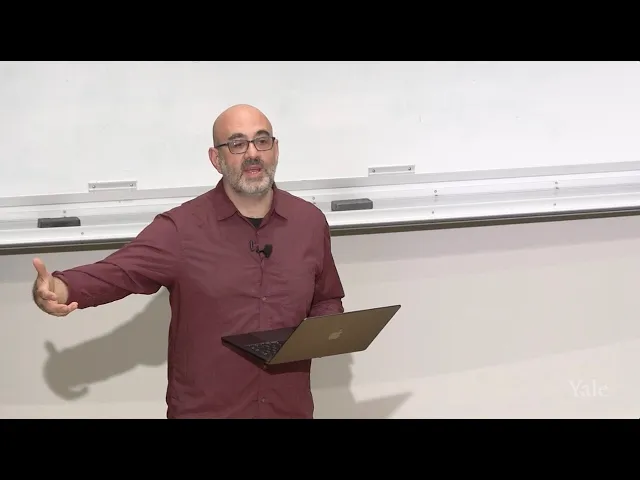
- You only have to buy one book,
0:15
and I'm very happy to hold it in my hands
0:16
because it took me six years of work
0:19
with a colleague who did
an amazing translation,
0:22
which I checked meticulously
against the German
0:24
and argued with him on
and off for six years.
0:30
It's a good translation
in a number of ways
Advertisement
0:32
that the other translations weren't.
0:34
There are only really two
viable translations before this.
0:38
I'm not gonna spend much
time talking about that,
0:40
but this opens up the whole panoply
0:42
of Marx's voices and styles,
0:45
including his humor,
0:46
his cutthroat insult capacity,
0:51
his polemics, his storytelling,
0:55
his myth making, and other things.
0:59
You only have to read one book,
Advertisement
1:00
but you need to read it
slowly and repeatedly,
1:02
as maybe you noticed for today.
1:04
It's funny to start a book
with the hardest part,
1:08
that's something we don't usually do.
1:09
Marx did that and then almost
instantly regretted it.
1:12
He wrote to some friends after,
1:14
"Maybe people should
start with Chapter 5."
1:18
Chapter 1 is a doozy.
1:19
It's long and it's full of
problems that Marx hadn't,
1:24
he had worked out and
maybe just worked out
1:28
and he hadn't found the
best mode of presentation.
1:32
Although if you've read the "Grundrisse,"
1:34
which he wrote in the '50s, the late '50s,
1:37
you'll notice that this
is much better laid out
1:40
than the "Grundrisse."
1:43
I recommend that you read
this with other people.
1:46
What better way to contribute
1:49
different understandings
together and build one?
1:53
What better way to produce solidarity?
1:55
A lot of solidarity has
been produced over 150 years
1:59
of reading this book.
2:00
My colleague Michael Denning,
2:02
has a great article which I'll post
2:04
about workers getting together in groups
2:07
and reading this book.
2:11
Okay, I'm gonna say a little bit about
2:13
what kind of course this is.
2:14
This is a text course.
2:16
If you're not into texts,
2:19
I don't mean SMSs,
2:22
this is not the course for you,
2:24
but I imagine you're all text people
2:26
and probably also commentary people
2:28
given that the internet
2:29
is just a big maybe
wasteland of commentary.
2:32
But the practice of commentary
has really come back,
2:35
and we are going to comment this text.
2:37
We won't go through it line by line,
2:38
but I will look at passages in class,
2:40
and so you should bring
your book with you.
2:43
If you have back problems,
2:46
ask someone to carry it for you.
2:49
And we will be actually opening
the book and looking down,
2:52
so you will start to have
2:53
repetitive worker injuries to your neck
2:56
because you'll be going like that.
2:58
You'll have the hunched over thing, right?
3:01
And your arms and shoulders
will start to hurt
3:03
because of carrying this.
3:04
But what a good way to move through
3:07
the pains of work
towards something better.
3:11
I wanna start with some preliminaries
3:15
and divide the book and our work
3:17
into two sides, two elements.
3:21
One is the capital system.
3:25
This is what we'll call it.
3:26
Capitalism, as you may
know, is a common word.
3:30
It's something people talk about
3:32
sometimes with a little bit
of rue and regret and anger,
3:36
sometimes with joy and
hope and determination,
3:42
often with some dogmatic attachments.
3:44
But this is really a system
3:47
and it isn't a belief,
3:49
let's put it that way.
3:52
It's a system that was
not given to us by Marx,
3:54
but given to us by History,
maybe with a capital H.
3:57
And the roots to it are complicated,
4:00
the roots to this system
4:02
that History has thrown up for us
4:04
and in which we live.
4:06
One route,
4:08
I still think the best route,
4:10
to get to the capitalist system
4:11
is through what I call
the capital venture,
4:14
which is like an entrepreneurial
exercise on Marx's part
4:18
to understand it.
4:20
These two go together,
4:21
the capital system gets constructed
4:23
in Marx's capital venture.
4:25
It has to get constructed somewhere.
4:27
Where does capitalism live as a whole?
4:29
It lives here
4:31
because you'll never see
any more than a part of it
4:33
and you won't see it as what it is.
4:36
So Marx made it his task
4:38
to make it accessible to you in a book,
4:41
and this is only Volume 1, as you know.
4:43
Next semester, Volume 2 and then Volume 3
4:46
and then we start
writing Volume 4 together
4:49
in the second year.
4:51
These three volumes out
of a planned four volumes
4:55
are the place, the only
place you can find the system
4:58
altogether analyzed and laid out for you
5:01
in its functions and
parts and ways of being,
5:06
how it affects the
people who live under it.
5:09
The capital venture, as
opposed to the capital system,
5:11
was given to us by Marx
5:14
through a lot of reflection in sources
5:20
that he took up in political economy,
5:23
chiefly English political economy,
5:25
in German philosophy,
5:28
in journalism,
5:30
in these amazing texts called
the Factory Inspector Reports,
5:35
which he relied on,
5:37
through the editing work
5:38
of his daughters and his wife Jenny,
5:41
through reflecting it back
5:44
in the mind of and in the letters
5:46
of his friend Friedrich Engels.
5:50
You know, you could be named
one or two things in Germany,
5:53
Friedrich, Karl,
5:54
there were some Heinrichs,
5:56
get used talking about
people by their last name.
6:01
He among all the people that he befriended
6:04
and then cursed out one way or the other,
6:06
Engels was the only one
that he never divorced.
6:11
And he passed a lot of
his ideas through Engels.
6:13
It was a very important
philosophical friendship.
6:19
The capital system as
a fully fledged system
6:21
is only a few centuries old.
6:24
You can date it from
somewhere in the 18th century,
6:27
that all its parts are together,
6:29
they're all working,
6:30
and it starts to be a
machine or an organism.
6:32
We're gonna go back and forth
between the two figures,
6:35
a machine or an organism,
6:37
that begins to devour its outside,
6:42
take the outside into it ceaselessly.
6:47
Okay, so the first basic insight
6:50
that Marx had about the capital system
6:51
was that it was too big and too complex
6:55
and also to cunning
for anybody to observe.
6:58
There was no standpoint
7:00
from which you could
observe the capital system.
7:03
You feel some of its effects
on your body when you work,
7:07
when you learn how to sit still
in kindergarten, et cetera,
7:10
you feel some of its effects
in your bank account.
7:15
You would feel an effect if
you get evicted from your home
7:18
in a financial crisis.
7:19
In many ways you feel the effects,
7:20
but you can't tell why most of the time.
7:24
The why involves the connections
that make up the whole.
7:29
And the problem with the
whole is that it's enormous,
7:31
has many complex parts.
7:34
Is that its complexity is higher
7:37
than any of the political
economists gave it credit for.
7:40
That's why Marx had to
turn to some other logics,
7:44
including Hegelian logic.
7:48
And there's a third reason
why you can't observe capital,
7:51
the capital system,
7:52
and that is that it likes to hide.
7:55
It really likes to hide.
7:56
In fact, hiding is one of the ways
7:58
that it carries out its operations.
8:00
Its operations depend on
a certain concealment.
8:04
It is a phenomenal logical operation too.
8:07
Its phenomenological operations
8:09
are essential to its economic
and social operations.
8:13
You look at it and you see something
8:14
that isn't the way it actually operates,
8:17
except the way it doesn't operate
8:19
that you're seeing is the way it operates.
8:22
You can see where the
complexity is coming in here.
8:25
Does that make sense?
8:26
Marx calls these necessary
appearances or real appearances,
8:31
and that has a couple
of consequences for us
8:33
when we're studying capital,
8:35
it does not make sense to call
yourself an anti-capitalist.
8:39
You can't be anti something
you can't even encounter.
8:43
You can't be anti something
8:45
that even if you can encounter it
8:46
by reading all these books,
8:49
if you take away its appearances,
8:53
it still operates.
8:56
It operates anyway.
8:58
That it's just by knowing
about it doesn't stop it.
9:01
Just by knowing the truth
about it doesn't stop it.
9:04
In that sense,
9:05
it's not like Marx at
a certain early point
9:07
fantasized about religion
9:08
that if you showed it to be illusioned
9:11
that people would be like,
"Well, okay, I don't need that."
9:14
Which is not true.
9:15
It's not true that religion's
all illusion either.
9:19
Taking away appearances
does not hurt it mortally.
9:26
We will talk about the capital system
9:28
as a historical subject,
9:31
not an object.
9:33
It is something like a king or a god
9:38
that does things,
9:39
it does things to us.
9:41
It's a funny, personified,
impersonal set of processes
9:44
that catches up what we consider persons,
9:47
people, humans, psyches, souls in its web
9:52
and produces actions
through its agency in us,
9:57
a very peculiar kind of subject,
10:01
a historical subject.
10:03
Marx will personify capital a lot,
10:06
and personification is a
tool he uses for critique.
10:09
One of the benefits of this translation,
10:10
I can say them because I
wasn't actually the translator.
10:13
One of the benefits of this translation
10:15
is that the personifications
are made very clear.
10:17
When Marx speaks in the
voice of a commodity,
10:20
when capitalism speaks,
10:24
you can see exactly the maneuver,
10:27
the Marxian maneuver.
10:28
This is the system that's in
charge and makes the decisions
10:31
so he treats it like
the only person around,
10:33
the only person left, capital.
10:36
But we shouldn't capitulate to this
10:39
and start asking it out on dates
10:41
or feeding it dinner.
10:43
We should be suspicious
10:46
also because even though
Marx personifies it
10:49
as a critical gesture,
10:50
it is an impersonal
machine, it doesn't care,
10:52
so it's missing some personal gestures,
10:55
it does not care.
10:56
It doesn't care about anything, in fact.
11:00
It has a very high degree
of impersonal necessity,
11:04
the system, it keeps going,
11:05
it wants to keep going,
11:08
but it doesn't really have affect.
11:13
So Marx's capital venture
11:14
is the adventure of finding the system
11:18
and putting it on display in all its parts
11:20
and its interactions,
11:22
showing where the necessities
are and how they're made
11:25
and where the contingencies are.
11:27
Obviously, his aim is
ultimately revolutionary,
11:31
but as you may know,
11:32
if you've read "The Communist Manifesto"
11:35
and you've now read the
first chapter of this,
11:37
it's a very different tone.
11:39
He is not calling for
people to gather together
11:41
and overthrow anything.
11:42
First of all, you can't see
what there is to overthrow.
11:46
He hasn't described it yet,
11:48
so maybe after these books are done,
11:50
someone could come along,
11:52
and people have come along, as you know,
11:54
to say, "Okay, now that we see this,
11:56
here's how we overthrow it."
11:57
But Marx came to a point late in his life
12:00
in which after many
revolutionary disappointments,
12:03
many, that he wasn't gonna
work on that anymore.
12:08
What he was gonna do
is describe the system
12:10
in a sense to show why the revolutions
12:13
had not been successful.
12:15
So in that regard,
12:17
you have to put your activist
hope a little bit to the side
12:22
and accept this as the
most pessimistic book
12:26
you'll ever read.
12:28
I'm sorry to say that,
12:29
but I like to think that
pessimism leads to realism,
12:34
and realism can lead to real change.
12:37
Marx certainly thought so.
12:42
He also spends a lot of time
12:44
putting on display the
way capitalism hides
12:46
because that's just one of its functions.
12:48
Does that make sense?
12:50
You can't respond by
debunking and exposing,
12:54
that's not a revolutionary activity.
12:58
But it is part of the analysis
13:00
to see how the parts that hide
13:03
and the parts that show
13:04
are related to one another,
13:05
and how it motivates certain
actors in capitalism,
13:08
like labor, like owners,
13:10
like the apologists for capital,
13:15
what he calls sometimes vulgar economists.
13:19
The best way to do this is unfortunately
13:23
I just realized that the subtitle
13:25
didn't make it onto the cover,
13:27
but in fact the original title for this
13:28
was "Critique of Political Economy,"
13:30
and then later he decided,
13:32
"Well, this is about capital too."
13:34
But you can see both activities
13:37
that he wants to take care of there.
13:39
He wants to deal with the way
13:41
it's been thought of in the past
13:44
and show you how capital works.
13:48
He thought the best way
to do it was to critique
13:51
the accounts of capital
that had come before.
13:56
I'm gonna say this is just preliminary
13:59
is leading us towards looking
into the first chapter, okay?
14:04
How many of you managed to get a book?
14:07
Yeah, it's so funny,
14:08
this like capitalist model,
14:09
they said, "Oh, we only
order half of the books
14:13
because we don't know who's gonna stay."
14:14
I said, "It's a Capital course.
14:15
You know, they're off,
they have to be committed,
14:17
they would never do it otherwise."
14:19
So they claim that they're getting
14:20
the rest of the books for next week.
14:26
Marx couldn't write this book
14:28
because he was some sort of
special kind of individual,
14:31
although he was unique,
14:35
a kind of unique freak.
14:37
In fact, this book is the product
14:38
of about 30 years of work,
14:41
40 if you count the very
beginning to the very end
14:45
of his work.
14:48
It takes an enormous
amount of sitzfleisch,
14:50
as they say in German,
14:53
butt flesh, that is the
ability to sit in a chair
14:57
to do that.
15:00
It's not that he could write this book
15:01
because he was a special person,
15:04
he understood the world
better than anyone else.
15:07
And it wasn't because the capital system
15:09
was brand new when he started to write.
15:12
It wasn't,
15:13
it was already 100 years old, let's say,
15:15
as a full-fledged system.
15:19
And on top of that, you can't really see
15:20
what's brand new when it's brand new.
15:22
Wait 50 years to see
what all of this garbage
15:25
about AI is worth.
15:27
Maybe AI will be something big,
15:29
maybe one of these pieces of writing
15:32
will be the key to it,
15:33
but we won't really know for 50 years.
15:35
And so Marx came at a perfect
time about 100 years later
15:40
after the thing had happened
15:42
and its first theorists had theorized it.
15:46
So it wasn't because he
had an inspired vision,
15:48
he was situated at a juncture.
15:51
That juncture was when the capital system
15:53
had consolidated itself
in the 18th century,
15:56
had ramped up in the early 19th century
15:58
into industrial fury,
16:01
and the first theorists had started.
16:04
Interestingly, capitalism was theorized
16:08
for the first time between 1776 and 1817
16:12
between Adam Smith's "An
Inquiry into the Nature
16:16
and Causes of the Wealth of Nations,"
16:17
known as "The Wealth of Nations,"
16:19
and David Ricardo's "On the Principles
16:21
of Political Economy
and Taxation" in 1817,
16:24
which is strangely coeval
16:26
with the American Revolution, 1776,
16:29
and the opening of the New
York Stock Exchange, 1817,
16:33
whatever you want to say
about the birth of capital
16:35
and the US American way of life.
16:39
It is true that those were the poles
16:41
of the first theorization of capital
16:44
between Smith and Ricardo,
16:46
which Marx knew well
16:47
and both had spawned schools
16:50
of political economic study.
16:54
What's the good of the
first theorists of anything?
16:57
Well, they name the topic,
16:59
they say it's a thing,
17:00
and they give you a first approximation
17:03
of what it might look like to study it.
17:06
They invented this course,
17:07
and Marx more than anything,
17:10
not more than anything,
17:11
but in addition to writing in German
17:13
is writing in English.
17:15
Even though in German,
17:16
he's using the terms and the phrases
17:18
and the grammar of English
political economy in this book.
17:21
He does use a lot of terms in English
17:24
and leaves them in
English in the original.
17:28
What he liked about the
political economists
17:30
was the unhealthy mixture
of rightness and wrongness
17:34
in what they wrote about.
17:37
Because when faced with
a giant impersonal system
17:40
that's difficult to see,
17:41
that was taking over the world,
17:43
making labor look totally different,
17:46
making wealth look totally different,
17:47
making all your decision
making look different,
17:49
making agricultural work look different,
17:52
there was nowhere to exactly look for it
17:55
except in the books,
17:58
in the people who had
started to theorize it.
18:01
So what he meant by critique,
18:03
this is the first meaning
of critique for Marx,
18:05
was finding the blind spots, the stubs,
18:08
the unworked out ideas,
18:10
the lacking logic in the
political economists.
18:17
That's why you have "Critique
of Political Economy"
18:19
as really an important part of the title.
18:22
They overstated things,
they made mistakes,
18:24
but they saw a lot.
18:26
For example, they saw
how important labor was
18:30
to the capital system.
18:33
He then compared those blind spots
18:36
to the best evidence of his day,
18:38
which in some ways is a lot better
18:40
than the evidence we have today.
18:42
There aren't that many anthropologies,
18:46
ethnographic studies of work anymore.
18:48
There were a lot in the 20th century.
18:53
He compared the political economists
18:56
to newspapers, to novels,
18:58
which you'll see he
quotes and reminds us of,
19:01
to ethnographies of factories,
19:03
especially the one by his
friend Friedrich Engels,
19:06
who wrote "The Condition of
the Working Class in England"
19:08
in 1844, and opened Marx's eyes.
19:12
It's a great book.
19:13
Engels, as you probably know,
19:15
was the son of a factory owner
19:18
who owned factories in
Germany and in England,
19:21
and he sent the 18 or 19-year-old
Engels out to Manchester
19:26
to work in the factory.
19:27
And Engels was like, "Whoa,
19:30
this is awful, dad."
19:34
Not the only time
19:35
that being against your
parents changed world history,
19:40
there was Oedipus,
19:42
but this was a very important one.
19:47
In this book, you will notice
19:50
that there is one set of heroes.
19:52
It isn't Marx, it isn't even the workers,
19:55
it is the factory inspectors.
19:57
They are the David Copperfields
of this gothic novel.
20:01
They went out to the factories in England
20:03
and they wrote the most scathing reports.
20:05
The irony of this, just so you know,
20:07
was that the factory inspectors
20:08
were empowered by the House of Lords,
20:11
which was the old aristocracy
20:12
who wanted to get the wealth back
20:14
from the rotten capitalists.
20:16
So if they exposed their dastardly
treatment of the workers,
20:20
they thought they could climb back up
20:22
to social hegemony,
20:25
obviously didn't work,
20:27
but the factory inspectors
provide the most scathing,
20:31
searing, clear sighted review
20:34
of child labor, for example,
20:37
of long hours, of disease,
20:40
of injury, of hopelessness,
20:43
of the immiseration of the workers,
20:47
no matter how much they worked,
20:48
they couldn't feed themselves,
20:49
of malnutrition.
20:51
The factory inspectors are the heroes
20:54
and they served the purpose
20:57
of socialism unknowingly.
21:02
Okay, so between the descriptive accounts
21:06
and the theoretical accounts,
21:08
with the help of a bigger
philosophical framework,
21:11
a different logic and
a different ontology,
21:13
which we'll talk about today,
21:14
Marx could describe the capital system
21:16
in a way that it still operates today.
21:19
I will maintain this.
21:20
You will look around and see
if that's true for yourselves.
21:23
In essence, it still
operates in the same way
21:25
as is described starting in Chapter 1.
21:29
What does a capital system do?
21:32
We wanna talk about it in a
way that isn't just logical,
21:35
that isn't just about its contradictions
21:38
in the sense that it doesn't make sense.
21:40
Oftentimes you think, "This
just doesn't make sense."
21:45
It's not a matter of making sense,
21:46
but the toxic effect it has
on people who live under it.
21:51
Capitalism is a strange,
21:52
the capital system is a strange mix
21:55
of a toxin and a remedy.
21:57
Sometimes it poisons you
22:00
and then offers you the cure,
22:02
which poisons you even worse,
22:05
as we know.
22:07
It feeds and clothes most of the planet,
22:09
we have to concede this right away.
22:12
There isn't a way you
could snap your fingers
22:14
and have some central organization
22:16
that suddenly took over the distribution,
22:20
production of food and
all other necessities,
22:24
but this comes at a cost
22:27
of poisoning sociality according to Marx,
22:30
that's called wage labor,
22:32
that's the poison of human sociology.
22:37
It generates unprecedented wealth,
22:41
but it distributes that wealth
22:42
in terribly uneven and
frankly preposterous ways
22:46
that makes no sense
22:47
and it redounds on our lives
22:50
to the extent that we
have to do crazy things
22:54
just to survive.
22:55
It gives work to billions
22:57
and is constantly about to
throw millions out of work,
23:01
and you never know whether you're the one
23:02
who's gonna be thrown out of work today
23:04
or you're gonna be promoted.
23:07
Right now in any present,
23:09
you are in this precarious position,
23:11
so much so,
23:12
and that is kept from you
23:15
in the form of our language and ideation
23:18
where you say,
23:19
I run one of the colleges here
23:21
and students are always worried
about, "Will I get a job?"
23:24
I'm like, "Get a job?
23:25
You're giving them some,
they're getting you."
23:28
Obviously, it doesn't work that way,
23:30
but we believe we're
lucky when we get a job
23:32
and we believe we should
not only have that job
23:34
and give them everything but love it.
23:37
You must love your work.
23:42
As Marx says, "You're free.
23:44
Free to sell your or die."
23:49
The capital system divides
everything up in a different way
23:52
and it conquers.
23:54
It forms classes, social classes,
23:57
it re-skills labor in the factory,
24:00
it de-skills labor in factories,
24:03
it occupies lands and peoples,
24:05
it extracts resources,
24:06
all this stuff we know.
24:07
It uses race, gender, ethnicity,
24:10
country of origin to distribute
wealth in different ways,
24:15
unevenly, and not just wealth but labor.
24:18
We should think not only of the
distribution of the outcome,
24:22
but the distribution of the input,
24:26
so labor.
24:27
And the affective
distribution of suffering
24:29
is another thing we should consider.
24:32
"Capital is what makes live and lets die,"
24:34
to quote Foucault.
24:37
It builds and destroys,
24:39
it gives rise to immense
technological change
24:42
such that you might be dreaming
24:44
of what's the technology
from your childhood
24:48
that's no longer around?
24:49
The DVD.
24:50
You might be dreaming of the DVD at night,
24:52
but you'll never see one in the day
24:54
that has been totally
vanquished from the Earth,
24:57
that technology.
24:59
And we know the ways in
which it makes life on Earth
25:01
precarious to the point of extinction.
25:07
It builds and destroys.
25:09
It is, to quote Wendy Brown
in her preface to the book,
25:13
"World making and world destroying."
25:20
There's much more we
can say about the ills
25:23
and the goods of capital,
25:25
but maybe we can do that
as we go through the book.
25:30
Let's open the book
25:31
or open your PDF
25:35
and begin to look at it.
25:37
I wanna start today
25:40
from the first sentences,
25:44
very famous sentences,
25:47
but we need to look into it a little more.
25:55
"The wealth of society is dominated
25:57
by the capitalist mode of production,
25:59
appears in the form
26:00
of an enormous accumulation
of commodities."
26:03
There Marx is quoting himself.
26:06
Why not? He's an authority.
26:08
"The individual commodity appears
26:10
as the elementary form of that wealth.
26:12
Hence, our investigation begins
by analyzing the commodity."
26:16
Let's just take a look at these words
26:17
because they will help us
figure out where Marx is going,
26:21
starting with wealth.
26:24
What is wealth?
26:25
Anyone wanna bore me
26:29
an explanation?
26:35
Shout it out.
26:39
I got a room full of people
26:41
either who are so wealthy
they never thought about it
26:44
or so poor they're too
mad to say anything.
26:46
Yeah.
26:48
- An accumulation of capital.
26:51
- No.
26:52
Yes, no.
26:53
Yes and no.
26:55
It is certainly an accumulation,
26:57
but wealth is not capital.
26:58
Wealth is a pre-capitalist form,
27:00
an extra capitalist form.
27:02
We call things wealth under capital,
27:05
but wealth is simply an
accumulation of possessions
27:09
and maybe you could say an
accumulation of possessions
27:11
that have some purchasing power
27:13
that allow you to get something else.
27:16
Capital is not wealth,
27:30
it is a term that belongs
to a different system.
27:33
For example, it comes from the system
27:36
where you think of the wellbeing
of the whole community.
27:39
In fact, the word comes
from the word weal or well,
27:42
which means to not be ill,
27:46
to keep your health.
27:48
And is used frequently in the 18th century
27:52
in the compound commonwealth.
27:54
There's no such thing as common capital.
27:56
You couldn't say common capital.
27:58
So when we say wealth management,
28:00
they're really not thinking
of the meaning of the term.
28:02
It is another form of appearance,
28:06
a way of talking about it.
28:07
And Marx would say this is
not a necessary form of,
28:10
this is misleading way to talk about it.
28:13
And you'll see that he talks about
28:16
what he calls the vulgar economists
28:18
or the bourgeois economists
28:19
in these terms all the time.
28:21
They're not taking up
28:22
capital's necessary forms of appearance
28:24
where value appears as money, for example.
28:28
What they're doing is deceiving you
28:30
and they're just (indistinct)
28:31
because they're deceived themselves.
28:33
Capital is not wealth.
28:35
When your wealth is being managed,
28:37
it's being used as capital, not wealth.
28:40
And we're going to get to what capital is.
28:42
Capital has a whole other operation.
28:45
You notice in the first sentence,
28:46
the wealth of society
28:47
is dominated by the
capitalist mode of production.
28:52
He talks about societies
28:54
and he talks about something
that takes them over
28:58
at a certain moment in a certain way
29:01
under certain conditions.
29:05
We have to be wary of thinking of capital
29:07
as something that is natural
29:10
that exists longer in history.
29:12
Capital itself as a technique
is a kind of social technique
29:17
for taking money, putting it to work
29:20
and getting more money out of it,
29:21
it's a contract in which you
take a certain amount of value
29:24
and you say, "I'll give this to you now
29:26
if you give me more later
along with the original."
29:29
That started to be a social
technique in the 15th century,
29:34
so still not that old
when it comes down to it,
29:37
certainly much younger than wealth.
29:41
Anyone in the European context
in the last 2,000 years
29:45
could amass possessions
29:50
and then use them as they wanted to.
29:52
The idea that they would then grow
29:54
is an absurd and very new idea,
29:59
new to the tune of about 500 years.
30:04
The wealth of society
30:05
is dominated by the
capitalist mode of production.
30:08
Wealth gets transformed
30:11
when capitalist ways
30:14
of doing things take over.
30:17
It's no longer wealth,
30:18
it gets translated,
30:19
as many, many things do under this system.
30:22
It takes old things.
30:23
That is why the persistence
30:25
of old ways of understanding them,
30:27
as in the political economists,
30:28
is worrisome because the names carry over
30:31
other social systems
30:32
and ignore the newness of this system.
30:40
What is a mode of production?
30:41
Let's talk about that.
30:43
So we talk about wealth,
30:45
dominate is important
30:46
because Marx is already thinking here
30:50
that there's power involved,
30:53
that the mode
30:56
or the way of living
30:57
or the form of life
30:59
takes over and kicks other things out.
31:02
You will see in later chapters,
31:03
especially in the original
accumulation chapters,
31:06
how that happened through violence and law
31:10
and deceit and treachery.
31:14
So it came to be,
31:16
it came to hegemony or
came to power, capital,
31:20
through a domineering way.
31:23
I don't think it's the
case that every social form
31:25
comes to be through domination,
31:28
through taking over and
kicking everything out,
31:30
but capital has that quality,
31:32
and historically it had that quality.
31:34
It was like, to personify it,
31:37
"You're out of here.
31:38
The rest of you are out of here.
31:39
We're gonna marshal all our resources
31:41
to push out collective
farming or feudal relations."
31:46
It dominates.
31:48
So the trace of power
goes through capital,
31:50
even though he doesn't have
an analysis of the state,
31:54
there are power relations at stake.
31:57
In fact, the main relation,
31:59
the capital relation,
32:01
is something you'll get to down the line,
32:03
which is the core of his analysis,
32:06
the core of his critique.
32:07
This is what exactly the
political economists missed.
32:11
And the thing that remains
steadfast in our capitalism,
32:15
even though some of the forms
of exchange have changed,
32:20
the commodities, of course, have changed,
32:22
is the capital relation,
32:23
and that is a relation of extortion
32:26
in which the owners hold
back the means of production
32:31
from the very ones who can
use the means of production
32:34
and force them to sign a
contract to give over their labor
32:36
and its product to the owners.
32:40
That's the capital relation,
32:42
and it's a relation of domination.
32:45
So keep your eye on domination
32:48
and other modes of power,
including extortion.
32:51
Mode of production
32:52
is a term that comes up a
lot in Marxist discourse.
32:55
You probably will notice
32:57
that I don't give that dogmatic view
33:02
of Marxist discourse,
33:03
maybe some of you are
better at it than I am.
33:06
For a long time I was
saying, "I'm not a Marxist."
33:08
You know, Marx said this famously,
33:10
his son-in-law, Paul Lafargue quotes,
33:12
"Je ne suis pas marxiste."
33:16
But you know strategically
in the right moment
33:18
you're like, "I'm a Marxist."
33:24
We leave that question open,
33:25
and you'll leave that
question open for yourselves
33:27
where you fall on this.
33:29
But mode of production is
a typical phrase in Marxism
33:33
and it implies a number of things.
33:35
First of all, it implies that
production is not natural.
33:39
You don't always make
things in the same way.
33:42
It has modes,
33:43
so it is modal or modular
33:48
or plastic or elastic.
33:50
And one of the ways you
could do a revolution,
33:53
one of the ways capitalism
does its revolutions
33:55
is by plastifying the mode of production,
33:59
changing the mode of production
34:01
from hand work to machine
work to digital work.
34:05
That is a transformation
of the mode of production.
34:08
There are potentially
34:12
modes of production
34:13
and transformations of
the modes of production
34:15
that could lead out of
the capital relation,
34:18
that's possible.
34:19
It upholds it as we think about it.
34:22
And capital is very good,
34:24
the capital system,
34:24
Mr. Capital. Mrs. Capital, Sir Capital,
34:27
what should we call it?
34:28
King Capital? King Capital.
34:30
King Capital,
34:33
we are writing a kind of fairytale,
34:35
King Capital excels
34:38
in changing the mode of production
34:41
to increase profit
34:46
and not to decrease profit
34:49
is why kind of hand work movements fail
34:54
as big movements.
34:57
Okay, what other words
are we dealing with here?
35:03
Appears in,
35:04
you'll notice that the first four chapters
35:07
are about appearances.
35:09
It starts very close to you
35:11
in the thing that appears
to you first every day.
35:14
What's the thing that appears
to you first every day?
35:16
It's not your toothbrush anymore,
35:18
it's here like this.
35:19
He's like, "This is how
capitalism appears to me."
35:22
It's a very,
35:24
it's materialist in a sense
35:25
that you're looking at
the actual things you use,
35:28
Marx starts with this in the book,
35:31
but it's something you can't see
35:34
because iPhone is a perfect
35:35
or a smartphone is a perfect example
35:36
because it's so close to your face
35:39
you can't see it for what it is.
35:42
You can't see it as a commodity, for sure,
35:44
while you're using it.
35:45
You also can't see its constitution.
35:48
It is constituted by all its connections
35:50
to everything else in the world:
35:51
what made it,
35:54
its parts, the labor, the ideas,
35:57
the history of technology
that led up to it.
35:59
Actually, Marx says
somewhere, "If you take a pen
36:04
and you started to enumerate
36:05
all the labor that went into it,
36:07
you would become nauseous very quickly,"
36:10
because in fact every made object
36:11
is connected to every bit of work
36:14
that was ever done in human history
36:15
plus all of nature and
evolution back to the Big Bang.
36:20
These are the kinds of thoughts
36:21
we're dealing with in this class.
36:23
The world of commodities
36:25
is an immense accumulation
36:28
of diverse things,
36:30
and Marx will say, "There's
one way to hold onto them."
36:33
Capitalism does this.
36:35
It holds onto them by value.
36:37
That's the thing they all
have in common for capitalism.
36:39
But if you look at the
world of commodities,
36:42
it is dizzying.
36:44
Someone sent me recently
a Rosa Parks bikini.
36:50
Okay, they didn't send me the bikini,
36:51
they send me a link to the bikini,
36:53
which is like 19.95,
36:55
but you can commodify anything,
36:58
everything can be commodified.
37:00
We'll talk about the
processes of commodification,
37:03
but if you look at one commodity,
37:07
you don't see its commodity character,
37:10
you don't see its relationship to labor
37:11
and the history of all labor,
37:15
and you don't see its relations
to the immense diversity,
37:18
the mind-boggling, infinite,
potentially infinite diversity
37:22
of all the commodities that are out there.
37:24
Very hard to see.
37:25
We're gonna be enumerating this.
37:31
Where are we?
37:33
Appears in the form of.
37:34
Marx sticks with a kind of Aristotelian
37:37
philosophical distinction
between form and matter
37:40
or form and material.
37:41
This comes up a lot,
37:42
but he's gonna switch around
what those things are.
37:44
And unlike Aristotle,
37:47
form is not natural,
37:48
it's not given by God or born with nature.
37:51
The forms of things,
37:52
capitalism, the capital system,
37:55
specializes in transformation of forms,
38:00
which you will have seen
in Section 3 of Chapter 1,
38:04
which we will talk about on Friday.
38:07
Form of, this is a very
important phrase to hold onto,
38:10
you will see something
that you want to understand
38:13
changing its form a lot.
38:14
It takes the form of this
and the form of that, right?
38:17
Don't be nervous about it.
38:19
If the material content of the commodity
38:22
is use or use value,
38:26
its form is exchange value.
38:30
A very strange way of
understanding things,
38:32
he takes this from Hegel,
38:33
really moves it around to
make us able to understand
38:38
this world of commodities.
38:43
It takes the form of an enormous
38:45
accumulation of commodities.
38:46
Well, this is a very flat phrase,
38:48
enormous accumulation of commodities.
38:51
What's an accumulation?
38:55
Nothing, it's just a bunch of things.
38:57
It's a bunch of things with
no relation to one another.
39:00
That's what wealth is and accumulation,
39:02
that hides the fact that all
those things are related.
39:05
Somebody made them,
39:06
somebody bought them,
39:08
somebody sold them,
39:09
somebody extracted the
materials from the Earth,
39:11
the Earth produced those materials,
39:12
the Earth is gonna get back
39:14
the disjecta membra of that thing
39:17
in some form that ruins it, most likely.
39:22
All of the relations are
gone in an accumulation,
39:24
so this is the first appearance,
39:27
two first appearances
39:29
that this is the elementary
form, the commodity,
39:33
and that it shows up
39:35
as an enormous accumulation
of them, right?
39:39
Especially if you are,
39:41
you know, when my partner
Catalina came from Argentina
39:44
and we went to Target,
39:46
maybe if some of you come from
a less consumerized culture,
39:51
she was like, she couldn't believe it,
39:53
she just walked around like.
39:55
Now we bring everyone who comes to visit
39:56
for the first time to Target
39:57
or one of those places.
40:00
I don't go into Walmart,
40:01
but I imagine it's even bigger,
40:03
and you're just like, "It's astounding.
40:05
It looks like an immense accumulation.
40:06
It's just like it grew,
it's like paradise.
40:10
A very fluorescent paradise."
40:15
But it is not an accumulation
40:17
and it doesn't have an elementary form.
40:21
It's a set of dynamic
relations in which people live,
40:25
expend their energies and die.
40:28
Nourish themselves,
interact with one another,
40:31
it's not an economy, it's a social system.
40:34
This is the main aim of this book
40:36
is to say economy has its place,
40:40
but we need to move beyond
economistic thinking
40:43
towards what Marx calls social thinking.
40:46
We can see what that is.
40:50
(hums) We're getting there.
40:54
The main mode,
40:57
especially in these first
chapters, is analysis.
41:01
Just to say what analysis is.
41:02
It's very hard to read this book.
41:04
It switches around a lot.
41:06
You'll find he'll be
telling a joke one minute,
41:08
he'll be doing dialectics another minute,
41:10
what's dialectics?
41:11
We'll talk about that.
41:14
But the first chapters are about analysis
41:17
because he thinks he can
take you to the falsity
41:21
of what you think a commodity is
41:23
and your relationship to it
41:25
by breaking it down into its parts,
41:27
which is what analyzing is.
41:29
So he does a lot of
operations in this book,
41:33
critique of the political economists,
41:35
analysis of what we take
to be the basic forms.
41:38
He will do dialectics,
41:40
which is a synthetic operation
41:41
so that we can get from
the elementary form
41:44
and its false appearance
as an accumulation
41:47
to the whole,
41:49
which is the only perspective
41:50
from which to understand capital.
41:53
So if you feel lost at the beginning,
41:55
I think it's the best
way to start the book
41:57
for people who are reading
it 150 years later.
42:02
Why?
42:02
Because it starts exactly
42:04
with the false position that you're in
42:06
and moves you very slow.
42:07
This is what he thought he was doing,
42:09
moves you slowly to the whole,
42:10
which is the only perspective
42:12
from which to know that
these are false appearances
42:15
because the iPhone is a the product,
42:19
I mean, so much you could
say about the iPhone.
42:21
I always tell students,
42:22
"You should do an analysis of the iPhone."
42:24
I'm sure there are good ones.
42:25
If you know one, send it to me
42:31
because it is a temporary,
42:34
in so many ways,
42:36
embodiment of drives of the system.
42:42
And only when you know
the system and its drives
42:45
can you understand how
this is just a part.
42:52
False to look at it as a thing.
42:55
Commodities are not things.
42:57
Oh, we didn't talk about commodity.
43:00
What is a commodity?
43:01
And then I'm gonna open up to questions.
43:03
Does that sound good?
43:06
Yes? Okay.
43:10
By analyzing the commodity, right?
43:12
So that's already a kind of false move.
43:14
What you would wanna do is
start with the capital system.
43:16
I would be like, "What's that?
43:19
There's no capital system,
43:20
there's no system.
43:21
I just go to work,
43:22
I have this thing,
43:23
I go shopping, right?"
43:24
I know somebody picked this,
43:26
but you don't know all the
steps that happened in between,
43:28
including the pressures on the farmers
43:31
to put out a certain amount
43:32
and to buy genetically modified seeds
43:35
that are copyrighted, et cetera.
43:38
You have to know the whole system
43:40
to be able to understand
even one of its phenomena.
43:43
So he starts with one of its phenomena
43:44
to show you that you can't understand it
43:46
without moving well beyond it.
43:49
A commodity is, this is important,
43:53
it's like a spoiler,
43:55
it's like we've got to the end of,
43:58
what did I watch recently?
44:01
We just watched "Stranger
Things" for like the 10th time.
44:03
It's like you get to started with the end
44:04
of the first season of
"Stranger Things," right?
44:07
So here it is,
44:08
a commodity is a product
produced for exchange.
44:19
Oh, that was a long exposition
44:22
of the first two
sentences, three sentences.
44:27
How about some questions?
44:34
- You said that something,
44:36
I don't know what it was,
44:37
that doesn't have an elementary form.
44:38
You said something doesn't
have an elementary form,
44:40
maybe accumulation,
44:41
you just explain what you meant by that?
44:43
- Yeah, the capital system
has no elementary forms.
44:46
Marx does not think that
at least social forms,
44:50
and actually if you think about
the science he was reading
44:53
in the 19th century, also natural forms,
44:56
start from elements
which then build them up.
44:59
That's something you might think of
45:01
in physics or in chemistry,
45:04
but it's also false.
45:06
We break out the table of elements,
45:08
but when you look at a compound,
45:10
it has all of these characteristics
45:13
that aren't reducible to their elements.
45:15
So I would say that the capital system
45:17
is not reducible to its elements
45:19
and it's not explainable by its elements.
45:22
For that reason, he turns to Hegel
45:25
and you need a mode of discourse
45:28
that starts from the whole
45:31
because the parts all existed
45:32
in one form or another
beforehand in history.
45:35
There was money,
45:36
there was exchange,
45:38
there were dirty merchants
trying to get more for less.
45:42
There was exploitation, for sure,
45:45
there was extortion.
45:47
It's only this whole that puts
them in a certain position
45:51
and makes them do certain
things vis-a-vis one another.
45:55
Why do we need an iPhone?
45:57
Because of the way work turns out really,
46:00
or because you're far away from home
46:02
because of the way work turns out really,
46:06
or because students need to
contact me while I'm walking.
46:10
I don't know why that is.
46:14
Only explainable by the whole.
46:15
But that's a real conundrum
for a scientist of capital
46:18
because how do you explain
the whole as a whole?
46:23
To explain the whole as a whole.
46:24
Describe the whole as a whole.
46:27
Yeah.
46:28
- I was wondering if you
could talk a little bit about
46:30
translation means and its use
in this version of the text
46:34
because I noticed you referenced
46:36
in bold, black and key rule,
46:38
but used writing, machine, journaling,
46:40
you were image it by
many times crazy a bit-
46:42
- Yes.
- Into English.
46:44
And there was one phrase particular,
46:46
the power of production
46:48
or the productiony power,
46:50
I've lost it on (indistinct)
productive power.
46:53
- Yes.
- But I wonder if it
46:53
could also be read as
like productive potential
46:56
and how much something
like that would shift
46:59
capitalism of indifferently seen.
47:02
- It's a great question,
47:03
a question about translation
and Marxist language,
47:07
how much English changes it
47:09
and how many other languages
Marx was working with.
47:12
Marx knew, I don't know,
six or seven languages.
47:16
He was a 19th century intellectual,
47:18
that's what you did.
47:19
Aren't we weak in comparison?
47:22
I encourage you to go out.
47:23
I managed like five,
47:27
but many of them badly.
47:28
I encourage you to go out,
47:30
and he could read in all of them
47:31
and quote in all of them
and remember all of them,
47:33
it was really astounding,
really astounding.
47:38
About how translation affects the text,
47:42
it of course has a big effect.
47:44
And let's take the word
term you mentioned,
47:46
produktivkraft, productive power,
47:49
or arbeitskraft, labor power.
47:53
Not only are those
47:57
hard to understand conceptually,
48:00
but Marx is actually inventing
labor power as a term.
48:04
In fact, he considered that
to be his biggest contribution
48:07
or one of his biggest contributions,
48:09
the idea that there is this
thing called labor power.
48:13
I think it would be going
beyond the translation
48:17
to imagine that that would be
something like a potential,
48:23
but that doesn't make it wrong,
48:25
that would be an interpretation.
48:26
Marx was very precise with
his terms most of the time,
48:33
but he did have a bit of
an Aristotelian background,
48:36
so he likes matter and form,
48:38
and he also likes
potentiality and actuality
48:43
as a set of terms that
describe how things work.
48:46
And it is true that when
you sell your labor power,
48:48
you're selling a potential.
48:49
And the big joke on workers
48:53
is a terrible way to put it,
48:55
the big deception is you
sell them your labor power,
48:58
but they're getting your actual labor.
49:01
So you have a certain
quantity of labor power,
49:02
like, "I could do this much, here it is."
49:04
But then you go in there
49:05
and they're like, "Well,
sorry, you're doing this much,"
49:07
you're actually doing a lot more.
49:09
So labor power is a tool of capitalism
49:12
to make it work out such that
more comes from the same.
49:17
So you could do a good
interpretation of arbeitskraft
49:21
or produktivkraft as a kind of potential
49:25
that when it's actualized is
different than its potential,
49:28
so that would be also moving
beyond Aristotle or Hegel.
49:32
Yeah.
49:33
- I had a question
about the different ways
49:35
that bridged Marxist writing
49:36
because you mentioned he
was also very a satirist
49:39
and also wrote stern and
also political economists,
49:42
so like how does the
style itself try to work
49:45
oh, would capital against (indistinct)?
49:47
- Yes.
49:48
Oh, that's a great question.
49:50
I've thought about this a lot,
49:51
and you should think of Marx
and Engels as genre geniuses.
49:57
These were like the Rupert Murdochs
49:59
of the left in the 19th century.
50:01
They tried everything
50:03
to liberate labor,
50:07
first to bring about liberal changes
50:09
and also to move towards socialism.
50:10
They tried every genre imaginable.
50:12
One of them you know, "The Manifesto,"
50:14
another one you might know the
"Thesis," remember that text?
50:18
Famous text, "Theses on Feuerbach."
50:21
They wrote letters, they gave speeches.
50:22
Marx was up in 1871 in La
Commune on the barricades
50:26
giving a speech to the Communards.
50:30
He gave founding speeches,
50:31
which included a lot of
theory at the inauguration
50:34
of the International
Working Men's Association.
50:37
They sent sometimes shameful,
50:42
insulting letters about
other people to one another.
50:45
They really tried everything.
50:46
He wrote, of course, he was a journalist
50:47
and he wrote hundreds of articles.
50:49
They wrote encyclopedia entries,
50:52
Engels writes long entries about arms
50:56
and how they're useful
for popular uprisings.
50:58
He has a great article on the rifle.
51:01
So they were trying everything,
51:02
and in this text, Marx
is doing the same thing.
51:05
I mean, what's the difference
if you take capitalism
51:08
that bourgeoisie down by logic
51:10
or you take them down by yelling at them,
51:12
doesn't matter,
51:13
so he tried everything
51:15
and I think that goes to an
important theoretical point,
51:18
which is even though he found
ways to analyze the system,
51:22
he did not find the way
that it would disintegrate.
51:28
And he was constantly trying
all the way up to the end,
51:31
including in his last years
51:35
learning calculus
51:36
so that he could better
understand business cycles.
51:41
Yeah.
51:42
- So, you began the
lecture you said to be wary
51:46
thinking of capital as natural,
51:48
but you also brought up how,
51:50
at least from ours,
51:51
what matters about capital
51:52
is less about quadruple contradictions
51:54
and more about the negative effects
51:56
of the people way under it.
51:58
I guess like two questions.
52:00
One, maybe when God is just like,
52:02
"What do you mean by natural?
52:03
Is history natural?"
52:04
But also assuming that people
52:06
can set their by natural (indistinct),
52:09
why does it matter whether capital is at?
52:11
- That's a great question.
52:13
The question was
52:16
why did I say capital is not natural
52:19
or the capital system is not natural?
52:21
And the question is why does it matter?
52:26
And for Marx it mattered,
52:28
first of all, within the theory
that there's a separation
52:32
between social things and natural things.
52:36
Social things modify natural things.
52:41
He was aware,
52:42
in fact, he read Darwin's
"Origin of Species,"
52:46
and there's a footnote to it, praising it.
52:49
He was aware that nature
was being understood
52:51
itself as having a history
52:54
and as being a kind of
self-modifying thing.
52:58
One word for that is organism,
52:59
self-sustaining, self-modifying,
53:02
and that's a word that Marx
likes to use for capital too.
53:06
But this has to be separate and malleable
53:08
in a different way than nature.
53:11
Social things, in fact, they
have to be made by humans.
53:16
So history for Marx,
53:18
you could have natural history,
53:20
but social history was the history
53:22
of the way human beings
make their means for living
53:27
and produce for themselves
their wants and needs.
53:30
Only if it's not natural for him
53:32
in the sense of being fixed
53:34
and given outside of human activities,
53:38
only if it's not natural,
is it criticizable for him.
53:41
Things that are natural or not
thought of as criticizable,
53:44
you know, criticize a comet,
53:48
criticize a tiger,
53:51
criticize a tectonic plate,
53:54
and then come back and tell me about it.
53:55
Yes.
53:56
- Do you find it more helpful
53:58
or more insightful to read "Capital"
54:00
as kind of an accumulation,
54:02
I guess, of Marx's previous styles,
54:04
be that German idealism
54:07
or journalism or what have you?
54:10
Or do you find it more
helpful to kind of read it
54:12
as a turning away to something new,
54:15
to a (indistinct)?
54:19
- The question is about Marxist styles,
54:22
is it a kind of compendium
of previous styles
54:25
or is it something new?
54:27
He had been working in political
economy since about 1843.
54:31
He writes the first draft of this in 1867.
54:34
The first draft of this set of drafts,
54:37
the Latin American
54:40
Marx philosopher Enrique Dussel
54:43
calculates that this book
54:45
is about 1/72nd of all the
manuscripts he produced
54:48
around the "Capital" project.
54:51
The "Capital" project is huge.
54:54
It goes on and on.
54:54
It starts from the "Grundrisse"
54:56
and ends with notes he
was making towards changes
54:59
all the way up into the late '70s.
55:03
So the project was ongoing,
55:05
and my sense is as he got
more of an understanding
55:09
of the intractability of capitalism,
55:13
he started to marshal
more of his own forces.
55:16
I think it's great that
he had all this practice
55:19
in different genres.
55:20
For example, he wrote hundreds of articles
55:22
for the New York Daily Tribune in English,
55:26
which were during the Civil War
55:29
reports of Europe's
reactions to the Civil War.
55:32
Marx was a staunch abolitionist,
55:35
and so this was important work for him,
55:39
but it trained him in
approaching things of the day
55:43
with a certain kind of attitude.
55:46
And you'll find that
all throughout the book,
55:48
especially in Chapter
8 on the working day.
55:51
So I think what I would like
to say is he saw this task
55:55
as requiring these specific resources
55:58
at these specific times
56:00
to understand, for example, how capital
56:03
as an organism that eats its limits,
56:08
how it does this,
56:09
you have to look at worker struggles
56:11
and you need to do that
in a documentary fashion.
56:14
And that's Chapter 8,
56:14
it's 100 pages, I'm sorry,
56:16
I think we're doing it in a week.
56:18
It'll be like a history class there
56:20
or give up philosophy
56:21
and you read all these
accounts of what it was like
56:23
and how they fought and how
the legislation changed.
56:26
And what he does is demonstrate to you
56:27
that even if you get
a shorter working day,
56:29
they're gonna get their pound of flesh,
56:32
and they did.
56:33
So he uses this historical
documentary style
56:37
to make a point he couldn't
have made theoretically,
56:39
or had he made it theoretically
56:41
it would be like reading Hegel,
56:43
you'd be like, "Is that really true?"
56:47
Here's what I recommend, buy this book.
56:51
Really it's mainly supporting
the Academic Press.
56:55
We begged them to come out
with a paperback first,
56:57
but they have to make their money back.
56:59
But buy the book, it's a great book,
57:01
and we will continue with Chapter 1
57:04
all the way through Monday.
57:06
Don't forget that Friday is Monday,
57:08
so we will meet back here Friday at 11:35.
57:11
And thank you all for coming.
57:13
I hope you've liked this.
57:19
(gentle music)
57:21
(switch clicking)
57:22
(air whooshing)
(suspenseful music)
— end of transcript —
Advertisement