Advertisement
 50:06
50:06
Class 5: Capital Chapters 2-4: Exchange, Money, Capital, part 2
YaleCourses
·
May 11, 2026
Open on YouTube
Transcript
0:00
(lively orchestral music)
0:12
- This is where we've come
0:15
by way of certain mediating doublets.
0:27
Right, we saw how values
are made by this peculiar,
0:33
what do you call it?
0:34
Union of incompatibles
I would like to call it.
0:43
We saw how
0:56
concrete labor becomes the bearer
Advertisement
1:01
'cause it makes use
values of abstract labor,
1:04
which has to go through.
1:07
You'll notice that these,
1:08
I don't like to call
this dialectics exactly
1:10
because it isn't exact.
1:12
Hegel really wanted
dialectics to be exact.
1:16
The kinds of pairings
1:19
and the kinds of transformations
1:20
that happen here are not regular.
1:23
But nonetheless, this will
help you see a little bit
Advertisement
1:25
what has happened so far.
1:28
Forms of value, what are they?
1:30
Do you remember?
1:33
The two main ones.
1:37
The equivalent form
1:40
and the relative form.
1:44
They work together in a certain way
1:46
to make money precipitate out.
1:48
You can see how the way
the result comes out
1:50
of this strange doubling process
1:53
is not the same in every case.
1:57
Thank you for turning that down.
2:02
This is not all that happens,
but it's a kind of a skeleton.
2:05
And then the question is, how
do you get from here to here?
2:13
And that's what we're talking about today.
2:19
In the end, we get a formula,
which is something like this.
2:30
And it also goes...
2:33
Let's see.
2:37
It goes in all dimensions at once, right?
2:42
Not exactly sure how, but there is a...
2:44
It's probably like
2:47
this money gets used for
something else altogether.
2:51
In any case, I would want to
just point out to you again
2:54
that the use process
2:57
and the capital process
are the same and different.
3:04
This is commodity exchange.
3:08
This is money exchange.
3:13
This is what Marx will focus on
3:15
as the signature of capitalism,
3:18
of the capital system.
3:20
He calls it the general formula,
3:21
and it will have a lot of problems.
3:23
It can't dispense with commodity exchange,
3:26
especially because what this produces
3:28
is everything we consume to keep going,
3:33
but our consumption is now...
3:35
So this is, you could call
it a consumption formula,
3:40
and you could call this
a production formula,
3:44
but it's a production of value.
3:47
And this is a consumption
3:49
for the purposes of surviving. (laughs)
3:55
Surviving becomes the handmaid
3:59
of the production of value.
4:03
You survive in order to produce value.
4:07
This is how, incidentally,
the commodity formula
4:12
and the money formula are
the same and different
4:15
at the same time as the economic structure
4:17
of society is the same and different
4:20
as the social structure of society.
4:21
You begin to see that social
things like surviving,
4:25
what you have to eat, what
you have to live with,
4:28
and producing value
4:32
come out of the particular change
4:34
from one economy to the next,
4:38
from a commodity economy to
a money or value economy.
4:46
There's another feature here
that's really important,
4:49
that a merchant
4:58
looks at the capital system from here.
5:01
A merchant, an investor,
and a businessperson,
5:03
and all the economists that
Marx was arguing against,
5:07
they look at it from
this particular chain.
5:10
They don't look at it from here.
5:12
This is what Marx is adding.
5:14
These are the operations that go on
5:17
to turn products
5:20
into capital.
5:27
The economist and the
businessperson looks at it
5:29
from circulation,
5:34
and they don't see what
Marx calls the difference
5:37
in content lurking in the form.
5:40
This form seems the same
until you break it in two,
5:44
and then it's drastically different.
5:46
You have different starting
points and different endpoints,
5:51
and the difference in
content is significant.
5:53
One concentrates on producing commodities
5:56
and supporting consumption.
5:58
The other concentrates on producing money
6:00
and supporting value production.
6:08
You need the one for the other,
6:10
but you don't need the other for the one.
6:11
This is where socialism would
enter into something more.
6:15
It wouldn't dispense
with money necessarily.
6:17
It might not even dispense with value,
6:19
but it certainly would
dispense with capital.
6:26
I love this.
6:28
Humanists don't have so
many blackboards usually.
6:33
I just want to point out
that there is a simple...
6:35
Oh, this is not what I want.
6:37
There is a simpler formula,
commodity to commodity,
6:42
in which you might have
the mediation of money,
6:45
but that would be money of account only,
6:48
where you would say a
banana's worth three tires.
6:52
Three would be money there,
6:53
but it just keeps the account of the value
6:56
so you know how much you need
to give of bananas for tires
6:59
or tires for bananas.
7:02
Here,
7:05
you have money as...
7:10
Remember the different functions of money?
7:14
Money as a standard of
value or money of account.
7:17
So this, if there was money in here,
7:20
it would just be like, I'd say,
7:22
"You know, give me 20
bananas for those tires."
7:25
20 would be the money of account
or the standard of value.
7:31
This would be money as
a means of circulation.
7:33
You need it in there.
7:34
It would actually
facilitate the handing over
7:37
because, as you remember,
7:38
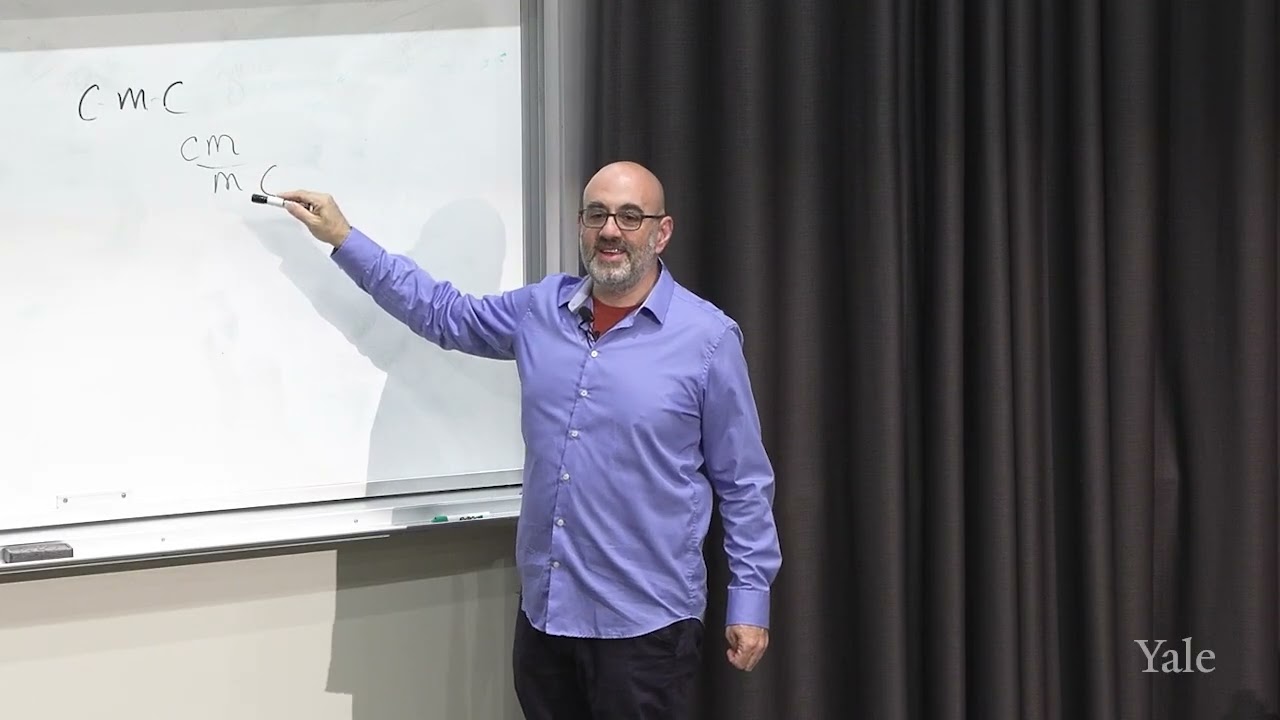
CM is separated in space and time from MC.
7:44
These are really the same M.
7:47
Someone gives money for something,
7:50
and that person would go
and buy another commodity
7:52
at a different space and time.
7:54
So without money in that size of economy,
7:58
you could not do your economy.
7:59
You couldn't get your bananas.
8:02
So we're talking very
different sizes of economy,
8:04
but you can see how
the different functions
8:06
of money are used in different
kinds of economies, right?
8:10
Money of account could just be a number.
8:12
It could be you're counting
these things in dates,
8:14
but no dates have to change hands.
8:15
You don't even have to have dates there.
8:17
You're just like, "Okay,
this is worth 20 dates.
8:19
That's worth 30 dates.
8:21
I'll give you, you know,
8:23
I'll give you 2/3 of my
thing for your other thing."
8:28
This, money takes on a different function.
8:31
It's very odd that the same thing
8:32
can be functionally different,
8:34
but this is the way Marx is
beginning to see the world.
8:38
Money still functions
as a money of account
8:41
or standard of value,
8:42
but it has to be there in
some sort of form to mediate,
8:48
to stretch space and time so
that the transaction can occur.
8:52
There was a question which I missed.
8:53
Yeah, Tomas.
8:55
- For the first one we see C?
8:58
- Yeah.
9:00
- What sort of economy is that?
9:01
- I mean, it could be
like a barter economy,
9:03
but nonetheless you could
still have a standard of value,
9:06
and normally you would,
9:08
but because you could trade
the thing for the thing
9:10
because you were close enough,
9:12
you'd only need to refer
9:13
to the standard of value notionally.
9:17
- On the side notation,
referring to C and C, right?
9:20
- This is a commodity
economy, which is larger,
9:23
and you need money to mediate.
9:25
And there is something like,
9:26
there's value in a more robust sense.
9:32
So you notice that in this,
9:40
in the middle one, money is a mediator.
9:44
In this, you have a special verb.
9:46
You say, "I spend money."
9:49
You spend money to buy,
9:54
and you gain money when you sell,
9:58
and the exchange is equal.
9:59
You end up with the same
value on either side.
10:04
Does that make sense?
10:05
It starts with production
and ends with consumption.
10:08
And it's only about use values,
10:10
although use values are mediated by value.
10:17
And as we said last time,
10:18
the same piece of money
changes place twice,
10:19
and it moves in an eccentric fashion
10:22
away from the original owner of the money.
10:27
The disposition of each
buyer, as I said last time,
10:30
is, "I don't need my money.
10:31
I want a banana.
10:33
Take it.
10:34
Do what you want with it."
10:40
In this, the commodity is
the mediator for money.
10:44
It's a vehicle to bring
the money back to you,
10:47
and money returns in a reflux.
10:52
The commodity is a mediator,
10:54
and money, as Marx said, is the alpha
10:56
and omega of this religion.
10:57
It begins, it creates, and it redeems.
11:03
In this, money is not spent.
11:04
It is advanced.
11:06
This is what capitalists call it.
11:10
I don't think I've ever advanced money.
11:11
That's why I guess I'm
in the situation I'm in,
11:15
unless you count advancing
it to my teenager. (laughs)
11:17
There's no reflux there
except his joy and health,
11:22
and, right, that's okay.
11:24
In this case, the same
commodity changes place twice,
11:27
but the money comes back,
11:30
and this makes circulation
11:32
into a circuit that has to be completed.
11:35
It's not commodities flying off
11:36
into people's mouths or backyards.
11:39
It is money returning to the account
11:43
of the original advancer.
11:47
But the problem, as Marx says,
11:49
is that the buyer ends up with the same...
11:51
I mean, the capitalist ends up
11:54
with the same thing
that they started with.
11:56
Give money away, you get a commodity.
12:00
You sell that commodity,
you get the money back
12:02
because everything trades at its value.
12:05
This, he says, is absurd,
12:07
and yet all of the people
12:09
who only see the circulation system,
12:11
who see that as the source of value,
12:14
imagine that out of the
same, you can get more.
12:18
This is the fantasy, pernicious fantasy,
12:22
of the traders,
12:25
the business owners,
12:27
and the economists who
take their perspective
12:30
or their standpoint
12:33
because the general formula, as you know,
12:38
like "The Wizard of Oz,"
12:42
is MCM prime,
12:44
or MC delta M, delta meaning change.
12:48
There has to be a change in the advance.
12:50
Otherwise, why would you do it?
12:52
Because the use value of
money is to bring more money,
12:54
just like the use value of
a seed is to bring a carrot.
12:58
If your stuff doesn't grow...
13:01
My one foray into gardening,
13:03
I tilled this giant garden
when I was in college,
13:05
planted the whole thing,
13:06
and one sprout of tomatoes
came up in the compost heap.
13:11
So, I was a very bad gardener/capitalist.
13:17
A supplement has to enter
the picture somewhere,
13:21
and Marx wants to argue
that this supplement
13:24
cannot possibly enter in circulation
13:27
no matter how high you sell your stuff
13:29
because as we said last time,
13:32
and we'll say over and over,
13:34
all overages and all
underages are passed on.
13:38
Someone will make it up out of somewhere
13:40
because the economy in these
terms is a zero-sum game.
13:45
If I buy dear,
13:48
then I have to get something else cheaper
13:49
'cause I only have a limited amount.
13:51
If someone gets something for more,
13:53
they can pay more for something,
13:55
and someone's gonna raise the price.
13:57
Supply and demand equal out over time.
14:00
You cannot get what Marx
will now call surplus value
14:05
out of the circulation sphere.
14:07
The sphere of circulation
doesn't make more of anything.
14:10
It just passes around the same.
14:12
You must have it, but it's
not the productive source.
14:17
It's the location of the
realization of value.
14:21
But the productive source
has to be elsewhere.
14:22
We don't know yet where it is.
14:24
It could be in your
dreams, in your fantasies.
14:32
Those people who live
in a commodity society,
14:35
which is all of us, we all
live in a commodity society,
14:39
we say, "Well, you can't eat money."
14:44
And those people who
live in a value society,
14:46
which we all do,
14:48
it's just layered on top
of the commodity society,
14:51
you say, "We can't eat our commodities."
14:54
You see the difference?
14:56
The people who are out for value want
14:58
to preserve their commodities
14:59
to make value before they're eaten.
15:01
If you eat what you produce,
you're not a capitalist.
15:06
So he needs a new form change.
15:08
He needs a kind of form change
15:10
that brings more from the same
15:12
or finds a new source.
15:17
Under capital, all of
these processes transform
15:21
to be headed towards M prime,
15:23
headed towards this more or this plus,
15:25
the plus of value.
15:29
Now if we ask what capital means,
15:31
we go back to the definition
of one very good economist,
15:34
Kit Sims Taylor.
15:36
Capital is value held over time.
15:40
We start to think, "Well,
there's something missing
15:42
from that."
15:43
I've held a lot of things over time,
15:45
and they tend to lose their value.
15:48
If capital is what brings
more or the more that comes,
15:52
it can't simply be that.
15:56
What you need is a commodity,
15:58
a special commodity that
brings more than it costs
16:04
because of its special qualities.
16:08
A couple of stipulations.
16:09
When you get to studying the
capital system in these terms,
16:13
you can no longer say
profit until the very end.
16:16
We're not concerned with
the genesis of profit.
16:18
The terms that Marx uses are
capital and surplus value.
16:22
Capital is made up of surplus value.
16:24
Profit is mystified.
16:26
It doesn't tell you anything
about where it comes from.
16:29
It doesn't even tell
you that it's a surplus.
16:32
This is huge.
16:34
In a zero-sum system, where
does the surplus come from?
16:37
We know one place it comes from, nature,
16:40
which is thought of in capitalism
as a bottomless abundance.
16:45
We know how this is not true in many ways.
16:50
And in fact, all surplus
will come from nature.
16:52
It's just it also comes from
the nature of human beings.
16:56
That is their capacity to labor.
17:00
Okay.
17:02
Capital is not just
value held through time.
17:06
It is value that is in movement here,
17:10
but it's not just in movement
through space and time.
17:13
It does have to circulate to get realized.
17:17
It's in movement within itself.
17:19
It transforms within itself
in an increasing way.
17:23
It valorizes itself.
17:27
We go from a production process here
17:30
in which you produce a commodity.
17:32
You use money to get it somewhere,
17:33
and someone consumes it.
17:35
This would be,
17:36
the production of commodities
would start this out
17:39
to a system in which
you are producing value
17:44
that has to come back with more,
17:48
and Marx calls that valorization.
17:51
So every time you see valorization,
17:53
it's where something is getting
what it didn't have before.
17:57
And Marx
18:00
holds to Occam's razor,
18:03
or holds to Spinoza and Leibniz.
18:07
He believes everything has
to have a sufficient reason.
18:12
If you have more, it has
to come from somewhere.
18:15
Nothing comes from nothing.
18:18
You can argue with this, but Marx doesn't.
18:20
That's his instrument to show
that the economists are silly
18:26
or blind or...
18:28
And you will notice how
many of them he quotes
18:30
in the footnotes and in the body like,
18:32
"Condillac and others who say,
18:34
'Yes, the one who sells
something gets more back,
18:37
and the one who buys
something gets more back.'"
18:39
And Marx was like, "Huh,
that's interesting." (laughs)
18:42
A lot of fantasies among the people
18:45
who are thinking about the
economy because it's a mystery.
18:48
It was the biggest mystery,
and Marx solved it,
18:52
and he solved it by giving names
18:53
to the parts that nobody had thought of,
18:55
one of which is surplus value.
18:56
Now we have to ask where it comes from,
18:58
which is in our reading this week,
19:02
but I want to make sure
you understand this stuff
19:04
before we go on.
19:05
Questions while I sip my cold brew?
19:11
You notice that the capitalist fuels
19:12
are getting stronger
and stronger? (chuckles)
19:18
This all clear?
19:21
- Does cold brew valorize?
19:23
- Cold brew of course valorizes, yeah,
19:25
by the poor guys who are
pulling shots all day.
19:29
- Is it monetized?
19:30
- (laughs) No, I'm not invested,
if that's what you mean.
19:34
I always think it would be
good to invest in something,
19:37
and I think, "How does one do that?"
19:40
- Will you say more about
(speaks faintly) topic?
19:45
- Sure.
19:47
I will say also that I taught this book.
19:49
In prison, one of the guys
asked me if when they got out,
19:53
they use it to start a business.
19:56
You might learn how to invest.
19:58
I mean, it is real economics,
20:00
so you might learn how to
invest here, but I resist.
20:06
Why not profit?
20:10
Because profit seems to be the thing
20:12
that comes from trade.
20:16
That's what it means.
20:17
It seems to emerge
20:18
at the moment where
you're selling something.
20:22
Profit is what you get back.
20:24
Surplus value is what goes in.
20:28
So if you're asking where's
this extra coming from
20:32
in a ontologically sufficient universe,
20:36
then it has to come from somewhere,
20:39
and profit denies that.
20:41
Profit is the most mystified concept.
20:44
Wait, there was a question up here.
20:47
- Right, so my question
is about value in society.
20:51
When you're buying a commodity with money,
20:54
and then you exchange the commodity,
20:56
you know, and you leave it there,
20:57
are you using the commodity
as a store of value?
21:01
- Yeah.
21:02
- And so M prime is a newer value?
21:05
- Uh-huh, it comes from somewhere,
21:07
extra value.
- Right, okay.
21:08
- Yep.
21:09
Yep, commodities store value too.
21:10
If these things didn't hold
value and preserve value...
21:13
Now we're gonna see in the labor process
21:15
how preserving the value
21:17
of the semi-products that come in
21:20
and also of your means of production,
21:22
your tools and your equipment,
21:24
is one of the chief jobs of the capitalist
21:28
to ensure by/through two methods,
21:32
discipline, called supervising,
21:36
and propaganda,
21:40
Marx calls real subsumption.
21:43
You preserve your stuff at
work much more carefully
21:47
and with much less effort
on the part of the owner
21:49
when you love your work.
21:53
- So you say value and
mainly while, I guess,
21:56
still talking like simple society.
21:57
You say this added
value, this valorization,
22:00
can't come from circulation.
22:02
- Oh, well, Marx says that.
22:08
- But if we bring something
from a market in which,
22:10
say, if we bring a commodity
from a market, right,
22:12
in which it's very easy to produce
22:13
to a place where it's
much harder to produce,
22:17
then doesn't value simply
come from that circulation?
22:21
Or are we saying that, like,
transporting the commodity...
22:23
Say we bring bananas from a
very sunny place to a very cold.
22:26
- You mean, imagine that, let's say,
22:29
a shirt is made much more
cheaply in Bangladesh?
22:32
Just imagine
(student speaks faintly)
22:35
it's made more cheaply
in Bangladesh than here.
22:37
Yeah, it just means
that the market switches
22:39
to get all the fashion from Bangladesh,
22:40
so you're not really
comparing anything there.
22:44
- But we're getting this delta M
22:46
from moving something, right?
22:50
Like, you bought it-
- Well, yeah, I mean, it's...
22:52
Well, you're getting the shirt from there,
22:54
but you're no longer comparing it
22:56
to shirts made in the US, for example,
22:58
except as a luxury good.
23:01
So there's no added value
to getting it from there.
23:03
It's just that when you go
23:05
to a place where labor is much cheaper
23:07
or technology is much more efficient,
23:11
then the cost of production goes down.
23:15
Sorry, Richard and then Tomas.
23:17
- I'm trying to think
about the relationship
23:19
between production and consumption here
23:21
because it's all in
one circuit, basically,
23:24
in throughout the society.
23:26
So does circulation conceal production?
23:30
- Yes, circulation conceals production
23:33
and consumption, actually.
23:35
In this circuit,
23:38
the question is about
production and consumption.
23:40
In this circuit, Marx
says consumption happens
23:44
outside of circulation.
23:46
This is for private consumption.
23:50
I can't load this anymore, can I?
23:52
Ah.
23:54
It's big, the economy.
23:55
You noticed?
23:57
Private consumption
24:03
here.
24:05
In this, there's a kind of
consumption, as you'll notice,
24:08
that he calls productive consumption,
24:12
which money uses to make a commodity
24:16
to make more money,
24:18
and that is raw materials
and means of production.
24:24
Those are consumed in
the production process.
24:26
So there's two types of consumption.
24:30
It is true that circulation,
24:31
at least historically for the economists,
24:36
has concealed the abode of production
24:38
or the place of production,
24:39
and that's where we're going today.
24:41
Marx makes it very dramatic
in this version of the book.
24:44
In other versions of the
book, it's much drier.
24:46
But he wanted this to captivate you.
24:49
So he says, "We will now move
24:50
into the hidden place of production."
24:53
Production is hidden historically
24:55
because economists have just thought
24:57
that magically the more
comes out of there.
25:00
But it's also the case
25:03
that circulation is very public,
25:07
and production is hidden
even by capitalists.
25:10
It's locked behind doors.
25:11
It's hidden for all sorts of reasons.
25:13
So there's a factual material concealment
25:17
that goes on as well.
25:19
What of course is hidden
25:20
because we didn't have the
analytic tools to see it
25:23
is the capital process
in its real operations.
25:28
Nobody had seen that before,
not Ricardo, not Smith,
25:32
certainly not Hegel,
25:36
according to Marx.
25:39
One more question, yeah.
25:41
Tomas.
- To the previous question,
25:43
on value-
25:44
- Yeah.
- We'd need the (indistinct)
25:45
and the dash.
25:46
So when the conditions of productions of,
25:49
we have a car that won't
(indistinct) change,
25:52
which is what today in like, yeah,
25:54
"Financial Times" is
called adding value, right,
25:59
that's no longer the same commodity.
26:01
What happens is that the
commodity changes entirely anew,
26:04
so that's all you can compare,
26:06
yeah, right, wouldn't you say?
26:07
- No, it's because the
conditions of production.
26:10
Once you start making cheap Xs in Mexico,
26:16
it doesn't matter where it is,
26:17
but it does obviously for
the lives of the people there
26:20
and international relations.
26:22
But wherever it is that
you're making a thing cheaper
26:25
because labor is cheaper
26:26
or because there's better technology,
26:31
then everything switches to that source.
26:34
So,
26:37
it may be that it's cheaper
for the people to buy it,
26:41
for us to buy it here in a core economy.
26:44
But, I mean, it's just like
any other value production,
26:47
just happened to move there,
26:49
and the factors of
production have changed.
26:53
It doesn't change the
way value is made at all.
26:57
- It's also, like, one market.
27:00
There aren't different markets,
27:01
so it's just the socially
necessary labor time.
27:04
- Yeah, exactly, socially...
27:06
So I'm trying to call it SNAALT
27:08
with a kind of Swedish accent,
27:10
socially necessary average
abstract labor time,
27:14
(laughs) SNAALT.
27:17
So hold on to that one, but that's right.
27:19
It's just that the parameters
of SNAALT have changed,
27:24
but anyone who wants to get a shirt
27:27
has to compete with Bangladesh.
27:34
Okay.
27:37
We know that the main contradiction,
27:39
what he calls a contradiction
in the general formula,
27:41
is that in the general formula,
27:47
you have to somehow get
more out of the same.
27:51
That's the contradiction.
27:57
We're looking at chapter four.
28:00
If you take a look at the
last four or five pages,
28:02
they're very important.
28:09
They start to tell you some of
28:14
the real inputs here.
28:20
Buying and selling labor
power is an important section.
28:23
This will be the special commodity
28:26
that allows more to be added
28:30
to the money that you circulate.
28:32
That means, actually, that
the more comes in here.
28:38
It's the only place it can come in.
28:40
It doesn't come in in consumption.
28:41
How am I adding more to it
when I consume something?
28:44
In fact, I'm using it up.
28:46
The value will be gone
by the time I'm done,
28:48
or slowly over the use of a hammer,
28:52
I will waste the value of that hammer.
28:55
It doesn't come in in circulation
28:57
'cause that's just the
exchange of equal values.
28:59
There's no way I'm gonna give you my car,
29:02
old and crappy as it is, for your banana.
29:04
Sorry, you'll have to
give me a few bushels
29:08
of bananas, at least.
29:12
The only place Marx says it
can happen is in production,
29:17
and particularly in one
aspect of production,
29:21
in the buying and selling of labor power.
29:24
This is the only place the
change of value can happen
29:26
because of the schizoid nature of labor.
29:31
Labor's double.
29:36
This is really what makes
capital the difference
29:39
between labor power and labor.
29:43
This you will have
noticed from your reading,
29:48
that like any commodity,
29:53
the capacity to use the commodity
29:56
and the using of commodity
are different things.
29:58
One is kind of stored in it,
30:01
and the other is used
up when you consume it.
30:04
In fact, labor power is
consumed when you're laboring.
30:08
Does that make sense?
30:11
There's no question that
labor is a commodity
30:14
in a market economy, right?
30:17
It's a natural endowment.
30:18
It's an enhanced endowment
through skill-building
30:22
and education and all of those things.
30:24
It's a natural cultural/societal endowment
30:27
that can be stretched and
built, and waxes and wanes.
30:31
But nonetheless,
30:33
what makes this all go
round is that it's traded.
30:39
In fact, if you think of an economy,
30:41
if I couldn't trade my labor power,
30:43
if I couldn't use my
labor power for trade,
30:45
I wouldn't get anything back
30:47
so that I could go to
the supermarket, right?
30:52
I must.
30:53
My labor power has to become a commodity
30:55
in a large exchange economy.
30:57
Otherwise, I wouldn't
have that thing I need to
31:00
unless I started out with
a huge amount of capital.
31:03
But if I came into this world
with nearly nothing, as I did,
31:07
I have only my labor power to sell.
31:13
And on the other side, commodity sales,
31:18
capitalism requires
someone with labor power
31:21
to sell so that they can have money
31:23
to buy the commodities that I'm making.
31:25
Marx uses the example
of the company store.
31:27
You go to work.
31:28
You make a, what, a shoe.
31:30
And then of course to shoe your family,
31:32
you need to go to your boss
31:34
and buy the shoes at full price,
31:36
even though you can make them.
31:38
These are the ironies
of the capital system.
31:40
So if I didn't have labor
power to sell, right,
31:43
my being able to shoe my family,
31:45
though I have the skills
to make the shoes,
31:47
is now mediated by labor power.
31:52
I have this thing.
31:53
I promise them I'm gonna give
them X amount of my time.
32:00
Does that make sense?
32:09
The split that makes this not an economy
32:14
for the laborer, but a schizonomy,
32:17
if you want to be Deleuzian
about it or something like that,
32:20
what makes it for me as
a worker a schizonomy
32:23
is that I sell my labor power,
but the owner gets my labor.
32:28
What's the difference between
labor and labor power?
32:31
Labor power is what I promise
as my capacity to do things,
32:33
but labor is as much as
they can get out of me
32:36
in the time I've contracted
to work, actual labor.
32:43
My labor power is valued at
its cost of reproduction,
32:47
just like any commodity.
32:48
What does it cost to
produce my labor power?
32:51
What are the factors in my labor power?
32:53
Can you shout them out?
32:56
Strength, it's a cost,
but what builds strength?
33:01
Food, sleep.
33:03
So, a house, all of those things, right?
33:06
This is called my
33:12
means of subsistence.
33:13
There's a lot of little monograms.
33:16
My means of subsistence.
33:17
So labor power is sold
33:22
from my means of subsistence.
33:24
But you see what the issue is here.
33:26
The capitalist has to pay
my means of subsistence
33:30
and their means of subsistence
out of my labor power.
33:36
They have to pay for
next year's contingencies
33:39
out of my labor power.
33:41
They have to hedge their bets
against weather and thieves
33:45
and the up and downs of the markets
33:47
all out of my labor power.
33:49
So that better be pretty elastic
33:51
because it's not just gonna be...
33:53
They're not just gonna
be getting out of it
33:55
what they pay me.
34:02
A laborer lives a schizonomy
34:04
in which their labor power is what is sold
34:06
and that what they get is the
cost to reproduce themselves.
34:10
What they give, however, is the cost
34:12
to reproduce the business,
34:16
which might include a
higher standard of living
34:18
for the owner, but doesn't
necessarily have to.
34:21
The whole business depends
on the value put in
34:24
through actual labor.
34:27
The value of labor power is determined
34:28
by my wants and needs.
34:32
It's worth saying that this is
not a natural determination,
34:36
but a historical determination.
34:37
So if my wants and
needs include an iPhone,
34:43
what else, an umbrella,
34:46
what do we need that are historical,
34:49
socially determined rather
than naturally determined?
34:52
Huh?
34:53
Tuition for your children, amen.
34:57
That's right, the things
I've done for tuition,
35:00
future tuition for my children.
35:02
Yep, depends on the society you live in.
35:04
If you live in Argentina,
where my partner is from,
35:06
you don't save for tuition
because the universities are?
35:09
- Free.
35:10
- You pay taxes, but the
state has decided it wants
35:13
to allow you to go to these
extremely dilapidated buildings
35:19
without a charge, right?
35:21
So this list of wants
35:23
and needs are not just, like, biological.
35:27
I don't want you to think
that any of this is natural.
35:29
It's socially determined,
35:30
and it might very well include a car,
35:35
a state government,
35:38
diapers for your kids
35:39
rather than running around
pooping all over the place.
35:41
Yeah.
35:42
- So labor power is based
at the (indistinct),
35:46
but it's in the (indistinct) sense, right?
35:48
- Yeah.
35:49
- And goods are priced as their SNAALT.
35:54
- Yes.
35:56
- How do we...
35:59
There's gotta be a difference between
36:01
like how we're pricing labor times
36:04
and how we're pricing means,
36:05
and how we're valuing labor power.
36:07
- That's right.
36:09
Yeah, you have to...
36:10
Well, one of the main controls
36:13
when we get to talking about
36:17
relative surplus value later,
36:19
you'll see that one of the main controls
36:21
that a capitalist has to
increase their surplus value
36:24
is to diminish the cost of those goods
36:29
that maintain the means of subsistence.
36:33
So it doesn't help the capitalist
36:35
to drive down prices anywhere,
36:37
but it does help them to
drive down the price of rice
36:41
because that means they can reproduce
36:42
the worker more cheaply.
36:44
So there's a lot of pressures
on the agricultural sector
36:47
and other kind of infrastructure sectors
36:49
for individual consumption
to go down and down and down.
36:52
Technologies in those parts of the economy
36:55
actually help profits rise
or surplus value increase.
37:00
Richard.
37:02
- Talking about labor power,
37:04
and she says it's like all the capacities
37:06
that exist in a person.
37:07
But like, as one notices,
like, an office worker,
37:11
which is like typing on
Excel, saying something,
37:16
you know, (speaks faintly),
37:18
like, how are they, like, valued typically
37:21
if they're valued differently?
37:23
- No, they're always valued at the cost
37:24
to reproduce the worker
regardless of what it is.
37:27
This is an another averaging force.
37:33
Right, all labor is the same.
37:35
That's why the proletariat
is ultimately uniform
37:37
because they only get...
37:40
Their wages get driven down...
37:42
Wait till you see the
mystification of the wage form.
37:46
Their wages get driven down
37:48
to the minimum of their
historical means of subsistence
37:51
when at all possible.
37:54
Workers' groups can fight
against that and can raise it,
37:57
but it gets taken out in
other places, as he will show.
38:01
The capital system eats its
limits, including unions.
38:04
So what do you do?
38:06
Form a union?
38:08
Shorten the day?
38:10
You can do that, but as he
shows in the 19th century,
38:13
this increased the pressure
to raise productivity
38:17
to such a degree that
people were just dying
38:19
in a shorter time.
38:22
We don't have to be cynical about it,
38:24
but it is worth showing,
understanding how capital,
38:27
the capital system, eats its limits.
38:28
Or if you try to make a
reasonable capital system,
38:32
it always backfires.
38:34
This is Marx's view.
38:36
There is no way to make
a better capital system.
38:39
It can be better temporarily.
38:41
It can be better for certain groups.
38:43
But it will always recoup
38:45
in one way or the other the misery
38:47
that it imposes on people.
38:50
This is Marx's position.
38:51
It's a structural analytic position.
38:53
It's not a moral position by any means,
38:57
and this is a very strong
challenge to current economics
39:00
and liberalism that is
worth thinking through,
39:04
whether you end up
agreeing with it or not.
39:06
It is relentlessly and
resolutely negative,
39:11
the effects of capital.
39:13
Though it feeds the world,
39:14
it drives the majority of people
39:17
into an immiserated circumstance
39:20
such that their lives
are kind of keeping pace
39:23
with their own misery.
39:27
AJ.
39:32
Sure, you can for a short time,
39:34
but as Marx says in one of these chapters,
39:36
the quality of their work
suffers, (laughs) right?
39:40
You can give them less
than they need to eat,
39:41
but they're gonna wear out faster.
39:43
You can see that humans are now a form
39:46
of capital that are invested in,
39:49
and we end today's session talking about
39:54
constant and variable capital.
39:56
What used to be called workers
39:57
are now called variable capital,
39:59
variable because you can get more
40:02
and less surplus value out of them
40:05
depending how you turn the dials.
40:09
Okay, a few more things.
40:11
We only have 10 minutes left.
40:15
We go to chapter five,
40:17
the labor process and
the valorization process.
40:22
But do reread if you have
a chance the last pages
40:25
of chapter four.
40:33
One irony that comes up in the last pages
40:35
of chapter four, which I love,
40:36
is that in addition to being exploited,
40:40
that is, paid less than the
value they actually create,
40:43
the workers have to loan
their labor to the employer
40:47
and get paid at the end of the week.
40:49
Isn't that astounding?
40:51
The workers, not only are they exploited,
40:54
but they're the
capitalist's first creditor,
40:58
and they have no choice
but to lend them to work.
41:01
I always found it astounding.
41:02
Why do I have to wait till the
end of the month to get paid?
41:06
Well, because they're
extorting the work from you.
41:11
Did I tell you the four Xs?
41:14
Extortion, expropriation,
extraction, exploitation.
41:18
This is the relentless negativity
41:20
that this book is giving you, the four Xs.
41:23
Those are the modes by which
capital depletes everything.
41:33
Okay.
41:36
We're going into the
sphere of production now,
41:39
but we're going in, first of all,
41:42
from the standpoint of the capitalist.
41:44
This is what production looks like
41:46
for the capitalists from their standpoint.
41:49
I'm giving you a lot of formulas today,
41:51
but let's do this one last one.
42:03
This is what it looks like.
42:10
This is where value is created.
42:27
You start with money that's
advanced from the capitalist
42:31
to get a commodity that's a raw material.
42:36
It goes into production.
42:39
It gets worked by labor and
becomes commodity prime,
42:43
that is, you get a lump of iron,
42:44
and it comes out cast-iron pot, right?
42:49
And that cast-iron pot goes out
42:51
and brings more than
the money you invested
42:54
in the means of production, which is
43:00
raw materials and the means of labor,
43:04
tools and equipment and objects,
43:13
and the labor power you've bought.
43:17
You've bought labor power.
43:18
You've bought means of production.
43:20
It goes into production,
43:21
and you get out something
more than you got in, right?
43:23
That's what we understand work to be.
43:24
You've worked something,
43:26
and the thing is different, more,
43:27
better suited to something
than it was before.
43:30
It's more developed like the lump,
43:33
like iron ore becomes an iron rod.
43:37
You just snap your fingers.
43:39
An iron rod becomes a cast-iron
pot (snaps) like that.
43:42
You just snap your fingers.
43:43
No, there's this labor that
happens in the meantime.
43:46
So he's adding this in here
43:48
and showing you what
hides behind circulation
43:51
is actually the hidden place of production
43:55
in which these factors
of production depend
43:58
on this difference in
order to produce the more,
44:04
the difference between labor power
44:06
and the actual labor that comes out.
44:10
Okay, before we get to surplus value,
44:12
which I think we'll get to next time,
44:17
and remember, just we're doing
44:18
this weird formula dance today.
44:29
This is what a laborer sees,
44:32
sees their labor power
exchanged for money,
44:35
which they use to buy a commodity,
44:37
which is their means of subsistence.
44:41
So this is the standpoint of labor
44:44
and the standpoint of capital,
44:48
if they knew it,
44:50
which they don't, unless they read Marx,
44:55
which they don't.
45:00
Okay, before we go, I want
to just say a few things
45:02
about what labor is for
Marx, where it comes from,
45:06
how it differs from Ricardo and Smith.
45:09
I'm gonna leave this up here
'cause it looks so good.
45:12
I realize spending a life
reading texts like poems
45:15
with people, you don't put
anything on the board, really.
45:19
It's not as impressive.
45:23
Okay, what is labor?
45:32
Labor is according to Marx...
45:35
What is labor?
45:36
Do you have a good definition?
45:40
Seminar moment.
45:46
Labor work?
45:50
AJ?
45:51
- The thing done to transform a thing.
45:53
- Thing done to transform
one thing to another.
45:55
So if I take a hat,
45:57
and I pull a rabbit out
of it, that's labor?
46:00
Well, maybe.
46:02
Could be.
46:03
Yeah.
- So maybe add to that
46:05
it's an ability,
46:06
so it's a capacity to make change
46:10
or work on something.
46:12
- It is true Marx is
Aristotelian in this way.
46:15
He thinks things go from
capacities to actualities.
46:19
So, labor, if you can do it,
46:21
there was a capacity that preceded it.
46:22
This is not the only way
to think about things.
46:24
Hazal.
46:25
- There has to be an idea behind it,
46:26
so it's not like the land engages in it.
46:29
- Okay, so nature does not do labor.
46:31
Nature transforms.
46:33
But as he says, quoting Aristotle,
46:37
labor, human labor, has an idea
46:41
and leads that idea as part of
the capacity into actuality.
46:44
That's true.
46:46
Yeah.
46:47
- Is it like energy?
46:49
- Labor, that would be a
physical definition of it,
46:51
that it's energy that does work
46:54
or effort that produces a product, yeah.
46:59
I'm gonna do another formula.
47:01
This is good.
47:02
Ooh, I can pull this down?
47:05
Is that true?
47:07
Yeah, look at that.
(object whirring)
47:08
Ah.
47:11
Labor has a very particular
intentional structure.
47:16
It's gonna sound insane.
47:20
- Wow.
47:26
- How's that?
47:28
This is the intentional
structure of labor.
47:31
A worker works a workable into a worked.
47:35
It has a temporal structure too.
47:40
This is the subjective element,
47:41
what he calls the subjective element.
47:45
This is the objective element.
47:48
And this is a process.
47:54
These two belong to nature.
47:59
The process of work
belongs to human nature
48:04
according to Marx.
48:05
I'm not sure I agree with this,
48:07
but it certainly has
a non-natural element,
48:10
which is that the way of
working changes socially.
48:17
But fundamentally, working is a natural,
48:20
as is the workable object,
48:23
comes from nature.
48:25
And the process here he likens to
48:31
another natural.
48:33
He likens to it, it's a little different,
48:36
where at least, in work in socialism
48:39
or pre-capitalist formations,
48:42
work is like a metabolism.
48:43
It takes a workable, and it digests it
48:47
and spits it out as a worked,
48:50
or as as a work, if you
want to put it that way.
48:52
Yeah.
48:53
- Do capitalists do labor or do work?
48:56
- No.
48:57
Nope, capitalists never work,
49:00
not because they're sitting around either.
49:03
Capitalists are,
49:05
what do you call them?
49:07
What do they call them here? Stewards.
49:09
It's a terrible institutional name.
49:11
They're stewards of work
49:12
or overseers of work, organizers of work,
49:14
but always other people's work.
49:16
So work is not equivalent to effort.
49:19
You make a lot of efforts
that are not work.
49:22
Richard.
- So it's not really labor.
49:25
It's laboring.
49:27
- Yeah, laboring.
49:29
It's a process.
49:33
This changes somewhat.
49:35
This is the basis for
labor under capitalism,
49:39
but it changes somewhat,
49:40
and we'll talk about that next time
49:43
when we get into surplus value,
49:44
the different modes of capital.
49:46
Just warning you that for next week,
49:48
we're talking about the
working-day chapter,
49:49
which is about 100 pages.
49:51
It's not theoretical exactly.
49:54
It's historical,
49:55
but might want to get
started on your reading.
49:59
(electronic signal humming)
50:01
(electronic device buzzing)
(bright music)
— end of transcript —
Advertisement