Advertisement
 49:47
49:47
Transcript
0:00
(bright music)
0:12
- We ended without talking
about money's four functions.
0:15
Money as a measure of value,
as a means of circulation,
0:18
as a store of value and
as a means of payment.
0:21
There are other related
functions like standard of price.
0:26
Standard of price simply
means what you're paying in,
0:32
so and so many dollars.
0:34
The price will be counted in dollars.
Advertisement
0:37
The price will be counted in gold.
0:38
That's a function of the money.
0:40
It tells you that you're
not gonna be paying
0:42
in calorie shells or,
0:46
locks of your hair.
0:50
That's as a standard of price.
0:53
As a measure of value
0:55
it's more substantial.
1:01
The measure of value is talking
1:02
about not the particular
content of the measure of value,
Advertisement
1:07
that is the price.
1:08
The price is the content
of the measure of value.
1:10
It just tells you that money
functions to measure value.
1:16
Okay?
1:17
Marx is not gonna talk
about how you arrive
1:19
at specific prices
1:21
and it turns out the factors
involved in this specific price
1:25
are too much for even him to calculate
1:27
or anyone to calculate in advance.
1:30
There are many factors,
it's highly contingent.
1:32
They go up and down,
1:33
but value is still the main determinant.
1:36
Makes up the body of the price
1:38
and the the clothing of the
price changes minute by minute,
1:42
day by day.
1:45
You can get to where he works
that out in volume three.
1:47
So, if you stick with me for
the next couple of years.
1:51
Money as a measure of value
1:53
is related to money as
a standard of price.
1:55
It's because that money
1:57
has stepped out of the commodity
world, become independent
2:01
and serves only now its main function
2:05
as being the value of those commodities,
2:09
as being able to hold the value,
2:10
as being able to transport the value
2:13
and also being able to measure
the value in its units.
2:18
(clears throat)
2:19
So, first he talks
about a measure of value
2:21
as values, form of appearance.
2:26
The determining reflection,
2:28
the value mirror for labor time.
2:31
Money as the measure of
value allows the value
2:34
of any commodity to appear just
like the equivalent formed.
2:38
It is an equivalent.
2:39
It's the universal equivalent.
2:41
It is the mirror.
2:42
So, if you wanna know what
the value of something is,
2:44
you can't give me more of that thing.
2:47
It would be ridiculous to say
2:48
the value of a banana is a banana,
2:51
or the value of a ton of
iron is a ton of iron.
2:56
You have to give it
either in something else
2:58
or when the system becomes complex enough,
3:01
you give it in money
3:03
and the money will tell
you what the value is,
3:05
tell you that there is value
and will represent that value.
3:10
So, money as a measure of
value becomes the denominator
3:16
for all commodities.
3:17
Iron over gold, wheat over gold,
3:21
locks of hair over gold
3:23
and education over gold.
3:27
It's what he calls the value
expression for a commodity.
3:30
So, you need to know
these different terms.
3:31
Again, he's not really laying out
3:34
a scientifically finished system.
3:36
He's trying to figure out how it works
3:39
in the third or fourth iteration here,
3:42
and figure out how to express it to you
3:43
in ways you will understand.
3:45
So, if you think it's one analogy too many
3:49
or one opposite phrase too many,
3:53
you can just leave them aside.
3:55
But money is the value
expression for a commodity.
3:59
It is the money form of that commodity
4:02
and that's what measure of value means.
4:05
It both represents the value
4:07
and it represents the amount of value,
4:09
which is the most important
4:10
and only quality of value
is that it has an amount.
4:21
One thing that happens here, however,
4:22
is commodity gets a money name
4:26
or money gets a money name like pounds
4:28
and you say, what is the
value of this commodity?
4:30
Well, it's worth so and so many pounds
4:33
or it's worth so and so many dollars.
4:35
This money name,
4:38
things have a name, they have a form
4:40
and they have a content.
4:41
For Marx, this is the way
his philosophical vocabulary
4:45
is being developed.
4:47
A name,
4:49
a form, and a content.
4:50
The money name,
4:52
and he's a little bit suspicious of names,
4:54
they can do both things.
4:56
They can express something,
4:58
but they can also conceal something
5:00
and the money name conceals
this entire process.
5:03
We say 10 bucks, 10 bucks.
5:06
I'll give you this thing for 10 bucks.
5:08
Gimme that thing for 10 bucks
5:09
and the 10 bucks comes to stand in
5:11
for the whole ontological machination
5:14
that makes something into a value.
5:19
Money is a real concealer
5:21
and you should remember that
what expresses also conceals
5:27
because it only expresses something.
5:29
It's very particular capitalistic,
5:32
semiotics or capitalistic aesthetics
5:35
is always made to express
something in particular
5:38
and hide the rest.
5:42
(clears throat)
5:44
Money as a means of circulation.
5:45
We're just about to overcome all of these.
5:47
These are, by the way, not
things that Marx invented,
5:51
they're things that he
found in political economy
5:53
and he's about to do a critique of it,
5:55
but calling them insufficient
for understanding capital.
5:57
Any of them can be working
in other systems and were,
6:01
the way they work together,
6:03
plus one extra factor, the extra,
6:07
the more the surplus,
6:09
which is what the capital system
is aiming for its purpose.
6:14
Constitutes his critique
of political economy.
6:16
They forgot where the more comes from.
6:18
All of this just explains
value in an equivalent system
6:21
that circulates around and
doesn't make any more of itself.
6:26
So, we're working between
chapters three and four.
6:28
Chapter four is one of
my favorite chapters,
6:30
really revelatory,
6:31
especially in the last four or five pages.
6:34
But we need to understand
how these work so we can see
6:38
how central money is to
the capitalist economy,
6:41
capitalistic economy,
6:43
and how it changes its nature.
6:47
So, second, money has been traditionally
6:50
a means of circulation.
6:51
It facilitates the form change
6:53
or metamorphosis of commodities
6:55
that mediates the social metabolism.
6:58
This is page 79.
7:00
Marx says this.
7:02
"Money is a means or a
medium or a mediator,
7:06
a facilitator.
7:07
Without it, things couldn't circulate"
7:09
and so you need a certain amount of money
7:11
in circulation all the time,
7:12
so the deals can be happening,
7:14
the trades can be happening all over.
7:16
If there's insufficient
money, people can't trade
7:18
because they're not gonna
suddenly become barterers.
7:23
This is related but
different function of money.
7:28
Under capital, things take
on different functions,
7:32
and in economics things
take on different functions.
7:35
In economies,
7:38
money is a means of circulation.
7:43
As a means of circulation, it,
7:49
produces a contradiction.
7:57
Here's what he says,
let's take a look at this.
8:04
I'm looking at page 79 as
means of circulation, 78.
8:10
He gives the form of circulation
8:15
as an ellipse,
8:19
which is the geometric corollary
8:22
of what he calls a real contradiction.
8:30
Here's one contradiction.
8:32
When a body is both
falling toward another body
8:35
and falling away from it,
8:37
the ellipse is one of the forms of motion
8:39
through which this contradiction
8:40
is just as much realized as resolved.
8:43
And this is what happens
in the circulation form.
8:49
Money is moving away and
coming back at the same time.
8:55
It takes the form of an ellipse.
8:59
(clears throat)
9:05
Value is moving away and
coming back at the same time.
9:07
In so far as I trade
one thing for another,
9:10
the value moves along with that thing,
9:12
but it also comes back to
me in a different form.
9:16
You could call this a
contradiction unfolded in time.
9:18
Here we're talking about the
philosophical ideas in play.
9:23
But nonetheless, if at the
very instant of a trade
9:28
you said this value is both in the money
9:31
and in the commodity, it
would be it's an oddity.
9:35
There has to be a moment in
which it's in both of them
9:37
and then switches.
9:39
There is a ontological
contradiction there,
9:44
and he wants to play that out.
9:53
Circulation he calls a
moving contradiction.
9:56
What you have, I want
what I have you want,
9:59
the value that I have transfers to you,
10:00
the value that you have transfers to me,
10:03
value moves in these eccentric ellipses.
10:08
Sandra.
10:08
- Where's the contradiction?
10:10
- The contradiction is
that for a moment at least
10:13
the value is going in both directions.
10:17
- How does that non fiction?
10:19
- Well, it can't,
10:20
value doesn't double
itself just out of nowhere.
10:25
- But there there are
two commodities, right?
10:26
There's the double of value.
10:27
- Mm-hmm.
- Half of it is going,
10:28
yeah, who is gonna other place.
10:30
- No, it's not half of
it going, it's the whole.
10:33
- Yeah, the whole of one
and the whole of the other.
10:34
- That's right, but at
a moment they switch.
10:36
So, he thinks of this as a contradiction,
10:38
is a real contradiction.
10:40
That's one way to think
of the transformation
10:42
or the transfer of value
as a real contradiction.
10:45
I have the value now you have the value,
10:47
you have the value now I have the value.
10:51
How did it become naturalized
10:52
to think that that makes sense?
10:56
Where is the thing that's
moving between the two?
10:58
There is no actual
transfer that takes place.
11:03
That the physical transfer.
11:05
- While you're exchanging commodities.
11:09
- Let's keep going
11:10
and see if we can get a
better handle on this.
11:13
He calls it also social metabolism.
11:17
That is taking something that's
locked inside something else
11:20
and making it available
11:23
to be used in a different part of society.
11:25
This is what happens with
the value in one thing,
11:27
which is not useful to me
as I give it to someone else
11:31
for whom it is a value.
11:36
He calls it social metabolism
11:37
where these things are getting processed.
11:40
Another analogy he uses is digestion.
11:43
These are things becoming digested.
11:48
(clears throat)
11:48
And if you think about circulation
as a kind of metabolism
11:53
on the analogy of a body,
11:55
you can also think about
the rate of metabolism.
11:58
That is that things not only
have to get transferred,
12:02
but if they get transferred
at a certain speed,
12:04
you need more of them.
12:06
Like my nemesis, skinny
people who can eat a lot.
12:11
You need more of it and it
has almost no consequence.
12:14
Da.
12:16
(clears throat)
12:17
All right.
12:21
Money as a means of circulation
works in this formula,
12:27
which is the formula
of exchange economies.
12:30
This is famous.
12:31
People have taught this
formula for 150 years.
12:34
It's kind of beautiful that
Marx can boil everything down
12:37
to a simple formula or a simple visual.
12:40
But then it's not so simple
12:42
because here's the
contradiction right there.
12:47
It's actually happening simultaneously.
12:49
When I sell my commodity to you for money,
12:51
you give your money to
me for the commodity.
12:54
This is a kind of heuristic
12:57
or an artificial unfolding
13:01
of what happens like this.
13:03
So, the money doubles there for a minute.
13:15
This is a simultaneous thing
13:18
and you can see also that,
13:23
let's see,
13:25
it could go on,
13:29
right?
13:31
You have one transaction,
13:37
a second transaction.
13:40
This is how circulation
works in simple circulation.
13:46
(clears throat)
13:48
When you get money for your
commodity, as you know,
13:51
the value that's in this
commodity has changed forms.
13:56
It comes in a different form altogether.
14:01
This is a change that's absolutely crucial
14:04
for the capital system
14:05
just as it's crucial for other
not fully capitalist systems
14:09
that use a trade economy.
14:14
One thing you start to
get here in this section,
14:17
you get even more in the next chapter,
14:20
is the picture of an economy
as an immense network of trades
14:25
that are going on all at once
in a fairly chaotic fashion.
14:29
Except they all have to have this form
14:30
and to some degree this commodity
14:32
has to be more or less the same.
14:34
Say it is iron for money
14:38
and money for, let's see
what are we doing here?
14:41
A money for iron, that's that one thing.
14:44
So, then the iron goes to something else.
14:52
Let me think about that.
14:54
(clears throat)
14:56
What he's showing you above
all here is how the sale
15:02
is different than the
purchase in its perspective.
15:05
A purchase is turning a
money into a commodity
15:09
and a sale is turning
a commodity into money.
15:13
In a purchase, prices he
calls the bedroom eyes
15:17
with which commodities wink at money.
15:20
It's a beautiful line.
15:22
And it implies the kind
of power and seduction
15:26
and attraction that's involved in this.
15:28
You look at a price and you think,
15:30
my money is attracted to that price.
15:33
My money is very close to that price.
15:35
I might even have something
left over for lunch.
15:37
I'll buy it.
15:40
But you see also here
a kind of schizophrenia
15:43
where the seller is also a buyer.
15:48
The seller is a buyer of money,
15:52
and the buyer is also a seller.
15:55
The buyer is a seller of money.
15:59
Yeah, the buyer's a seller of money.
16:01
(clears throat)
16:02
And in this way we begin to see
16:04
how every economic activity
turns into a circuit
16:09
that has to be closed.
16:14
The seller takes their money
16:15
and goes invest it in something they need.
16:17
The buyer takes their banana
16:20
and reproduces their labor-power.
16:25
It's a kind of perpetual motion machine
16:27
and this is one of the
characteristics of the capital system
16:29
that is not characteristic
of feudalism or other things,
16:32
although in all economic
systems, you need to reproduce.
16:37
You need to reproduce your own energies,
16:39
you need to reproduce the society.
16:42
It doesn't have to become
restless endless notion.
16:50
Circulation, in case you
wanna know, is taken up,
16:53
exploded and developed in volume two,
16:56
which I recommend you reading.
16:59
If you look at pages 86 to 87,
17:03
you have here a really
clear initial interpretation
17:09
of how circulation changes space and time.
17:17
First of all,
17:20
if you look in the middle of
the second full paragraph,
17:24
starting with commodity
circulation differs
17:26
from the direct exchange of products,
17:28
not only in terms of form,
but also in its essence.
17:30
He says in the middle, "We
see here how the exchange
17:35
of commodities bursts the individual
17:37
and local limits that go
17:38
with the direct exchange of products,
17:40
thereby advancing the
metabolization of human labor.
17:44
On the other hand,
17:44
a whole network of natural
social connections develops
17:47
through commodity circulation.
17:49
One that human actors
involved can't control.
17:53
The weaver can sell his linen only
17:54
because the farmer has
already sold his wheat.
17:57
The drunk can sell his bible.
17:59
Ha ha ha.
18:01
Only because the weaver
has already sold his linen.
18:04
The distiller can sell his
Eau-de-vie only because the drunk
18:07
has already sold the water of
everlasting life and so on."
18:10
Marx's never tires
18:11
of ridiculing certain aspects of religion.
18:17
Drunk priests who needed a
buck to buy their schnapps,
18:22
maybe not in the best taste,
18:24
but he was not always in the best taste.
18:27
What happens with circulation?
18:29
With circulation space spreads out,
18:33
the limits of a society spread
18:35
to almost unlimited spatial size.
18:40
Watch the expense.
18:42
Look at the title of that TV show.
18:44
Did you ever watch that show "Expense?"
18:46
They do mining in the outer belts
18:48
where they have a bunch of wage slaves
18:51
who do all the mining, who then rebel.
18:56
(clears throat)
18:57
Time also changes because my time
19:00
is totally dependent on when
you can sell your product.
19:03
'Cause I can't sell my product to you
19:04
until you sell your product
to Austin, for example.
19:09
This is called turnover times
19:10
and time becomes the measure of turnovers,
19:13
and this impinges on us.
19:14
This is like the new seasons,
the seasons of capital.
19:18
It's no longer the
harvest, it's the turnover.
19:22
A new calendar, a new clock,
19:23
the clock to begin with, Richard.
19:27
- So, like is time
contractors is (indistinct)
19:32
- I don't know if it's as simple
19:33
as to say time is contracted
and space is expanded
19:36
because space is also abrogated completely
19:38
by virtual networks.
19:41
Time becomes much more critical,
19:46
much more in need of calculation,
19:50
but not calculable in
a simple clock format.
19:55
Because there's so many
sets of dependencies,
19:58
you can't really fully calculate it.
19:59
So, time is incalculable,
let's say in a human life
20:03
because you don't know
when you're gonna die.
20:05
So, you live in a species not of infinity
20:08
as a certain romantic
imaginary would have it.
20:11
But confusion and in determination, right?
20:16
Could be tomorrow, could be whenever.
20:18
This is not the time of capital.
20:20
The time of capital is
not the time of existence.
20:23
Sorry, Martin Heidegger.
20:26
You can try to be a living
existent under capital,
20:29
but you're likely to have to
go to work in the meantime.
20:34
There's a lot to say about that.
20:36
It is important to understand
20:37
that money as a means of circulation,
20:40
if you didn't have money, if
it didn't serve this function,
20:44
we would have a different universe,
20:46
a different cosmology, different space
20:48
and time pressures on ourselves.
20:56
(clears throat)
20:57
It also gets right into
the center of beings.
21:00
Sorry, again, Martin Heidegger, page 87.
21:06
There is a kind of schizo
tendency in capital
21:09
to split things apart,
21:11
like a thing becomes a purchase
thing and a sold thing.
21:15
Those are not the same thing at all.
21:18
A sold thing could be
used for its use value.
21:23
It might be resold,
21:24
but in simple circulation,
21:25
we're not talking about capital yet.
21:28
So, the person who buys it uses it.
21:31
A thing that is sold
21:33
is a couple of steps away from use value.
21:36
It is still a value.
21:39
The identity of things gets broken.
21:42
Space and time get transformed.
21:49
This is the recipe for a set of crises
21:53
in which the things don't arrive on time.
21:56
The money doesn't arrive on time.
21:58
Space becomes an obstacle
rather than a facilitator.
22:01
You can see here on the bottom of page 87,
22:04
he mentions for the first time
22:05
a very important word for Marx.
22:07
He spent his whole life tracking crises,
22:10
real crises, monetary crises,
overproduction crises,
22:16
natural crises like weather,
22:19
and was interested in
finding out, as you know,
22:22
where the internal tendencies
towards crises were
22:25
in the capital system.
22:27
He was convinced that if there
wasn't gonna be a revolution,
22:30
there were certainly gonna be
crises that wounded capital
22:34
and maybe even brought it down.
22:37
Although he never saw
that in a fateful way,
22:41
despite some Marxist
readings of this book,
22:44
there was no prediction
22:45
that within a certain
amount of generations
22:47
a crisis would happen
and capital would fall.
22:57
This is the philosophical explanation
22:59
of a crisis in the bottom of 87.
23:01
I just wanna point it out to you.
23:03
If things that complete
each other internally
23:06
and thus aren't independent,
23:08
become externally, independent
past a certain point,
23:11
then their unity will make
itself felt with great force
23:14
by way of a crisis.
23:17
So, money and commodities
23:18
are absolutely internally
dependent on one another.
23:21
If you take all the money out
23:23
of the system one way or the other,
23:24
that's a crisis,
23:26
that acts as though money is independent.
23:29
This is already leading towards
the definition of capital,
23:33
which is not just money or value,
23:35
but money in constant circulation
23:37
and value in constant transformation
for a certain purpose.
23:43
Does that make sense?
23:44
That's a very abstract view of a crisis.
23:46
We can talk about how crises
happen otherwise, yes.
23:49
- Yeah, I heard actually
his circuit, right?
23:53
So, it looks like the C, it mixes
23:55
that CMC will represent
that there's some depend,
24:00
but like circuits that added in it,
24:01
because we get to there'll be C prime,
24:04
C prime prime, C prime prime, right?
24:07
There could be a sacrificial
way the trinity of one.
24:10
But I guess my question is to what extent
24:13
or at what level do we start, right?
24:15
What level the owners of commodities
24:19
or the owners of money say, okay,
24:21
there's a point where I
no longer need a commodity
24:23
and I want to like see if my body, right?
24:25
That's my first question.
24:26
And then the second question-
24:28
- Death.
- To do with-
24:29
- That's my answer.
24:31
- What's the difference?
24:32
I don't know if Marx says this,
24:33
but I don't know what's the difference
24:35
between commodity circulation and barter?
24:38
The barter system (indistinct)
makes that distinction.
24:42
- Yeah, no, no, he certainly
makes that distinction.
24:45
The first question is when
does this commodity exchange
24:49
or commodity circulation stop?
24:51
And it only stops when the
whole society is destroyed
24:54
and it stops for an
individual when they're dead.
24:57
It has to keep going.
24:58
That is one of the basic
assumptions of Marxist system
25:04
that individuals need to
reproduce their life forces
25:09
and societies need to
reproduce their individuals
25:12
and their life forces interdependently.
25:15
'Cause my life forces depend on all of you
25:17
and yours all depend on me and each other.
25:20
Your individuality is not separable.
25:22
That would be another thing
that if you separated it out,
25:25
it would be a big crisis.
25:27
That is if,
25:32
libertarianism were not
such a ridiculous fantasy,
25:36
if you could actually carry it out
25:38
and everyone severed
themselves from everyone else,
25:42
everyone would die.
25:44
So, it is libertarianism
is not just a death wish,
25:47
but a murderous wish.
25:50
AJ.
25:51
- So, capital has a tendency
25:52
to split couple things into
their kind of independent parts
25:57
and crises arise when that split happened.
26:00
- No, what one definition of a crisis
26:02
is when the capital
system can't keep going.
26:05
So, it must keep going
26:08
and keep these interdependencies alive.
26:11
Your second question
was about the difference
26:14
between the circulation
of commodities and barter.
26:18
Barter is not according
to Marx circulation,
26:22
it's not circular.
26:26
It doesn't send something
out to get something back.
26:28
Well, it does actually.
26:30
But it doesn't circulate in society.
26:32
It goes just usually between individuals.
26:35
So, I would as a barterer,
barter each one of my what?
26:41
Pens to individuals who have
individual wants for them.
26:47
That is not circulation.
26:48
Circulation is where someone
trades something to me
26:52
and I trade that to someone else.
26:55
Yep.
26:57
- So, does Marx explain
27:00
the evolution from barter to circulation?
27:04
- There is no evolution
from barter to circulation,
27:06
at least historically,
27:11
they're just different systems.
27:15
Yep, circulation comes into play
27:16
when a society is so
big that is big enough
27:23
and the form simply takes hold.
27:26
Both of those are true.
27:27
So, it's contingent,
27:28
but also there's some necessity in there,
27:30
that one producer couldn't
get all that they want
27:34
from bartering their own thing.
27:39
But that doesn't happen
because barter develops.
27:41
That happens for all
sorts of other reasons.
27:44
Does that make sense?
27:44
Population growth, ideas,
27:47
trial and error.
27:49
The strange success of the idea of capital
27:51
in the 15th century for
trading across large distances,
27:55
the historical forces
27:57
and contingencies,
27:59
accidents that make it possible
28:02
that the rollercoaster,
28:05
that the perpetual motion
machine of capital gets started
28:08
are not part of the
perpetual motion machine.
28:11
There is no necessity that capitalism
28:13
would have inaugurated, none whatsoever.
28:17
And you'll see that in later chapters.
28:19
It did.
28:20
Once it got going, it consumes everything
28:22
and its necessity takes over.
28:24
That's the problem really.
28:27
Yeah.
- Yeah, you just-
28:29
- Another question out.
28:30
So it looks to me like from Marx
28:32
the difference between
circulation and barter will be
28:35
that whereas in the barter system
28:36
there's a kind of
restriction of place and time
28:38
as you mentioned earlier
28:39
in circulation there are restriction,
28:41
circulation goes beyond presents.
28:44
- Yeah.
28:45
And the name for that lack
of restriction is money.
28:49
So, it's not just an
ideal lack of restriction,
28:52
it is a material lack of restriction.
28:54
We have this technology called money
28:56
that's used in this particular way
28:58
and as he'll say in commodity circulation,
29:02
the money is constantly
moving in an eccentric path.
29:06
It moves from this person to that person,
29:12
and then from this person to that person,
29:17
will have a very different circulatory
29:19
movement under capital.
29:22
- But this is not the capitalist.
29:26
- We're not a capital yet.
29:27
We're in a kind of threshold form,
29:29
which is commodity circulation
in an exchange market.
29:32
But no one wants the
capital difference yet,
29:36
which is getting more from the same.
29:39
A totally absurd requirement,
which it turns out is a lie.
29:46
Okay.
29:48
He spends a while here talking
29:50
about the circulation of money.
29:51
It's very important that
money circulate too,
29:54
because insofar as commodities
change places with money,
29:59
money has to be there
30:00
for these commodities to change places.
30:02
And even though the reason
commodities are sold
30:07
is because of their use value, I need it.
30:09
The reason they're sold
30:11
is because money is there to make them go.
30:14
So, which of these reasons wins out?
30:16
Well, in an exchange economy, money does
30:18
or it comes to look like it does.
30:20
And so we have phrases
like money is power.
30:23
Money makes the world go round.
30:25
It does make the world go round.
30:27
Of course there would
be no world to go round
30:28
if we didn't make commodities
30:30
that people could use to
reproduce their powers,
30:34
and to just enjoy them.
30:35
I love a good commodity,
30:38
sometimes too much.
30:41
In the commodity system,
30:42
commodities move towards consumption.
30:46
Money moves away from its starting point
30:48
and they move towards consumption.
30:53
Marx wants you to be absolutely clear,
30:55
however that commodities move money,
30:58
not the other way around.
31:00
Money in fact is a commodity.
31:01
It has value.
31:02
Somebody made it.
31:04
If nobody made it, it would
be valueless like air.
31:10
Without the commodity
there'd be no system.
31:13
Marx says, despite the appearance
31:14
that money makes the world go round,
31:16
commodities are prime movers.
31:22
He talks about the need
31:23
to have a certain amount
of money in circulation
31:25
and to relate the amount
of money in circulation
31:30
to the speed by which it circulates.
31:31
You can have less money in
circulation if it goes faster,
31:34
obviously 'cause it makes its way
31:36
to the other transactions more quickly.
31:39
Okay, quickly these other ones.
31:41
Well, money has to store value
because of the temporality
31:45
in an exchange economy.
31:48
When I'm waiting for something to come in,
31:50
I have to have the money for it.
31:51
So, it has to keep the value
that it's representing.
31:56
This is one of its functions.
31:58
So, long as I have the money give or take,
32:01
given inflation and other things,
32:02
which is another reason it
should be put into circulation.
32:05
If it's put into circulation,
it can absorb inflation.
32:10
If it's taken out of circulation
32:11
is just sitting in the bank,
32:12
it will deplete along with inflation.
32:17
It has to be a store of value as well.
32:19
These are separate functions,
though they're related,
32:21
insofar as it's a measure of value,
32:23
it can be a store of value.
32:26
Insofar as it's a means of circulation,
32:31
well, really everything derives
32:32
from it's being a measure of value.
32:34
I wanna mention this too
32:36
because it relates to the other aspect
32:39
that he brackets out
here, which is credit.
32:43
Money has to be the
accepted means of payment
32:45
when you take a loan.
32:47
If they give you a loan of your car
32:49
and you go to pay it back in bananas,
32:51
well, you can imagine.
32:57
This by the way, gives you in
an important set of passages
33:01
on page 105,
33:03
the genesis of the specific
type of capitalist wealth.
33:11
There's no wealth in capitalism,
33:13
even though people talk about it.
33:15
There's only capital.
33:18
We'll see that in the next chapter.
33:20
In so far as it's wealth, it's
been taken out of circulation
33:23
and it's steadily becoming less wealthy.
33:26
Ask Warren Buffet.
33:28
You gotta have it all
moving, all invested,
33:31
otherwise it loses.
33:36
Is this the page I want?
33:42
In so far as money stores value
33:45
and can be a means of payment,
33:47
it's worth accumulating.
33:51
Also in so far as it's a
future means of circulation,
33:55
so in fact, these three
go together really well.
33:59
As a future means of circulation,
34:01
as a store of value and
as a means of payment,
34:03
I can accumulate, but my accumulation
34:05
is called a reserve fund.
34:09
There's no treasure store.
34:11
There's no dragon there
sitting on its treasure
34:14
for eons and eons.
34:15
As it steadily goes down in value,
34:17
people look at it and be like,
what are all these trinkets?
34:20
Imagine if you kept like all the old Marx,
34:23
well maybe they're worth
something, I dunno.
34:27
The idea that money can be stored,
34:34
value can be stored in money,
34:36
shows you the form of wealth
34:38
and why it's important for certain people
34:40
to hoard under the capital system.
34:43
It's not for their enjoyment,
34:45
it's not for their
higher purchasing power.
34:49
Even though these super wealthy people
34:50
are constantly buying luxury things,
34:53
it's so that they can put
it back into circulation
34:55
and it can act as a measure
of value, just to say that.
34:58
It becomes a market power,
35:01
not purchasing power, not private power.
35:04
It's a means of storing market power.
35:08
That I wanted to mention to you
35:09
because the transformation of
wealth is really important.
35:16
Capital is not wealth,
35:18
it is value in circulation for a purpose,
35:23
but that value needs to be
sometimes put aside as a reserve,
35:29
never as wealth for the
individual person always
35:32
as a bet on future investments.
35:37
Yeah, Thomas.
35:39
- So, you say that it must always,
35:41
any accumulation must always go back
35:45
or at least that's what the
individual must intend to,
35:47
but in practice must
actually always go back
35:50
into circulation or can
it be just accumulated?
35:56
- Well, it can be,
35:57
but it runs the risk of becoming worthless
36:00
in a crisis, for example.
36:02
If you own capital in a crisis,
36:04
let's say you own a factory,
36:06
it's possible that after
the crisis that becomes,
36:09
goes back up to its value.
36:11
But in a crisis, the money
you can just burn it.
36:15
Yeah.
- Yeah.
36:16
- Yes, please.
36:19
- I'm a bit confused
because this CMC circulation
36:24
is also possible in a
pre-capitalist society
36:27
that uses money.
36:29
- Yes.
- It's not money
36:29
that makes the capital, right?
36:32
- No, but this circulation by
means of money as a mediator
36:37
is crucial for capital.
36:39
Capital is like a parasite.
36:40
It takes older things and it
makes them do its bidding.
36:44
- But the process
36:45
we're talking about is
not unique to capitalism.
36:48
- It's unique to capitalism.
36:50
The question is, is this
process unique to capitalism?
36:53
It's unique to capitalism
in its totality and scope.
36:58
For example,
36:58
a feudal society did have some
circulation of commodities.
37:02
There were trades people
37:03
and there were some exchange of money,
37:06
but there were other ways
37:07
to get your needs fulfilled as well.
37:10
This takes over completely.
37:17
Alright, we understand a
little bit about money,
37:19
now we have to understand
money and simple circulation.
37:22
We have to understand
37:23
how money gets transformed into capital.
37:28
The main thrust of this chapter,
37:30
because this is a critique
of political economy,
37:32
is to show all the wrong opinions
37:36
about where capital comes from.
37:38
It does not come from circulation.
37:41
He's gonna demonstrate
this to you by showing
37:43
that it's impossible that
it comes from circulation.
37:48
I just wanna read because
I love his polemical voice.
37:58
This is the last two pages
of the chapter 148 to 149,
38:02
in which he makes fun.
38:05
Ridicules the people who think
38:07
that profit comes from circulation.
38:12
"The sphere of circulation
or commodity exchange
38:14
within whose limits
38:15
the movement of buying and
selling labor-power occurs,
38:18
is in fact a veritable Eden
of innate human rights.
38:22
You can tell already since
he's got religion in there
38:25
that he's making fun of somebody.
38:28
What reigns is exclusively
freedom, equality,
38:31
property and Bentham.
38:33
Freedom because only the
free wills of the buyer
38:36
and seller of a commodity,
38:37
for example, labor-power
determine how these figures act.
38:40
They enter into business dealings
38:42
as free persons equal before the law, ha.
38:47
The end result is the contract
38:48
that represents a joint legal
expression of their wills.
38:51
Equality, because they interact
only as commodity owners
38:54
and exchange an equivalent
for an equivalent, ha.
38:58
Property, because each
owner does whatever he wants
39:01
with only what is his.
39:03
Ha.
39:05
Bentham.
39:06
Bentham, poor Jeremy Bentham,
39:07
because each cares only about himself.
39:10
The only force that brings
the two parties together
39:12
and into a relation with
each other as self concern,
39:15
private interests, personal gain.
39:18
This is the view of the market
that he wants to knock down.
39:24
That profit comes from the market
39:26
that it is selfishly motivated
that everyone is equal in it.
39:32
Not that they're unequal
39:33
because if they had equal
access to the market,
39:35
they would be equal.
39:36
But the market is inherently unequal,
39:38
not because of the market,
39:41
because of the way production works.
39:44
This is where he tells us
39:46
that we will leave together
with the money owner
39:49
and the labor-powers owner
will leave the surface area
39:53
and follow them into the
hidden place of production.
39:56
The rest of the book will be
about the way surplus value
40:00
is made in production
40:02
and then the origins
of the capital system.
40:07
So, before we move on,
we need to understand
40:10
why this is not true,
40:12
why he feels so free at
the end of this chapter
40:14
to ridicule these people.
40:17
One simple definition of capital
40:19
is that it is the products
of labor held through time.
40:25
The products of labor held through time.
40:27
So, if I make something
and I hold it through time,
40:29
it becomes worth more.
40:32
This is a funny economist's
idea of capital.
40:38
I just hold onto it.
40:39
Maybe that happens with some things
40:41
if they disappear off
the face of the earth,
40:43
but insofar as they're still there,
40:45
it shouldn't change at
all just by holding it.
40:47
Of course it has to hold
its value, we know that.
40:50
But it's more than this.
40:52
It's more than value.
40:54
It's more than the super sensible
40:56
quasi metaphysical substance
40:59
that we've been talking about.
41:01
In fact, he's gonna ask you to go beyond.
41:04
First he asks you to
go beyond the commodity
41:07
and see it as double.
41:09
Then he asks you to go beyond
physical and useful things
41:11
to see them as the bearers
41:12
of quasi metaphysical
objects called value.
41:15
Then he asks you to think
that labor is double,
41:19
which he is gonna now exploit.
41:22
Then he wants you to understand
41:23
how commodity exchange makes
money happen and this blows up
41:26
and changes space and time
41:28
and changes the identity
of a simple object,
41:33
and it has to keep going
or else everyone starves.
41:36
Now he's gonna ask you to put
all that aside to overcome it
41:41
and see where the more comes from.
41:46
Because under capital
we need constantly more
41:49
to keep the minimum of life going.
41:54
All of social life in the capital system
41:56
is dedicated to making this more.
42:00
In youth societies more
comes generally from nature.
42:04
The idea is that nature is abundant
42:06
and we can just take some more,
42:07
which is also perhaps now
clearly a pernicious idea,
42:13
but it's nature's repetitions
42:14
that give more in a youth society.
42:16
It gives more humans, it gives more crops,
42:19
it gives more air and water,
42:22
and there's also a sense
42:23
that there's a cycle there where
we're giving back our water
42:26
and food in a certain form
and our bodies in the end.
42:30
This is an idea.
42:31
This is not the only way,
42:32
you have to think about the exchange
42:34
between humans and nature,
42:35
but it has a kind of virtuous cycle.
42:38
And Marx makes this as an assumption
42:40
that there is a virtuous cycle
42:42
and then there is a vicious cycle.
42:48
(clears throat)
42:51
How do we explain this
different kind of more
42:53
that is capital.
42:55
Boswell, economists explain
it from circulation.
43:00
We look at the capital system
and we see circulation.
43:03
We say, you know, I can
sell to Alan my computer,
43:06
and I'm like $3,500,
43:10
why not?
43:11
And he's gullible and he'll say, sure.
43:14
But then when Alan goes to buy lunch,
43:17
he's gonna be about, I don't
know, $2,000 in the hole.
43:21
Where's it gonna come from?
43:22
It has to come from someone else.
43:24
This is Marx's argument.
43:26
He's gonna then pay
that much less for a car
43:28
or that much less for his lunch,
43:30
or his poor partner is gonna be like,
43:32
where's or where's all
the money gone Alan?
43:34
We needed to redo the roof
43:35
on our beautiful 18th century house.
43:39
Yeah.
43:42
All of the extra that you could get
43:44
from circulation Marx
argues, gets passed on.
43:48
Someone will pay it and
it comes out to the same,
43:50
because the circulation system
43:52
is an exchange of equivalence.
43:54
You can't get more out of the same.
43:56
But they're saying we
get more out of the same.
44:01
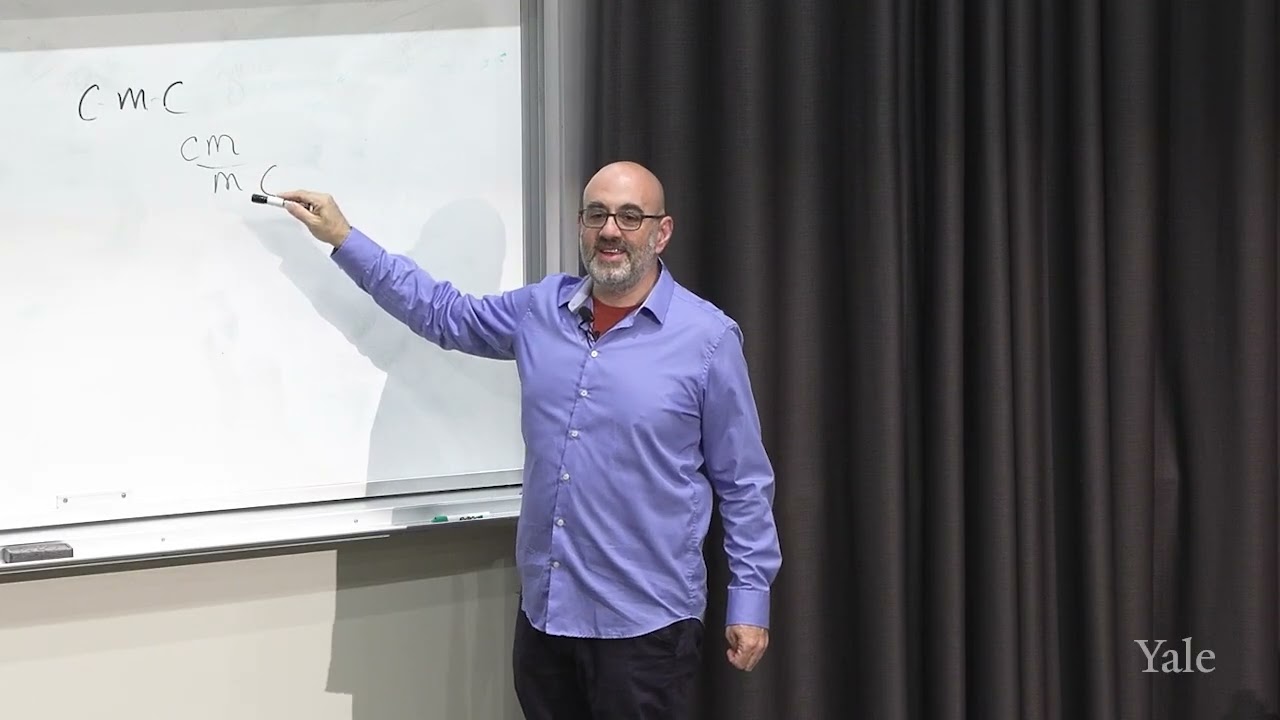
There is, he says,
44:04
a formal difference
44:07
between CMC and MCM.
44:16
We still don't know how you
get more out of the same,
44:20
but he's gonna tell us
44:22
that there's a certain kind of circulation
44:26
that is necessary for it.
44:28
Now if you look at this,
44:33
they're embedded in one another.
44:34
Obviously this is an infinite series,
44:37
so what's the difference?
44:39
It turns out if you cut this series here,
44:43
it's totally different than
if you cut this series here,
44:52
which you're an initial starting point
44:54
is determines whether you're
in a capitalist system
44:58
or a commodity exchange system.
45:02
There is a difference in content lurking
45:05
in the form, he says.
45:07
Okay, let's just give you the outline
45:10
and then we'll fill in
the details next time.
45:12
'Cause we have only a little time left.
45:15
The commodity circulation
system starts with production
45:18
and ends with consumption.
45:21
It is only about use values
45:24
and in a system where use values
45:25
are all that we're concerned
with, you can't get any profit.
45:29
The extra will be passed
on one way or the other.
45:35
In this system, the
commodity exchange system,
45:39
the same piece of money
changes place twice.
45:42
I give to Alan 10 bucks
45:44
and Alan gives 10 bucks to Samuel.
45:49
I won't use you in as an
example forever, I promise,
45:53
to get something else.
45:55
The money changes hands twice.
46:00
Money moves in this eccentric fashion
46:02
because I have a need and Alan has a need
46:06
and Samuel has a thing that he wants
46:07
and I have a thing that Alan wants.
46:09
You can see where the money
goes just to exemplify it.
46:11
Marx says this, it's pretty clear,
46:13
the money goes from me to Alan to Samuel.
46:16
That's not capitalism.
46:18
The money has to be back to me.
46:22
(clears throat)
46:25
And this produces a
certain kind of disposition
46:30
in the buyer.
46:31
The buyer says it's
fine to give money away
46:34
if I get what I want.
46:37
I don't need to see that money back.
46:39
Everyone is this kind
of buyer fundamentally,
46:42
Marx would say.
46:45
Our capitalist economy,
our high capitalist economy
46:48
is still a commodity circulation system.
46:51
We still need to get our needs
46:52
and they're in some way primary,
46:55
but not for the capitalists.
46:58
There's two primaries here.
47:01
And again, the ultimate
purpose is consumption
47:04
and Marx says this is an end outside
47:06
of the circulation system.
47:08
You take your thing
outside, you devour it,
47:10
you sleep with it, you watch it on TV,
47:13
it doesn't get traded again.
47:18
The MCM circuit starting with
money, totally different.
47:21
Obviously your disposition is,
Hey, gimme that money back.
47:26
What are you gonna get if
you give your money away
47:28
for a commodity that you don't need?
47:32
You need to get money out of that.
47:34
You need to get your money back.
47:37
In this version, the same
commodity changes place twice.
47:41
I give money to Alan for his commodity
47:45
and then what happens?
47:49
- And you sell it?
47:50
- Then I sell the commodity.
47:55
- To get more money.
47:56
- To get money, to get
more money, exactly.
47:58
That's right, okay, sorry.
47:59
I'm not an economist,
48:00
so all this stuff is like,
why should I waste my time?
48:03
Sorry.
48:05
That's right, exactly.
48:06
Then I get my money back by
selling it on, by selling it on.
48:09
So, the commodity has
an eccentric movement,
48:12
because I don't need it.
48:13
What I need is money.
48:14
This is a beautiful illustration
of the switch of values,
48:17
what nature would call
48:18
the transvaluation of
values under capital.
48:22
You can see this is not just
a technical or formal switch.
48:25
This is a switch in
psychology, in valuing,
48:28
in everything that's gonna
be important in the society.
48:33
When money flows back
to its starting point,
48:35
it is a circuit that has to be completed.
48:39
If I buy something from Alan,
48:41
and he has the money,
48:42
there's no reason he has to buy anything.
48:44
If he's satisfied, he
can just, I don't know,
48:46
burn the money in his
fireplace if he wants.
48:49
That's not the case for a money circuit.
48:55
The ultimate purpose for the money
48:57
is that it returns to its starting point.
48:58
So, money has a different purpose.
49:00
It's not to satisfy wants and needs.
49:03
Oddly though, the buyer ends up
49:05
with exactly what they started with.
49:08
It seems like nothing happened,
49:10
and this is where this
formula is not sufficient,
49:26
and we need to discover
49:31
where this mysterious
change delta comes from,
49:37
and we'll talk about that next time.
49:40
(tense music)
— end of transcript —
Advertisement