Advertisement
 15:58
15:58
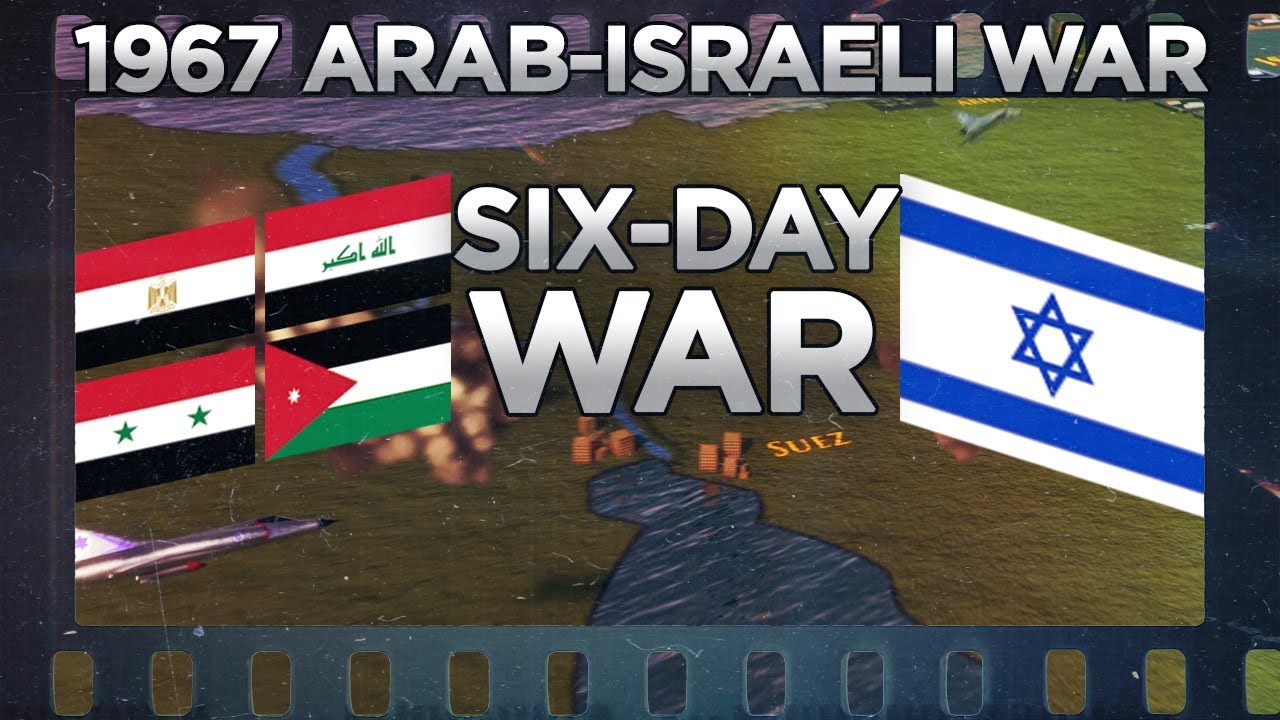
Six-Day War (1967) - Third Arab–Israeli War DOCUMENTARY
Kings and Generals
·
May 11, 2026
Open on YouTube
Transcript
0:10
This video is sponsored by Skillshare.
0:12
Learn more about Skillshare and the exclusive
offer they have for our viewers at the end
0:18
of the video.
0:20
Ever since Israeli victory during the wars
of 1948 and 1956, the Arab coalition led by
0:27
Egypt, Syria and Jordan was eager to change
the situation in the region by defeating Israel.
0:36
Both sides understood that the conflict was
far from over and were preparing for the next
0:41
stage of confrontation.
0:44
International interference and inability of
the sides to find a settlement made one of
Advertisement
0:50
the most iconic conflicts of the modern era
– the Six-day War inevitable.
0:56
On May 13, 1967 the Soviet Union falsely informed
Egypt about concentration of 11-13 brigades
1:05
of the Israeli Defence Forces with an intent
to strike Syria.
1:10
In response Egypt started concentrating forces
along the border with Israel in Sinai and
1:16
on May 16 demanded the UN peacekeeping forces
to leave the peninsula.
1:22
At the same time, Israel refused the request
of the UN on deployment of the UNEF on their
1:28
side of the border either.
1:30
In the next few days Egypt, Israel, Jordan
and Sudan started mobilization of their forces,
1:37
Iraq sent expeditionary forces to Jordan,
Saudi Arabia expressed its willingness to
1:42
participate in military actions.
Advertisement
1:45
But the turning point, which made the full
scale confrontation inevitable was the decision
1:50
of Egypt to block Israeli ships from entering
the Straits of Tiran on May 22-23.
2:00
On June 1 Israel established a National Unity
Government, which on June 4 decided to go
2:07
to war.
2:08
The Arab Coalition of Egypt, Jordan and Syria
had an advantage over Israel in deployed troops
2:15
with 240 thousand against 100 thousand, in
tanks with 2504 against 800 and in aircrafts
2:24
with 957 against 300.
2:29
Israel planned to strike on June 5 with the
Operation Focus, which aimed to destroy Egyptian
2:35
air force.
2:36
The Israeli media published false reports
claiming Israeli soldiers are on vacation,
2:42
while their pilots were carrying out training
sorties as usual and their intelligence helped
2:48
make these trainings as realistic as possible
and damaged the tracking antenna of the US
2:55
Embassy to prevent the Americans finding out
about the operation before the strike took
3:00
place.
3:01
The Israeli pilots were informed about the
start of the operation only 5 hours in advance.
3:08
At the same time Egyptian air defence system
was effectively off on June 5.
3:14
Nearly 200 Israeli aircrafts attacked 14 Egyptian
airfields and caught them absolutely off guard.
3:22
338 Egyptian aircrafts were destroyed, 100
pilots were killed within 3 hours.
3:29
Jordanian and Syrian Airforce attacked Israel
in retaliation at 11 am June 5.
3:36
The response of Israeli airforce was attack
on their airfields which led to destruction
3:42
of all 28 Jordanian, 53 Syrian and 10 Iraqi
planes.
3:47
The Operation Focus was a decisive success:
Israel lost only 19 planes in this Operation
3:54
and guaranteed its total air dominance for
the rest of the war.
3:59
The ground war was taking place at three fronts:
the Sinai front, the Jordanian front, the
4:05
Syrian front.
4:06
At the Sinai front the Egyptian forces consisted
of seven divisions: four armoured, two infantry,
4:13
and one mechanized infantry.
4:16
Egypt had 100,000 troops and 900–950 tanks
in the Sinai, so Israel concentrated three
4:24
divisions consisting of six armoured, one
infantry, one mechanized infantry and three
4:29
paratrooper brigades for a total of 70,000
men and 700 tanks along this front.
4:37
Israel’s plan was to catch Egyptians off
guard by attacking simultaneously with air
4:42
strikes, and attacking through the Northern
and Central routes in the Sinai Peninsula
4:47
instead of the Central and Southern Routes
used during the Sinai War.
4:52
On 5 June, at 7:50 a.m., the northernmost
Israeli division, consisting of three brigades
4:59
and commanded by Major General Israel Tal
started its advance towards Arish through
5:04
Gaza with an aim to encircle Khan Yunis, while
the paratroopers were ordered to take Rafah.
5:11
Initially, Egyptians offered little resistance,
since their intelligence concluded that, this
5:16
was a diversion rather than a main attack.
5:20
However, soon resistance against the 60th
armoured brigade ramped up.
5:25
This did not stop the Israeli forces from
reaching Khan Yunis Railway junction in 4
5:31
hours.
5:32
Afterwards IDF advanced on Sheikh Zuweid and
defeated fierce Egyptian resistance thanks
5:38
to air domination.
5:40
The road on Arish was open and by 8 am of
6 July elements of the 79th Armored Battalion
5:48
and the 7th brigade entered the suspiciously
quiet city.
5:53
Suddenly the Egyptians started firing from
the balconies, windows and there was a heavy
5:57
battle going on for control in the city and
the IDF was only able to take full control
6:03
of the city after reinforcements were sent.
6:07
The northernmost division then split into
two parts.
6:10
One of them continued the advance on the Suez
channel, while the second group turned south
6:16
and captured Bir Lahfan and Jabal Libni.
6:20
Further south on 6 June, the 14 thousand men
150 tank strong Israeli 38th Armored Division
6:27
under Major-General Ariel Sharon was confronted
by the Egyptian 2nd Infantry Division under
6:33
Major-General Sa'adi Nagib, consisting of
16,000 troops and 90 tanks.
6:40
Israel successfully advanced towards Abu Ageila.
6:43
The paratroopers landed behind Egyptian positions
and sew enough confusion to weaken the artillery
6:49
of the Egyptian defense, which opened the
way of the IDF to capture Um Katef.
6:55
It was followed by fierce close tank battle,
which ended in an Israeli victory with 40
7:02
Egyptian and 19 Israeli tanks destroyed.
7:07
The Egyptian forces in Sinai were still largely
intact, but their Field Marshal Abdel Hakim
7:14
Amer panicked and ordered retreat of all units
from Sinai after hearing about the fall of
7:21
Abu-Ageila.
7:22
This order did not elaborate on the sequence
and manner of the retreat, which only decreased
7:27
the defensive capabilities of the Egyptian
troops.
7:33
During the following days the IDF continued
its advance westward and inflicted heavy losses
7:39
on the Egyptians.
7:42
Despite episodic heavy resistance by the Egyptians
as in Bin Gafgafa, the napalm bombing by the
7:48
Israeli aviation and uncontrolled retreat
weakened the morale of the Egyptian troops.
7:55
Instead of catching retreating Egyptians,
the IDF decided to capture 3 passes from Sinai
8:00
to the Egyptian mainland and face the Egyptian
troops there.
8:05
Although IDF was not able to stop all Egyptian
troops from crossing, these passes became
8:11
a killing ground for the Egyptian troops with
10000 being killed in one day alone.
8:17
The capture of Sinai was completed by the
fall of Sharm El-Sheikh on June 7 and Ras
8:23
Sudar on June 8.
8:25
On June 9 UN Security council achieved armistice
between sides.
8:32
Israel wanted to avoid confrontation with
Jordan and Syria before defeating Egypt, but
8:38
the offers of neutrality to Jordan were rejected,
as the Egyptian president Nasser persuaded
8:44
King Hussain of Jordan that, Egypt had an
advantage against Israel.
8:49
On the morning of 5 June both sides started
the fire, but Israel attempted a last grasp
8:56
attempt to avoid confrontation with Jordan
by passing its message of request of peace
9:01
through the UN representative Bull.
9:04
King Hussain countered that it was too late
and the Jordanian aviation was already on
9:09
the way.
9:11
Jordanian and Iraqi aviation started shelling
Israeli controlled West Jerusalem, which caused
9:18
16, military and 20 civilian casualties, with
900 buildings damaged.
9:24
Israel responded with its own air attack within
the Operation Focus, which damaged military
9:29
aviation infrastructure of Jordan and secured
the Israeli air dominance.
9:35
East Jerusalem was controlled by Jordan at
the time and the Jordanian army took position
9:41
in the UN residency – the Government House
to fire on the Israeli sector.
9:47
The Jerusalem Brigade's Reserve Battalion
161 of Israel took the Government house despite
9:53
heavy losses and forced Jordanians to retreat
to Bethlehem.
9:58
Later on that day Israel encircled Eastern
Jerusalem with the Jerusalem Brigade from
10:03
the south, and the mechanized Harel Brigade
and 55th Paratroopers Brigade from the north.
10:10
Fierce battle happened for the Ammunition
Hill.
10:14
Jordanian resistance was so strong that, the
IDF lost all but two of their attacking officers
10:19
and achieved the goal only after 4 hours.
10:23
55th Paratroopers Brigade afterwards drove
eastwards linked up with Mount Scopus defeated
10:29
the other Jordanian positions around the American
Colony.
10:34
Towards the evening of June 5, the mechanized
Harel Brigade succeeded in taking Latrun and
10:39
Ramallah.
10:41
Also, the 163rd Infantry Battalion secured
Abu Tor and cut the Old City from Bethlehem
10:48
and Hebron.
10:50
On June 7 the Israeli Minister of Defence
Moshe Dayan ordered IDF to enter Old City
10:57
despite reservations and concerns of the Israeli
Government.
11:02
The fighting was conducted solely by the paratroopers
out of fear of destruction of holy sites.
11:08
IDF took control of the Old City after little
resistance.
11:12
Judea, Hebron, Bethlehem and Nablus were also
captured by IDF on June 7.
11:20
Remnants of the Jordanian army fell back into
Jordan.
11:24
Israel was victorious on this front as well.
11:30
Syria also believed the Nasser about Egypt’s
early success in the conflict and sent its
11:35
aviation to attack Galilee.
11:38
This attack was intercepted by the Israeli
aviation.
11:41
A minor ground attack was also attempted by
the Syrians in attempt to capture the water
11:47
plants at Tel Dan, Dan, and She'ar Yashuv.
11:50
This was repulsed by IDF as well.
11:55
Israeli air domination, lack of communication
by Syrian units, tanks being too wide for
12:00
bridges were among the causes of unsuccessful
attack of the Syrians.
12:06
This caused them to abandon any attempts to
make ground offensive on Israel and airstrikes
12:11
were chosen as a method instead.
12:14
However, on the evening of June 5 Israel stroke
Syrian airfields within the Operation Focus,
12:20
destroying 2/3 of the Syrian airforce and
forcing the rest out of the conflict.
12:26
The Israeli leadership was unsure whether
to attack Syria or not.
12:31
On one hand Syria was using Golan Heights
to shell Israel, on the other hand it would
12:37
have been a literally uphill battle against
a fortified enemy.
12:41
But the intelligence about weakened positions
of Syria in general and in Golan Heights in
12:47
particular led Dayan to order an offensive
on Golan without government authorization.
12:54
The Israeli offensive started with air strikes
which severely damaged defensive infrastructure
12:59
and morale of the Syrian Army.
13:02
The 8th Armored Brigade, led by Colonel Albert
Mandler, advanced into the Golan Heights from
13:08
Givat HaEm.
13:10
Heavy fighting in unfavourable terrain led
to numerous casualties on both sides, but
13:15
with the help of aviation IDF ultimately captured
Zaura, Qala and Ein Fit fortresses.
13:22
In the central sector, the Israeli 181st Battalion
captured the strongholds of Dardara and Tel
13:29
Hillal after fierce fighting.
13:32
By the evening of June 9 Israel reached the
plateau, which allowed reinforcements to come.
13:40
Israel had 8 brigades by dawn ready for an
assault on the second line of defenses..
13:45
Soon the ceasefire was negotiated around the
so called Purple Line.
13:51
By 11 June all military actions stopped.
13:55
Up to 983 Israelis, 15000 Egyptians, 700 Jordanians
and 2500 Syrians were killed in action.
14:07
Israel gained a huge victory.
14:09
It seized the Gaza Strip, the Sinai Peninsula,
the West Bank of the Jordan River (including
14:15
East Jerusalem), and the Golan Heights.
14:18
About one million Arabs were placed under
Israel's direct control in the newly captured
14:23
territories.
14:25
The Israeli victory came as a result of more
efficient military leadership, better preparation
14:31
of troops and intelligence.
14:33
But the Six-Day war by no means was the last
conflict and merely 6 years later the confrontation
14:40
escalated into another war.
14:44
The sponsor of this video – Skillshare is
the premier online learning community with
14:48
more than 22,000 classes that teach videography,
productivity, photography, and more.
14:56
The modern life is fast paced and demands
constant self-improving, so Skillshare is
15:01
great for people who want to learn a new skill
or make their passion a full-time job.
15:07
If you are planning to create a youtube channel
– Skillshare is the place to start.
15:12
It has more than 500 courses teacher After
Effects ranging from the basics to the courses
15:18
that can surprise even the advanced users.
15:21
Premium Membership begins around $10 a month
- but for the first 300 people to sign up
15:27
with the link in the description, you can
get 2 months of Skillshare for FREE!
15:33
These spots typically go quite quickly so
make sure to get in there!
15:37
We are planning to make more videos on the
modern warfare, so be sure that you are subscribed
15:44
to our channel and pressed the bell button
to be notified of our videos.
15:45
We would like to express our gratitude to
our Patreon supporters and youtube sponsors,
15:48
who make the creation of our videos possible.
15:51
This is the Kings and Generals channel, and
we will catch you on the next one.
— end of transcript —
Advertisement
More from Kings and Generals
 1:24:12
Caesar in Gaul - Roman History DOCUMENTARY
Kings and Generals
 12:21
12:21
Yasuke: Story of the African Samurai in Japan
Kings and Generals
 17:53
17:53
Muslim Schism: How Islam Split into the Sunni and Shia Branches
Kings and Generals
 21:46
21:46
Hashashins: Origins of the Order of Assassins
Kings and Generals