Advertisement
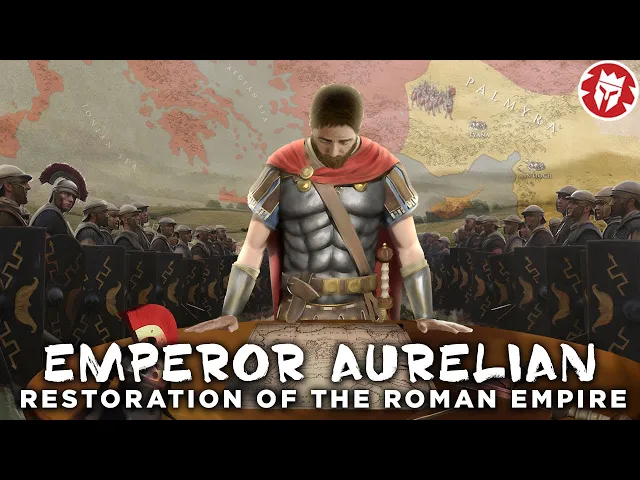 23:39
23:39
Transcript
0:04
At the height of Rome’s period of anarchy
during the third century, with the empire
0:10
on the very brink of total collapse, a group
of tough soldier emperors took the throne
0:15
for themselves and set about restoring what
had been lost.
0:20
One of these formidable men, Aurelian, took
the Roman Empire with an iron grip, glued
0:25
together its crumbling domain, and set the
stage for another two centuries of dominance.
0:31
Welcome to our video on the Restorer of the
World.
0:34
We are not saying that the Roman Empire fell
because they never used the sponsor of this
0:39
video NordVPN, but we are using it, and doing
really well.
Advertisement
0:44
Fact: NordVPN is indispensable for the modern
internet user.
0:48
It is not only a VPN service that protects
your communications and personal data, but
0:53
its 5500 super-fast servers located in 60
countries will allow you to change your IP
1:00
to avoid regional restrictions.
1:02
Trust us, being geo-locked is no fun, and
with NordVPN you will be able to connect to
1:07
get more content out of your streaming subscriptions.
1:10
Also, it is important to keep our browsing
info safe from the prying eyes of the ISPs
1:17
and NordVPN will do just that!
1:18
You can use it even in the countries where
VPNs are banned.
1:22
NordVPN never logs your data and protects
your information in public spaces by using
Advertisement
1:27
double data encryption!
1:29
It works on Windows, Linux, iOs, and Android
and has 24/7 customer support and a 30-day
1:34
money-back guarantee!
1:36
And most impressively, you can get all that
for 3.49$ per month!
1:40
So, what are you waiting for?
1:42
Support us, get a free month of premium VPN
and Save 70% nordvpn.com/KingsandGenerals
1:49
or the link in the description!
1:52
Don’t forget to use the coupon code KingsAndGenerals!
1:56
One evening in early September of the year
268, Emperor Gallienus ate supper in his army’s
2:02
camp near Mediolanum, which was under siege.
2:05
He was there to deal with a treacherous general
named Aureolus, but that would not have been
2:10
all on his mind.
2:12
Rome was in total crisis.
2:15
Almost a decade earlier, the empire had been
ripped into three pieces by Postumus’ revolt
2:20
in the west, and a withering Sassanian assault
in the east.
2:25
Moreover, barbarian attacks from across the
northern frontier were steadily getting worse.
2:31
In the midst of his meal, Cecropius - one
of Gallienus’ commanders - brought word
2:36
that their besieged enemy was readying a sortie.
2:39
The emperor immediately got to his feet and
rushed off to deal with them.
2:43
Suspecting nothing, Gallienus departed without
his personal guard and was quickly beset and
2:49
killed by assassins from within his own ranks,
Cecropius among them.
2:54
The perpetrators were a group of military
commanders from Illyria who had seen considerable
2:59
advancement under the now-dead emperor and
his father Valerian.
3:04
One of them was raised to the throne as Claudius
II.
3:08
Also among the conspirators was the subject
of our video - Lucius Domitius Aurelianus.
3:14
He had been born near Serdica on September
9th of either 214 or 215.
3:20
After joining the army at about the age of
20, he rose through the ranks with astounding
3:25
success.
3:27
By 268 Aurelian was in his early fifties and
had risen to be a high ranking officer who
3:33
was incredibly popular with the troops.
3:36
He had earned so much renown for bravery and
talent that the nickname of manu ad ferrum
3:41
- ‘hand on sword’ - became his.
3:44
Upon taking the Roman throne, Claudius immediately
granted Aurelian a high cavalry command and
3:50
effectively made him his right hand man.
3:53
Together, they took up where Gallienus left
off.
3:57
After quickly executing Aureolus, Claudius
II, with manu ad ferrum at his side, marched
4:03
to Northern Italy and smashed an Alamanni
invasion at Lake Garda.
4:08
The Romans then turned southeast and advanced
into the Balkans, where they managed to defeat
4:13
a Gothic incursion into the Balkans at Naissus
in 269.
4:18
In both of these triumphs and whilst mopping
up afterwards, Aurelian is said to have played
4:22
a decisive role.
4:25
Before Claudius Gothicus Maximus had a chance
to celebrate these victories, he died of plague
4:30
in early 270, triggering yet another power
struggle.
4:35
Quintilius - the late emperor’s brother
and commander of the troops in Italy - claimed
4:39
the throne.
4:41
However Aurelian, by far the most respected
and feared figure in the empire, was simultaneously
4:47
acclaimed emperor by the legions who were
with him.
4:50
Though Quintilius marshalled his forces at
Aquileia, it was not enough.
4:55
By the time Aurelian and his legions neared
Italy, Quintilius’ troops had faltered,
5:01
killed their commander, and confirmed the
ascension of Aurelian in September of 270.
5:07
After deifying his short-lived predecessor,
Aurelian marched back to Pannonia, which was
5:12
being threatened by a Vandal horde.
5:15
The emperor first waged a war of attrition
against them, denying them food and supplies,
5:20
then smashed the weakened barbarians in battle.
5:24
As soon as Aurelian had repelled that Vandal
threat, he received word that a united Juthungi-Alamanni
5:31
army had cut through Raetia and was making
a beeline for Italy.
5:36
Rushing to protect the home province, Aurelian’s
forces caught up with the Germans near Placentia.
5:41
However, the emperor had not been careful
enough, and his exhausted forces were ambushed
5:47
near the city, resulting in a terrible defeat.
5:50
Rumours of the humiliation sent Rome itself
into a panic, but Aurelian continued on as
5:56
though nothing had happened, recovering from
a setback that would have been the end of
6:01
lesser leaders.
6:02
The emperor regrouped his army, pursued the
invaders south for a second time, and managed
6:08
to defeat them by pinning their army against
the Metaurus river.
6:12
Despite its losses, the Juthungi-Alamanni
coalition was still strong, but Aurelian was
6:17
not willing to allow the enemy to retreat
with any Roman spoils.
6:22
After hard, uncompromising negotiations, and
without any further fighting, the barbarians
6:28
eventually departed empty-handed.
6:31
Having dealt with all of this external pressure
in a mere nine months, Aurelian was also keen
6:36
to deal with corruption at home.
6:39
When the corrupt rationalis - or chief financial
minister of the Roman mint - was confronted
6:44
about his own underhanded operations, he incited
his workers, who feared Aurelian’s retribution,
6:51
to riot.
6:53
Quintilius-sympathising senators, disruption
of the grain supply from now Palmyrene-controlled
6:57
Egypt and the prior months’ invasion scare
ratcheted up the tension to the point that
7:03
the riot turned into small-scale pitched battles.
7:07
Up to 7,000 were dead by the time Aurelian
subdued the city with an iron fist.
7:12
Ringleaders, including senators, were summarily
rounded up and executed.
7:17
However, along with this punitive solution,
the emperor also took measures to prevent
7:22
future unrest.
7:24
Beginning in 271 and continuing throughout
the rest of his reign, Aurelian attempted
7:29
to stabilise the coinage and harshly deal
with corruption.
7:34
Most notable of his financial reforms however,
was the strategic relocation of mints away
7:40
from Rome, instead favouring strategic locations,
such as Milan and Siscia, where pay could
7:46
more easily be transported to the armies.
7:49
It was also clear to Aurelian that Rome’s
legions and age-old frontier defences were
7:55
no longer sufficient to protect the empire’s
heartland; individual cities now needed their
8:01
own fortifications.
8:02
So, the construction of a series of practical,
non-aesthetic defensive walls began around
8:08
Rome, which still remain in the modern day
- the Aurelian walls.
8:14
Having done this, Aurelian marshaled the legions
and moved to meet a Gothic raid in the Balkans.
8:20
He arrived during the autumn of 271 and quickly
pushed them back across the river Danube.
8:26
Not content to let the barbarians off so easily,
the emperor crossed the river into enemy territory,
8:32
defeated the Goths decisively, and killed
their king - Cannabaudes.
8:37
It is possible that this Gothic ruler was
the same individual as Cniva, the raider who
8:42
had defeated Decius at Abritus two decades
earlier.
8:47
In the wake of this last conflict, Aurelian
acknowledged that the province of Dacia, which
8:52
was beyond the Danube frontier, was a pointless
exertion of imperial resources and a vulnerable
8:58
gateway into the empire.
9:01
To remedy this, Aurelian ordered that all
legionary forces and citizens withdraw from
9:06
the region, effectively abandoning the province.
9:10
The border was consolidated and shortened
on the near side of the river, and a deal
9:15
was negotiated with a tribe of friendly Germans
to settle in the abandoned area as a buffer.
9:21
It must have been a big step for the conservative
Romans to voluntarily and pragmatically admit
9:26
to this, and it is a sign of Aurelian’s
adaptable and charismatic nature.
9:32
With his central section of the empire safe
for the time being, Aurelian set about mustering
9:37
one of the greatest armies of the third century
throughout the winter months of 271.
9:43
It was made up of some of the most veteran
military units in the empire, including a
9:48
core of legions from Pannonia, Raetia, Noricum
and Moesia.
9:52
To supplement that, Aurelian also brought
along some loyal, elite vexillationes which
9:57
had been with him since the beginning, along
with contingents of Dalmatian and Mauritanian
10:02
cavalry who had proven their worth in the
Gothic war.
10:07
When spring of 272 was near, the emperor ferried
his great invading force across the Hellespont
10:13
and began a steady march across Asia Minor.
10:17
His ultimate aim was an ambitious one - to
reclaim the eastern empire from the de facto
10:22
Palmyrene ruler, Zenobia, who ruled on behalf
of her young son Vaballathus.
10:28
As Aurelian rode at the head of the main field
army, he also sent a naval taskforce to reclaim
10:34
Egypt in May.
10:36
It was possibly, but not certainly, under
the command of future emperor Probus.
10:42
Very little detail is known of the campaign,
but the recently captured Palmyrene possession
10:46
was weakly held, and the Romans recaptured
it by midsummer.
10:52
Meanwhile to the north, Aurelian’s advance
was almost totally unopposed until he reached
10:57
the Cappadocian city of Tyana, which refused
to admit the emperor.
11:02
He was so infuriated by this defiance that
he pledged not to leave even a dog alive once
11:08
the city fell to his armies.
11:10
However, the relatively short siege cooled
Aurelian’s temper and he came to realise
11:15
that leniency would be a more prudent course
of action in the long term.
11:20
To that end, he ordered that his triumphant
army spare the citizens rather than slaying
11:25
them.
11:26
He was to be a liberator of these Roman lands,
rather than a vicious foreign conqueror.
11:31
News of this angered the soldiers, who were
denied their opportunity to sack Tyana.
11:36
They reminded Aurelian of the pledge he had
made, but the emperor was not intimidated,
11:42
replying that “I did indeed decree that
no dog should be allowed to live.
11:46
Well then, kill all the dogs!”
11:49
The angry soldiers were pleased with the joke
and set about carrying out their ruler’s
11:54
orders with calmed tempers.
11:57
Such clemency proved to be a wise strategy.
12:00
After Tyana no city in Asia Minor resisted
Aurelian’s march, and he emerged from the
12:05
Cilician gates into Syria, ready to confront
the Palmyrenes in their home territory.
12:11
Zenobia’s greatest general Zabdas placed
his army in between Aurelian and Antioch.
12:17
Instead of attacking the great city from the
north, where the tactical incentive lay with
12:22
Zabdas, Aurelian instead shifted his forces
to outflank him from the east.
12:27
Worrying that this would move the clash into
unfavourable terrain and onto his own line
12:32
of retreat, the Palmyrene general sent most
of his cavalry to intercept Aurelian on the
12:38
eastern shores of Lake Antioch.
12:41
Rather than risking his infantry against Zabdas’
cataphracts, the Roman emperor sent out his
12:46
horsemen to bait the enemy into a trap.
12:49
When the Palmyrene heavy cavalry charged,
the lighter armoured and armed Roman units
12:54
fled at the first contact, fleeing several
kilometres towards the town of Immae.
13:00
When the overburdened cataphracts and their
horses began to slow down from exhaustion,
13:05
Aurelian’s cavalry turned and countercharged
them, scattering the Palmyrene forces, winning
13:10
a decisive victory and allowing the emperor
to sit on the enemy’s line of retreat.
13:16
Zenobia and Zabdas’ defeat led them to abandon
Antioch and retreat south to Emesa, where
13:22
it is said that 60,000 of Aurelian’s men
faced 70,000 of Zenobia and Zabdas.
13:29
Aurelian once again tried to lure the Palmyrene
cataphractarii into a similar trap.
13:34
But this time the maneuver went wrong and
the emperor’s cavalry caught the brunt of
13:39
the enemy’s charge, resulting in massive
losses and a near-rout.
13:44
The veteran legions of Aurelian were still
fighting however, and they managed to break
13:49
the Palmyrene infantry in front of them.
13:52
On the flanks, Zenobia’s cataphracts charged
too far, and were themselves cut to pieces
13:57
when the Roman infantry pivoted to the wings
and smashed into them.
14:02
The queen fled Emesa to Palmyra, leaving so
quickly that there was not even enough time
14:06
to transport the treasury away from danger.
14:10
As the sweltering high summer approached,
Aurelian wasted no time and embarked on a
14:15
grueling march east through the desert, putting
the enemy capital under siege whilst also
14:21
securing a deal with local bedouins to receive
food.
14:26
Realising that her only hope for aid now was
a personal appeal to the Sassanian king, Zenobia
14:31
snuck through the Roman siege lines and attempted
to flee into Persian territory on a camel.
14:37
However when the alarm was quickly raised,
the Palmyrene ruler was captured by Aurelian’s
14:43
outriders and brought to the emperor.
14:46
The besieged oasis’ population was divided,
but the emperor ended any uncertainty by ordering
14:52
those who wished for peace to come out and
surrender.
14:55
At first people were slow to do so, but when
they witnessed Aurelian’s mercy to the initial
15:01
few, more and more came and submitted, giving
him gifts and tribute in return for pardon.
15:08
Without any further shedding of blood, Aurelian
entered the city of Palmyra in total victory.
15:13
Whilst present there, he trialed and executed
some of the main enemy leaders, including
15:19
Zabdas, imposed a garrison upon the city,
and distributed much of its wealth to the
15:25
soldiers.
15:26
He also received an ambassador from the Sassanian
Empire who brought the shah’s congratulations
15:31
on the great victory.
15:33
His own realm was riven by internal strife
and could not risk a war against Aurelian’s
15:38
power, even if the prize was such a great
one as Palmyra.
15:43
The emperor’s most treasured prize was Zenobia
herself.
15:46
She was spared, but suffered the indignity
of being paraded through Syria’s cities
15:51
chained to a camel.
15:52
This, and rumours of her cowardice in the
face of defeat, were designed to snuff out
15:58
any lingering support the queen may have had.
16:02
As he marched back to the city of Byzantium,
Aurelian assumed the title for which he is
16:06
most well-known, restitutor orbis - ‘restorer
of the world’.
16:11
Still, he had much to do.
16:14
Upon his arrival in Europe, Aurelian crushed
yet another barbarian incursion into Moesia,
16:19
but was then forced to return to Palmyra in
early 273 upon receiving intelligence from
16:25
a loyal subordinate in the area that the city’s
leaders intended to betray him.
16:30
For the second time in less than a year, the
presumably furious emperor approached Palmyra
16:36
after a lightning quick march which took the
rebel leaders totally by surprise.
16:41
There was no time to prepare proper defences,
and Aurelian took the city swiftly.
16:47
Again he showed remarkable restraint in his
vengeance.
16:50
The ringleaders were immediately slain, but
the citizens were permitted to leave.
16:55
The city of Palmyra itself was not so lucky.
16:58
Aurelian allowed his troops to ravage the
troublesome enemy capital; much of its wealth
17:03
was plundered and many of its great structures
razed.
17:07
After this second siege, Palmyra never again
regained its once-held importance and grandeur,
17:13
becoming yet another irrelevant provincial
town on the Roman frontier.
17:19
Before he returned to the west, Aurelian had
to march on Egypt and subdue a revolt there,
17:24
securing Rome’s grain supplies.
17:26
With all business in the east taken care of,
the emperor and his field army returned to
17:31
the capital and set about preparing an expedition
to finally put an end to the Gallic Empire,
17:38
which was at that point under the control
of Tetricus.
17:41
By the time campaigning of 274 began, all
preparations were complete.
17:47
Aurelian marched across the Alps to his foothold
in Gallia Narbonensis, then quickly took Lugdunum.
17:52
The Gallic Empire was weak, but Tetricus nevertheless
rallied his Rhine legions and met Aurelian
18:00
near Chalons in late February.
18:03
Historians debate what truly happened, but
the contest was decided before the first pila
18:08
was thrown.
18:10
Either Aurelian’s superior generalship quickly
gained him mastery of the battlefield, or
18:15
Tetricus made a deal with the emperor to submit
before any fighting was necessary.
18:20
Whatever the case, the splinter empire in
Gaul and Britannia was extinguished, its military
18:26
units were reintegrated into the Roman army,
and the empire was whole once again for the
18:31
first time in fourteen years.
18:34
With his victory now total, Aurelian went
back to the capital with his spoils in tow
18:39
and hosted what might have been one of the
greatest triumphs in all of Roman history.
18:45
Coming up first in the procession were vast
eastern treasures gained from the conquest
18:49
of Palmyra, most prominent among the hoard
being three ornate royal chariots arrayed
18:55
one behind the other.
18:57
First among them was a fabulously crafted
vehicle, ordained with silver, gold, and jewels
19:03
which had belonged to Odenathus before his
own death years before.
19:08
The second was an equally masterful creation
- a Persian chariot which had been granted
19:13
to Aurelian as a gift from the Sassanian king.
19:17
Finally came the true prize, the Palmyrene
queen Zenobia herself, riding in a grand chariot
19:23
that it is said she herself constructed.
19:27
After this glorious display, vast amounts
of exotic animals were exhibited before the
19:31
awestruck population of Rome, such as elephants,
tigers, giraffes, and elks.
19:37
After them came rank upon rank of bound prisoners,
prominent men from Palmyra and barbarian tribes
19:43
in the region - including representations
of the mythical amazons, who had been captured
19:49
during the campaign.
19:51
From his western conquest Aurelian’s highlight
was Tetricus, self proclaimed ‘emperor’,
19:56
clad in a scarlet imperial cloak, yellow tunic
and Gallic trousers.
20:01
Along with the western usurper was his son
whom the former had acclaimed co-emperor the
20:06
year before his defeat.
20:09
When the grand procession came to an end,
vast entertainments were held for days afterwards,
20:14
including theatrical plays, chariot races
in the circus, wild beast hunts, gladiator
20:20
fights, and even a naval battle reenactment.
20:24
After all of the celebrations were over, Aurelian
still could not or would not rest on his laurels.
20:30
As the fifth year of his reign dawned, the
emperor went west to deal with a minor Alamanni
20:36
invasion, and then marched east into Thrace
in the summer.
20:41
Because third century sources can be somewhat
unreliable, it is not agreed as to why Aurelian
20:46
moved east.
20:48
However, most historians either believe that
the emperor was in the Balkans to deal with
20:52
a barbarian invasion, or to prepare for a
great offensive against the civil war-ridden
20:57
Sassanian Empire, whose capture and humiliation
of Valerian had not been forgotten.
21:04
Whatever the case, at some point in the middle
of 275 Aurelian encamped at a waystation on
21:10
the road to Byzantium called Caenophurium,
which was next to the Sea of Marmara.
21:15
It was to be his final resting place.
21:18
While he was there, one of Aurelian’s administrators
of secretaries - a slave or freedman known
21:24
as Eros - did an unknown deed which would
both be inevitably discovered and would inevitably
21:30
bring the emperor’s notorious wrath upon
him when it was discovered.
21:35
To save himself, Eros came up with a desperate
solution.
21:39
Since the bureaucrat was able to imitate Aurelian’s
writing style, he forged a series of documents
21:45
accusing many senior army officers of crimes
and misdeeds, and condemning those same men
21:51
to death.
21:52
When Eros showed the men this list, they were
terrified and reacted too quickly, without
21:58
thought.
21:59
A group of desperate conspirators, led by
a general known as Mucapor, waited until Aurelian
22:05
dismissed his bodyguard, and then stabbed
their emperor to death.
22:09
Yet, the assassination was not a crime of
hatred.
22:13
When the reality of Eros’ deceit came to
light, the officers who had murdered the emperor
22:18
were filled with a combination of guilt, grief,
and fury.
22:22
It was all directed at the desperate secretary,
who the Historia Augusta tells us was tied
22:27
to a stake and savaged by ravenous wild beasts.
22:32
Just like that, with a crude act of deception,
the life of Aurelian came to an end in the
22:37
middle of 275, only five years after he took
the throne.
22:42
Grief struck the entire empire when it learned
of their great emperor’s passing.
22:47
To indicate just what a significant occasion
it really was, the senate and the army did
22:51
not jostle to install the new emperor.
22:54
Conversely, they even bestowed that right
on the other party, aiming to push away the
22:59
accusation of guilt.
23:01
Eventually, Aurelian’s second in command
Probus came to the throne, and after a few
23:06
more tentative years, Diocletian inherited
the Roman Empire and ended the crisis years.
23:14
We will talk about Roman history more in the
coming months, so make sure you are subscribed
23:18
to our channel and have pressed the bell button.
23:21
We would like to express our gratitude to
our Patreon supporters and channel members,
23:26
who make the creation of our videos possible.
23:28
Now, you can also support us by buying our
merchandise via the link in the description.
23:34
This is the Kings and Generals channel, and
we will catch you on the next one.
— end of transcript —
Advertisement
More from Kings and Generals
 15:58
15:58
Six-Day War (1967) - Third Arab–Israeli War DOCUMENTARY
Kings and Generals
 17:53
17:53
Muslim Schism: How Islam Split into the Sunni and Shia Branches
Kings and Generals
 12:21
12:21
Yasuke: Story of the African Samurai in Japan
Kings and Generals
 1:24:12
Caesar in Gaul - Roman History DOCUMENTARY
Kings and Generals