Advertisement
 10:41
10:41
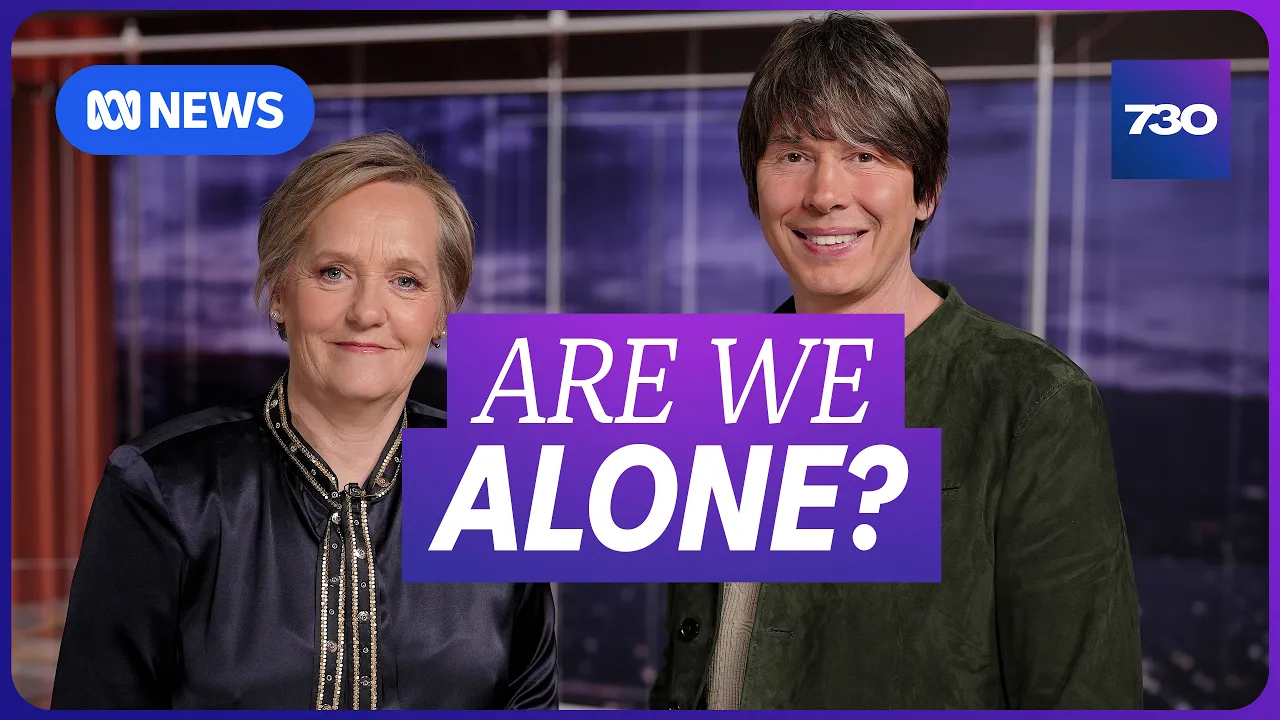
Professor Brian Cox on the big questions of the universe | 7.30
ABC News In-depth
·
May 10, 2026
Open on YouTube
Transcript
0:00
Brian Cox, welcome.
0:02
>> Thank you.
0:03
>> It's particularly nice to have you in
0:04
the studio, not down the line somewhere.
0:06
Yeah. In a hotel room. Um, I just wanted
0:09
to start by talking about your uh
0:11
Australia and its skies because you're
0:13
here. Why is Australia a great place for
Advertisement
0:15
stargazers?
0:17
>> Well, part of it is the geometry of the
0:19
solar system. So, the southern
0:20
hemisphere points towards the galactic
0:22
center. So, the Milky Way is far richer.
0:25
If you come from the north, you're
0:26
dazzled by the Milky Way here because
0:29
Australia points towards the galactic
0:31
center. And you also have the two
0:33
satellite galaxies of the Milky Way, the
Advertisement
0:35
Melanic clouds, which um just dominate
0:38
the sky, beautiful things which you
0:39
can't see from the north. So in the
0:41
north, we're pointing outwards to the
0:43
outer sort of backwaters of our galaxy.
0:45
So you're very lucky here. So for
0:48
someone who's never gone out and looked
0:50
at the stars with any particular focus,
0:55
what is it that looking at the stars,
0:57
what does it do to you, to your mind?
0:59
>> Oh, it's it's it's always been um it's
1:02
the thing that got me into science in
1:04
the first place. Um so for some reason
1:06
when I was very young and I don't know
1:08
why I became fascinated by these points
1:11
of light in the sky and it's an example
1:13
of something that's common I think
1:14
throughout science which is the more you
1:16
know the more magical it becomes. So for
1:19
example now we know that I would say
1:22
pretty much every star you see in the
1:24
night sky has planets which we we now we
1:26
didn't know that when I was growing up
1:28
in the 1970s but we know it now. So you
1:31
your imagination can begin to wander
1:32
that they're all solar systems. Every
1:35
single one of them is a solar system.
1:36
Then you start thinking well you know
1:38
are the planets with oceans on them and
1:40
if there's oceans on the planets is
1:42
there life out there beyond beyond our
1:44
solar system beyond the earth and so on.
1:46
So I think it's um it's a it's a science
1:49
that you can do from your back garden as
1:51
you said and it's a science that allows
1:54
your imagination to wander.
1:56
>> So is that what it does? We understand a
1:58
little of what it did to you to put you
2:00
on the journey that you're on, but for
2:02
someone doing it for the first time, how
2:04
much does it change you to have that
2:07
sense of wonder in the sky?
2:09
>> I think it's it's a good question. I
2:11
think astronomy has always been in part
2:14
about our place in initially with our
2:17
place in creation. My my show starts
2:20
actually in around 1600 people like
2:22
Galileo and Kepler laying the
2:24
foundations of the modern science modern
2:26
science at the time cosmology was
2:29
Aristotle's cosmology that so the earth
2:31
is motionless at the center of a finite
2:34
universe nothing changes beyond the
2:36
orbit of the moon and this is 1600 and
2:40
within a few decades we have Newton's
2:42
law of universal gravitation and within
2:44
a few centuries we've discovered that
2:46
there are two trillion galaxies in the
2:49
observable universe
2:51
the universe 13.8 8 billion years since
2:53
the big bang. That raises questions
2:56
though to your to your question because
2:58
obviously then you immediately say what
3:00
is our place and I think astronomy and
3:03
cosmology are the two sciences that
3:05
really force you to ask that question.
3:08
What is the value of of of our
3:10
civilization? What is our place in that
3:12
vast universe? So what happens to that
3:14
question if you say that's 400 years
3:16
that we got from Galileo and his
3:18
telescope
3:20
to now to conceiving of the possibility
3:23
of of humans living on the moon even the
3:27
remoter notion of a colony on Mars if we
3:31
survive what's another 400 years going
3:33
to bring us
3:35
>> you know that that's also a very great
3:37
question because it it feeds so I would
3:40
say it will take us to the stars if we
3:42
carry on at this rate of progress just a
3:45
few centuries. We've already got two
3:47
spacecraft now in interstellar space
3:50
that we are communicating with primarily
3:52
actually through the deep space network
3:53
in Canberra. So that's pointing towards
3:55
those telescopes that those um
3:57
spacecraft. So in in 400 years of modern
4:00
science, we've gone beyond our solar
4:02
system. So you're right, we should be
4:04
voyaging to the stars in the next few
4:05
centuries if we survive. does raise an
4:08
interesting question that actually which
4:09
is why does nobody else appear to have
4:11
done that which is sometimes called the
4:13
Fermy paradox which I do discuss in the
4:16
show. It's one of the I I I think it's
4:18
one of the most puzzling observations we
4:20
have made that as far as we can tell
4:23
there isn't anybody else out there.
4:25
>> I I noticed that you said a friend of
4:27
yours, a biologist I think said don't
4:30
worry about it. It's just if there's
4:31
anything out there it's slime. Could he
4:34
could he be wrong?
4:36
Absolutely. I mean it could, you know,
4:38
we we systematically look for signs of
4:41
other civilizations. It's called SETI
4:43
and it's we use radio telescopes like
4:45
the parks telescope here in Australia
4:47
and we we listen and we look for
4:49
signals. So the reason we do that is
4:51
because we would not be surprised if we
4:53
saw something tomorrow. But it's
4:55
actually you said don't wor it's
4:57
interesting you said don't worry it's
4:58
all slime. I would worry if if
5:00
everything
5:01
>> if we are alone. Well, yeah, because
5:03
then in in some sense I would say that
5:06
we have the responsibility to um allow
5:10
meaning to persist in a galaxy of 400
5:13
billion suns. We're the only intelligent
5:15
civilization of weight on our shoulders.
5:17
>> Yes, indeed. So, I actually personally
5:20
would perhaps be more relaxed about
5:22
events here on Earth if there was
5:24
somebody else carrying the torch as
5:26
well.
5:27
>> The the show that you're doing here is
5:29
called Emergence. What is the emergence
5:32
of the title?
5:34
>> It starts with a story of Johannes
5:36
Kepler. So the idea that planets move in
5:38
ellipses around the sun. This is Kepler.
5:41
But um in 1610 he wrote a book called
5:44
the six cornered snowflake and it's
5:47
still available. I strongly recommend
5:49
it. It's a beautiful book. And he just
5:51
asked this question about snowflakes.
5:53
Why are they all six cornered? Why are
5:54
they all similar? Um and it's actually
5:57
extremely deep question um for for many
6:01
reasons. One is that you it's a 20th
6:03
century answer. It's to do with the
6:05
water molecule and quantum mechanics and
6:07
all these things we discovered in the
6:08
20th century. So he couldn't have
6:10
answered it. But one of the most
6:12
important things is that at the end of
6:14
the book he says I don't know the
6:16
answer. He he writes, you know, I leave
6:19
it to to you to it's actually to his
6:21
benefactor this who he wrote the book
6:23
to, but also to future generations to to
6:26
to find out. And if you think about
6:28
progress, I' i've seen it written that
6:30
progress was invented pretty much around
6:33
that time. You real progress starts. We
6:36
talked about 400 years after that we're,
6:39
you know, flying to the stars.
6:41
>> But for progress, you need to accept
6:44
there are things you don't know. Is that
6:46
why you describe certainty as something
6:48
brutish? I yeah I say yeah the at the
6:51
end of the show actually I say that um
6:54
we we that we live in a world where the
6:56
silence necessary for progress is
6:59
drowned out by the vulgar noise of
7:01
certainty and it's it is it's a it's a
7:04
noise if you see so if you think about
7:06
it if if you think you know everything
7:08
you cannot make progress and the idea
7:11
that that was radical only a few
7:14
centuries ago is is really central to
7:16
the show I say right at the start and
7:18
we're going to focus on a lot of things
7:19
that we don't know because that's where
7:22
the excitement is and that's where
7:24
that's the reason the future will be
7:26
better than the past is because we
7:28
accept that there are things yet to be
7:29
known.
7:30
>> At the same time I I I see that you tend
7:33
optimistic in the way you think about
7:35
the future and progress. But at the same
7:37
time there's an enormous amount of
7:38
exploration going on around the moon
7:41
around possibilities of of
7:43
exploitation of the moon and indeed the
7:47
universe. How much damage could we do
7:50
with satellites and radio waves?
7:52
>> I I don't think that's the the way to
7:55
think about it. So because the so the
7:58
space economy is one of the fastest
8:01
growing areas of the global economy.
8:03
Indeed, many economists I speak to say
8:06
don't don't talk of the space economy
8:07
and the it's just the economy. You think
8:10
about the GPS system, for example. It's
8:13
it's central to the way that we live our
8:15
lives. Um I think the number in the UK
8:19
is I think it's 18%
8:23
16 or 18% of UK GDP is relies on
8:27
space-based infrastructure and that's
8:29
including things such as financial
8:30
transactions that take the timing
8:32
information from space and so on. So it
8:35
tells us that already our economies the
8:38
global economy and our national
8:39
economies are reliant on that
8:41
infrastructure. And so the more we
8:44
expand that infrastructure then really
8:46
what you're talking about is growing the
8:48
economy.
8:49
>> So so we we should learn to trust people
8:51
like in a way learn to trust Jeff Bezos
8:54
and Elon Musk. Obviously people have all
8:56
these doubts and anxieties about what
8:58
they're doing along with the the
9:00
brilliance that attends a lot of the the
9:03
engineering
9:04
achievements. Should we trust them a bit
9:06
more? The reason that we have
9:08
international bodies like the the UN and
9:10
intergovernmental organizations that are
9:12
working on that framework is of course
9:14
that we don't just trust industry or you
9:18
know this is not a judgment on industry
9:21
being moral or otherwise industries are
9:23
industries but we do have frameworks
9:26
that that obviously regulate how
9:28
industries operate in our countries and
9:29
internationally and we need to make sure
9:31
the right frameworks are there because
9:33
it's becoming as I said it's it's some
9:35
like something like approaching ing a
9:37
fifth of the UK economy reliant on that
9:41
infrastructure, then you begin to
9:44
understand that there needs to be some
9:46
it's just like it's no different to the
9:48
the the rules and regulations that
9:50
govern international air travel or or or
9:53
travel on the oceans. We understand that
9:55
that's necessary. In fact, in some ways
9:58
to you call me an optimist. So the
9:59
optimistic take on it is that we are
10:02
forced to collaborate and to operate as
10:05
a world when we start to try to
10:07
understand how we navigate the
10:09
challenges of space. It makes no sense
10:11
does it if you think about the
10:12
international space station for example.
10:14
>> You think well it's in it's in
10:15
Australian airspace if it goes I don't
10:17
know how often it goes over Australia
10:19
but but it's in your airspace as a
10:21
country for a few minutes. So it makes
10:24
no sense to but I I take that as very
10:27
positive because it forces collaboration
10:30
on us.
10:31
>> Brian Cox, thank you very much indeed
10:32
for talking to us.
10:33
>> Thank you.
— end of transcript —
Advertisement
More from ABC News In-depth
 24:16
24:16
How Qatar's careful plans for security failed | If You're Listening
ABC News In-depth
 24:40
24:40
How did Palantir get so powerful? | If You're Listening
ABC News In-depth
 7:22
7:22
Will One Nation win the Farrer by-election? | 7.30
ABC News In-depth
 10:15
10:15
Coalition suggests stealth bombers could be used as AUKUS stop-gap | 7.30
ABC News In-depth