Advertisement
 24:16
24:16
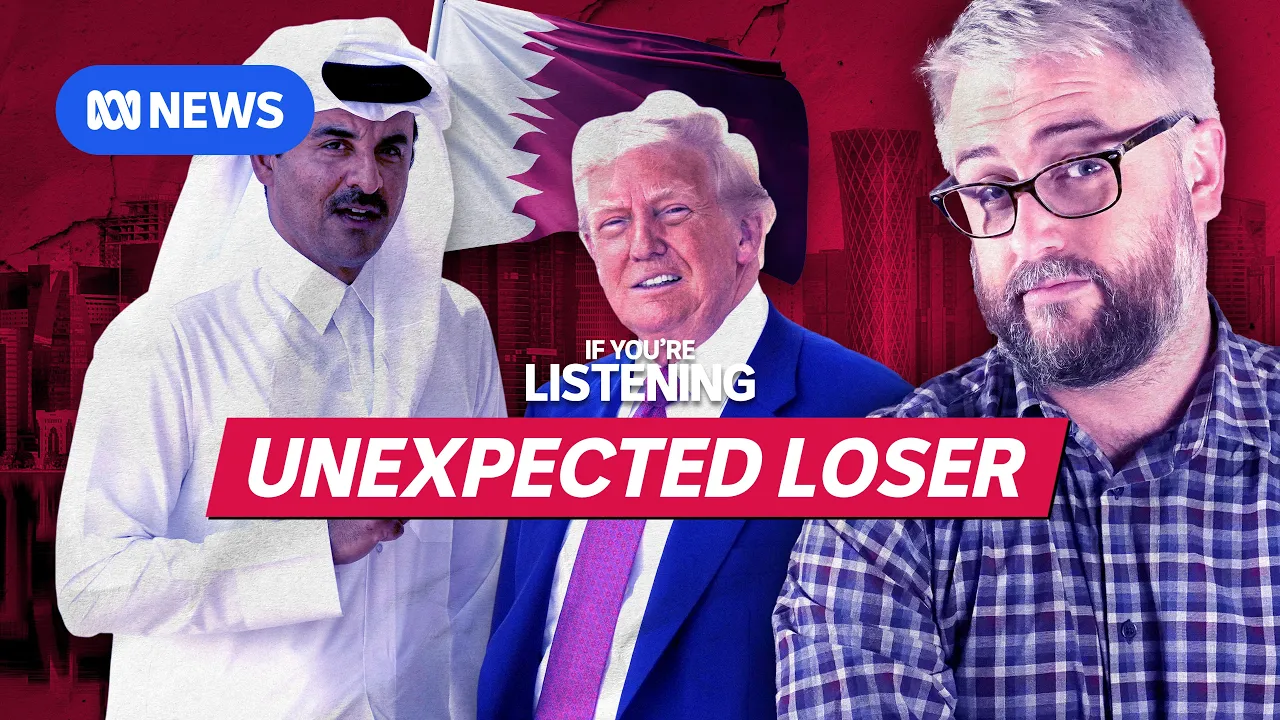
How Qatar's careful plans for security failed | If You're Listening
ABC News In-depth
·
May 10, 2026
Open on YouTube
Transcript
0:00
My supervising producer, Kara Jensen-McKinnon,
0:01
has coined a phrase that I think I'm going to start using.
0:05
The phrase is "Jungle Times."
0:08
As in, "We now live in the Jungle Times."
0:12
You know the ones.
0:13
>> Soldiers boarding container ships with rifles drawn.
0:16
>> Streets littered with cars torched in the intense bombardment.
0:19
>> Delta Force commandos seized Venezuela's president.
Advertisement
0:23
>> Russia has unleashed its deadliest attack so far this year on Ukraine.
0:28
>> The sound of several gunshots sent the president ducking that way
0:34
as a swarm of officers surrounded. >> This show is generally
0:37
about looking at historical moments that either lead to current events
0:41
or help us better understand current events.
0:44
We find historical precedents. And taken individually,
0:49
all the things happening right now do have a precedent. From oil shocks
0:54
to wars in the Middle East.
0:55
We have been talking about these precedents for weeks.
0:59
>> In the 80s in Sydney, the petrol rationing was done by state governments.
Advertisement
1:02
>> We all know from Iraq, from Afghanistan, a war that's one month,
1:07
that becomes six months, that becomes six years, that becomes a decade.
1:10
>> But I think that, in one very important way, what we're watching now is different.
1:16
And it's because all of these things are happening at once,
1:20
and every day things just seem to get more and more chaotic.
1:24
>> We have a plan where every bridge in Iran
1:29
will be decimated, where every power plant in Iran
1:33
will be out of business. I mean, complete demolition.
1:37
>> We're watching the world change in a way that will be with us for a long time.
1:42
I think the best example of what I mean by this is found
1:45
not in Iran, Israel, the US or Lebanon, but in Qatar.
1:51
>> Qatar, where the world's biggest gas plant is. >> Qatar has spent the last 50 years
1:56
meticulously planning, scheming and plotting to make itself
2:00
immune to global instability, to make sure that something like this:
2:05
>> Iran targeted Qatari gas infrastructure in retaliation
2:08
to a strike on its major gas field. >> Can never happen.
2:12
And yet it has. Why?
2:15
Well, because unfortunately for Qatar, we're no longer in the stable times.
2:20
We're in the Jungle Times.
2:23
And meticulous planning doesn't count for anything in the jungle. Today,
2:28
the story of the elaborate, decades-long, trillion-dollar scheme that Qatar hoped
2:34
would protect them, and what its failure tells us about what we are about to face.
2:40
I'm Matt Bevan,
2:42
and this is If You're Listening.
2:43
Welcome to the Jungle Times.
2:50
I love old atlases.
2:53
If you've got one you're trying to unload, send it to me.
2:55
I'll take it.
2:56
This one I've got here is from 1961.
2:59
And it's not only full of extremely dated maps, but it's got fascinating
3:04
statistical information about every country in the world.
3:08
For example, in 1961, there were significantly more cars
3:12
in Australia alone than there were in all of Asia combined.
3:17
That's a fun fact.
3:22
I went looking through the atlas
3:23
for fun facts about Qatar, and there is none.
3:29
Qatar is drawn on a map of the Middle East.
3:31
But apart from its roughly sketched border,
3:33
the fun facts are very much lacking.
3:36
Apparently Encyclopaedia Britannica knew
3:38
nothing about it, not even its population.
3:42
And that's because:
3:43
>> The sheikhdom of Qatar is geographically prominent
3:46
but otherwise one of the least-known of the Arab Gulf states.
3:50
It was essentially famous for not being famous.
3:53
>> Perhaps more than any Gulf state, Qatar's history is shrouded in obscurity.
3:58
>> And look, to a certain extent, that is understandable.
4:00
Qatar is a barren, flat, horrifically hot,
4:04
windswept peninsula on the edge of Saudi Arabia.
4:08
It had very little connection with the outside world.
4:11
In fact, in one of the country's museums, it's noted that it wasn't until the 1960s
4:16
that football was first introduced to the country.
4:20
If Britannica had checked, they'd have found that Qatar's
4:22
population in 1961 was just 36,000.
4:26
And yet it had its own royal family.
4:29
>> There's no question that Sheikh
4:30
Khalifa and his family rule the emirate in every respect.
4:34
>> Now, usually, royal families are ripe for scandal and intrigue,
4:38
but the royal family of Qatar, the Al Thanis, are almost bizarrely boring,
4:44
apart from the fact that they have a fondness
4:47
for conducting coups while the emir, the leader of the country, is on holiday.
4:53
>> Sheikh Khalifa bin Hamad Al Thani,
4:55
who's just celebrated ten years as ruler
4:58
after deposing his cousin in a bloodless royal coup.
5:01
>> The former emir made the grave mistake of going on holiday to Iran,
5:06
and while he was away, his cousin Khalifa changed the locks and bingo
5:10
bango, he became the new emir.
5:13
Now, why pull a sneaky coup
5:15
to take charge of a barren peninsula populated by fishermen?
5:19
Well, they'd found something under their feet.
5:22
>> Its oil reserves are not large by the standards of its bigger neighbours,
5:26
but it has got gas to exploit for the next 500 years.
5:33
>> So, 500 years worth of gas and a very tiny population.
5:36
The Al Thanis used the gas to make their
5:40
population incredibly rich. Today, Qatari nationals are provided
5:44
with a free home for every family, a free car.
5:47
They pay no taxes, no rent,
5:50
no utility charges, no telephone bills.
5:53
Education for Qatari nationals is free, whether it's at home
6:00
or at the most exclusive and expensive college abroad.
6:04
Healthcare is unlimited.
6:06
Qataris can fly to any specialist anywhere in the world,
6:10
and the government will pick up the airfares, the doctor's bill
6:14
and the family's luxury hotel bill for as long as they're abroad.
6:18
Now, this sounds like an incredibly sweet deal.
6:21
And if you were one of the 40,000-odd Qataris, it really was.
6:26
Work was pretty much optional.
6:29
>> We encountered an elderly
6:30
and delightful man working as an occasional government car driver,
6:34
although he was a dollar millionaire twice over.
6:37
>> But this decadent lifestyle had a couple of pretty dark clouds hanging over it.
6:42
For one thing, because Qataris didn't really need to work,
6:45
they imported basically their entire labour force.
6:49
Most of the actual work in Qatar was done
6:52
by migrant labourers and indentured servants.
6:56
By the 80s, the labourers outnumbered Qataris three to one, and lived
7:00
as a virtual underclass with almost none of the rights Qatari citizens had.
7:05
>> Menial tasks are reserved almost exclusively for non-Qataris.
7:10
They definitely didn't get free cars and unlimited healthcare —
7:14
not a particularly sweet deal for them.
7:16
>> The other dark cloud hanging over it all was Saudi Arabia.
7:21
>> Big brother is Saudi Arabia,
7:23
with which Qatar shares its only and unmarked land border.
7:27
>> Khalifa and his people lived like kings, but only in the material sense.
7:33
They were reliant on big brother for security, and when push came to shove,
7:38
it was the Saudis who were really calling the shots.
7:41
>> Qatar could have just lived with that reality.
7:43
It's what their fellow emirs in Bahrain and the United Arab Emirates
7:47
decided to do, basically.
7:49
Accept that they were all a big happy family of Sunni Arabs
7:53
and that there was more that united them than divided them.
7:57
Just let the Saudis run the show.
7:59
Don't rock the boat.
8:00
Just sit there quietly and be rich.
8:03
But in 1995, Khalifa did something that no Qatari emir
8:07
should ever do, and went on holiday to Switzerland.
8:11
His son Hamad saw an opportunity to take a leaf out of his dad's book.
8:15
>> Sheikh Hamad bin Khalifa Al Thani seized power
8:19
from his father in a palace coup. >> The thing was, the new emir, Hamad,
8:23
wanted to exercise more autonomy over Qatar's foreign affairs
8:28
than his father had.
8:30
This displeased Qatar's big brother.
8:32
And in case you've forgotten,
8:34
>> big brother is Saudi Arabia. >> The new emir wasn't
8:37
willing to accept Saudi Arabia's role as the regional superpower.
8:41
So Saudi Arabia tried to get rid of him.
8:44
The Saudi counter-coup failed, potentially because Hamad refused to go on holiday,
8:49
but it left him in a tricky position.
8:52
Wedged between a pushy big brother
8:54
to the south and something even scarier to the north.
8:58
>> The only real threat to the development programs of the ruling family
9:01
would appear to be Islamic fundamentalism
9:04
along the lines of the Iran model.
9:07
>> Iran. While Saudi Arabia might see the Qataris
9:10
as a little brother, they were at least from the same family.
9:14
Iran is extremely different in almost every way.
9:18
Different ethnicity, different language,
9:20
different religion — Shia instead of Sunni Islam —
9:23
and a totally different regime. A fundamentalist theocracy
9:28
that had overthrown their monarch in a violent revolution.
9:34
>> They would need to find
9:35
a bigger, scarier friend.
9:38
And so they went to the biggest and scariest friend there is.
9:41
>> It's my honour to welcome
9:44
the Emir of Qatar to the Oval Office.
9:47
>> I'm pretty sure George W. Bush just called him the Emir of Gutter,
9:51
but anyway.
9:52
>> Your Highness, it's such an honour to have you here.
9:55
And I welcome you.
9:57
And I want to thank you for your friendship.
10:01
>> To secure this new friendship, Hamad agreed
10:03
to host an enormous American air base in his country.
10:06
>> It's one of the most state-of-the-art ones that you'll find in the region.
10:09
>> And to say thanks,
10:10
the US moved its regional base of operations to Qatar ahead
10:14
of the invasion of Iraq in 2003.
10:26
>> This is CENTCOM, the US military's central command.
10:27
As a result, Qatar became the epicentre of US military operations in the Middle East.
10:31
>> We're here with permission of the Qataris, and we're doing
10:34
our best to be good guests.
10:38
>> Luring the Americans gave his tiny country a powerful protector against,
10:42
at times, aggressive neighbours. But it wasn't just about demonstrating military strength and bringing in guys with big guns.
10:47
Hamad wanted to show that Qatar was allied to the west in ideological ways as well.
10:53
So he started democratic reforms, then spent millions setting up Al Jazeera.
10:59
>> Welcome to the world news from Al Jazeera,
11:02
and the very first program live from our Doha news
11:05
headquarters here in the heart of the Middle East.
11:08
>> By advocating for a freer press in a region where that's not really a thing,
11:12
Al Jazeera became both a thorn in the side of authoritarian regimes
11:17
and the most important platform for those regimes
11:21
to communicate with the wider world.
11:23
Just about every government in the region has, for a time,
11:26
closed Al Jazeera's bureau.
11:29
Some have withdrawn ambassadors from Qatar in protest.
11:33
But today, even the toughest Arab leaders have to deal
11:36
with Al Jazeera, because it speaks to the people.
11:39
>> So, Qatar has become the region's US military
11:42
base and centre of information.
11:45
But for Hamad, that wasn't enough.
11:48
>> Fly to over 80 destinations onboard one of the world's youngest fleets.
11:53
Qatar Airways.
11:55
World's five-star airline.
11:56
>> He dumped investment into Qatar Airways, hoping to turn the Qatari
12:00
capital, Doha, into a global business travel hub.
12:04
>> Halfway to anywhere with plenty of time to spare.
12:08
At the Qatar Airways premium terminal in Doha —
12:11
>> five-star service for first and business class passengers.
12:14
>> And he spent money trying to get people to actually leave the airport
12:18
and see the country, instead of just flying through.
12:31
>> Hamad basically bought the FIFA World Cup,
12:34
only 50 years after football was first seen in his country.
12:38
Then he spent more money on it than every other World Cup in history
12:43
combined.
12:51
Hosting the World Cup
12:52
wasn't just about football.
12:55
Qatar wanted to be the place where the world gathered,
12:58
where people with nothing in common could come together.
13:01
During the tournament, Iran played against its greatest enemy, the United States.
13:07
>> Whenever these two teams play anywhere, in any competition,
13:10
it brings with it history.
13:12
It brings with it culture, it brings with it politics.
13:14
>> We talked in last week's episode about how important it is to build
13:18
trust and credibility when you're trying to negotiate with your enemies.
13:22
Qatar decided to try and be the place where that trust was brokered.
13:27
>> Senior Taliban leaders are in Qatar for peace talks with US officials.
13:30
>> Qatar welcomed not only the US military to its territory,
13:32
but the Taliban.
13:36
>> We are prepared to engage the Taliban
13:39
through a negotiations office in Doha.
13:44
>> With implicit western backing, Qatar hosted offices of the Taliban,
13:49
financiers of al-Qaeda, the Muslim Brotherhood and rebel factions
13:53
from all over Africa. All of this, just a few kilometres from the regional headquarters
13:57
of US Central Command.
13:59
It is a very small country, after all.
14:01
Not everyone was a fan of this.
14:03
It's a small-world style of politics, and Qatar was publicly criticised
14:08
for trying to bring these groups together,
14:09
particularly by Israel and its supporters.
14:13
>> It is quite strange that the Emir of Qatar
14:17
should take sides with Hamas.
14:22
>> I blame Qatar. That very rich emirate that's been pouring money into the hands of Hamas.
14:25
>> Despite publicly disagreeing with what Qatar was doing, behind the scenes
14:30
the Israeli government under Benjamin Netanyahu was supportive of it.
14:34
>> Netanyahu allowed Qatar to give massive amounts of cash to Hamas in Gaza.
14:39
>> Qatar electronically transfers cash to Israel.
14:43
That cash is then physically carried over the border by UN officials
14:48
and by Israeli officials into Gaza.
14:50
>> It was a
14:51
divide-and-conquer strategy, with Netanyahu hoping
14:54
Hamas would weaken the more moderate Palestinian Authority.
14:58
>> We did everything in order to make sure
15:01
that Hamas will go on controlling Gaza, and the Palestinian
15:05
Authority will control the West Bank, so they will fight each other.
15:10
>> So there's money flowing in all sorts of directions for all sorts of reasons.
15:14
And Qatar wanted to be at the centre of it. Having a diplomatic and financial
15:18
relationship with everybody means nobody will want to attack you.
15:22
Simple.
15:24
Over the last 50 years, Qatar has grown from being
15:26
a strange, barren peninsula with no fun facts
15:31
to being home to the richest citizen population on earth,
15:34
to being the centre of an enormous,
15:37
intricate spiderweb which stretched into the business,
15:41
economic, journalistic, tourism, cultural, energy and political worlds.
15:47
But Hamad — and after his abdication in 2013, his son
15:50
Tamim — didn't do all this for fun, or for ego, or for glory.
15:55
It was a long-term strategy of making Qatar
15:58
a significant player in world affairs.
16:01
If they were at the centre of the web,
16:03
they would be too important to mess with.
16:06
It was a rational strategy formed during
16:09
an era where rational people ran the world.
16:12
Their refusal to just sit there and be rich
16:14
may have made Saudi Arabia grumpy.
16:17
But what was Saudi Arabia going to do about it?
16:19
Qatar had made itself too important.
16:23
The strategy was all working
16:24
very well until around May 2017, when there were hints
16:29
that the era of rational strategy may be coming to an end.
16:34
>> From bagpipes to men on horseback.
16:36
Saudi Arabia turned up the pomp for Donald Trump's first foreign visit.
16:40
>> The new US president, Donald Trump,
16:42
was invited to the Saudi capital, Riyadh, to dance with swords
16:46
and join the Saudi king, Salman, in laying his hands upon a glowing orb.
16:51
>> It was a surprising destination for Trump's first foreign trip as president.
16:56
>> Donald Trump has been welcomed to Saudi Arabia with open arms,
17:00
despite his campaign rhetoric depicting the Saudis as woman-hating
17:04
gay killers and promising a ban on Muslim travel.
17:08
>> Before he left, the Saudis agreed to a massive trade and weapons deal.
17:12
>> Around $147 billion in US arms sales to Saudi Arabia,
17:18
and $270 billion in other trade.
17:22
>> Two weeks after Trump's visit, the Saudi crown prince, Mohammed bin Salman, ordered
17:26
an extraordinary military operation against Qatar. Saudi Arabia, Egypt,
17:31
the United Arab Emirates and Bahrain imposed an aggressive blockade on Qatar.
17:37
Land, air and sea routes in and out of Qatar were blocked.
17:41
>> The four blockade countries alleged Qatar used its wealth to fund extremist
17:45
groups linked to Iran. >> They demanded that Qatar decrease
17:49
its diplomatic and military engagement with Iran and Turkey,
17:54
kick terrorist groups out of the country,
17:57
and shut down its government-funded broadcaster, Al Jazeera.
18:02
>> The US military and State Department were shocked.
18:05
>> The US has 10,000 troops at a critical air base in Qatar.
18:11
American diplomats rushed to stop any fallout.
18:14
>> While the Clinton, Bush and Obama administrations had seen Qatar as an ally,
18:19
this time around, the vibe from the White House was very different.
18:23
>> The US president even took credit for the crackdown on Qatar, tweeting:
18:28
"Perhaps this will be the beginning of the end to the horror of terrorism."
18:32
>> I've heard reports that President Trump didn't even realise that
18:35
the United States had a base within Qatar, which is pretty alarming.
18:39
>> It turns out, hosting a US military headquarters isn't
18:43
a great insurance policy if the US president doesn't know it exists.
18:48
Thankfully, Trump had some people in his cabinet
18:50
who were aware of the significance of Qatar.
18:53
>> We call on the Kingdom of Saudi Arabia, the United Arab Emirates, Bahrain
18:59
and Egypt to ease the blockade against Qatar.
19:03
>> A group of Trump cabinet officials,
19:04
informally referred to as the "axis of adults",
19:08
basically ignored his instructions and shored up the relationship with Qatar.
19:12
>> The blockade is also impairing US
19:14
and other international business activities in the region.
19:17
>> The blockade is hindering US
19:19
military actions in the region and the campaign against ISIS.
19:22
>> Eventually, the blockade was eased and officially ended
19:26
in the early months of the Biden administration.
19:29
>> Qatar didn't cave in to any of the Saudi demands.
19:32
They survived the blockade with their strategy intact,
19:35
and their importance as a location for resolving disputes between enemies
19:40
only increased. Following the October 7 attacks by Hamas on Israel,
19:45
Qatar was the only mediator able to get both sides to the table
19:50
for ceasefire and hostage release negotiations.
19:53
>> With officials in Doha insisting talks can continue
19:57
if both Israel and Hamas show a willingness to negotiate in good faith.
20:02
>> In a world ruled by rational people, you need a safe place for those people
20:05
to be able to talk to each other while they sort out key differences —
20:09
somewhere bitter enemies can come and sit at a table
20:13
and try and find common ground, without worrying
20:15
they're going to get poisoned or stabbed in the middle of the night.
20:19
>> Qatar was that place.
20:21
But then Donald Trump returned to the White House, and things started changing.
20:28
>> A brazen attack in Qatar's capital.
20:33
>> Israeli forces
20:34
targeting Hamas's political headquarters in a residential area of Doha.
20:39
>> Decades spent shoring up their position as an important ally of the west
20:43
had failed to protect Qatar from Israeli airstrikes.
20:47
Hamas's political leadership had reportedly gathered in Doha
20:49
to discuss the latest US proposal for a ceasefire in Gaza.
20:53
It wasn't the first time
20:54
that Hamas's leadership had been in Qatar to talk with the Americans and Israelis,
20:59
but Bibi Netanyahu saw an opportunity this time to strike
21:02
without any fear of ramifications.
21:05
>> These are the terrorist chiefs who planned,
21:10
launched and celebrated the massacres of October 7.
21:14
>> The Qatari government called it state terrorism.
21:17
Any other US president would have been furious.
21:20
Donald Trump, though —
21:23
>> Well, I'm not thrilled. I'm not thrilled about it.
21:26
Not jazzed. Not psyched.
21:28
>> There was no condemnation of Israel, no axis of adults
21:31
to give Israel a rap on the knuckles and tell them to stop.
21:34
In fact, when Netanyahu suggested just a few months later that it might be
21:38
a good idea to attack Iran during peace negotiations with the US, Trump joined in.
21:43
>> The Israeli-US joint strikes began in broad daylight,
21:47
hitting multiple Iranian cities, including the capital.
21:49
>> Iran responded with fury, firing missiles at anyone within reach.
21:55
For hours, missiles crisscrossed Middle Eastern skies. Warning
21:59
sirens blared.
21:59
Israelis ran for cover.
22:01
Missiles were also fired towards Qatar.
22:03
>> In Doha, Qatar's military has been intercepting missiles
22:07
aimed at a US air base and the international airport.
22:11
>> Iran targeted Qatari gas infrastructure in retaliation to a strike on its major
22:16
gas field, wiping out 17% of capacity for up to five years.
22:22
>> Decades of planning, investment and diplomacy by the Qataris went up in smoke.
22:28
>> The Qatari government has labelled the strike a flagrant
22:31
breach of international law.
22:32
>> The trouble is, international law doesn't really apply during the Jungle Times.
22:39
Qatar has always
22:40
been incredibly vulnerable geographically,
22:43
so it spent decades building strategic security.
22:47
It played the game better than most.
22:50
But that game is over now.
22:52
Alliances don't matter.
22:54
The people with the power don't think about consequences.
22:57
In the Jungle Times, strength is the only thing that matters.
23:01
And Trump, Netanyahu and Mohammed
23:04
bin Salman in Saudi Arabia have the strength.
23:07
Qatar will survive this crisis.
23:10
They're still rich and they still have the US military on their side,
23:14
but they will not feel nearly as secure.
23:17
Will people continue to choose Qatar as a place for negotiating
23:20
if they're worried about Israeli airstrikes?
23:23
Will people invest and travel there
23:25
if Iran might bomb them at any moment?
23:28
Is the relationship with America secure
23:31
if the US president doesn't even know that Qatar is home to the most important
23:35
American military base in the world's most volatile region?
23:40
Qatar was under the impression it had solved the problem
23:43
of being a small country in a scary neighbourhood.
23:48
It hasn't.
23:49
This is the Jungle Times.
23:51
If you're not big and scary, you need to find a tree to hide in.
— end of transcript —
Advertisement
More from ABC News In-depth
 7:22
7:22
Will One Nation win the Farrer by-election? | 7.30
ABC News In-depth
 24:40
24:40
How did Palantir get so powerful? | If You're Listening
ABC News In-depth
 10:41
10:41
Professor Brian Cox on the big questions of the universe | 7.30
ABC News In-depth
 10:15
10:15
Coalition suggests stealth bombers could be used as AUKUS stop-gap | 7.30
ABC News In-depth