Advertisement
 14:04
14:04
Transcript
0:12
So in college,
0:15
I was a government major,
0:16
which means I had to write
a lot of papers.
0:19
Now, when a normal student writes a paper,
0:21
they might spread the work out
a little like this.
0:23
So, you know --
0:25
(Laughter)
0:26
you get started maybe a little slowly,
Advertisement
0:28
but you get enough done in the first week
0:30
that, with some heavier days later on,
0:32
everything gets done, things stay civil.
0:34
(Laughter)
0:35
And I would want to do that like that.
0:38
That would be the plan.
0:39
I would have it all ready to go,
0:41
but then, actually, the paper
would come along,
0:44
and then I would kind of do this.
0:46
(Laughter)
Advertisement
0:48
And that would happen every single paper.
0:51
But then came my 90-page senior thesis,
0:55
a paper you're supposed
to spend a year on.
0:57
And I knew for a paper like that,
my normal work flow was not an option.
1:01
It was way too big a project.
1:02
So I planned things out,
1:04
and I decided I kind of had
to go something like this.
1:07
This is how the year would go.
1:09
So I'd start off light,
1:11
and I'd bump it up in the middle months,
1:13
and then at the end,
I would kick it up into high gear
1:16
just like a little staircase.
1:17
How hard could it be
to walk up the stairs?
1:20
No big deal, right?
1:23
But then, the funniest thing happened.
1:24
Those first few months?
1:26
They came and went,
1:27
and I couldn't quite do stuff.
1:29
So we had an awesome new revised plan.
1:31
(Laughter)
1:32
And then --
1:33
(Laughter)
1:35
But then those middle months
actually went by,
1:38
and I didn't really write words,
1:40
and so we were here.
1:43
And then two months turned into one month,
1:46
which turned into two weeks.
1:47
And one day I woke up
1:49
with three days until the deadline,
1:53
still not having written a word,
1:55
and so I did the only thing I could:
1:57
I wrote 90 pages over 72 hours,
2:00
pulling not one but two all-nighters --
2:02
humans are not supposed to pull
two all-nighters --
2:06
sprinted across campus,
2:08
dove in slow motion,
2:09
and got it in just at the deadline.
2:11
I thought that was the end of everything.
2:14
But a week later I get a call,
2:15
and it's the school.
2:17
And they say, "Is this Tim Urban?"
2:19
And I say, "Yeah."
2:20
And they say, "We need
to talk about your thesis."
2:23
And I say, "OK."
2:25
And they say,
2:27
"It's the best one we've ever seen."
2:29
(Laughter)
2:32
(Applause)
2:36
That did not happen.
2:38
(Laughter)
2:40
It was a very, very bad thesis.
2:43
(Laughter)
2:45
I just wanted to enjoy that one moment
when all of you thought,
2:49
"This guy is amazing!"
2:51
(Laughter)
2:52
No, no, it was very, very bad.
2:55
Anyway, today I'm a writer-blogger guy.
2:58
I write the blog Wait But Why.
3:00
And a couple of years ago,
I decided to write about procrastination.
3:04
My behavior has always perplexed
the non-procrastinators around me,
3:07
and I wanted to explain
to the non-procrastinators of the world
3:11
what goes on in the heads
of procrastinators,
3:13
and why we are the way we are.
3:14
Now, I had a hypothesis
3:16
that the brains of procrastinators
were actually different
3:18
than the brains of other people.
3:21
And to test this, I found an MRI lab
3:23
that actually let me scan both my brain
3:26
and the brain of a proven
non-procrastinator,
3:29
so I could compare them.
3:30
I actually brought them here
to show you today.
3:32
I want you to take a look carefully
to see if you can notice a difference.
3:36
I know that if you're not
a trained brain expert,
3:38
it's not that obvious,
but just take a look, OK?
3:40
So here's the brain
of a non-procrastinator.
3:43
(Laughter)
3:46
Now ...
3:48
here's my brain.
3:50
(Laughter)
3:55
There is a difference.
3:57
Both brains have a Rational
Decision-Maker in them,
4:00
but the procrastinator's brain
4:01
also has an Instant Gratification Monkey.
4:05
Now, what does this mean
for the procrastinator?
4:07
Well, it means everything's fine
until this happens.
4:09
[This is a perfect time
to get some work done.] [Nope!]
4:12
So the Rational Decision-Maker
will make the rational decision
4:15
to do something productive,
4:17
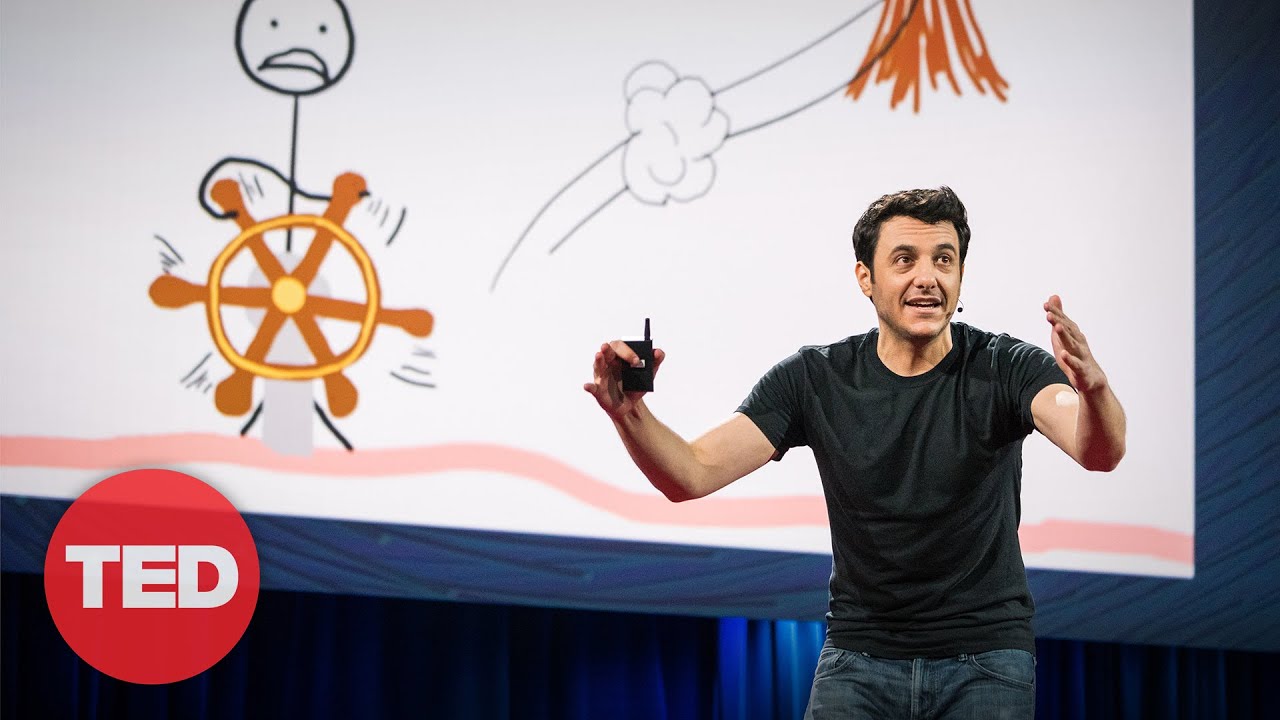
but the Monkey doesn't like that plan,
4:19
so he actually takes the wheel,
4:20
and he says, "Actually, let's read
the entire Wikipedia page
4:23
of the Nancy Kerrigan/
Tonya Harding scandal,
4:25
because I just remembered
that that happened.
4:28
(Laughter)
4:29
Then --
4:30
(Laughter)
4:31
Then we're going to go over to the fridge,
4:33
to see if there's anything new
in there since 10 minutes ago.
4:36
After that, we're going to go
on a YouTube spiral
4:39
that starts with videos
of Richard Feynman talking about magnets
4:42
and ends much, much later
with us watching interviews
4:45
with Justin Bieber's mom.
4:47
(Laughter)
4:49
"All of that's going to take a while,
4:51
so we're not going to really have room
on the schedule for any work today.
4:54
Sorry!"
4:55
(Sigh)
4:58
Now, what is going on here?
5:03
The Instant Gratification Monkey
does not seem like a guy
5:06
you want behind the wheel.
5:07
He lives entirely in the present moment.
5:09
He has no memory of the past,
no knowledge of the future,
5:12
and he only cares about two things:
5:14
easy and fun.
5:16
Now, in the animal world, that works fine.
5:19
If you're a dog
5:20
and you spend your whole life doing
nothing other than easy and fun things,
5:24
you're a huge success!
5:25
(Laughter)
5:27
And to the Monkey,
5:29
humans are just another animal species.
5:32
You have to keep well-slept, well-fed
and propagating into the next generation,
5:36
which in tribal times
might have worked OK.
5:38
But, if you haven't noticed,
now we're not in tribal times.
5:41
We're in an advanced civilization,
and the Monkey does not know what that is.
5:45
Which is why we have
another guy in our brain,
5:48
the Rational Decision-Maker,
5:50
who gives us the ability to do things
no other animal can do.
5:53
We can visualize the future.
5:55
We can see the big picture.
5:57
We can make long-term plans.
5:58
And he wants to take
all of that into account.
6:02
And he wants to just have us do
6:03
whatever makes sense
to be doing right now.
6:06
Now, sometimes it makes sense
6:08
to be doing things that are easy and fun,
6:10
like when you're having dinner
or going to bed
6:12
or enjoying well-earned leisure time.
6:14
That's why there's an overlap.
6:15
Sometimes they agree.
6:17
But other times, it makes much more sense
6:20
to be doing things that are harder
and less pleasant,
6:24
for the sake of the big picture.
6:25
And that's when we have a conflict.
6:28
And for the procrastinator,
6:29
that conflict tends to end
a certain way every time,
6:31
leaving him spending a lot of time
in this orange zone,
6:35
an easy and fun place that's entirely
out of the Makes Sense circle.
6:39
I call it the Dark Playground.
6:42
(Laughter)
6:43
Now, the Dark Playground is a place
6:47
that all of you procrastinators
out there know very well.
6:50
It's where leisure activities happen
6:52
at times when leisure activities
are not supposed to be happening.
6:56
The fun you have in the Dark Playground
6:58
isn't actually fun,
because it's completely unearned,
7:00
and the air is filled with guilt,
dread, anxiety, self-hatred --
7:04
all of those good procrastinator feelings.
7:06
And the question is, in this situation,
with the Monkey behind the wheel,
7:10
how does the procrastinator ever get
himself over here to this blue zone,
7:13
a less pleasant place, but where
really important things happen?
7:17
Well, turns out the procrastinator
has a guardian angel,
7:22
someone who's always looking
down on him and watching over him
7:25
in his darkest moments --
7:26
someone called the Panic Monster.
7:28
(Laughter)
7:34
Now, the Panic Monster
is dormant most of the time,
7:39
but he suddenly wakes up
anytime a deadline gets too close
7:43
or there's danger of public embarrassment,
7:45
a career disaster or some other
scary consequence.
7:47
And importantly, he's the only thing
the Monkey is terrified of.
7:51
Now, he became very relevant
in my life pretty recently,
7:56
because the people of TED
reached out to me about six months ago
7:59
and invited me to do a TED Talk.
8:01
(Laughter)
8:07
Now, of course, I said yes.
8:08
It's always been a dream of mine
to have done a TED Talk in the past.
8:12
(Laughter)
8:16
(Applause)
8:24
But in the middle of all this excitement,
8:26
the Rational Decision-Maker seemed
to have something else on his mind.
8:29
He was saying, "Are we clear
on what we just accepted?
8:32
Do we get what's going to be now
happening one day in the future?
8:35
We need to sit down
and work on this right now."
8:37
And the Monkey said, "Totally agree,
but let's just open Google Earth
8:40
and zoom in to the bottom of India,
like 200 feet above the ground,
8:44
and scroll up for two and a half hours
til we get to the top of the country,
8:47
so we can get a better feel for India."
8:49
(Laughter)
8:55
So that's what we did that day.
8:56
(Laughter)
9:00
As six months turned into four
and then two and then one,
9:04
the people of TED decided
to release the speakers.
9:07
And I opened up the website,
and there was my face
9:10
staring right back at me.
9:11
And guess who woke up?
9:13
(Laughter)
9:17
So the Panic Monster
starts losing his mind,
9:19
and a few seconds later,
the whole system's in mayhem.
9:22
(Laughter)
9:27
And the Monkey -- remember,
he's terrified of the Panic Monster --
9:30
boom, he's up the tree!
9:31
And finally,
9:32
finally, the Rational Decision-Maker
can take the wheel
9:35
and I can start working on the talk.
9:37
Now, the Panic Monster explains
9:39
all kinds of pretty insane
procrastinator behavior,
9:43
like how someone like me
could spend two weeks
9:45
unable to start the opening
sentence of a paper,
9:49
and then miraculously find
the unbelievable work ethic
9:52
to stay up all night
and write eight pages.
9:56
And this entire situation,
with the three characters --
9:59
this is the procrastinator's system.
10:02
It's not pretty, but in the end, it works.
10:05
This is what I decided to write about
on the blog a couple of years ago.
10:09
When I did, I was amazed by the response.
10:12
Literally thousands of emails came in,
10:14
from all different kinds of people
from all over the world,
10:17
doing all different kinds of things.
10:19
These are people who were nurses,
bankers, painters, engineers
10:22
and lots and lots of PhD students.
10:24
(Laughter)
10:26
And they were all writing,
saying the same thing:
10:29
"I have this problem too."
10:31
But what struck me was the contrast
between the light tone of the post
10:34
and the heaviness of these emails.
10:36
These people were writing
with intense frustration
10:40
about what procrastination
had done to their lives,
10:42
about what this Monkey had done to them.
10:46
And I thought about this, and I said,
10:49
well, if the procrastinator's system
works, then what's going on?
10:53
Why are all of these people
in such a dark place?
10:55
Well, it turns out that there's
two kinds of procrastination.
10:59
Everything I've talked about today,
the examples I've given,
11:02
they all have deadlines.
11:04
And when there's deadlines,
11:05
the effects of procrastination
are contained to the short term
11:08
because the Panic Monster gets involved.
11:10
But there's a second kind
of procrastination
11:12
that happens in situations
when there is no deadline.
11:14
So if you wanted a career
where you're a self-starter --
11:17
something in the arts,
something entrepreneurial --
11:19
there's no deadlines on those things
at first, because nothing's happening,
11:23
not until you've gone out
and done the hard work
11:25
to get momentum, get things going.
11:27
There's also all kinds of important things
outside of your career
11:30
that don't involve any deadlines,
11:32
like seeing your family or exercising
and taking care of your health,
11:35
working on your relationship
11:36
or getting out of a relationship
that isn't working.
11:39
Now if the procrastinator's only mechanism
of doing these hard things
11:44
is the Panic Monster, that's a problem,
11:46
because in all of these
non-deadline situations,
11:49
the Panic Monster doesn't show up.
11:51
He has nothing to wake up for,
11:52
so the effects of procrastination,
they're not contained;
11:55
they just extend outward forever.
11:57
And it's this long-term
kind of procrastination
12:00
that's much less visible
and much less talked about
12:03
than the funnier, short-term
deadline-based kind.
12:06
It's usually suffered
quietly and privately.
12:10
And it can be the source
12:11
of a huge amount of long-term
unhappiness, and regrets.
12:16
And I thought, that's why
those people are emailing,
12:19
and that's why they're
in such a bad place.
12:21
It's not that they're cramming
for some project.
12:24
It's that long-term procrastination
has made them feel like a spectator,
12:28
at times, in their own lives.
12:30
The frustration is not
that they couldn't achieve their dreams;
12:33
it's that they weren't even
able to start chasing them.
12:36
So I read these emails
and I had a little bit of an epiphany --
12:42
that I don't think
non-procrastinators exist.
12:45
That's right -- I think all of you
are procrastinators.
12:49
Now, you might not all be a mess,
12:51
like some of us,
12:53
(Laughter)
12:54
and some of you may have
a healthy relationship with deadlines,
12:58
but remember: the Monkey's sneakiest trick
13:00
is when the deadlines aren't there.
13:03
Now, I want to show you one last thing.
13:05
I call this a Life Calendar.
13:08
That's one box for every week
of a 90-year life.
13:13
That's not that many boxes,
13:14
especially since we've already
used a bunch of those.
13:18
So I think we need to all take a long,
hard look at that calendar.
13:24
We need to think about what
we're really procrastinating on,
13:28
because everyone is procrastinating
on something in life.
13:32
We need to stay aware
of the Instant Gratification Monkey.
13:37
That's a job for all of us.
13:40
And because there's not
that many boxes on there,
13:42
it's a job that should
probably start today.
13:45
Well, maybe not today, but ...
13:48
(Laughter)
13:49
You know.
13:51
Sometime soon.
13:53
Thank you.
13:54
(Applause)
— end of transcript —
Advertisement
More from TED
 12:54
12:54
How to Make Learning as Addictive as Social Media | Duolingo's Luis Von Ahn | TED
TED
 20:32
20:32
This could be why you're depressed or anxious | Johann Hari | TED
TED
 10:46
10:46
The secrets of learning a new language | Lýdia Machová | TED
TED
 11:44
11:44
Celeste Headlee: 10 ways to have a better conversation | TED
TED