Advertisement
 12:54
12:54
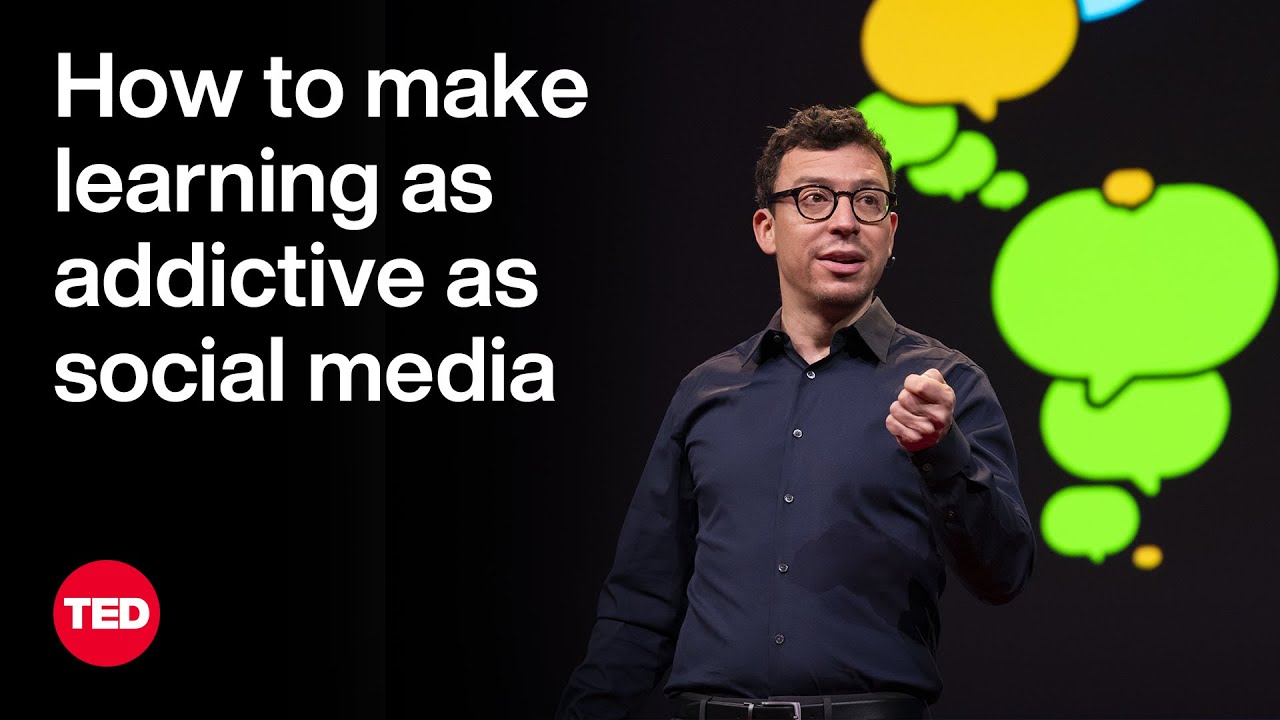
How to Make Learning as Addictive as Social Media | Duolingo's Luis Von Ahn | TED
TED
·
May 10, 2026
Open on YouTube
Transcript
0:04
So, I'm from Guatemala.
0:07
This is a public service announcement,
0:09
that is where Guatemala is.
0:10
(Laughter)
0:13
Also, that is not
where they keep the prisoners.
0:15
That is called Guantanamo.
0:17
(Laughter)
0:18
Not the same place.
Advertisement
0:20
So Guatemala's right below Mexico.
0:22
And for the Americans in the audience,
0:24
and let this sink in,
because it really applies in most ways,
0:27
for the Americans in the audience,
0:29
you can think of it as Mexico's Mexico.
0:31
(Laughter)
0:33
Just like the US doesn't want
illegal immigration from Mexico,
0:36
Mexico doesn't want
illegal immigration from Guatemala.
0:39
It's a smaller country.
0:41
It's a poor country.
Advertisement
0:43
And well, what can I tell you,
0:45
it has much better Mexican food.
0:47
(Laughter)
0:51
Guatemala is a very poor country.
0:53
And a lot of people talk about education
0:56
as something that brings equality
to different social classes.
0:59
But I always saw it as the opposite,
as something that brings inequality.
1:02
Because what happens in practice
1:04
is that people who have a lot of money
can buy themselves a really good education
1:07
and therefore continue
having a lot of money.
1:10
Whereas people who don't have
very much money
1:12
barely learn how to read and write
1:13
and therefore never make a lot of money.
1:15
And this is especially true
in poor countries.
1:17
Now, I was fortunate that I received
a rich person's education
1:21
even though I didn't grow up rich.
1:23
And it’s because I’m an only child.
1:25
And my mother, who was a single mother,
1:27
spent all of her resources
on my education.
1:30
And this allowed me to come
to college to the US
1:33
and eventually get a PhD
in computer science.
1:36
Now because of all of this
1:39
about 10 years ago,
1:41
I decided I wanted to do something
1:42
that would give equal access
to education to everyone.
1:46
Oh, by the way, this is what I want
to talk to you about today,
1:49
giving equal access
to education to everyone.
1:51
At the time, I was a professor
of computer science
1:53
at Carnegie Mellon University,
1:55
and I decided to work on this
with my PhD student, Severin.
2:01
The way my brain works,
2:02
all of education is just
too general of a problem.
2:05
So I decided, let's start
by teaching one thing.
2:08
And then I started thinking,
OK, well, what should we teach first?
2:12
Should we teach math?
2:13
I mean, we both love math.
2:14
Me and my cofounder, we both love math.
2:16
And, you know, we didn't
decide to do math.
2:19
Then we started thinking, well, maybe
we should teach computer science.
2:23
But eventually, and this is maybe
surprising to people in North America,
2:26
eventually, we decided
that the best subject to start with
2:29
was teaching foreign languages.
2:31
And let me tell you why.
2:33
There's a number of reasons.
2:35
One of them is that there's
a huge audience for it.
2:37
There’s about two billion people
in the world learning a foreign language,
2:41
both in school and outside of schools.
2:43
Most of these people, by the way,
are learning English.
2:45
About 80 percent of them
are learning English.
2:47
In this weird map right here,
2:49
all the countries in green
2:50
are countries in which people
are predominantly learning English.
2:53
And the reason for that
2:54
is because English can truly
transform your life.
2:57
In most countries in the world,
2:58
knowledge of English can significantly
increase your income potential.
3:02
So this is another reason why we decided
to start with foreign languages.
3:05
And it's because you can directly
make more money
3:08
if you learn another language,
in particular English.
3:10
And see, this is pretty different
than many other subjects.
3:13
For example, take math.
3:14
In the case of math,
3:15
just knowledge of math does not
increase your income potential
3:18
because usually you have to learn math
to then learn physics
3:21
to then become a civil engineer,
that's how you make more money.
3:24
Whereas with languages,
if you are a waiter and you learn English,
3:27
now you can be a waiter at a hotel
and make more money.
3:30
So we decided, well, let's get started
by teaching languages.
3:34
Now, we also convinced ourselves
3:36
that the only way
to really reach a lot of people
3:40
was by using a mobile phone,
or a smartphone in particular.
3:44
See, building schools all over the world
is simply too expensive.
3:47
On the other hand,
3:49
most of the world's population
already has access to a smartphone,
3:52
and the trend is that that fraction
is only going to increase.
3:55
So we decided at the time
3:56
that we would make a way to learn
foreign languages on a mobile phone
4:00
that was accessible to everyone.
4:02
And then we called it Duolingo.
4:04
Thank you.
4:06
(Applause)
4:09
Now in order to truly be accessible
to everyone, rich and poor,
4:13
Duolingo uses a freemium model
to support itself.
4:16
What that means is that you can learn
as much as you want
4:20
without ever having to pay.
4:22
But if you don't pay,
4:23
you may have to see an ad
at the end of a lesson.
4:25
Now, if you don't like ads,
4:27
you can also pay to subscribe
to turn off the ads.
4:30
And it turns out that the vast majority
of the revenue for Duolingo
4:33
comes from people who pay
to subscribe to turn off the ads.
4:38
Now, who are these people who pay
to subscribe to turn off the ads?
4:41
Well, they're usually well-off people
in rich countries like the US and Canada.
4:47
Who are the people
who don't pay to subscribe?
4:49
They usually come from poorer countries
like Brazil or Vietnam or Guatemala.
4:53
So what I like about this model
4:55
is that it is a small form
of wealth redistribution
4:57
because we're basically
getting the rich people
5:00
to pay for the education of everyone.
5:02
So I like that.
5:03
(Applause)
5:06
So with smartphones,
we can reach a lot of people
5:09
and we can even get the rich people
to pay for the whole thing,
5:12
which is great.
5:13
However, if you're trying to deliver
education with a smartphone,
5:16
you run into a humongous problem.
5:18
And it is that smartphones come equipped
5:20
with some of the most addictive drugs
that humanity has ever engineered.
5:24
TikTok, Instagram, mobile games.
5:27
See, delivering education
over a smartphone
5:29
is like hoping that people
will eat their broccoli,
5:32
but right next to it, you put
the most delicious dessert ever made.
5:35
(Laughter)
5:38
If you really want to deliver
education to everyone,
5:40
not only do you have
to make it accessible,
5:42
but also you have to make it
so that people want to actually learn.
5:46
And with Duolingo,
we've been able to do this.
5:48
And at the highest level,
the way we've done this
5:51
is by making the broccoli
taste like dessert.
5:55
I'll say it another way.
5:56
What we've done is that we've used
the same psychological techniques
5:59
that apps like Instagram,
TikTok or mobile games use
6:04
to keep people engaged,
6:05
but in this case, we use them
to keep people engaged
6:07
but with education.
6:09
Let me give you some examples
of these techniques.
6:11
One of the most powerful ones
is the notion of a streak.
6:14
What a streak is, is it’s just a counter
6:16
that measures the number of days
6:18
that you've used
the product consecutively.
6:21
You just take that number,
6:22
you put it very prominently
in your product
6:24
and then people come back every day.
6:27
And the reason people come back
every day is because, well,
6:30
if they don't come back,
that number resets to zero
6:33
and people don't want
to lose their streak.
6:35
It works.
6:37
Now, on the one side,
6:38
streaks have been criticized
for, for example,
6:42
getting teens addicted to Snapchat.
6:44
But in the case of an educational app,
6:47
streaks get people to come back
to study every day.
6:50
Now, to give you an idea
of the power of streaks,
6:52
in the case of Duolingo,
6:53
we have over three million
daily active users
6:55
that have a streak longer than 365.
6:58
(Applause)
7:02
That means they haven't missed a day
in the last year or longer.
7:05
Now, fun fact about streaks.
7:07
What country do you think
has the longest average streaks
7:11
for an educational app?
7:13
It's Japan.
7:15
Of course.
7:17
Shortest-ever streaks?
7:19
Latin America, baby.
7:21
(Laughter)
7:22
But we're fun, hey, we're fun.
7:24
(Laughter)
7:26
Another important mechanism to get people
to come back to your product
7:30
are notifications.
7:31
On the one side, notifications
can be really spammy and annoying,
7:34
but in the case of an educational product,
7:36
people actually want
to be reminded to learn.
7:38
In the case of Duolingo, we have
a very sophisticated AI system
7:42
that basically chooses
when to send the notification
7:46
and also what to say in each notification
7:48
to maximize the probability
that people come back.
7:51
Now, interestingly,
7:53
even after all this sophistication,
7:55
it turns out that the algorithm
for choosing what time
7:58
to send you a notification
is pretty simple.
8:00
Do you know what is the best time
to send people a notification?
8:03
I'll tell you.
8:04
It's 24 hours after
they used the product last.
8:06
There's an easy explanation.
8:08
If you were free yesterday at 3pm,
8:10
you’re probably free today
at 3pm as well.
8:13
So this is what a very sophisticated
millions of dollars of AI found.
8:16
(Laughter)
8:19
It's funny.
8:20
Now with notifications
you shouldn't be spamming.
8:23
And we're not spamming, with Duolingo,
8:25
we actually stop sending notifications
after seven days of inactivity.
8:28
So if you don't use Duolingo
for seven days,
8:30
we stop sending you notifications.
8:32
Now, at some point it occurred to us,
8:34
if we're stopping
to send people notifications,
8:36
we should let them know.
8:37
So we started sending
this notification to people saying,
8:40
"Hey, these reminders
don't seem to be working.
8:42
We'll stop sending them for now."
8:44
You know what people do
when they get this notification?
8:47
They come back.
8:48
(Laughter)
8:50
Passive aggressive.
8:51
(Laughter)
8:54
Works for my mother, works for Duolingo.
8:56
(Laughter and applause)
9:02
These passive aggressive notifications
9:04
are really good at getting
people to come back
9:07
back because they feel like our green
owl mascot has given up on them,
9:10
so they come back.
9:11
And speaking of our
green owl mascot, by the way,
9:13
because all our notifications come
from our green owl mascot
9:16
and well, he's passive aggressive
and also pretty pushy,
9:19
this has given rise to a lot
of memes on the internet
9:21
that make fun of the great lengths
that he will go through
9:24
to get you back to learn a language.
9:26
Here's one of my favorite ones.
9:28
This is it's a meme,
it’s one of my favorite ones.
9:30
(Laughter)
9:32
Basically looks like you forgot
your Spanish lessons.
9:35
And then there's an intruder alert,
9:36
presumably the owl broke into your house
to get you to learn language.
9:40
Now, Duolingo has entered the zeitgeist.
9:43
And there's thousands of memes,
there's SNL skits about it.
9:46
And it's because we've managed
to get people to want to learn a language
9:50
by using the same techniques
9:52
that mobile games and social media use
to get people engaged.
9:57
And this is a really important point,
10:00
let me say this.
10:02
I don't actually believe that there's
a way to make an educational app
10:05
be as engaging as something like TikTok
or Instagram or mobile games.
10:11
But the good news is that --
10:12
And by the way, the reason
I don't believe that
10:14
is because ultimately you have
to teach people something.
10:17
And it's hard to compete with,
like, cats and celebrities.
10:20
But the good news is
that I don't think you have to.
10:22
See, here's the thing.
10:23
When you're learning something,
you get meaning out of it.
10:26
Whereas when you're scrolling
for two hours on Instagram,
10:29
a lot of times afterwards, you feel
like you just wasted your time.
10:32
So I think it's actually OK
if your educational product
10:36
is only 80 or 90 percent as engaging
as something like TikTok,
10:39
because the other 10 or 20 percent
10:41
will be provided
by people's internal motivation,
10:44
though of course, not much more than that.
10:46
This is really a key point.
10:47
If we want to get people
to do something meaningful,
10:51
you can use the same techniques
that apps like social media use
10:54
to get people to do it.
10:56
And even if you're not as engaging
as those apps are,
10:59
you can still get hundreds of millions
of people to use your product.
11:02
In the case of Duolingo, for example,
11:04
there are more people learning languages
on Duolingo in the United States
11:08
than there are people learning languages
across all US high schools combined.
11:12
(Applause)
11:13
And this is true
in most countries in the world.
11:16
My hope is that -- I know
we can do this, but, you know,
11:20
my hope is that as humanity,
11:21
we can do what Duolingo has done
for learning languages
11:24
but for all other subjects.
11:26
Where we can get people
to learn math with mobile phones,
11:29
like millions of people to learn
math with mobile phones
11:32
or physics or whatever.
11:34
I hope for a future in which
screen time is not a bad thing,
11:38
in which we can deliver high-quality
education to everyone, rich or poor,
11:42
using a mobile phone.
11:43
But the single most important thing
that I can end this talk with,
11:47
is a reminder to please,
pretty please, I beg you,
11:52
do your language lessons today.
11:53
Thank you very much.
11:55
(Laughter)
11:56
Thank you.
11:57
(Applause)
12:05
Helen Walters: Luis, thank you so much.
12:07
I wonder if you can just say
a little bit more about that last point,
12:10
how do you think you can apply
this type of thinking
12:14
to other subjects?
12:16
So you mentioned math,
and things like that.
12:18
How do you do that?
12:20
Luis von Ahn: I think in particular,
12:22
subjects that are learned
through repetition
12:24
and it turns out most things
that are kind of really meaningful
12:27
are learned through
thousands of repetitions.
12:29
You learn to read through repetition,
12:31
you learn elementary school math
through repetition.
12:33
Most things that you can learn
through repetition,
12:35
you can actually gamify
and turn into something like Duolingo,
12:38
where people just
do it a lot and do it fun.
12:40
It's a little harder for things
like explanations.
12:43
That probably is going to require
some really good videos.
12:46
Sal Khan is doing a really
good job with that.
12:48
But for things that require
a lot of repetition,
12:50
I think we can use the same methods.
12:52
(Applause)
— end of transcript —
Advertisement
More from TED
 10:46
10:46
The secrets of learning a new language | Lýdia Machová | TED
TED
 20:32
20:32
This could be why you're depressed or anxious | Johann Hari | TED
TED
 20:50
20:50
The Power of Vulnerability | Brené Brown | TED
TED
 12:47
12:47
What Makes a Good Life? Lessons from the Longest Study on Happiness | Robert Waldinger | TED
TED