Advertisement
 5:21
5:21
Transcript
0:06
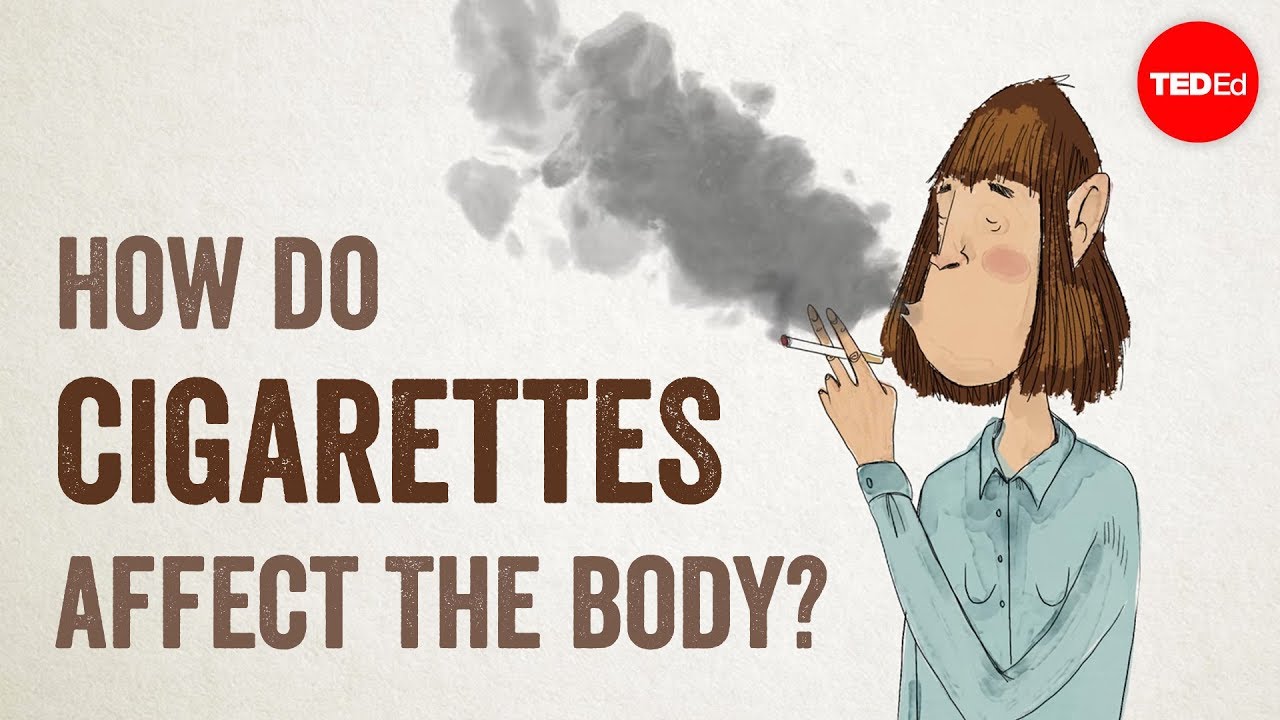
Cigarettes aren’t good for us.
0:09
That’s hardly news--we’ve known
about the dangers of smoking for decades.
0:13
But how exactly do cigarettes harm us?
0:16
Let’s look at what happens
as their ingredients
0:19
make their way through our bodies,
0:20
and how we benefit physically
when we finally give up smoking.
0:25
With each inhalation,
0:27
smoke brings its more than 5,000
chemical substances
Advertisement
0:31
into contact with the body’s tissues.
0:33
From the start, tar,
a black, resinous material,
0:37
begins to coat the teeth and gums,
0:39
damaging tooth enamel,
and eventually causing decay.
0:43
Over time, smoke also damages
nerve-endings in the nose,
0:47
causing loss of smell.
0:50
Inside the airways and lungs,
0:51
smoke increases
the likelihood of infections,
0:54
as well as chronic diseases
like bronchitis and emphysema.
0:59
It does this by damaging the cilia,
Advertisement
1:01
tiny hairlike structures whose job it is
to keep the airways clean.
1:07
It then fills the alveoli,
1:09
tiny air sacs that enable the exchange
of oxygen and carbon dioxide
1:13
between the lungs and blood.
1:15
A toxic gas called carbon monoxide
crosses that membrane into the blood,
1:20
binding to hemoglobin
1:21
and displacing the oxygen
1:23
it would usually have transported
around the body.
1:26
That’s one of the reasons smoking
can lead to oxygen deprivation
1:30
and shortness of breath.
1:32
Within about 10 seconds,
1:35
the bloodstream carries a stimulant
called nicotine to the brain,
1:38
triggering the release of dopamine
and other neurotransmitters
1:42
including endorphins
1:43
that create the pleasurable sensations
which make smoking highly addictive.
1:47
Nicotine and other chemicals
from the cigarette
1:50
simultaneously cause constriction
of blood vessels
1:53
and damage their delicate
endothelial lining,
1:55
restricting blood flow.
1:57
These vascular effects lead
to thickening of blood vessel walls
2:00
and enhance blood platelet stickiness,
2:03
increasing the likelihood
that clots will form
2:06
and trigger heart attacks and strokes.
2:08
Many of the chemicals inside cigarettes
can trigger dangerous mutations
2:12
in the body’s DNA that make cancers form.
2:15
Additionally, ingredients like arsenic
and nickel
2:18
may disrupt the process of DNA repair,
2:21
thus compromising the body’s ability
to fight many cancers.
2:25
In fact, about one of every three
cancer deaths in the United States
2:29
is caused by smoking.
2:31
And it’s not just lung cancer.
2:33
Smoking can cause cancer
in multiple tissues and organs,
2:36
as well as damaged eyesight
2:38
and weakened bones.
2:40
It makes it harder
for women to get pregnant.
2:43
And in men,
it can cause erectile dysfunction.
2:46
But for those who quit smoking,
2:47
there’s a huge positive upside
2:49
with almost immediate
and long-lasting physical benefits.
2:53
Just 20 minutes after
a smoker’s final cigarette,
2:57
their heart rate and blood pressure
begin to return to normal.
3:00
After 12 hours,
carbon monoxide levels stabilize,
3:04
increasing the blood’s
oxygen-carrying capacity.
3:07
A day after ceasing,
3:08
heart attack risk begins to decrease as
blood pressure and heart rates normalize.
3:13
After two days,
3:15
the nerve endings responsible
for smell and taste start to recover.
3:20
Lungs become healthier
after about one month,
3:23
with less coughing
and shortness of breath.
3:25
The delicate hair-like cilia
in the airways and lungs
3:28
start recovering within weeks,
3:31
and are restored after 9 months,
improving resistance to infection.
3:35
By the one-year anniversary of quitting,
3:37
heart disease risk plummets to half
as blood vessel function improves.
3:42
Five years in,
3:44
the chance of a clot forming
dramatically declines,
3:46
and the risk of stroke
continues to reduce.
3:49
After ten years, the chances
of developing fatal lung cancer
3:53
go down by 50%,
3:55
probably because the body’s ability
to repair DNA is once again restored.
4:00
Fifteen years in, the likelihood
of developing coronary heart disease
4:04
is essentially the same
as that of a non-smoker.
4:07
There’s no point pretending
this is all easy to achieve.
4:10
Quitting can lead to anxiety
and depression,
4:13
resulting from nicotine withdrawal.
4:15
But fortunately,
such effects are usually temporary.
4:19
And quitting is getting easier,
thanks to a growing arsenal of tools.
4:23
Nicotine replacement therapy through gum,
4:26
skin patches,
4:27
lozenges,
4:28
and sprays
4:29
may help wean smokers off cigarettes.
4:32
They work by stimulating
nicotine receptors in the brain
4:35
and thus preventing withdrawal symptoms,
4:37
without the addition
of other harmful chemicals.
4:40
Counselling and support groups,
4:42
cognitive behavioral therapy,
4:44
and moderate intensity exercise
4:46
also help smokers stay cigarette-free.
4:50
That’s good news,
4:51
since quitting puts you and your body
on the path back to health.
— end of transcript —
Advertisement