Advertisement
 5:09
5:09
Transcript
0:06
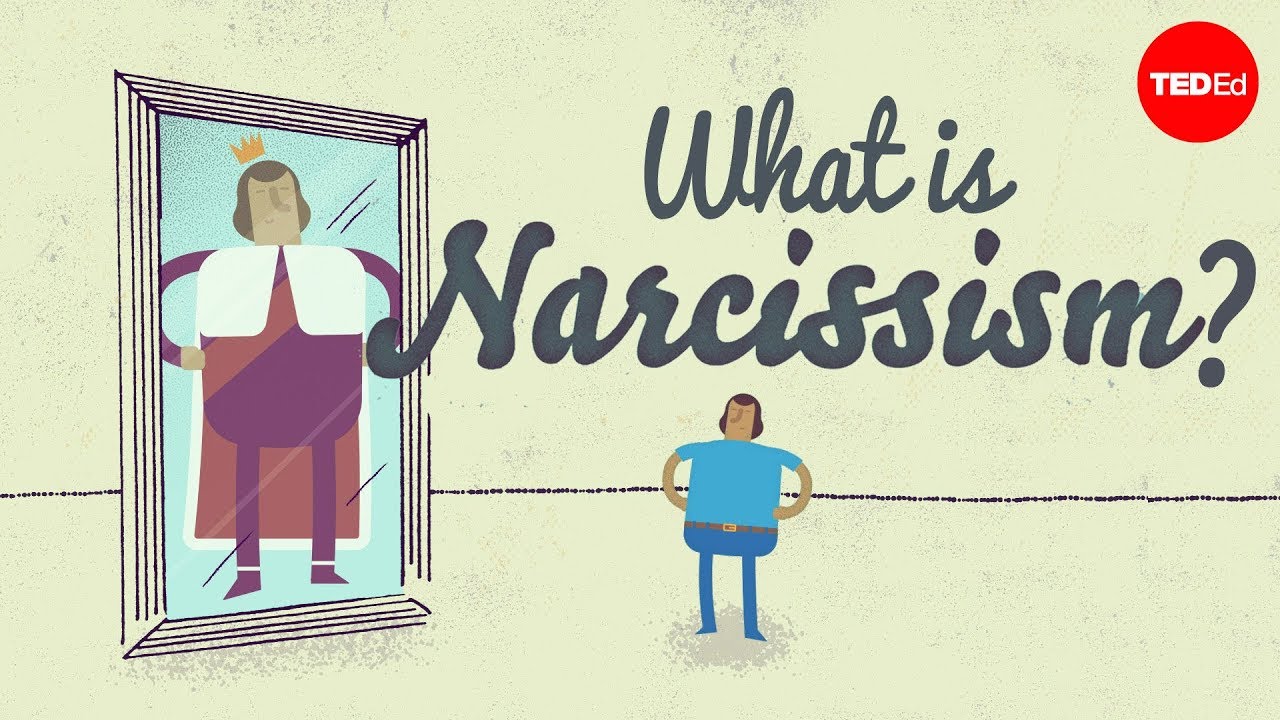
Way before the first selfie,
0:08
the ancient Greeks and Romans had a myth
0:10
about someone a little too obsessed
with his own image.
0:14
In one telling,
0:15
Narcissus was a handsome guy wandering
the world in search of someone to love.
0:20
After rejecting a nymph named Echo,
0:23
he caught a glimpse
of his own reflection in a river,
0:26
and fell in love with it.
Advertisement
0:28
Unable to tear himself away,
0:30
Narcissus drowned.
0:31
A flower marked the spot of where he died,
and we call that flower the Narcissus.
0:37
The myth captures
the basic idea of narcissism,
0:40
elevated and sometimes
detrimental self-involvement.
0:44
But it's not just a personality type
that shows up in advice columns.
0:48
It's actually a set of traits classified
and studied by psychologists.
0:52
The psychological definition of narcissism
is an inflated, grandiose self-image.
0:58
To varying degrees, narcissists think
they're better looking,
1:02
smarter,
Advertisement
1:02
and more important than other people,
1:05
and that they deserve special treatment.
1:08
Psychologists recognize two forms
of narcissism as a personality trait:
1:12
grandiose and vulnerable narcissism.
1:15
There's also narcissistic
personality disorder,
1:18
a more extreme form,
which we'll return to shortly.
1:22
Grandiose narcissism
is the most familiar kind,
1:25
characterized by extroversion,
1:27
dominance,
1:28
and attention seeking.
1:30
Grandiose narcissists pursue
attention and power,
1:33
sometimes as politicians,
1:35
celebrities,
1:36
or cultural leaders.
1:38
Of course, not everyone who pursues
these positions of power is narcissistic.
1:42
Many do it for very positive reasons,
1:44
like reaching their full potential,
1:46
or helping make people's lives better.
1:48
But narcissistic individuals seek power
1:50
for the status
and attention that goes with it.
1:53
Meanwhile, vulnerable narcissists
can be quiet and reserved.
1:57
They have a strong sense of entitlement,
1:59
but are easily threatened or slighted.
2:02
In either case, the dark side of
narcissism shows up over the long term.
2:07
Narcissists tend to act selfishly,
2:09
so narcissistic leaders may make risky
or unethical decisions,
2:14
and narcissistic partners may be dishonest
or unfaithful.
2:19
When their rosy view of themselves
is challenged,
2:21
they can become resentful and aggressive.
2:24
It's like a disease where the sufferers
feel pretty good,
2:27
but the people around them suffer.
2:29
Taken to the extreme,
2:30
this behavior is classified
as a psychological disorder
2:34
called narcissistic personality disorder.
2:36
It affects one to two percent
of the population,
2:39
more commonly men.
2:41
It is also a diagnosis
reserved for adults.
2:44
Young people, especially children,
can be very self-centered,
2:48
but this might just be a normal
part of development.
2:51
The fifth edition of the American
Psychiatric Association's
2:54
Diagnostic and Statistical Manual
2:57
describes several traits associated
with narcissistic personality disorder.
3:01
They include a grandiose view of oneself,
3:04
problems with empathy,
3:06
a sense of entitlement,
3:07
and a need for admiration or attention.
3:10
What makes these trait a true
personality disorder
3:13
is that they take over people's lives
and cause significant problems.
3:17
Imagine that instead of caring
for your spouse or children,
3:21
you used them as a source
of attention or admiration.
3:24
Or imagine that instead of seeking
3:26
constructive feedback
about your performance,
3:28
you instead told everyone
who tried to help you
3:30
that they were wrong.
3:32
So what causes narcissism?
3:35
Twin studies show
a strong genetic component,
3:37
although we don't know
which genes are involved.
3:41
But environment matters, too.
3:42
Parents who put their child
on a pedestal
3:45
can foster grandiose narcissism.
3:47
And cold, controlling parents
can contribute to vulnerable narcissism.
3:53
Narcissism also seems to be higher
3:55
in cultures that value individuality
and self-promotion.
3:59
In the United States, for example,
4:01
narcissism as a personality trait
has been rising since the 1970s,
4:05
when the communal focus of the 60s
4:07
gave way to the self-esteem movement
4:10
and a rise in materialism.
4:12
More recently, social media has multiplied
the possibilities for self-promotion,
4:17
though it's worth noting
4:18
that there's no clear evidence
that social media causes narcissism.
4:22
Rather, it provides narcissists a means
to seek social status and attention.
4:27
So can narcissists improve
on those negative traits?
4:31
Yes!
4:32
Anything that promotes honest reflection
on their own behavior
4:35
and caring for others,
4:37
like psychotherapy or practicing
compassion towards others, can be helpful.
4:42
The difficulty is it can be challenging
4:44
for people with
narcissistic personality disorder
4:46
to keep working at self-betterment.
4:48
For a narcissist, self-reflection is hard
from an unflattering angle.
— end of transcript —
Advertisement