Advertisement
 4:20
4:20
Transcript
0:06
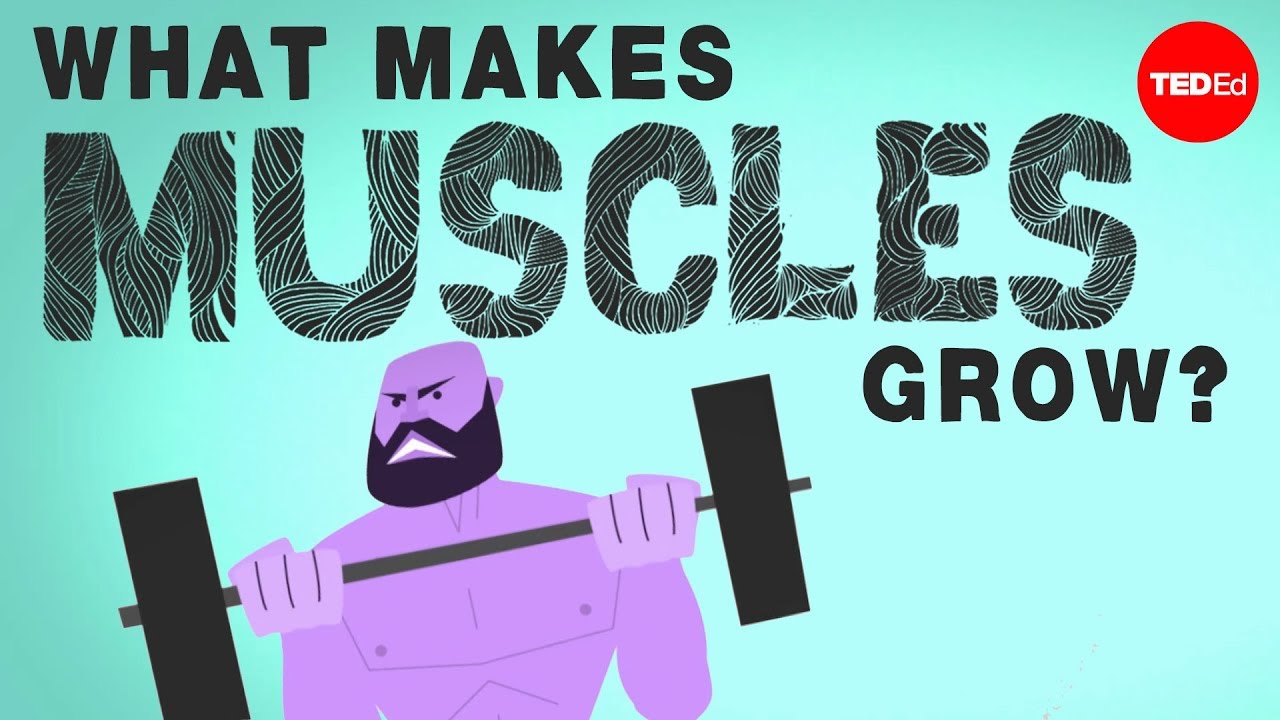
Muscles.
0:08
We have over 600 of them.
0:10
They make up between
1/3 and 1/2 of our body weight,
0:14
and along with connective tissue,
0:16
they bind us together, hold us up,
and help us move.
0:20
And whether or not body building
is your hobby,
0:22
muscles need your constant attention
0:25
because the way you treat
them on a daily basis
Advertisement
0:27
determines whether
they will wither or grow.
0:31
Say you're standing in front of a door,
ready to pull it open.
0:34
Your brain and muscles are perfectly
poised to help you achieve this goal.
0:39
First, your brain sends a signal
to motor neurons inside your arm.
0:43
When they receive this message,
they fire,
0:45
causing muscles to contract and relax,
0:49
which pull on the bones in your arm
and generate the needed movement.
0:53
The bigger the challenge becomes,
the bigger the brain's signal grows,
0:57
and the more motor units it rallies
to help you achieve your task.
1:01
But what if the door
is made of solid iron?
Advertisement
1:04
At this point, your arm muscles alone
1:06
won't be able to generate
enough tension to pull it open,
1:10
so your brain appeals
to other muscles for help.
1:13
You plant your feet, tighten your belly,
and tense your back,
1:17
generating enough force to yank it open.
1:20
Your nervous system has just leveraged
the resources you already have,
1:24
other muscles,
1:26
to meet the demand.
1:27
While all this is happening,
1:28
your muscle fibers undergo
another kind of cellular change.
1:32
As you expose them to stress,
they experience microscopic damage,
1:37
which, in this context, is a good thing.
1:40
In response, the injured cells release
inflammatory molecules called cytokines
1:45
that activate the immune system
to repair the injury.
1:50
This is when the muscle-building
magic happens.
1:53
The greater the damage
to the muscle tissue,
1:55
the more your body
will need to repair itself.
1:59
The resulting cycle of damage and repair
2:01
eventually makes muscles
bigger and stronger
2:04
as they adapt to progressively
greater demands.
2:08
Since our bodies have already adapted
to most everyday activities,
2:11
those generally don't produce
enough stress
2:14
to stimulate new muscle growth.
2:17
So, to build new muscle,
a process called hypertrophy,
2:20
our cells need to be exposed to higher
workloads than they are used to.
2:25
In fact, if you don't continuously expose
your muscles to some resistance,
2:29
they will shrink,
2:31
a process known as muscular atrophy.
2:34
In contrast, exposing the muscle
to a high-degree of tension,
2:37
especially while
the muscle is lengthening,
2:40
also called an eccentric contraction,
2:42
generates effective conditions
for new growth.
2:46
However, muscles rely on more than
just activity to grow.
2:50
Without proper nutrition,
hormones, and rest,
2:53
your body would never be able
to repair damaged muscle fibers.
2:56
Protein in our diet preserves muscle mass
2:59
by providing the building
blocks for new tissue
3:02
in the form of amino acids.
3:04
Adequate protein intake,
along with naturally occurring hormones,
3:08
like insulin-like growth factor
and testosterone,
3:11
help shift the body into a state
where tissue is repaired and grown.
3:16
This vital repair process mainly occurs
when we're resting,
3:19
especially at night while sleeping.
3:22
Gender and age
affect this repair mechanism,
3:25
which is why young men
with more testosterone
3:27
have a leg up in the muscle building game.
3:30
Genetic factors also play a role
in one's ability to grow muscle.
3:34
Some people have more robust
immune reactions to muscle damage,
3:38
and are better able to repair
and replace damaged muscle fibers,
3:42
increasing their
muscle-building potential.
3:44
The body responds to the demands
you place on it.
3:47
If you tear your muscles up,
eat right, rest and repeat,
3:52
you'll create the conditions to make your
muscles as big and strong as possible.
3:57
It is with muscles as it is with life:
3:59
Meaningful growth requires challenge
and stress.
— end of transcript —
Advertisement