Advertisement
 11:43
11:43
Transcript
0:10
On the 11th June 323 BC, Alexander the Great
passed away.
0:21
Following his death in Babylon, his body became
a continuing source of war, intrigue and mystery.
0:29
His body and his tomb were lost; yet the legend
lives on and historians are still trying to
0:35
uncover clues to their whereabouts.
0:38
But how did this all come about?
0:41
Why did all records of Alexander’s tomb
abruptly cease?
0:45
In this two-part documentary, we shall unravel
the history surrounding Alexander’s tomb
0:50
and attempt to answer this question.
Advertisement
0:53
This is the story behind Alexander’s body
and his tomb.
0:59
Almost immediately after Alexander’s death,
chaos erupted, as the Macedonians quickly
1:05
began arguing over the fate of the empire,
leaving his body unattended for many days
1:11
in the Babylonian heat.
1:14
Legend has it that upon returning to the corpse,
to everyone’s amazement, they found it in
1:19
pristine condition – untouched by decay.
1:22
Perdiccas, the highest-ranking commander in
Babylon, then had Alexander’s body embalmed
1:29
and placed in a golden coffin.
1:34
For the next two years Alexander’s body
remained in Babylon, as Perdiccas and his
1:40
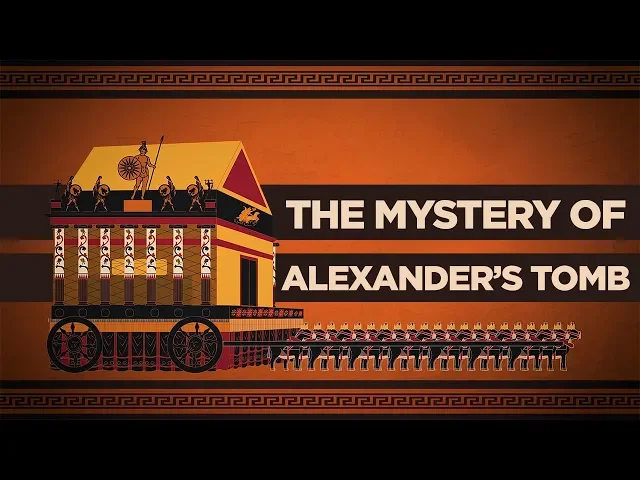
followers oversaw the construction of a funeral
carriage unlike any other the world had seen.
Advertisement
1:47
The carriage was designed to resemble a great
temple: it had beautiful Ionic columns encircled
1:54
by paintings depicting Alexander and his army
and was covered with gold.
1:59
It was to be pulled by 64 mules, each bearing
a golden crown and bell.
2:07
Upon its completion, Perdiccas ordered that
Alexander’s body to be escorted home to
2:12
Aegae in Macedonia – the traditional resting
place of the Macedonian Kings.
2:19
Yet the plan went horribly wrong.
2:24
The governor of Egypt Ptolemy was aware of
the great wealth and potential of his domain
2:30
and soon grew ambitious, eager to get rid
of Perdiccas’ control.
2:36
He believed he might achieve this by taking
possession of Alexander’s body, as it was
2:42
a superhuman talisman representing authority
and legitimacy in this new post-Alexander
2:49
world.
2:50
Whoever controlled the body held great sway.
2:55
Ptolemy was not deterred by Perdiccas’ precautions
to keep the body, but he needed a daring plan.
3:05
In 321 BC, Alexander’s elaborate funeral
cart left Babylon for Macedonia.
3:12
Yet as the procession was making its way through
Syria, Ptolemy made his move, bribing the
3:18
escort, seizing the body and diverting it
to Egypt, where he had it housed in Memphis
3:24
– the traditional Egyptian capital.
3:29
Perdiccas was furious, as his authority as
regent had been severely tarnished.
3:35
It was the opposite for Ptolemy, as Alexander’s
soldiers came from far and wide to swell the
3:41
ranks of his army.
3:43
Perdiccas immediately marched on Egypt with
his army – his main aim to regain control
3:49
of the body and restore his authority.
3:53
In the ensuing war, covered in our documentary
which you can see here, Ptolemy emerged victorious
3:59
and Perdiccas was murdered.
4:01
Alexander’s body was now securely in Ptolemy’s
possession.
4:09
He quickly began proclaiming the link between
himself and Alexander, becoming the first
4:14
of the Diadochi to put Alexander’s image
on his coinage, and emphasising that he was
4:20
a favourite of Alexander in his account on
the conquest of Asia.
4:25
Ptolemy also cultivated a local legend of
Alexander.
4:29
Rather than being the son of Philip of Macedon,
Egyptian tales soon became widespread that
4:35
Alexander was the son of the last Egyptian
pharaoh Nectanebo II.
4:40
In 343 BC, the Persians had deposed Nectanebo,
who had then died in exile.
4:47
His pre-made sarcophagus in Memphis had therefore
remained empty.
4:53
It is likely Ptolemy had first placed Alexander
in this empty coffin and it was from here
4:58
that this fabulous story took root.
5:01
A pharaoh of Egypt could only be legitimate
if he was related to his predecessor, so this
5:07
tale helped portray Alexander as Nectanebo’s
rightful heir.
5:12
It also established a connection between the
Macedonian and Egyptian dynasties – a connection
5:18
that only helped Ptolemy’s cause.
5:21
At the same time, Ptolemy began spreading
the rumour that he was in fact an illegitimate
5:26
son of Philip II and thus the half-brother
of Alexander.
5:32
Both stories spread rapidly and helped Ptolemy
secure his rule in Egypt – thanks in good
5:38
measure to his clever use of Alexander’s
body.
5:42
Following the climactic battle of Ipsus in
301 BC, Ptolemy had Alexander’s body moved
5:49
to the centre of his new capital at Alexandria
and placed in a new, elaborate tomb.
5:56
The city had been founded by Alexander back
in 331 BC but had only recently been completed.
6:04
Immediately, Ptolemy set about promoting Alexander
adulation.
6:09
Not only did he have Alexander publicly honoured
as the founder of Alexandria, but he also
6:15
introduced a state cult of Alexander throughout
Egypt.
6:19
His statues were erected far and wide while
processions and festivals centred around the
6:25
great conqueror also appeared.
6:30
In 283 BC, Ptolemy I passed away.
6:35
For the next 150 years Ptolemy’s descendants
would rule Egypt, and the memory of the great
6:42
king was crucial for their dynasty.
6:48
Almost immediately after his father’s death,
Ptolemy II Philadelphus, had him deified and
6:54
worshipped alongside Alexander.
6:57
The message was clear: in both life and death
these two kings were inseparable.
7:04
Philadelphus also created a new religious
festival in honour of his father: the Ptolemaia.
7:11
Hosted every four years this festival attracted
many thousands of visitors not only from Egypt,
7:17
but all around the Greek World.
7:22
Fortunately for us, a description of the Ptolemaia
staged in 275-274 BC survives.
7:30
Dubbed, ‘the Grand Procession of Ptolemy
Philadelphus’, It was an EXTREMELY lavish
7:36
parade through the centre of Alexandria.
7:38
Soldiers, animals, gems, gold and images of
Gods – especially Dionysios - all featured,
7:47
emphasising the unbounded wealth, splendour
and power of Ptolemaic Egypt.
7:56
Alexander was central to the procession.
7:58
First, his statue appeared on top of a great
float accompanied by another statue of the
8:04
now-deified Ptolemy I - both wearing gold
diadems of ivy leaves.
8:11
Following this came a golden statue of Alexander
in a chariot, towed by four elephants and
8:16
surrounded by statues of the Gods.
8:20
This procession reminded the onlookers not
only that Alexandria was the home of Alexander’s
8:25
body but also of the inseparable link between
it and the Ptolemies.
8:31
Desiring to further emphasise this link Ptolemy
IV ‘Philopator’, placed Alexander’s
8:37
body in a new royal burial complex in c. 215
BC.
8:43
It soon became known as the ‘Soma’ or
the body – named after its main exhibit.
8:48
This new mausoleum was almost certainly visually
majestic – perhaps inspired by the famed
8:56
tomb of Mausolus at Halicarnassus.
8:59
The complex may also have been circular, in
its turn possibly inspiring the great tombs
9:05
of the Roman emperors Augustus and Hadrian.
9:09
Inside the enclosure, Alexander’s body was
placed in an underground chamber along with
9:14
remains of the Ptolemies, once again emphasising
the closest possible link between the Ptolemies
9:20
and Alexander.
9:22
The Soma soon became an iconic feature of
Alexandria.
9:27
From far and wide, visitors would journey
to Alexander’s city and see his marvellous
9:33
tomb.
9:34
It was a place of pagan pilgrimage.
9:36
Still, no dynasty can last forever and by
the beginning of the First Century BC, the
9:43
Ptolemaic dynasty had become a shadow of its
former power.
9:48
So great was its turmoil that in 89 BC King
Ptolemy X had done the unthinkable: in desperate
9:55
need of money to pay his mercenaries, he melted
down Alexander’s golden sarcophagus, replacing
10:01
it with one made of glass.
10:03
Regardless, Ptolemaic power continued to dwindle
and within 70 years, a new power would be
10:09
ruling Alexandria.
10:11
A power that also had a keen interest in Alexander’s
tomb – but for very different reasons: Rome.
11:18
The second video on the story behind Alexander’s
tomb and his body will we released soon, so
11:26
make sure you are subscribed to our channel
and pressed the bell button.
11:30
We would like to express our gratitude to
our Patreon supporters and channel members,
11:35
who make the creation of our videos possible.
11:38
This is the Kings and Generals channel, and
we will catch you on the next one.
— end of transcript —
Advertisement
More from Kings and Generals
 15:58
15:58
Six-Day War (1967) - Third Arab–Israeli War DOCUMENTARY
Kings and Generals
 17:53
17:53
Muslim Schism: How Islam Split into the Sunni and Shia Branches
Kings and Generals
 12:21
12:21
Yasuke: Story of the African Samurai in Japan
Kings and Generals
 1:24:12
Caesar in Gaul - Roman History DOCUMENTARY
Kings and Generals