Advertisement
 21:07
21:07
Transcript
0:00
There's a misconception that movies shot
0:02
with digital cameras [music] and those
0:03
shot with film cameras work in contrast
0:06
with one another. That one process
0:08
[music] negates the other. Like you're a
0:10
film person or a digital person. But a
0:12
movie shot digitally [music] can be
0:14
printed and projected on film. And a
Advertisement
0:16
movie shot on film will very likely at
0:18
some point go through a scanning process
0:20
[music]
0:21
for at least digital effects and
0:22
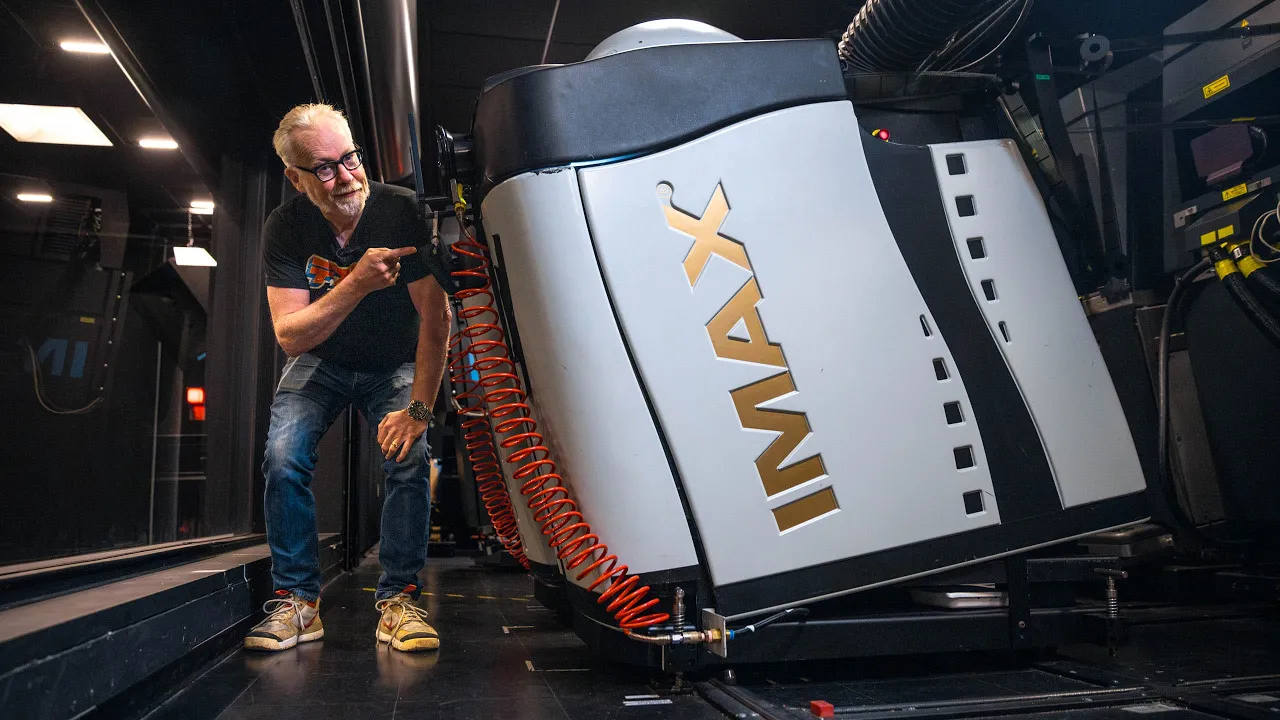
editing. And with IMAX, both ends of
0:25
that equation, the scanning and the
0:27
recording of large format 70 mm film
0:30
require purpose-built equipment and an
0:33
experienced [music]
0:34
technician to operate those machines. I
Advertisement
0:36
visited the 70 mm film scanning and
0:38
recording labs [music] at IMAX
0:39
headquarters to watch these machines in
0:42
action, including one of the most
0:44
beautiful bespoke machines I've ever
0:46
[music] seen, this film scanner that has
0:48
scanned almost every single IMAX film.
0:52
Hey, Fred. Hello. Such a pleasure.
0:55
Likewise, thank you. Um okay, so this is
0:57
the old scanner, and that's the new
1:00
scanner. I have so many questions about
1:02
this, but I want to just start with like
1:04
how long have you been working for IMAX?
1:06
I've been working for IMAX I'm in my
1:07
15th year now.
1:08
>> 15th year? Have you been scanning for
1:10
them the entire time?
1:11
>> Scanning and film recording. Amazing.
1:13
>> So, if you have a piece of IMAX film and
1:15
it needs to be a digital image, that's
1:17
me.
1:17
>> That's you. And if it's a digital image
1:19
and you need a piece of IMAX film,
1:21
that's also me.
1:22
>> Amazing. Okay, so I I we're going to
1:24
talk about the process
1:26
uh that film goes through in your room
1:27
here. But I right off the bat, I walk in
1:31
and I see a machine with a marble
1:33
countertop and these space-saving holes
1:36
and chrome polish, and then I touch it
1:38
and I'm like, wait a minute. Cuz cuz
1:41
Greg said outside that this was one of
1:43
This is serial number one of this
1:44
machine.
1:45
>> This is number one. This is the only 65
1:47
mm
1:49
scanner that that this company built.
1:51
Well, dude, whoever made this
1:52
>> 35 mm scanners afterwards, and they made
1:55
like, I don't know, pile of them. But
1:56
this is the only one for 65.
1:58
>> Okay, but whoever made this is an
2:00
important artist. Yes. Okay, you agree.
2:03
This is a masterpiece.
2:05
>> Yes. Yes, sir.
2:06
>> Oh my gosh. And then when you were
2:08
calibrating, I watched this whole thing
2:09
move or there's all these servos inside
2:11
here. Yep, motors and belts and you
2:14
can't lift the hood because it's
2:16
granite. And it's made granite so that
2:18
it's super stable so that it's
2:19
measurements are the same. OH MY GOD,
2:21
IT'S NOT even just aesthetic. It Yes.
2:24
It is
2:26
temperature. Uh because a few degrees in
2:29
temperature can change you know, metal
2:31
will change a little bit and that'll
2:33
throw this whole thing out of alignment.
2:34
So they built it on granite, polished
2:37
granite. Because you're scanning pixels
2:40
and you can't have any variance
2:42
whatsoever. We are scanning a frame this
2:45
big.
2:45
>> Yeah.
2:47
And how many pixels is that total?
2:48
>> And we are scanning it at a over 8,000
2:51
pixels across.
2:52
>> Crazy.
2:53
The way this machine was set up is it
2:55
only does a vertical line of pixels at a
2:57
time. Okay.
2:58
>> So it's slicing the image 8,424
3:02
times per image. That must
3:05
That must take a while.
3:06
>> put 12 and 1/2 seconds.
3:08
>> 12 and 1/2 seconds per frame?
3:10
>> Per frame. So every IMAX that's ever
3:13
been scanned went through this scanner
3:15
until Until VERY RECENTLY. YES.
3:17
>> WOW. THAT IS A
3:20
That you kind of have to work backwards
3:22
from deadlines and deliveries just to
3:25
ACCOMMODATE THIS.
3:27
>> YES.
3:28
WOW.
3:29
>> YEAH. Is this machine was semi-retired
3:32
at this point? Is it emeritus? I'm
3:34
sorry, it is very
3:35
>> [laughter]
3:35
>> very much semi-retired. I do test it,
3:38
you know, weekly to make sure that it's
3:40
still running because this is our
3:42
backup.
3:42
>> Right. If this goes out, this This is
3:45
it. Now, the nice thing is we haven't
3:48
had to use it. Right.
3:49
>> This has only seen me testing it for
3:53
a year now. Or a year? All right.
3:55
>> So it's not actually been in production.
3:58
It's such a
3:58
>> is capable of being being that 25 years
4:01
after it was made. For a machine. I
4:04
mean, there's a way in which I can tell
4:06
that the people that put this together
4:07
love machines and also love products.
4:10
Yes.
4:11
>> Like they weren't just making a one-off,
4:13
they were making it a beautiful product.
4:16
>> Yes. This is inspired by I feel like
4:18
German manufacturing from mid-century,
4:21
from Scandinavian. I mean, it's like
4:24
there's so much. Wow. Yeah. Okay, now
4:27
let's talk ABOUT THIS PROCESS.
4:28
>> [laughter]
4:29
>> LET ME PUT A PIECE OF FILM ON. OKAY, NO
4:31
MIND. SO,
4:33
take a piece of film and we thread it
4:36
up, starting this side.
4:39
It starts Make sure it doesn't want to
4:40
walk away on us.
4:41
>> Fair.
4:46
Make sure we take a few up, a few rolls
4:48
laps up on the on the roll.
4:50
And then
4:52
I like to pull a little bit extra and
4:54
thread it through here. So threading up
4:56
the gate first so that it sets correctly
4:58
and then with the sprockets,
5:01
make sure it locks in place.
5:04
So I just want to highlight here for a
5:05
second like, you know, film is all about
5:08
the fast shuttling and with precision.
5:11
Yes.
5:11
>> That's got to be an exponentially harder
5:13
problem at this size and scale,
5:16
especially for tiny variances of
5:19
sprockets, which I would imagine you
5:20
guys have reduced as close to zero as is
5:22
humanly possible.
5:23
>> Exactly. And that's why you may notice
5:24
the film path is very precisely defined.
5:28
I'm not making loops. I'm not making
5:30
approximately the right size. I'm going
5:32
it fits right here, it fits right here,
5:34
and everything lines up exactly.
5:36
>> So this machine knows what to expect
5:38
when this piece of film is through that
5:39
sprocket hole and when it's going to get
5:41
over here and it's never wrong.
5:43
>> And it's never wrong.
5:44
So,
5:46
then
5:46
>> Oh, and now it goes through all these
5:48
things.
5:48
>> all all these things. So,
5:51
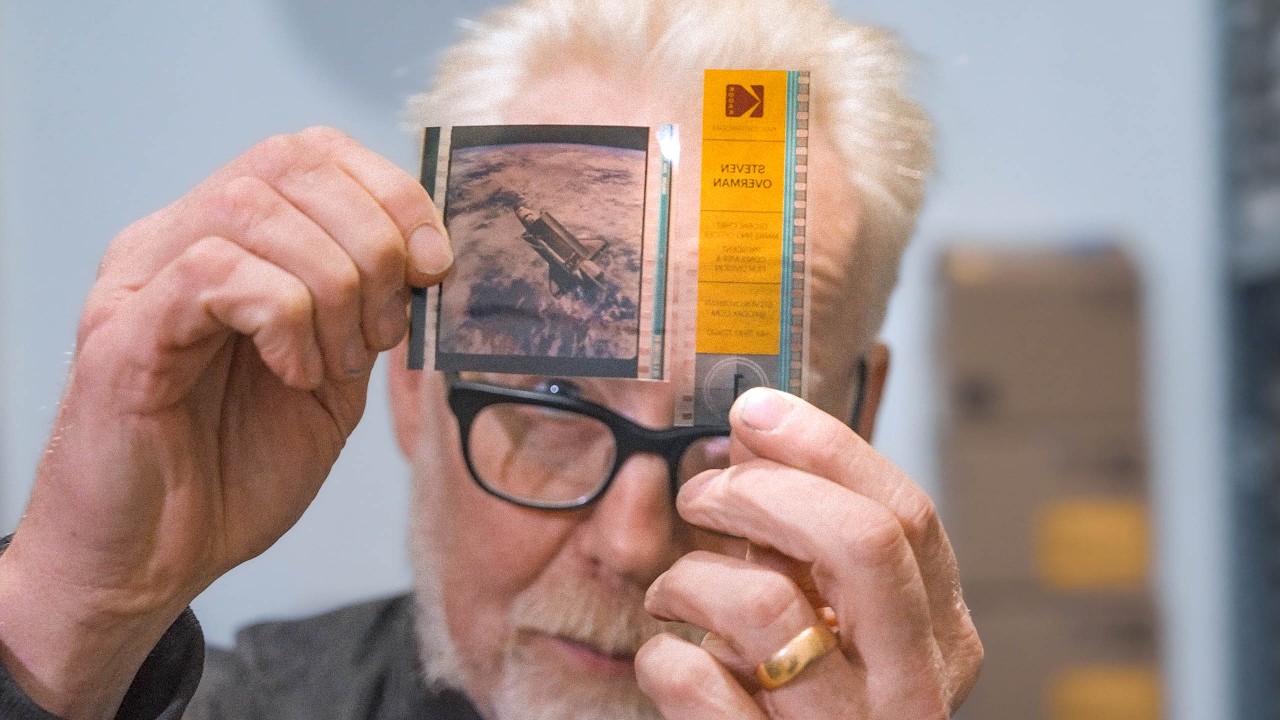
there is, I believe, a an edge code
5:54
because film comes with uh from Kodak
5:56
comes with a an edge code printed right
5:59
into the film. Oh, okay.
6:00
>> It's a latent image until obviously they
6:02
process the film. Unfortunately, this
6:04
one does not work, never has. So, it's
6:07
there. It was there with the idea of
6:09
making it work, but it never did.
6:10
>> Copy.
6:11
>> So we go around there. These two
6:13
basically are controlling the tension.
6:15
How much tension do do we take up?
6:17
>> I see.
6:17
>> And And watch when I spin it up, see how
6:20
that Mhm.
6:21
>> And it'll find a balance. And as the
6:23
film is transported, it'll make sure
6:25
that this thing's pulling at the right
6:26
amount, even if the roll's really big or
6:28
really small.
6:29
>> So that it's never winding it too tight
6:31
or too loose, it's always at a specific
6:33
>> Oh, exactly. Wow, of course it has to
6:35
be. Because too loose and your film goes
6:39
on the ground.
6:40
Too tight and you risk snapping the film
6:43
or
6:44
pulling the film past the the sprockets
6:46
and creating problems that way.
6:48
>> I cuz if film is surprisingly brittle.
6:51
Yes. I remember as a projectionist, I
6:53
remember having one smacking around and
6:56
creating a lot of celluloid confetti.
6:58
Yes.
7:00
>> [laughter]
7:00
>> When we get into film recording, I'll
7:02
tell you about chewed-up film.
7:04
>> Okay.
7:05
>> Cuz those machines like to chew film
7:06
occasionally. So do you only do tension
7:09
on the take-up side?
7:10
>> let me do this side as well. It's the
7:12
same thing just in reverse.
7:14
Or this.
7:15
Go around this way. This way and then
7:18
pull tight.
7:20
And that lets it find its level.
7:22
>> gate closes when I DO THAT.
7:23
>> OH, WOW.
7:25
>> It automatically knows, oh, I got
7:26
tension on both sides. That means I can
7:28
try to close the gate. That's some
7:30
really nice user experience right there.
7:32
>> When the gate tries to close, if it
7:35
can't pin that one Yep. and that one
7:38
>> Yep.
7:38
>> Those pins actually go through the film
7:40
from the other side to hold it in
7:42
position. Yep. If they go if if
7:45
everything's not lined up correctly,
7:47
they will try to pin through the film.
7:48
Very gently, they'll do it and they'll
7:50
stop.
7:50
>> won't poke through it.
7:51
>> And they'll go, nope, there's something
7:53
there. Nope, you know what? Forget it,
7:54
I'm not doing this. So it's not going to
7:56
punch a hole in your film. That's
7:58
beautiful.
7:58
>> 25 years ago,
8:00
somebody made this brilliant decision
8:03
that has saved so many rolls of film.
8:05
>> If any of the people that worked on this
8:06
is watching this video, reach out to us
8:08
in the comments cuz I want to talk to
8:10
you about this thing. Do you even This
8:12
this beautiful. These these circles and
8:14
lights here.
8:15
>> It's almost a face. It Oh, there there
8:17
is. It's almost a little like a droid.
8:19
Yeah.
8:20
Okay, so now the film is loaded up. So
8:22
once it's loaded up, I try to make sure
8:24
I I will advance a frame, a couple
8:26
frames just to make sure that it is
8:28
actually going to transport correctly.
8:31
Like that.
8:32
>> So that was one frame.
8:33
>> Those This is one frame.
8:35
Gotcha. That's moving 15 perfs.
8:37
>> It's moving 15 perfs at a go. Okay. And
8:40
as you can see, very smoothly. Yep. Yep,
8:42
through custom etched and machine
8:44
buttons that didn't get bought in a
8:45
catalog. Right?
8:47
Yes.
8:47
>> [laughter]
8:48
>> Then I'll wind down to the beginning of
8:50
the roll because this is leader for
8:52
handling purposes. That way I don't have
8:53
to handle people's film.
8:57
And if we look through here,
8:58
>> Oh, yeah, see the color test.
8:59
>> see the We can see the picture and I can
9:01
actually make adjustments to
9:06
Oh, I can go one perf at a time so that
9:09
I'm in frame. Gotcha. So that's the one
9:12
perf jog.
9:13
>> Yes. Amazing. Which is stop plus
9:16
forward. I can also, of course, do stop
9:18
plus backward to go the opposite
9:19
direction if I need to.
9:21
And we are almost ready to scan a frame,
9:23
but before I do, make sure I take the
9:25
calibration strip.
9:26
Oh.
9:27
>> scan like that, but it will not look
9:29
very good. So What does the calibration
9:32
strip do? It's a color calibration?
9:33
>> It's It's a color calibration and it
9:35
basically emulates the unexposed film
9:37
that is processed.
9:39
We call it the film base. Gotcha.
9:41
>> So it is
9:43
just a piece of clear Right, that is
9:46
sort of the neutral of film. Yes. And
9:48
yes, it's a little scuffed up. It's been
9:50
used many years.
9:52
>> [laughter]
9:52
>> The fact that it's here and not here
9:55
throws it so far out of focus, you don't
9:57
the blemishes or what have you.
9:59
>> the blemishes don't matter. Speaking of
10:00
which, one of the things that we do in
10:02
this room is we have to control the
10:04
temperature and humidity very tightly. I
10:06
would imagine the humidity could affect
10:07
image quality, right? Humidity will
10:10
cause the film to warp.
10:12
The IMAX frame is so big that it
10:14
actually can warp as it goes into the
10:16
gate and still feed through the machine.
10:19
Is it because the celluloid is slightly
10:20
hygroscopic, it absorbs a little water?
10:22
EXACTLY.
10:23
>> WOW.
10:23
>> EXACTLY.
10:25
And we've had
10:26
we've experienced it where it's like we
10:29
scan something then when we scanned it a
10:30
couple days later it's like, wait, why
10:33
is it a different focus? Wow, that's
10:35
amazing.
10:36
>> Let's We really jumped on it, made sure
10:38
that everything was
10:40
properly set up and So then temperature
10:42
and humidity control is part of the
10:44
calibration process of this room. Yes,
10:46
and that's why you hear air running
10:48
continuously
10:49
>> in this room. So you got a lot of
10:51
hoodies and fleeces. You make sure
10:53
you're buttoned down warm and you
10:55
[laughter] take care of the all of that
10:57
you make sure that that's good. Um and
10:58
this is the business end of the scanner
11:01
coming through this way. Uh so the light
11:02
column is here, the light is underneath.
11:04
Gotcha. Goes up and I think they use a
11:06
prism or a mirror and deflect it into
11:08
the camera which is here. Gotcha. Um And
11:12
it is a linear array so it's not taking
11:14
the entire picture at the same time.
11:16
It's taking
11:17
one set of pixels vertically up to 6,144
11:20
[laughter]
11:22
pixels vertically. So the scanner is
11:24
just basically one pixel wide and film
11:27
frame tall. Uh ish
11:29
>> Yes. ish Exactly, yeah.
11:33
12 and 1/2 seconds.
11:34
>> 12 and 1/2 seconds.
11:35
>> I I'll be frank, knowing what it's
11:37
trying to do that sounds fast.
11:40
But it also sounds slow.
11:42
>> Incredibly slow. [laughter] When we look
11:43
at the other machine you'll be like,
11:45
that is very very slow. Um can we just
11:47
able to actually just witness a scanning
11:49
sequence? Um yes, let give me a moment
11:52
to set that up.
11:53
Oh, one other thing you you hear the
11:56
hear the hiss? Yeah. That's actually we
11:58
actually have air knives on it.
12:00
Partly to blow off the dust, partly to
12:03
keep the film, you know, moving in it
12:05
smoothly. Right, right. Where are the
12:07
air knives? Are they here?
12:09
>> They are actually in this. Right, right.
12:11
Okay.
12:11
>> So with if there was no film in the gate
12:13
I could show you you could stick your
12:15
put your hand in the gate and see
12:16
actually feel them. Gotcha. Uh but the
12:18
whole goal is when it's here no dust has
12:21
been able to get anywhere near it.
12:22
Exactly. Uh I really appreciate you
12:24
walking me through this. This is it's
12:26
it's amazing. Let's talk about this
12:28
brand new one. Yes.
12:30
So what's the biggest difference between
12:31
the new machine and the old machine? Is
12:33
it just speed? Part of it speed, part of
12:36
it is the process that it takes the the
12:38
image. Mhm. Um the old machine took it a
12:41
single vertical line of pixels at a
12:43
time. This actually will scan an entire
12:45
frame except of course a gigantic frame
12:48
like an IMAX frame because an IMAX frame
12:51
is so big. So it actually scans the IMAX
12:53
frame in thirds. Oh, so it does 1/3,
12:56
middle third, other third. Yes. And it
12:59
does its own stitching of them? Um no,
13:01
we actually do that on a separate
13:02
machine. Oh, amazing.
13:03
>> We could do it on the separate on the
13:04
same machine but it is a separate
13:06
process.
13:06
>> Gotcha.
13:07
That allows us to do a little bit of
13:09
extra work if we need to do some
13:11
processing or something like that in
13:12
between. Okay. And this one you may
13:15
notice threads up the opposite direction
13:17
from the the other machine. Goes right
13:19
to left.
13:20
>> It goes right to left.
13:22
Apparently if we went left to right this
13:24
whole apparatus would be have to be
13:26
upside down and this whole big thing
13:27
would have to stick up in the air. So
13:31
>> Yes. That's so funny.
13:32
>> Because I was I was freaked out that
13:34
it's horrible when you have to scan on
13:35
both machines at the same time.
13:36
>> Oh cuz you're going back and
13:38
uh yeah.
13:38
>> and forth and you're like, which one is
13:40
wound the right way? Sometimes you just
13:42
have to stop and just yeah, I can
13:44
imagine. This is where being on the
13:46
computer helps because on the computer
13:48
forward is always forward, backward is
13:50
always backward. [laughter]
13:51
Okay.
13:52
>> So the setup is actually similar here as
13:54
you do a rough setup and then you do the
13:56
spool winding. Exactly, yes. Then fill
13:58
in the details as it were.
14:03
That's
14:05
There we go. And this one also has
14:06
tension arms. Gotcha.
14:09
Some things don't change. You always
14:11
need tension arms to make sure that the
14:12
motors on the
14:16
on the rolls of film aren't taking up
14:18
too tightly or too loosely. And your
14:20
goal is that each tension arm is
14:21
vertical. Roughly. It they au-
14:23
automatically will you know, they'll
14:26
stop if at a certain point. I go mostly
14:28
go approximately the right place,
14:29
sometimes a little past and then they
14:31
stop cuz that's where they need to be.
14:34
It's called reader. We can read the key
14:36
codes that are that Kodak puts on the
14:38
film
14:39
and that way the editorial people can
14:41
tell us scan these exact set of frames
14:43
and we can say
14:45
okay, wherever it is on the roll find
14:46
it, scan this.
14:47
>> Well that makes that process much
14:49
faster.
14:49
>> makes it much faster and very accurate.
14:52
Okay.
14:53
>> So instead of having to take those
14:54
numbers and go, okay, what's the number
14:56
at the beginning of the roll, do these
14:57
calculations, how far down do I have to
14:59
go?
14:59
>> And then go ahead and pick. Exactly,
15:01
just find it.
15:02
So that's kind of what we have for the
15:05
setup on that. And again notice it is a
15:07
vertical operation rather than a
15:09
horizontal one. Uh hence the glass doors
15:11
and the dust mitigation. But it's
15:13
effectively the same machine just more
15:15
than an order of magnitude faster. Yes.
15:20
Dude, I
15:21
already just in the last 10 minutes here
15:24
my mind has been blown like three or
15:26
four times and it's all about the scale.
15:28
The scale of this frame of film is is is
15:31
diabolical in terms of all your
15:33
processes with it. Yeah. This is
15:35
scanning. You guys also do a lot of
15:37
recording. What's the other part of this
15:39
process? Can we walk through that?
15:41
>> you don't have film and you need film.
15:43
Let's do that.
15:44
>> Okay, good.
15:45
All right. This is film recording. Yes.
15:48
IMAX has been around and has been
15:50
scanning for a long time. So this is
15:52
real legacy equipment back to the early
15:54
days. It is. If you remember the Silicon
15:57
Graphics machines
15:58
>> Yes, very well. Yeah, we used those to
16:01
run these machines.
16:02
>> Oh, hilarious. Good god, I remember one
16:04
year at the ILM Christmas party that was
16:06
actually the door prize for best costume
16:08
was an O2 workstation. Nice. Okay, so
16:11
what is the technology that is used to
16:13
get the image the digital image printed
16:15
onto the film?
16:16
>> So to get the digital image printed on
16:18
the film in the base here we have
16:22
obviously boards and stuff that run that
16:24
run this. But the big thing is the the
16:26
tube. The tube?
16:27
>> the We literally have a cathode ray
16:29
tube.
16:30
>> What? Like the old tube tube TVs but way
16:33
more advanced obviously. There's a CRT
16:35
at the heart of the scan of this
16:37
printer? There is. So obviously the CRT
16:39
machine gives you the precision that
16:41
you're looking for on a pixel by pixel
16:43
color fidelity by color fidelity basis.
16:46
Yes.
16:47
>> That's astounding to me.
16:48
>> Exactly, yeah. Um does it do it in a
16:50
mono color and then you use filters for
16:52
the color? We do indeed, yes. So the
16:54
tube itself is is a particular white and
16:57
then we run it through some filters. So
16:59
we have a We don't use the clear filter
17:01
but we could if we needed to. There's a
17:03
red, green and blue filter. I'm going
17:04
backwards here. That's the blue filter,
17:06
the green filter. So it's like the old
17:08
the old three strip process reversed in
17:11
order to obtain the imagery. That is so
17:14
cool that the CRT provides the precision
17:17
that you need.
17:18
>> Yes.
17:19
So
17:20
this is the tube.
17:23
And as you can see it is rather big.
17:25
God. The piece the piece here at the end
17:27
>> Yeah. is what they call the thick glass
17:30
because if dust settles on the tube
17:33
you have a problem. It sits there the
17:35
entire time and you have a speck
17:38
on your movie.
17:40
And if the camera pans, you know, the
17:42
the
17:43
>> [clears throat]
17:43
>> the speck just sits there and you can
17:45
totally see it. So they the way to do to
17:47
avoid that was that they came up with is
17:50
to put a big really thick piece of
17:51
glass. More than half the weight sits
17:53
just in this glass. Wow. And it puts the
17:56
the piece of dust if there is one way
17:59
outside the focal plane.
18:02
Oh, that's brilliant. That's so
18:03
brilliant. Yeah.
18:05
So you guys are are printing on the same
18:08
kind of reels like two, three minutes at
18:09
a time? Yes. What is the how slow is how
18:12
good I was not going to say how fast is
18:14
this. How slow is this?
18:15
>> So once upon a time we could get a lot
18:17
better speeds but with the CRTs as they
18:20
age they get dimmer and we have to
18:22
expose the image longer in order to get
18:24
the same exposure.
18:26
>> Am I correct that all the CRTs that have
18:28
ever been built for this are already
18:30
built and you're just grabbing new old
18:33
stock where it shows up?
18:34
>> And seeing if we can get them
18:35
refurbished which is a job
18:37
unto itself.
18:38
>> Oh my, can't even imagine. These are
18:40
technologies that are rapidly their
18:41
support structure is disappearing all
18:43
the time. It is, yeah. So they get
18:45
slower as they age.
18:46
>> Yeah. Currently we're running somewhere
18:48
between a minute and two and a half
18:50
minutes per frame. Oh my gosh. You
18:52
thought 12 and 1/2 seconds was slow?
18:55
A minute to a minute and a half. Um and
18:57
this is so like Christopher Nolan shoots
18:59
on film, he brings a couple of different
19:01
shots that need a an effect done to them
19:03
that is executed on these.
19:05
>> Exactly. Incredible. My joke is
19:08
I got tired of watching paint dry.
19:11
Grass grew too quickly [laughter] for me
19:13
so I went into film recording.
19:15
Hilarious. How many backup CRT tubes do
19:20
you have in stock currently?
19:22
How about the other question?
19:25
>> [laughter]
19:27
>> I have like seven machines in the room
19:29
and about four of them are working. Oh
19:31
my gosh.
19:32
>> Because of the CRTs. Um so I I would
19:34
imagine there are people working on
19:35
solving this problem currently. Yes.
19:38
>> Okay. There are various solutions by a
19:39
couple different groups trying to find
19:41
basically find replacements for the CRT.
19:43
Because this still exceeds the precision
19:45
of anything currently being built. And
19:47
reliability. You want something that's
19:49
not only precise but is reliable that
19:51
you can put a thousand feet of film, do
19:54
it a frame at a time, and 4,000 frames
19:56
later
19:57
get it processed, look at the print, and
19:58
go, "Yep, that looks good." Amazing.
20:01
>> Every time. Um I notice it's freezing
20:03
cold in this room. You're way colder
20:05
even than in the other in the scanning
20:06
room.
20:07
>> That's a little bit accidental. It's
20:08
supposed to be the same temperature and
20:10
humidity as the other [laughter] room.
20:12
Um because we used at one point we used
20:13
to have 18 of these machines. If you can
20:15
imagine 18 of them packed into this room
20:18
You needed to pump a lot of cool into
20:20
here to keep them all running optimally.
20:22
Exactly. Wow.
20:24
>> So, we've made some adjustments to the
20:26
temperature to accommodate for fewer
20:28
machines, but it's still cold. So, in
20:31
this day and age when some filmmakers
20:33
can leave critical decisions about a
20:35
shot up until days before the film's
20:37
release, they must have a rude awakening
20:39
when they come to you guys for post. I'm
20:41
sure they do. [laughter] I'm hoping that
20:43
they go, "Oh, okay, let's figure this
20:45
out. Let's make sure that this works."
20:47
Well, I mean because the deadlines are
20:49
real deadlines. Um this has been such an
20:52
eye-opener. Uh thank you so much, man.
20:54
This is
20:55
incredible.
— end of transcript —
Advertisement