Advertisement
 17:21
17:21
Transcript
0:00
[music]
0:05
>> When a movie is filmed for and projected
0:07
in IMAX, the large format that you're
0:09
watching isn't just about the size of
0:11
the theater screen. It's also about the
0:13
size of the image on the screen print.
0:16
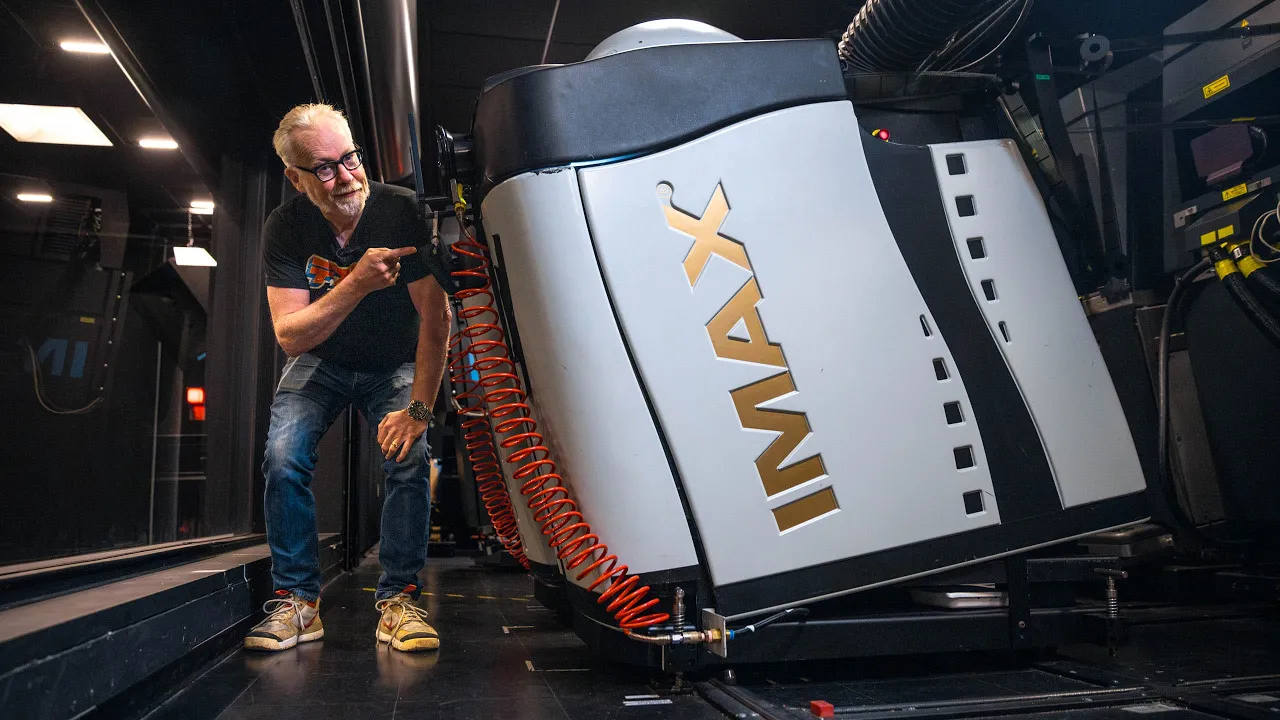
This is a single frame of IMAX 70 mm
0:19
film. It runs horizontally through the
Advertisement
0:21
projector and it's called 15 perf
0:23
because there [music] are 15
0:24
perforations on the film for every
0:26
frame. This picture is almost 10 times
0:29
the size [music]
0:30
of that stored on a standard 35 mm frame
0:34
which has the same [music] size
0:35
perforations on the smaller film and has
0:36
to share real estate with the soundtrack
0:38
on the right. That's a difference in
Advertisement
0:40
detail that I [music] can see with my
0:42
naked eye both on the frame and when
0:44
it's projected on a 90-ft tall film
0:46
screen. Tested went to IMAX's LA
0:48
headquarters to tour their vault of film
0:50
prints and bed [music] with technicians
0:52
splicing together reels heavier than me
0:54
and larger than this table and visit the
0:57
projection booth of their in-house
0:58
theater [music]
0:59
where some of the world's greatest
1:00
directors come daily to review and sign
1:03
off on their vision printed in film's
1:05
largest [music] format.
1:07
Greg, you you told me this is about 2
1:09
and 1/2 minutes of film give or take?
1:11
>> right. Um
1:13
I was a projectionist in my youth and
1:15
I'm just trying to wrap my head around
1:17
the volume and weight. How do you guys
1:19
handle something as simple as like
1:21
dailies or or post-production?
1:23
>> Well, we have a team that does that and
1:25
which you'll meet in a second. And so we
1:27
take this large roll film. This actually
1:30
is not as big as some.
1:31
They go up to 1,000 even bigger than
1:33
that. They all get assembled onto the
1:36
rewind on on a larger reel through the
1:38
rewind bench and they get spliced and
1:41
and we wheel them out there which you'll
1:43
see as well. Yeah.
1:43
>> Okay, let's let's let's walk through
1:45
this process. Okay.
1:48
All right Adam, so this is print
1:49
assembly. All right, so this is where
1:50
heavy things get assembled into heavier
1:52
things
1:53
>> [laughter]
1:53
>> and then eventually they leave.
1:55
>> Yes. God, the the volume of it is just
1:58
staggering.
1:59
>> Yeah, yeah, we have a lot of stations
2:00
here, a lot of work gets done. Irving
2:02
has a group of two so three all together
2:04
in print assembly. How many platters are
2:05
you processing out of this room in a
2:07
day?
2:07
>> It It really depends. I mean generally
2:09
they're working on one at a time. It
2:10
really depends if we have multiple
2:12
titles happening at the same time. In
2:13
this case we have one film that that is
2:16
getting plattered up for a screening
2:17
this afternoon and it's basically a
2:19
bunch of film out reels that are are
2:21
processed and printed at FotoKem and
2:23
we're going to show them here at our
2:24
theater. It's amazing. I mean I remember
2:26
my rewind table at the theater was like
2:28
the size of a thing. This is the size of
2:29
my first apartment in New York.
2:31
>> Yes, these are custom. There's one of
2:33
one and they're very old but they work.
2:35
Amazing. Hey Irving. How are you? Good
2:38
to see you. So you have been here for 33
2:41
years?
2:42
>> Yes, I am. Is it safe to say that you
2:43
have touched almost every print that's
2:46
come out of here? I would say yes. Okay,
2:48
so walk me through walk me through what
2:50
happens here. Usually when they start a
2:52
production they go with making dailies
2:55
and every daily that is made we
2:59
come to this place then it's get to be a
3:01
screen review, make sure that there is
3:03
no scratches, that physically look okay.
3:06
Because scratches can happen in the
3:08
camera and the negatives or it can
3:10
happen in printing in the lab. So you
3:12
want to make sure that everything is
3:14
okay. Also everything that we had a
3:17
screen we keep a record. So we had like
3:20
records in 1980s.
3:24
Yeah. We keep all those records. Every
3:26
single roll that have been
3:27
screened they keep a record and we keep
3:30
it on So every last thing that's come
3:32
through here is chronicled. Yes.
3:33
>> Okay. And right now we're working in a
3:37
project a demo and I'm going to pull um
3:42
There is different play different
3:44
pictures they're making from different
3:47
parts of the movies Yeah. and right now
3:49
we are trying trying to put a
3:52
a portion of that movie and put it
3:54
together like a puzzle and then that's
3:57
what we're going to do right now. I'm
3:58
looking for a specific scene.
4:01
Can I help? Uh you can try it if you
4:04
feel comfortable.
4:05
>> [laughter]
4:07
>> But we just going to roll it. This was
4:09
built like a
4:11
a month ago. Okay. And probably it was
4:14
made with a
4:17
It was make a
4:22
You have probably a hundred scenes
4:23
inside this. Okay, so this is our daily
4:25
reel with like a hundred scenes in it.
4:27
Yes and then we're going to look for the
4:29
specific one that they need right now.
4:31
But they they just give us we need this
4:34
and we have to find it in all of this.
4:36
You have to go through this and figure
4:38
out where it is. Okay. And usually
4:39
that's why we are trying to keep this
4:41
kind of list so they will give me an
4:43
idea where they are.
4:45
>> Amazing.
4:45
>> Cuz otherwise you will be impossible to
4:47
find it. And after that the piece that
4:50
we're going to find there is going to go
4:51
into this little roll and from that roll
4:54
we're going to take a portion of the
4:56
same material and go into the demo that
4:59
they need to screen tomorrow actually.
5:17
And this is like an
5:18
old tape machine. Remember when you push
5:21
the cassette tape and you play move this
5:23
way or move that way? Yeah, yeah.
5:25
Oh, that's what it is. Okay. So this one
5:27
will if I want to push over there, move
5:29
over there just press this one or if I
5:31
want to go the other way, go that way
5:33
and stop and
5:35
and it's very simple. And this are only
5:37
tension you know because you need it's a
5:39
lot of you need tension and these are
5:41
the speed control which is how one here
5:43
one here is the same one the same
5:45
control. And
5:47
I've been here for more than
5:49
35 years so
5:50
>> These have been here longer than you.
5:51
>> Yes. Okay.
5:55
But this one is say that start from
5:57
chapter 78 to 101 which is
6:01
what we got here. Okay, so now you go
6:03
find that.
6:03
>> 78 cuz it start 78 and then I'm going to
6:06
go all the way. It start from one but
6:09
But that means that all of these have
6:10
already been left in file.
6:11
>> a different platters.
6:12
>> Got you.
6:14
Cuz
6:15
you cannot this platters only can hold
6:17
like a one hour platter and sometime we
6:19
had a screening of two hours plus so we
6:22
need to build into small platters like
6:23
this and then take it to whatever we
6:26
need to screen. That's the small
6:28
platter. Uh this is the regular platter
6:31
45 inch platter. Okay. The this is the
6:33
standard for most of the films.
6:35
>> Got you. But a big movie two hours and a
6:37
half movie will go in three of this.
6:41
And then you build it into one platter
6:43
in whatever theater you go. Yes.
7:01
I find myself wondering if there's a
7:03
machine shop somewhere in the world that
7:05
just makes these. I mean maybe there's
7:07
more than one but I mean it's got to be
7:09
a pretty bespoke business.
7:12
Look at that.
7:15
Wow.
7:24
So here we are putting tension on this
7:26
side so it will not wind loose to this.
7:29
So we're
7:30
and then you have clutches that so it
7:32
can allow the engine to engage to the
7:35
platter and it can rotate.
7:37
So this one we're going to go that way
7:39
which is ready there.
7:44
I just help a little bit.
7:49
And because you cannot go see [snorts]
7:50
it doesn't have no number no nothing we
7:52
just You just scroll and then you go
7:54
hunt for it.
7:55
>> Yes. But you know that it's probably
7:57
right around
7:58
>> Somewhere there. Yeah, cuz this is This
8:00
have 100 shots
8:03
but it's starting from shot 78 so
8:05
probably somewhere in here.
8:06
Holy cow.
8:19
It really is sort of blowing my mind
8:21
just the sheer weight, the sheer volume
8:25
of plastic and aluminum required to move
8:29
these pieces and prints around. Um this
8:32
is less than an hour of film
8:35
but at such a resolution that it weighs,
8:37
you know, dozens and dozens of pounds.
8:39
It's amazing. It's like it's like the
8:41
single heaviest component of flying an
8:43
airplane is its fuel. Like you don't
8:45
really think about that but it really is
8:47
like most of managing an airplane's
8:49
weight is about managing the weight of
8:50
its fuel. And for some reason that seems
8:53
to me to have some parity to like if you
8:56
want the best the most the sharpest film
8:58
format, well it's it's going to get
9:00
heavy. It's going to get heavy in a
9:01
hurry.
9:03
That's the splice, yeah?
9:04
>> Yeah, that's the tape.
9:05
>> have a cutter that cuts that Yes and
9:07
this is the one that does that.
9:09
Oh, oh so is that the difference between
9:10
this splicer and that splicer? This one
9:12
does the zigzag splice. This one does
9:14
the zigzag so you can pull it apart and
9:17
put it back like a puzzle but this one
9:20
once you do one of those because it's
9:21
well kind of welded
9:23
so you cannot pull it apart. If you pull
9:25
it apart you cannot put it back
9:27
together. So this is for like final
9:29
assembly?
9:29
>> Yes. And this is for temporary assembly.
9:31
Got you.
9:43
Okay, so we're in part of the projection
9:44
room here.
9:45
>> We are. We are below it.
9:46
>> Okay. [laughter] Yeah. Um can can I
9:48
help? Can I help put load this? Oh,
9:50
amazing. Okay. So now we're lifting the
9:52
platter up onto the Mark
9:55
reel unit.
9:59
Okay, now we're going to lock it in. Ah,
10:01
okay.
10:02
>> Got to be careful like and also we have
10:04
the screws. If you could pass me this
10:06
one.
10:07
>> [snorts]
10:08
>> And I just got tight there.
10:09
>> all right.
10:13
Now,
10:14
this is going up to the projector.
10:16
And so we need a lot of free that leader
10:20
and we're going to spool a lot of it.
10:22
So we go cuz the projectors are in the
10:24
second floor. So you see it's going to
10:26
travel from here all the way up and then
10:28
coming down. So it's not going to be the
10:30
actual movie. It's just leader. Right,
10:33
right, right. So this is all just blank
10:34
film, but it's going to travel all the
10:36
way up where that rope's going through
10:37
the hole? Yes.
10:38
>> Because because all the work is done
10:40
down here and all the heavy lifting
10:41
comes down on the first floor. There's
10:43
there was no real way to get these into
10:45
the booth as you'll see when we go up
10:47
there. So the weight of this means that
10:49
architecturally
10:51
this is an accommodation because of how
10:53
heavy these are.
10:53
>> It is and it might seem crazy like why
10:55
would you invent something like that,
10:56
but it works. Amazing.
10:58
>> Yeah. You guys must now have some
10:59
intense HVAC here because I would
11:01
imagine small amounts of dust can damage
11:04
this print over time.
11:05
>> Yeah, it's it's not as big a deal as it
11:08
is with negative.
11:08
>> Of course.
11:09
>> And we have special rollers too that
11:11
help make sure that that everything's
11:12
clean before it goes into the projector.
11:13
Incredible. Yeah.
11:15
Okay, so that's a lot of film he just
11:17
wound up there. Oh, look at that.
11:21
Yeah, how many feet Irving do you have
11:22
of of leader on the head?
11:25
I don't know, probably like 100 ft.
11:28
Wow.
11:32
IMAX film is 337 ft per minute. So
11:34
that's just over you know, 20 seconds of
11:38
of of leader, right? Wow.
11:41
330 and 35 mm is like 90 ft per Yeah.
11:45
Yeah. [laughter]
11:47
Right, an hour is a mile in 35 mm.
11:50
Oh my god, the cable carries the film
11:53
up.
12:02
Okay, now we're going to walk up Okay.
12:04
>> and pull this so we can continue.
12:06
>> Okay, so you go up there and pull it.
12:08
You don't just We just go like fishing.
12:10
We kind of
12:11
I'm sort of I'm still wrapping my head
12:13
around the fact that this travels 30 ft
12:15
into the ceiling to get to the
12:16
projector.
12:17
>> Yeah, yeah, it does. And then it has to
12:18
come back down.
12:20
Oh my god, of course it does.
12:22
>> Yes. So it travels another 30 ft back
12:24
down to get the the take-up reel, which
12:26
is of course it's there.
12:29
>> That's insane. I love that that works.
12:32
It is amazing. For 3D movies is it
12:35
double this? It is double this. Yeah, we
12:37
actually have a whole other Mark II
12:39
assembly uh platter system over there.
12:41
And if you notice there's plat there's
12:42
there's these little pulleys that go
12:44
over your head. And so we actually have
12:46
two sets that can go up there for left
12:47
eye and right eye film projector.
12:49
>> Oh my god, two separate gigantic prints
12:53
for left eye and right eye. Yes.
12:55
Amazing. Just to give you a sense of the
12:57
size of this. This is a roughly
12:59
hour-long reel and loaded with film
13:02
weighs about 300 lb.
13:04
This is a 68-in reel holds just shy of 3
13:07
hours, weighs almost 600 lb and this is
13:10
not their biggest reel. This is their
13:12
second biggest reel.
13:15
Crazy.
13:16
I'm only a tiny bit taller than this.
13:19
>> [music]
13:23
>> So here's Yvon with the film that came
13:25
from below.
13:27
I just love that these are bolted to the
13:30
the engineering in me thinks this
13:31
shouldn't be possible, but it's perfect.
13:34
Okay, so what's the next step for this
13:36
to get into the projector? So he's going
13:38
to go through that hole. Okay.
13:46
And we're going to be using that film
13:48
projector.
13:54
Wow.
13:56
So this is the David Keighley theater
13:58
booth.
13:59
>> Got you. And we have three sets of
14:00
projectors, one film and two digital.
14:03
Okay, so that's a set of film
14:06
projectors.
14:06
>> Yes. A set of digital projectors and
14:08
another digital projector.
14:10
>> And they're all on a rail system that
14:12
allows us to basically prep for a
14:14
session. So we might have a digital
14:15
session 10 minutes ago, it wraps and
14:17
then we have to basically go right into
14:19
film. So they can prep all this and load
14:21
it all up and then slide it over in
14:23
literally 5 minutes we're operating on
14:25
film. Amazing. And is the reason there's
14:27
two digital projectors is for stereo
14:29
projection? Yes, and and also to get the
14:32
power we need on the screen. That's our
14:34
GT digital projection system. So you
14:36
double it? Yeah, it's it's full 143. In
14:39
fact, every morning we have a
14:40
calibration system. Anytime these
14:42
projectors move, we have an auto
14:44
calibration system that converges the
14:46
two projectors. Wow. And so you're
14:49
putting one image on top of the other to
14:50
get the maximum amount of brightness
14:52
from the digital projector.
14:53
>> Yes. This is the only way to achieve
14:54
full 143 digital projection in IMAX. So
14:57
even though he is spooling the film into
14:59
the film projector, that projector is
15:01
still going to move into its final
15:02
position.
15:03
>> And this rig can accommodate that.
15:05
>> Absolutely. Again, the engineer in me is
15:08
like this shouldn't really work. It
15:10
shouldn't, but it does.
15:13
All right, and then it's coming back.
15:15
>> That's right. This is the return trip.
15:17
Through the same hole. Right, cuz left
15:19
eye, right eye.
15:20
>> Right, right, right. Going fishing.
15:24
Yeah, and here's the the film projector
15:25
is going into place. You can run both
15:27
these projectors if you're doing 3D, but
15:30
also if you're doing a rollover. So
15:32
basically if you're going to transfer
15:34
over from one to the ever other. If he
15:36
had let's say two different reels that
15:38
we needed to go from one to the other,
15:40
we could go into that mode.
15:42
>> So they don't you don't have little burn
15:43
holes in the corner of the
15:45
>> Yeah,
15:45
cuz the first one
15:46
and the second one
15:47
>> Yeah, totally. You don't do that. How do
15:49
you know when to do the changeover?
15:50
>> Because we're not doing it for final
15:52
product.
15:52
>> Okay.
15:53
>> Yeah, so they'll basically just change
15:54
over to the other one when we need to.
15:56
But it's all it's all in sync. Even our
15:58
sound. Our sound is basically a digital
16:00
track that goes in on an optical disc
16:03
and we we ingest it into a hard drive
16:06
system. And it syncs up with that.
16:07
>> It syncs up with the with the film,
16:09
exactly.
16:11
Similar to the DTS system. Got you. All
16:14
right, so this is the business end of
16:16
the process we just watched. A director
16:18
[music] who is working on a film with
16:20
IMAX is coming in in a few minutes to
16:22
watch some dailies of their film. We
16:25
can't tell you what it is, but it's now
16:27
been spooled into this projector and
16:29
[music] it's about to be projected. I am
16:34
Everything about [music] this process is
16:35
sort of gargantuan and incredible to me
16:38
and I can only imagine how thrilling it
16:40
is for that director [music]
16:41
to see their footage in such a format.
16:44
It's got to be intoxicating.
16:47
>> [music]
16:55
[music]
17:09
[music]
— end of transcript —
Advertisement