Advertisement
 1:02:52
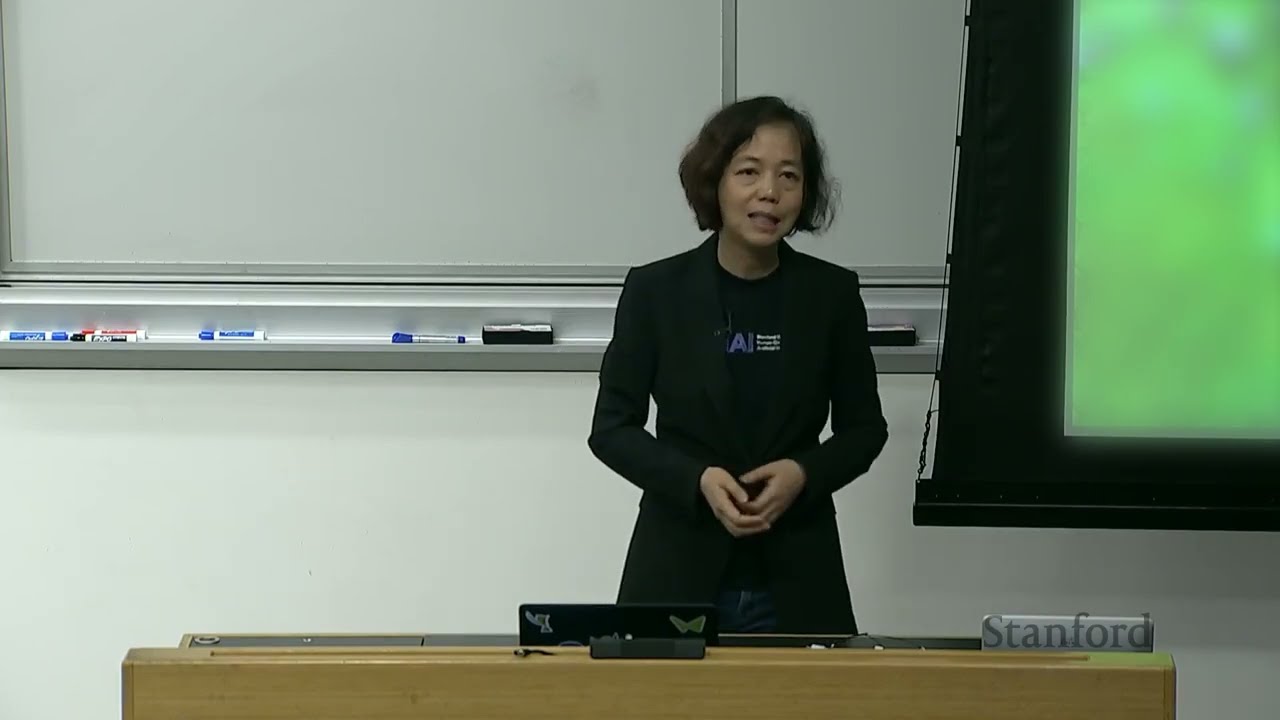
Stanford CS231N Deep Learning for Computer Vision | Spring 2025 | Lecture 1: Introduction
Stanford Online
·
May 10, 2026
Open on YouTube
Transcript
0:05
This is CS231n.
0:07
And I'm Professor Fei-Fei
Li from computer science
0:11
department.
0:11
I will be co-teaching
this quarter
0:14
with Professor Ehsan Adeli
and my graduate student Zane.
0:19
So you'll meet them as well
as our wonderful TA team
0:23
that you will meet later.
0:24
So I just want to get started.
Advertisement
0:28
So this is what
excites me, that AI
0:32
has become such an
interdisciplinary field,
0:35
that what you're going
to learn in this class,
0:38
of course, is very technical.
0:40
It's about computer
vision and deep learning.
0:42
But I really do
hope that you take
0:44
it to whichever discipline you
work in and are passionate about
0:48
and apply it.
0:49
So we hear a lot
about the field of AI.
0:52
So how do we position
computer vision
Advertisement
0:56
and the scope of this class?
0:57
If you consider AI
as this big bubble,
1:02
computer vision is very
much an integral part of AI.
1:07
Some of you have heard me
saying that not only vision is
1:10
part of intelligence, it's a
cornerstone to intelligence.
1:13
Unlocking the mystery
of visual intelligence
1:16
is unlocking the
mystery of intelligence.
1:20
But one of the most important
tools, mathematical tools,
1:25
to solving AI is machine
learning or some people
1:29
call statistical
machine learning.
1:31
And this is exactly what
we will be talking about.
1:36
Within the field of
machine learning,
1:38
in the past 10 plus years, we
have seen a major revolution
1:42
called deep learning.
1:43
And I'll explain a little
bit of what deep learning is.
1:46
Deep learning is a set
of algorithmic techniques
1:50
that is built around
a family of algorithms
1:54
called neural networks.
1:55
And so if you ask me to pinpoint
the scope of this class,
2:02
we'll not be able to cover the
entirety of computer vision.
2:05
We'll not be able to cover
the entirety of machine
2:07
learning or deep learning.
2:09
But we're going to cover the
core intersection of these two
2:12
fields.
2:13
And of course, just
like the entirety of AI,
2:18
computer vision is
becoming more and more
2:20
an interdisciplinary field.
2:23
A lot of the techniques
we use as well as
2:26
the problems we
work with intersect
2:28
with many different other
fields, like natural language
2:31
processing, speech recognition,
robotics, and AI as a whole
2:37
is a field that intersects
with mathematics, neuroscience,
2:41
computer science,
psychology, physics, biology,
2:44
and many application
areas from medicine
2:46
to law to education
and business and so on.
2:49
So what you will get for this
lecture, our first lecture,
2:55
is I'll give a very
brief history of computer
2:58
vision and deep learning.
2:59
And then Professor Adeli will go
over the overview of this course
3:05
and lay the groundwork of
how this course is set up
3:08
and what our expectations are.
3:11
So the history of vision did
not begin when you were born
3:19
or humanity was born.
3:20
The history of vision began
540 million years ago.
3:25
You might ask, what happened
540 million years ago?
3:29
Why are we pinpointing a
relatively specific date or year
3:34
in evolution.
3:35
Well, it's because a
lot of fossil studies
3:37
have shown us that there is a
mystery period called Cambrian
3:43
explosion.
3:45
The fossil studies showed about
10 million years in evolution
3:49
during that time, which is
a very short period of time
3:52
for evolution.
3:53
We see the explosion
of animal species
3:58
in the fossil study, which means
before the Cambrian explosion,
4:02
life on Earth was pretty chill.
4:05
It was actually in the water.
4:06
There's no animals
on the land yet.
4:10
And animals just float around.
4:13
So what caused this explosion
in animal speciation?
4:18
There were many theories, from
climate to chemical composition
4:21
of the ocean water.
4:23
But one of the most compelling
theories was the onset of ice.
4:29
The first animal,
a trilobite, they
4:32
gained photosensitive cells.
4:34
So the eyes we
were talking about
4:37
were not sophisticated lenses
and retinas and nerve cells.
4:41
It was literally a
very simple pinhole.
4:44
And that pinhole
collected light.
4:47
Once you collected light,
life is completely different.
4:53
Without sensors,
life is metabolism.
4:57
It's very passive.
4:59
It is just metabolism.
5:01
And you come and go.
5:02
With sensors, you become an
integral part of the environment
5:06
that you might want to change.
5:08
You might want to
actually survive in it.
5:11
Some animals or plants
become your dinner.
5:16
And you become
someone else's dinner.
5:18
So evolutionary forces
drives intelligence
5:24
to evolve because of
the onset of sensors,
5:27
because of the onset of
vision, along with haptics
5:31
or tactile sensing.
5:33
Those are the oldest
sensors for animals.
5:38
So that entire course
of 540 million years
5:41
of evolution of vision is the
evolution of intelligence.
5:46
Vision as one of the
primary senses of animals
5:49
drove the development of
nervous system, the development
5:54
of intelligence.
5:55
Almost all animals on
Earth today we know of
5:59
have vision or use vision as
one of the primary senses.
6:03
Humans are especially
visual animals.
6:06
More than half of
our cortical cells
6:08
are involved in
visual processing.
6:11
And we have a very complex
and convoluted visual system.
6:15
So this is what excites me
to enter the field of vision.
6:19
And I hope it excites you.
6:21
So now, let's just fast
forward from Cambrian explosion
6:30
to actually human civilization.
6:33
Humans do innovate.
6:35
And not only we see.
6:37
We want to build
machines that see.
6:40
So here's a couple of
drawings by, of course,
6:44
Leonardo da Vinci, who
was just forever curious
6:48
about everything.
6:49
He studied camera obscura for
how to make steam machines.
6:56
In fact, even way before
him, in ancient Greece
7:01
and in ancient China,
we have seen documents
7:05
about thinkers,
philosophers thinking
7:09
about how to project
objects through pinholes
7:15
and to create images of objects.
7:19
And of course, in
our modern life,
7:22
cameras have truly exploded.
7:25
But cameras are not enough for
seeing, just like eyes are not
7:30
enough for seeing.
7:31
These are apparatus.
7:33
We need to understand how
visual intelligence happens.
7:35
And that's really the
crux of this course.
7:38
So let's just talk a little bit
of the history that brought us
7:45
to this intersection of deep
learning and computer vision.
7:49
So let me go back to the 1950s.
7:57
The 1950s-- a set of very
critically important experiments
8:03
happened in neuroscience.
8:05
And that was the study
of the visual pathways
8:08
of mammals, especially
the seminal work
8:10
by Hubel and Wiesel.
8:11
They used electrodes to put
into live cats anesthetized.
8:18
And then they studied
the receptive field
8:21
of neurons that are in
the primary visual cortex.
8:25
What they have learned,
to their surprise,
8:28
are two very important things.
8:31
One is that neurons that
are responsible for seeing
8:38
in the primary
visual cortex have
8:41
their own individual
receptive fields.
8:44
Receptive fields means
that for every neuron,
8:48
there is a part of
space it actually sees.
8:52
It's not all the space.
8:54
It's not very big.
8:55
It tends to be a very
confined patch of the space.
9:00
And within that space, it
sees specialized patterns,
9:06
simple patterns, when you're
measuring from the early part
9:12
of the visual pathway.
9:15
And by and large, in the
primary visual cortex,
9:18
which is around here in the back
of the head, not near your eyes,
9:23
it's oriented edges or
moving oriented edges.
9:27
So every neuron,
some neuron will
9:28
be seeing an edge like this.
9:30
Some will be seeing an
edge like this or this.
9:32
And that's how the computation
in the brain begins.
9:39
The second thing they learned
is that visual pathway
9:42
is hierarchical.
9:43
As you move beyond
the visual pathway,
9:47
the neurons feed
into other neurons.
9:50
And the neurons in
the higher layers
9:54
or deeper layers of
the visual hierarchy
9:57
have more complex
receptive fields.
9:59
So if you begin
with oriented edges,
10:04
you might feed into
a corner receptor.
10:06
You might feed into
an object receptor.
10:10
I'm overly simplifying.
10:12
But that's the concept, is that
neurons feed into each other.
10:16
And then they create this
big network of computation.
10:23
Of course, most of
you sitting here
10:25
are already thinking
the way I've
10:27
been describing this will
have a profound impact
10:30
on the neural network
modeling of visual algorithms.
10:36
Let's keep going.
10:37
That's year 1959.
10:40
It's very early
studies of seeing.
10:43
By the way, about
30 years later--
10:48
maybe not quite-- 20
something years later,
10:50
Hubel and Wiesel won the
Nobel Prize in medicine
10:54
for studying this,
uncovering the principles
10:59
of visual processing.
11:01
Another milestone in the early
history of computer vision
11:05
was the first PhD thesis
of computer vision.
11:09
Most people attribute
Larry Roberts in 1963
11:13
writing the first PhD
thesis just studying shape.
11:17
And this is a very, very
character representation
11:21
of the world.
11:22
And the idea is that, can
we take a shape like this
11:26
and understand that the surfaces
and the corners and features
11:30
of this shape?
11:32
It's intuitive that humans do.
11:34
So an entire PhD thesis
is devoted to this.
11:39
And that's the beginning
of computer vision.
11:44
And around that time, in
1966, an MIT professor
11:52
created a summer
project in MIT and asked
11:56
to hire a few undergrads, very
smart ones, to study vision.
12:03
And the goal was pretty
much solve computer vision
12:07
or solve vision for one summer.
12:09
Of course, just like the
rest of the history of AI,
12:13
we tend to be overoptimistic
of what we can
12:18
do in a short period of time.
12:20
So vision did not get
solved in that summer.
12:24
In fact, it has blossomed into
an incredible computer science
12:29
field.
12:30
If you go to our annual
conferences every year now,
12:33
it has more than 10,000
people attending.
12:36
But 1960s is where, between
Larry Roberts PhD thesis as well
12:43
as this kind of project, we
in our field considered that
12:48
the beginning of the
field of computer vision.
12:51
A seminal book was written
in the 1970s by David Marr,
12:55
who unfortunately
died too early.
12:58
He wanted to study vision
systematically and start
13:01
to consider how visual
processing happens.
13:05
Even though this
is not explicitly
13:07
stated, but there is
a lot of inspiration
13:10
from neuroscience and
cognitive science.
13:12
He was thinking about, if
you take an input image,
13:20
how do we visually process
and understand the image?
13:23
Maybe the first layer is more
like edges, just like we saw.
13:28
He calls it primal sketch.
13:30
And then there is a 2 and 1/2 D
sketch which separates different
13:37
depth of the objects
in the image.
13:42
So the ball is the
foreground object.
13:45
And then the grass here--
13:47
oh, no, not grass.
13:48
The ground here
is the background.
13:51
So he does these 2
and 1/2 D sketch.
13:53
And then, finally, David Marr
believes the grand holy grail
14:01
victory of solving vision is
to know the entire full 3D
14:06
representation.
14:07
And that is actually the
hardest thing of vision.
14:12
Let me digress for 20 seconds.
14:15
Because if you think about
vision for all animals,
14:20
it's an ill posed problem.
14:23
Since the early trilobites
who collected light
14:27
from underwater, light--
14:30
the world through photons
is projected on something
14:35
on a surface more or less 2D.
14:38
At that time, it was just,
I don't know, some patch
14:40
in the animal.
14:42
But right now, for
us, it's a retina.
14:45
But the actual world is 3D.
14:47
So recovering 3D information,
the entire 3D world,
14:55
from 2D images is the
fundamental problem nature had
15:00
to solve and computer
vision has to solve.
15:02
And mathematically, that's
an ill-posed problem.
15:05
So what did we later do?
15:07
Anybody have a wild guess?
15:14
[INAUDIBLE]
15:17
Yes.
15:18
The trick that nature did is
develop multiple eyes, mostly
15:22
two.
15:22
Some animals have more than two.
15:25
And then you
triangulate information.
15:28
But two eyes are not enough.
15:29
You actually have to understand
correspondences and all that.
15:33
We'll touch on some
of these topics.
15:35
But there are other computer
vision classes taht Stanford
15:38
offers that also specifically
talk about 3D vision.
15:42
But the point is it's
a very hard problem.
15:45
And we have to solve it.
15:47
Nature has solved it.
15:48
Humans have solved it but
not to extreme precision.
15:53
In fact, humans are
not that precise.
15:55
I roughly know the 3D shapes.
15:58
But I don't have geometric
precision of all the shapes.
16:03
So that's one thing to
consider and appreciate
16:06
how hard this problem is.
16:08
Another thing that is very
different for computer vision
16:12
and language is
actually something
16:15
philosophically subtle.
16:17
Language doesn't
exist in nature.
16:20
You cannot point to something
and say there is language.
16:24
Language is a purely
generated thing.
16:30
I don't even know
what word to use.
16:31
It comes through our brain.
16:35
It's generated.
16:37
It's 1D.
16:38
It's sequential.
16:40
So this actually has profound
implications in the latest
16:44
wave of GenAI algorithms.
16:47
This is why these
LLMs, which is outside
16:50
of the scope of this class,
is so powerful because we
16:54
can model language that way.
16:56
But vision is not generated.
16:58
There is actually
a physical world
17:01
out there respecting the laws
of physics and materials and all
17:05
that.
17:06
So vision has very
different tasks.
17:09
So I just want you to appreciate
the difference between language
17:14
and vision and actually,
frankly, appreciate nature,
17:17
how it solved this problem.
17:19
Let's keep going.
17:21
1970s, the early pioneers of
computer vision, without data,
17:28
without really much
of powerful computers,
17:32
without the mathematical
advances we have seen today,
17:36
are already beginning to solve
some of the harder problems
17:40
of computer vision-- for
example, recognition of objects.
17:43
Here in Stanford, one
of the pioneering work
17:48
is called generalized cylinders
by Rodney Brooks and Tom
17:52
Binford.
17:52
And ironically, Rodney Brooks
today is on campus, actually,
17:58
over there giving a talk
at the robotics conference.
18:03
And he went on to become
one of the greatest
18:05
roboticists of our time
and was founder of Roomba
18:10
and many other robots.
18:11
And then not very far from us
in another part of Palo Alto,
18:16
researchers have worked on
these also compositional models
18:24
of human body and objects.
18:27
And then in the 1980s, digital
photos start to appear.
18:34
At least photos start to appear.
18:37
And people can digitize
that a little bit.
18:39
And then there are some
great work in edge detection.
18:43
You look at all this
and probably feel
18:48
a sense of disappointment.
18:50
I mean, it's kind of trivial
to get some sketches and edges.
18:55
And it's not really
going anywhere.
18:58
That's how computer
vision, works at that time.
19:02
And in fact, you're
not so wrong.
19:03
That was around the
time before many of you
19:07
were born that we
entered AI winter.
19:10
The field entered AI winter
because the enthusiasm
19:15
and, hence, funding for AI
research has really dwindled.
19:18
A lot of things didn't deliver.
19:20
Computer vision didn't deliver.
19:22
Expert systems didn't deliver.
19:24
Robotics didn't deliver.
19:26
But under the hood of this
winter, a lot of research
19:32
start to grow from
different fields,
19:34
like computer vision,
NLP, robotics.
19:37
So let's also look at
another strand of research
19:40
that had a profound
implication in computer vision,
19:43
is that cognitive
and neuroscience
19:45
continue to blossom.
19:46
And what is really
important, especially
19:49
for the field of computer
vision, is cognitive
19:52
and neuroscience is starting
to point to as the North Star
19:55
problems we should work on.
19:57
For example,
psychologists have told us
20:00
there's something special
about seeing nature,
20:02
seeing real world.
20:06
This is a study by
Irv Biederman, who
20:09
shows that the detection
of bicycles on two images
20:13
differ depending on if the
images are scrambled or not.
20:18
Think about it.
20:19
From a phton point of
view, these two bicycles
20:22
land in the same
location on your retina.
20:26
But somehow the
rest of the image
20:28
impacts the viewer,
seeing the target objects.
20:39
So there is something
telling us that seeing
20:41
the entire forest
or the entire world
20:44
impacts the way we see objects.
20:46
It also tells us visual
processing is very fast.
20:49
Here's another direct measure
of how fast we detect objects.
20:55
This is an early 1970s
experiment showing people
21:00
a video.
21:03
And the test for the subject
is to detect the human
21:07
in one of the frames.
21:09
I suppose every one of you
have seen that human in one
21:11
of the frames.
21:13
But think about how
remarkable your eyes are
21:15
or your brain is because
you've never seen this video.
21:19
I didn't tell you which frame
that the target object would
21:22
appear.
21:23
I did not tell you
what the target
21:24
object will look like, where it
is, its gestures, and all that.
21:28
Yet, you have no problem
detecting the humans.
21:34
And on top of that,
these frames are
21:37
played at 10 Hertz,
which means you're
21:39
seeing every frame for
only 100 milliseconds.
21:43
And this is how remarkable
our visual system is.
21:47
In fact, Simon Thorpe, another
cognitive neuroscientist,
21:53
have measured the speed.
21:55
If you hook people
up in EEG caps
21:58
and show them complex
natural scenes
22:01
and ask human subjects
to categorize things
22:05
from animals without--
22:07
versus things without animals--
22:10
hundreds of them.
22:11
And then you measure
the brain wave.
22:13
It turned out, after 150
milliseconds of seeing a photo,
22:18
your brain already has
a differential signal
22:22
that categorizes.
22:24
You might not be so impressed.
22:25
Because compared to today's
GPUs and modern chips,
22:29
150 milliseconds is really
orders of magnitude slower.
22:34
But you got to admire.
22:37
Our wetware, our
brain, our neurons
22:40
don't work as fast
as transistors.
22:43
150 milliseconds is
actually really fast.
22:46
It's only a few
hops in the brain
22:49
in terms of neural processing.
22:51
So yet, again,
this is telling us
22:53
humans are really good at seeing
objects and categorizing them.
22:59
In fact, not only we're
so good at seeing objects
23:02
and categorizing them, we
even develop specialized brain
23:05
areas that have expert
ability in recognizing
23:10
faces or places or body parts.
23:13
And these are discoveries by MIT
neurophysiologist in the 1990s
23:19
and early 21st century.
23:21
So all these studies tell
us, well, we should not just
23:26
be studying these kind
of character shapes
23:30
or the sketches of images.
23:33
We really should go after
important fundamental problems
23:38
that drives visual intelligence.
23:40
And one of those
problems that everything
23:43
has been telling us is
object recognition--
23:46
is object recognition
in natural setting.
23:49
There is a lot of objects
out there in the world.
23:52
And studying this
is going to be part
23:57
of the unlocking of
visual intelligence.
24:00
And that's what we did.
24:01
As a field, we
started by looking
24:04
at how we can separate
foreground objects
24:08
from background objects.
24:09
This is called recognition
by grouping in the 1990s.
24:14
Keep in mind, we're
still in AI winter.
24:16
But research is actually
happening and progressing.
24:20
And then there is
studies of features.
24:24
And some of you
might still remember
24:27
sift features and matching.
24:29
And when I enter grad school,
the most exciting thing
24:33
was face detection.
24:34
I remembered that first
year in my grad school,
24:37
this paper was published.
24:39
And five years later,
the first digital camera
24:42
used this paper's algorithm and
delivered automatic face focus
24:49
because of face detection.
24:51
So things started to work
and taken into industry.
24:56
And then around the
early 21st century,
25:01
a very important thing
started to happen,
25:04
is internet started to happen.
25:06
When internet started to happen,
data started to proliferate.
25:12
And the combination of
digital cameras and internet
25:16
started to give the
field of computer vision
25:19
some data to work with.
25:22
So in that early days, we're
working with thousands of images
25:26
or tens of thousands of images
to study the visual recognition
25:30
problem or the object
recognition problem.
25:32
So you've got data sets
like Pascal Visual Object
25:36
Challenge or Caltech 101.
25:40
I'm going to pause here.
25:43
And this is where the first
thread of computer vision
25:50
start to progress.
25:51
And you might be wondering,
why is she pausing?
25:54
Because I'm going to come back
and talk about deep learning.
25:57
So while this field of
vision was progressing
26:03
through neurophysiology
to computer vision,
26:06
to cognitive neuroscience,
to computer vision again,
26:11
a separate effort is
going on in parallel.
26:14
And that eventually
became deep learning.
26:17
It started from these early
studies of neural network,
26:22
things like perceptron.
26:24
And people like Rumelhart
started to work.
26:29
And of course, Jeff
Hinton in his early days,
26:32
started to work with a small
number of artificial neurons
26:35
and look at how that can
process information and learn.
26:41
And you've heard people like the
great minds like Marvin Minsky
26:48
and his colleagues working
on different aspects
26:52
of this perception.
26:54
But Marvin Minsky did say that
perceptrons cannot learn these
27:02
XOR logic functions.
27:05
And that caused a little bit
of a setback in neural network.
27:10
Well, things continued to
progress despite the setback.
27:14
And one of the most important
work before the first inflection
27:21
point is this neocognitron
work by Fukushima in Japan.
27:25
Fukushima hand-designed a neural
network that looks like this.
27:31
So it has about
five or six layers.
27:35
And then he kind of designed
the different functions
27:41
across the layers,
which you will
27:43
learn more, that
more or less was
27:46
inspired by the visual
pathway that I was describing.
27:50
Remember the cat experiment
from simple receptive field
27:54
to more complicated
receptive field.
27:56
And he was doing that here.
27:59
The early layers have
simple functions.
28:01
And then the later
lighter layers
28:03
have more complex functions.
28:05
And the simple ones can
call it convolution.
28:08
Or he uses the
convolution function.
28:10
And the more complex one, he
was pulling the information
28:13
from the convolution layers.
28:15
So neocognitron was
really an engineering feat
28:19
because every parameter
was hand-designed.
28:24
There are hundreds
of parameters.
28:26
He has to just meticulously
put them together
28:29
so that this small
neural network can
28:32
recognize digits or letters.
28:35
So the real breakthrough
came around that time in 1986
28:41
is a learning rule.
28:43
That learning rule is
called backpropagation.
28:45
It's going to be one
of our first classes
28:47
to show you that
Rumelhart, Jeff Hinton--
28:52
they took neural
network architecture
28:58
and introduced an error
correcting objective function
29:04
so that if you put in
some input and know
29:07
what the correct
output is, how do you
29:10
take the difference between
what the neural network outputs
29:14
versus the actual
correct answer and then
29:17
propagate the information
back so that you
29:22
can improve the parameters
along the neural network?
29:28
And that propagation
from the output
29:31
back to the entire
neural network
29:33
is called backpropagation.
29:35
It follows some of these
basic calculus chain rules.
29:39
And that was a watershed moment
for neural network algorithm.
29:47
And of course, we're still smack
in the middle of AI winter.
29:50
All these work was happening
without public fanfare.
29:54
But of course, in the
world of research,
29:57
these are very
important milestones.
29:59
One of the most earliest
applications of this neural
30:03
network with backpropagation
is Yann LeCun's convolutional
30:07
neural network, made in the
1990s when he was working
30:10
in the Bell Labs.
30:11
And what he did is just created
a slightly bigger network,
30:15
about seven layers-ish,
and made it good enough
30:20
with great engineering
capability to recognize letters.
30:25
And it was actually shipped
to some part of the US Postal
30:28
Offices and banks to
read digits and letters.
30:33
So that was an application
of early neural network.
30:37
And then Jeff Hinton
and Yann LeCun
30:41
continued to work
on neural network.
30:43
It didn't go very far.
30:45
Because despite these
improvements and tweaks
30:52
of these neural network, things
more or less just stalled.
30:57
They collected a big data
set of digits and letters.
31:00
And digits and letters
kind of was quasi soft
31:03
in terms of recognition.
31:05
But if you put the
system through the kind
31:08
of digital photos that the
neuroscientists were using
31:11
to recognize cats and dogs
and microwaves and chairs
31:14
and flowers, it
just didn't work.
31:17
And a huge part of this
problem is the lack of data.
31:22
And lack of data is not
just an inconvenience.
31:27
It's actually a
mathematical problem
31:29
because these algorithms are
high capacity algorithms that
31:36
actually needs to be
driven by lots of data
31:39
in order to learn to generalize.
31:42
And there is some deep
mathematical principles
31:45
behind these rules of
generalization and model
31:48
overfitting.
31:49
And data was
underappreciated, was
31:52
underlooked because
most people are just
31:54
looking at these architectures.
31:56
They did not
realize that data is
31:59
part of the first class
citizen for machine
32:02
learning and deep learning.
32:03
So this is part of the work
that my students and I did
32:08
in the early 2000s, that we
recognize this importance
32:14
of data.
32:15
We hypothesized that the
whole field was actually
32:21
missing this-- underappreciating
the importance of data.
32:24
So we went about and
collected a huge data
32:27
set called ImageNet that
has 50 million images
32:30
after cleaning a billion images.
32:32
And these 15 million images were
sorted across 22,000 categories
32:38
of objects.
32:39
We actually studied a lot of
the cognitive and psychology
32:43
literature to appreciate
that 22,000 images were--
32:51
sorry, 22,000 categories
were roughly in the order
32:54
of the number of categories
that humans learned to recognize
32:58
in the early years
of their life.
33:00
And then we open
sourced this data
33:02
set and created an ImageNet
challenge called the Large Scale
33:05
Visual Recognition Challenge.
33:07
We curated a subset of ImageNet
of a million images or a million
33:12
plus images and 1,000
object classes and then ran
33:16
an international object
recognition challenge for many
33:21
years.
33:22
And the goal is that we ask
researchers to participate.
33:26
And their goal is to
create algorithms.
33:29
It doesn't matter which
kind of algorithms.
33:31
And they will test you on your
algorithm's ability to recognize
33:35
photos and see if you can call
out these 1,000 object classes
33:40
as correctly as possible.
33:42
And here are the errors.
33:45
First year we run
this competition,
33:53
the best performing algorithms
error was nearly 30%.
33:57
And it's really pretty abysmal
because humans can perform
34:00
under like, say, 3% error.
34:03
And then 2011, it
wasn't that exciting.
34:07
But something happened in 2012.
34:09
That was the most exciting year.
34:12
That year, Jeff Hinton
and his students
34:16
participated in
this challenge using
34:18
convolutional neural network.
34:20
And they reduced the
error almost by half.
34:23
And it truly showed the power
of deep learning algorithms.
34:29
And so the participating
algorithm in 2012 ImageNet
34:34
challenge was called AlexNet.
34:36
And the funny thing is,
if you look at AlexNet,
34:42
it's not that different from
Fukushima's neocognitron
34:47
32 years ago.
34:49
But two major things
happened between these two.
34:54
One is that
backpropagation happened.
34:57
It's a principled,
mathematically rigorous learning
35:01
rule so that you don't
have to ever use hand
35:04
to tune parameters.
35:06
And that was a major
breakthrough theoretically.
35:09
Another breakthrough was data.
35:14
The recognition of data and the
understanding of data driving
35:19
these high capacity models,
which eventually will have
35:23
trillion parameters-- but
at that time was millions
35:26
of parameters-- was critical for
setting off the deep learning
35:34
for this to work.
35:36
And really, many people
consider the year of 2012
35:42
and the AlexNet algorithm
that won the ImageNet
35:46
the challenge the historical
moment of the birth
35:51
or rebirth of modern AI or
the birth of deep learning
35:54
revolution.
35:55
And of course, the reason
many of you are here
35:59
is since then, we are in the
era of deep learning explosion.
36:04
If you look at computer vision,
some main annual research
36:10
conference, called CVPR--
36:13
the number of papers
have exploded.
36:15
And our arXiv
paper has exploded.
36:18
And many new
algorithms since then
36:22
have been invented to
participate in the ImageNet
36:27
challenge.
36:28
In the following
years, we're going
36:29
to study some of
these algorithms.
36:31
But the point is
that some of these
36:34
algorithms beyond Alex that
have had a profound impact
36:39
in the progress of the
field of computer vision
36:43
and into the applications
of computer vision.
36:49
So a lot of things
have happened.
36:52
We're going to
cover some of these.
36:54
Not only the field
of computer vision
36:57
made a major progress
in creating algorithms
37:01
to recognize everyday m like
cats and dogs and chairs--
37:06
we also quickly, right
after ImageNet challenge,
37:10
the 2012 moment,
we've got algorithms
37:14
that can recognize much
more complicated images,
37:22
can retrieve images, or can
do multiple object detections,
37:27
can do image segmentation.
37:30
These are all different
tasks in visual recognition
37:34
that you'll find
yourself getting
37:36
familiar with
throughout this course
37:38
because vision is not just
calling out cats and dogs.
37:42
There is so much in the nuanced
ability of visual recognition.
37:48
And of course, vision is
not just static images.
37:52
So there are work in video
classification, human activity
37:57
recognition.
37:58
I'm showing you this overview.
38:00
You will learn some of these.
38:04
You don't have to understand
exactly what's going on here.
38:08
But I want you to appreciate
the variety of vision tasks.
38:14
Medical imaging, those of you
who come from a medical field,
38:20
whether it's radiology
or pathology or even
38:24
other aspects of medicine,
is deeply visual.
38:28
And this has a profound impact.
38:31
Scientific discovery--
even the seminal picture
38:37
you probably remember of the
first photography of black hole
38:41
uses a lot of computer vision
and computational photography
38:46
techniques.
38:47
Of course, applications in
sustainability and environment
38:52
is $also computer vision
contributed a lot of that.
38:58
And we also have made
a lot of progress
39:02
in image captioning right after
the image-- that 2012 moment.
39:07
This is actually work by
Andrej Karpathy, where he was
39:09
my student, his thesis work.
39:13
Then we also worked on
relationship understanding.
39:19
So not only visual
intelligence is
39:22
about seeing what's
on the pixel,
39:24
you can also see
what's beyond pixels,
39:26
including relationships of
objects and also style transfer.
39:33
A Lot of this work,
you will-- actually,
39:35
Justin Johnson, who will come
to guest lecture this course,
39:39
will tell you all about his
seminal work in style transfer.
39:45
And of course, in
generative AI eras,
39:48
we get these really incredible
results like face generation.
39:53
And this is the very early days
of image generation of Dall-E. I
39:59
think this is the early Dall-E.
Of course, now, Midjourney
40:03
and everything has gone beyond
these avocado and peach chairs.
40:08
But really, we are squarely in
the most exciting modern era
40:14
of AI explosion.
40:20
The three converging forces
of computation, algorithms,
40:25
and data have taken
this field just
40:29
to a whole different
level, where we're now
40:32
totally out of AI winter.
40:36
I would say we're in an
AI global warming period.
40:40
And I don't see any
of this slowing down
40:46
for both good and bad reasons.
40:48
And also, just a word, because
we are in the Silicon Valley,
40:53
we're in the very building
of Huang building and NVIDIA
40:58
lecture hall-- so we cannot
ignore also the progress
41:02
of hardware and
what that played.
41:05
So here is just the FLOP per
dollar graph for NVIDIA's GPUs.
41:14
And before 2020, the
progress was steady.
41:19
But as soon as deep
learning started
41:22
to drive these
GPUs and chips, you
41:27
can just see the GFLOPS have
just completely taken off.
41:33
And by any measure, we are
in this accelerated curve
41:40
of lots of compute as
well as lots of AI.
41:45
And these are just
different graphs
41:47
showing you conference
attendees, startups,
41:50
and enterprise applications
in AI all across
41:54
not just computer vision.
41:55
But also, NLP and others
have just exploded.
42:02
So quickly, last but not the
least, it's been exciting.
42:06
There has been a
lot of successes.
42:08
But there is still a lot to
be done in computer vision.
42:11
So this problem is still
not totally solved.
42:14
And with great tools comes with
great consequences as well.
42:19
So computer vision
can do a lot of good.
42:24
But it also can do harm.
42:26
For example, human bias--
42:28
every single AI algorithm
today, the large ones,
42:32
are driven by data.
42:33
And data is an artifact
of human activities
42:38
on Earth and in history.
42:40
And a lot of the
data carry our bias.
42:43
And this gets carried
in AI systems.
42:47
We have seen a lot of face
recognition algorithms having
42:50
the same kind of bias
that humans have.
42:52
And we do have to
really recognize that.
42:55
We can also use AI to impact
human lives, some for the good.
43:01
Think about medical imaging.
43:02
But some are questionable.
43:05
What if AI is solely
behind deciding your job
43:09
or deciding your
financial loans?
43:11
So again, is it totally bad?
43:15
Is it totally good?
43:17
These are very
complicated issues.
43:19
This is also why I always get so
excited when students from HMS
43:23
or law school or education
school or business school
43:26
attend my class
because not all AI
43:29
issues are engineering issues.
43:31
We have a lot of human factors
and societal issues to solve.
43:36
I'm also particularly excited
by AI's medicine and health care
43:40
use.
43:41
This is something
really dear to my heart.
43:43
Professor Adeli
and Zane, who are
43:46
also co-instructors of
this course, we three of us
43:49
work on AI for aging
population as well as
43:53
patients and to try to use
computer vision to deliver care
43:59
to people.
44:00
So this is a good use.
44:01
And also, even in
terms of technology,
44:04
human vision is remarkable.
44:07
I want you to come out
of not only today's class
44:10
but also this entire
course to appreciate,
44:14
despite how much
computer vision can do,
44:16
there's just so much more
nuance, subtlety, richness,
44:22
complexity, and also
emotion in human vision.
44:26
Look at these kids
studying whatever
44:29
that their curiosity lead them
or the humor in this image.
44:33
There's still a lot more that
computer vision cannot do.
44:36
So I hope that
continue to entice
44:38
you to study computer vision.
44:40
At this point, I'm going to give
the podium to Professor Adeli
44:45
to go over the
rest of the class.
44:48
Thank you.
44:49
[APPLAUSE]
44:50
Awesome.
44:51
Thank you, Fei-Fei.
44:55
Great to start of the quarter.
44:57
And I hope my microphone
is working right now.
45:00
OK, good.
45:01
I'm seeing some
nodding of heads.
45:05
So very excited to
be here with you all.
45:13
And I'm hoping that
you will have a fun
45:18
and challenging course with an
amazing list of core instructors
45:23
that we have and great TAs.
45:26
So in this class, we
are going to cover
45:31
a wide variety of topics
around computer vision and use
45:34
of deep learning in
this space, categorized
45:37
into four different topics.
45:41
We will start with
deep learning basics.
45:45
And let's start actually
with a simple question of,
45:48
what is computer vision really?
45:52
So at its core, it's
about enabling machines
45:57
to see and understand images.
46:00
And basically, this is the most
fundamental task in this space--
46:09
in this space is
image classification.
46:13
You give the model an
image, say, of a cat.
46:17
And the model should
output a label cat.
46:21
And that's it.
46:23
But this deceptively simple
task is the foundation
46:29
for much of more
complex applications,
46:32
from self-driving to
medical diagnosis and so on.
46:36
So how do we teach a
machine to do this?
46:40
One of the simplest approaches
is to use linear classification,
46:44
as you can see in this slide.
46:48
So imagine each of the
images in our data set
46:53
is shown with a
dot in that space.
46:57
And each axis shows
some sort of feature
47:02
which was driven from
the image itself.
47:05
Here, we are showing a
2D space for simplicity.
47:09
But the task of a
linear classifier
47:12
is to find the hyperplane
or the linear function
47:17
that separates these
two, say, cats from dogs.
47:23
But we all know that
these linear models often
47:26
go just only so far.
47:29
They struggle when the data
isn't cleanly separable
47:32
with a straight line.
47:33
So the question is, what's next?
47:36
We'll get into the topics of how
to model more complex patterns.
47:44
And if we do so, we
often face challenges
47:49
of overfitting and
underfitting, which
47:54
are the topics we will cover in
the early lectures of the class.
47:59
And to strike the
right balance, we
48:05
use techniques
like regularization
48:08
to control model complexity and
optimization to find the best
48:14
fit parameters.
48:16
So these are the nuts and bolts
of deep learning and creating
48:21
these models, training models,
that not only fits the data
48:26
but also generalizes to
unseen and new data as well.
48:31
And now comes the fun part--
48:33
neural networks.
48:34
We've been talking
about them quite a lot.
48:38
And what neural networks do,
unlike the linear classifiers,
48:43
they stack multiple
layers of operations
48:47
to model non-linear
functions to be
48:54
able to either classify, to
solve the same problem of image
48:59
classification, and so on.
49:04
These are the models powering
everything from Google Photos.
49:09
And now, everybody's familiar
with ChatGPT, ChatGPT's vision
49:13
models, and so on.
49:15
In this course, we will go deep
into the details of how they
49:24
work, how they are trained.
49:26
And we will be looking into
debugging and improving them.
49:31
After looking at the
deep learning basics,
49:35
we will cover the topics of
perceiving and understanding
49:39
the visual world, which
is a complex process that
49:44
involves interpreting a vast
array of visual information.
49:49
And to do so, we
often first define
49:52
tasks that refer to specific
challenges or problems.
49:56
We aim to solve--
49:59
some of the examples are object
detection, scene understanding,
50:02
motion detection, and so on.
50:03
And to solve these tasks, we
use different models, which
50:10
are computational
and theoretical
50:13
frameworks we develop
to mimic or explain
50:17
how our visual system
accomplishes these tasks.
50:22
One of the examples of
these types of models
50:25
is neural networks.
50:30
So by aligning
models with tasks,
50:36
we can create systems
that can see and interpret
50:41
the world around us.
50:43
Speaking of tasks, let's
go back to the topic
50:48
of image classification,
predicting a single label
50:53
for an entire image.
50:56
But we know that real
world computer vision
50:59
is much richer than this.
51:02
And let's walk through
some of the tasks that
51:05
go beyond classification.
51:06
First, semantic segmentation,
where we are not just
51:13
labeling the object
or the entire image
51:17
as cat or tree or whatever.
51:19
Here, we are looking for
labels for every single pixel
51:25
in the image.
51:25
So every pixel is a
grass, cat, tree, or sky.
51:30
But we don't distinguish
between individual objects.
51:34
And next, we have
object detection,
51:38
where we now want to not
only say what is in the image
51:45
but also pinpoint the location.
51:47
And that's why we
create bounding boxes
51:49
around the objects and associate
them with specific labels.
51:54
And finally, we have
instance segmentation.
51:58
We'll go into instance
segmentation, which is
52:01
the most granular of them all.
52:04
It combines the ideas of
detection and segmentation
52:08
together.
52:09
And every object instance
gets its own mask.
52:13
So these tasks require much
deeper special understanding
52:20
and images.
52:21
And they push the models
to do more than just
52:23
recognizing categories.
52:27
The complexity doesn't
stop with static images.
52:30
Let's look at some
temporal dimensions.
52:33
So there's the task of
video classification,
52:36
as Fei-Fei talked about,
where we want to understand
52:40
what's happening in video.
52:42
Is there someone running,
jumping, or dancing?
52:47
There is the topic of
multimodal video understanding,
52:51
which is combining vision and
sound and other modalities.
52:56
For example, in this
example, the person
53:00
is playing a vibraphone
to really understand
53:04
what's happening here.
53:05
We have to create a
blend of visual features
53:08
and audio features to be able
to understand what's happening.
53:11
And finally, there is the
topic of visualization
53:14
and understanding that we will
be covering in this class, where
53:19
we want to interpret what's
being learned by the models
53:24
and see an attention frame
or attention map of what
53:31
the model is attending to to
do a correct classification
53:35
and so on.
53:36
And then we have
models beyond tasks.
53:39
We look into models.
53:41
And the very first topic--
let me introduce to you--
53:46
that we'll be covering is
Convolutional Neural Networks
53:50
or CNNs.
53:51
There are a number
of operations.
53:52
We will be going
over the details
53:55
in the class, starting from an
image, a number of convolutions,
53:59
sampling and fully
connected operations,
54:01
and, finally,
creating the output.
54:05
And beyond convolutional
neural networks,
54:08
we will study recurrent neural
networks for sequential data
54:14
and even neural architectures,
such as transformers
54:19
and attention-based frameworks.
54:24
So next, we will be covering
some large-scale distributed
54:29
training topics, which is
kind of new this quarter.
54:34
I'm sure you've all heard
about large language models,
54:38
large vision models, and so on.
54:40
And we will be
briefly discussing
54:44
how these models are
actually trained.
54:47
We know that data and data
sets are expanding models.
54:51
And models are becoming
larger and larger.
54:56
And in order to
train such models,
54:59
there are some strategies--
55:02
for example, data
parallelization,
55:04
model parallelization-- that
we will cover in this class.
55:07
But beyond that, there
will be so many challenges,
55:11
such as synchronization between
these models and workers
55:15
and so on, as well as
several other aspects
55:20
that we'll be covering in one
of the lectures this quarter.
55:25
And we will go also over some
of the trends for training
55:31
these large models.
55:33
After completing this
topic, what we will do
55:36
next is looking into generative
and interactive visual
55:44
intelligence, where
we will first start
55:48
with self-supervised learning.
55:52
Self-supervised learning is
a branch of machine learning
55:55
in which models learn to
understand and represent data
56:00
by getting some training
signals from the data itself.
56:04
We will cover this topic.
56:06
It's one of the approaches
that has enabled training
56:10
of large scale models using
vast amounts of data that do not
56:15
require labels, unlabeled data.
56:18
And they have played a key
role in recent breakthroughs
56:23
in computer vision in general.
56:26
And we will talk a little
bit about generative models.
56:30
They go beyond recognition.
56:33
They actually generate.
56:35
This is an example of the
content of a Stanford campus
56:39
photo, which is reimagined in
the style of Van Gogh's Starry
56:44
Night.
56:45
This is known as style
transfer, a classic application
56:49
of neural generative techniques.
56:54
Generative models can
now translate language
56:58
into images given a prompt.
57:03
A model like Dall-E, Dall-E
2 generates an entirely novel
57:07
image.
57:09
This showcases how
generative vision models
57:12
blend understanding,
creativity, and control
57:16
in their generations.
57:19
And you've probably
heard recently
57:22
about the topic of
diffusion models in general.
57:26
That's another thing that we'll
be covering in this quarter.
57:33
They basically learn to
reverse a gradual noising
57:37
process to generate images.
57:40
And interestingly,
in assignment 3,
57:43
you will actually be
implementing a generative model
57:46
that generates emojis
from text inputs,
57:53
from prompts-- for example, a
face with a cowboy hat, which
57:57
is denoised from pure noise.
58:01
Vision language models are
the next topic of interest
58:06
we will be covering.
58:08
They connect text and images in
a shared representation space.
58:16
And given a caption
or image, the model
58:19
retrieves or generates
its corresponding pair,
58:24
as you can see.
58:25
So there are a lot of
advances in this area.
58:29
We'll be covering some
of the key examples.
58:32
Again, this is a key task
for cross-modal retrieval
58:37
or understanding and visual
question answering and so on.
58:41
So we'll get to
that in the class 2.
58:44
Moving beyond 2D, models can
now reconstruct and generate 3D
58:52
representations from images.
58:55
And here, you can see some
voxel-based reconstructions,
59:00
shape completion, and even 3D
object detection from single
59:06
view images.
59:09
So 3D vision enables
more especially grounded
59:14
understanding, which is
crucial for robotics and AI VR
59:19
applications.
59:20
And finally, vision
empowers embodied agents
59:26
that act in the physical world.
59:30
So these models often
must perceive, plan,
59:35
and execute whether it's
cleaning up a messy room
59:41
or generalizing from
human demonstrations.
59:44
So with all of these, we will
be covering different topics
59:50
around generative and
interactive visual intelligence.
59:53
And finally, we will cover some
human-centered applications
1:00:00
and implications, as Fei-Fei
very nicely explained.
1:00:05
So there is a computer vision.
1:00:08
And generally, AI
have been having a lot
1:00:12
of impact in the past years.
1:00:16
And it's very
important to understand
1:00:18
the human-centered
aspects and applications.
1:00:21
And some of these
impacts are reflected
1:00:24
by these awards that are going
to researchers in this space.
1:00:32
It was first recognized by
the Turing Award 2018, which
1:00:38
is the most prestigious
technical award given
1:00:41
to major contributions
of lasting importance
1:00:45
for computing.
1:00:47
Geoffrey Hinton, Yoshua
Bengio, and Yann LeCun
1:00:50
received the award for
conceptual and engineering
1:00:54
during breakthroughs
that have made
1:00:57
deep neural networks a critical
component of computing.
1:01:01
Beyond that, last year,
in 2024, Geoffrey Hinton
1:01:06
was jointly awarded the
Nobel Prize in physics
1:01:11
alongside John Hopfield for
their foundational contributions
1:01:14
to neural networks.
1:01:17
And finally, I want to very
briefly mention the learning
1:01:21
objectives for this class will
be formalizing computer vision
1:01:27
applications into tasks.
1:01:30
As you can see some
of the details here,
1:01:33
we want to develop and
train vision models, models
1:01:38
that operate on images
and visual data--
1:01:41
images, videos, and so on--
1:01:43
gain an understanding
of where the field is
1:01:46
and where it is headed.
1:01:48
That's why we have some new
topics also covered specifically
1:01:53
in this year.
1:01:56
So the four topics that
I mentioned earlier,
1:02:01
we will be going over the basics
in the very first few weeks.
1:02:06
Bear with us because these
are important topics.
1:02:09
And you need to understand
the details first,
1:02:12
how to build the
models from scratch.
1:02:15
And then we'll get to more
interesting, exciting topics
1:02:19
of the day--
1:02:20
computer vision.
1:02:21
And finally, we'll have one big
lecture on human-centered AI
1:02:27
and computer vision.
1:02:30
I want to just leave
you with what we
1:02:33
will be covering next session.
1:02:34
That's going to be
image classification
1:02:38
and linear classifiers,
which will get us started
1:02:43
with the world of CS231n.
1:02:45
Thank you.
— end of transcript —
Advertisement
More from Stanford Online
 1:11:40
Stanford CS25: V2 I Introduction to Transformers w/ Andrej Karpathy
Stanford Online
 1:49:54
Stanford CS230 | Autumn 2025 | Lecture 8: Agents, Prompts, and RAG
Stanford Online
 1:45:08
Stanford CS230 | Autumn 2025 | Lecture 9: Career Advice in AI
Stanford Online
 1:44:31
Stanford CS229 I Machine Learning I Building Large Language Models (LLMs)
Stanford Online