Advertisement
 11:40
11:40
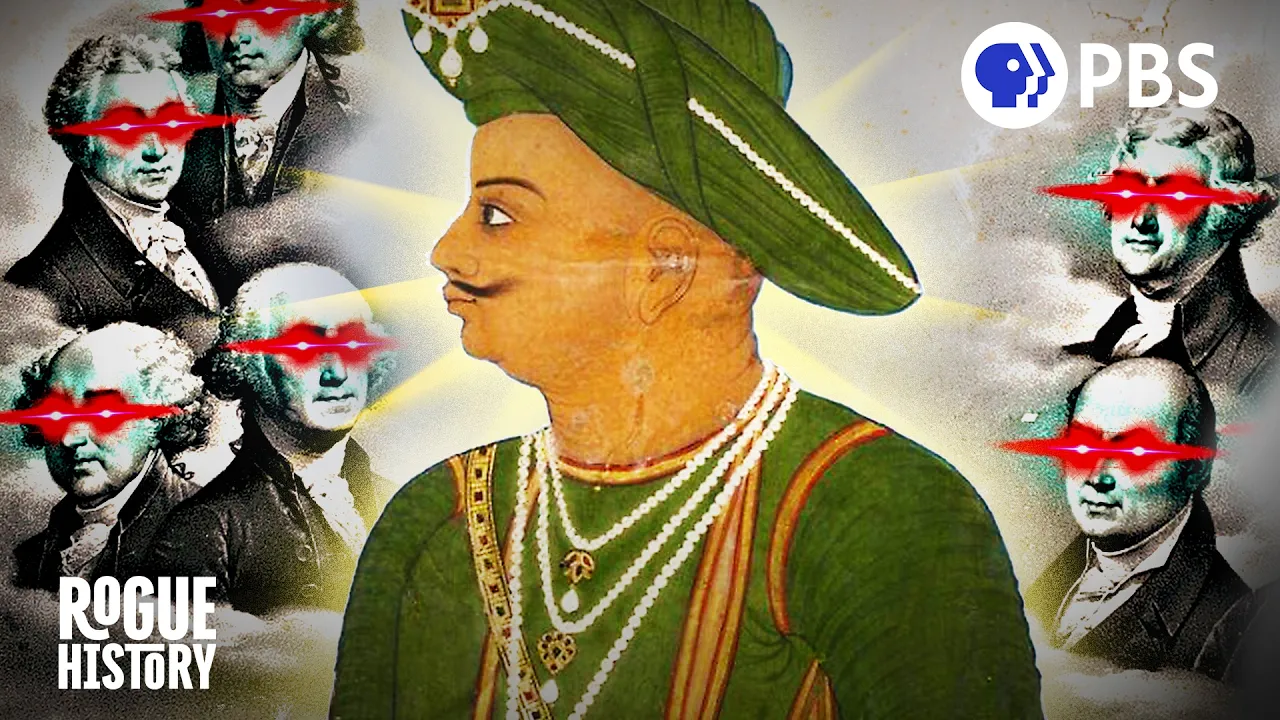
Why The Founding Fathers Were Obsessed with This Muslim Ruler
PBS Origins
·
May 10, 2026
Open on YouTube
Transcript
0:00
- All of Congress listened
with rapt attention
0:02
to a letter written by John Adams.
0:04
His message provided a play by play
0:06
of how the British were
holding up in the war,
0:08
but not the war in America.
0:10
The conflict that Congress
desperately wanted news of
0:13
was happening in Southern India.
0:14
The Americans understood that
they couldn't beat the British
Advertisement
0:17
in the Revolutionary War
without international support.
0:20
And when the founding fathers
needed to close the deal
0:22
against the most powerful
empire on the planet,
0:25
they got an unexpected
assist from Tipu Sultan,
0:28
the legendary Tiger of Mysore.
0:31
I'm Joel Cook, and this is Rogue History.
0:34
So what exactly would unite
a group of American rebels
0:37
with a Muslim ruler on the
other side of the world?
0:40
The same thing that
unites millions of people
0:42
to this very day- British imperialism.
Advertisement
0:44
But more specifically, British tea.
0:46
Let me spill a little for you.
0:47
Most of us know about the Boston Tea Party
0:50
where Americans dressed in
highly problematic disguises
0:53
tossed 342 chests of
tea into Boston Harbor.
0:57
The colonists were
furious about the Tea Act,
1:00
a piece of legislation intended to rescue
1:02
the struggling British East India Company
1:04
by selling its massive stock
of tea at much cheaper rates
1:07
than anything else on the American market.
1:09
The only problem was that this monopoly
1:12
risked putting American tea
sellers out of business,
1:14
hence the whole throwing company tea
1:16
into the harbor situation.
1:18
But what was the British
East India Company
1:20
and where did they get all this tea from?
1:23
The company was founded in December 1600
1:26
and served as the merchant arm
1:27
of British imperialism in Asia.
1:29
Imagine Amazon being in
charge of America's economy
1:32
and you'd have the right idea.
1:33
The company's dealings
with India, China, Persia,
1:36
and Indonesia provided
Britain with tea, textiles,
1:39
and piles of unused spices.
1:42
But all those deals
they managed to pull off
1:44
were because of a unique negotiating tool
1:46
most corporations didn't have,
1:48
a private army.
1:49
If the company couldn't talk Asian powers
1:51
into negotiating with them,
1:52
they were all too willing
to march troops in
1:54
to change their minds.
1:56
That is until they ran
into the Kingdom of Mysore.
1:59
You see, Mysore wasn't some young upstart
2:02
like the Americans.
2:03
When the company started
probing Mysore's borders
2:05
in the 1760s,
2:07
they were met by a brilliant Muslim leader
2:09
named Hyder Ali.
2:10
Hyder had recently taken control
of the South Indian Kingdom
2:13
from a Hindu dynasty
established around 1399.
2:17
As the newly crown sultan of Mysore,
2:19
Hyder led a sophisticated economy
2:22
and an army numbering in
the tens of thousands.
2:24
The Mysoreans were one
of the biggest obstacles
2:26
the British faced in South Asia.
2:29
And Hyder was smart enough to
amplify his kingdom's power
2:32
by forming an alliance with the French.
2:34
But his most effective
weapon against the British
2:36
wasn't his army or his alliances.
2:38
It was his tiger-obsessed son Tipu.
2:40
(tiger roaring)
The story behind the whole
2:42
Tiger of Mysore thing isn't
completely locked down.
2:45
Oral traditions and a
heck of a lot of murals
2:48
commissioned by Tipu
2:49
say that he was on a
wartime mission for his dad
2:52
when he fought and killed
an attacking Bengal tiger
2:54
with just a dagger.
2:55
Now, I wasn't there, so I can't say
2:57
whether Tipu exaggerated
the situation or not,
3:00
but for a 15-year-old
trying to build street cred
3:02
with his dad's veteran army,
3:04
a tiger fighting story
is awfully convenient.
3:06
Either way, Hyder's leadership
3:08
and Tipu's eye of the tiger
mentality on the battlefield
3:11
were catching the eye of a suitor
3:13
on the other side of the world.
3:14
By 1777,
3:16
that little tea incident in Boston
3:18
had spiraled into an all-out war
3:20
against the mighty British Empire.
3:22
The Americans knew they
needed allies in order to win,
3:25
and they sent diplomats across the map
3:27
in search of assistance.
3:28
The French, of course, were
ready to support anything
3:31
that stuck it to the British,
3:32
so they offered the Americans
an intimate correspondence
3:36
with a tall, dark, and handsome
friend from South Asia.
3:39
Though the Americans were excited
3:41
about building a relationship
with the Mysoreans,
3:43
things didn't exactly take off.
3:45
We all know how long
distance relationships are.
3:47
You're both busy. You
can't agree on date night.
3:49
There's a massive empire
trying to destroy you both.
3:52
And to be honest,
3:53
America didn't have much to
bring to the table anyway.
3:56
Sure, they were keeping a large portion
3:58
of the British military
occupied in North America,
4:00
which definitely helped Mysore,
4:02
but nobody, not even the
American rebels themselves,
4:06
was sure they'd be able to keep it up.
4:08
Prior to their victory
at Trenton, New Jersey
4:10
in December 1776,
4:12
the Americans hadn't won
a single major battle
4:14
against the British.
4:15
They thought about sending
their troops to help Mysore,
4:18
but they realized they didn't
even have enough troops
4:20
to fight their own war.
4:21
The best they could do was
instruct their privateers
4:24
and tiny Navy to attack
East India Company shipping
4:27
out of solidarity.
4:28
As much as I hate to admit it,
4:29
for Mysore, Revolutionary
America truly was the guy
4:33
sitting on the passenger side
of his best friend's ride.
4:36
But for the time being,
4:38
Tipu and Hyder didn't really need them.
4:40
Throughout the 1770s,
4:42
father and son built an army
4:43
nearly a hundred thousand strong.
4:45
And when the British threatened
4:46
their French homies in India,
4:48
the Tiger of Mysore showed everyone
4:50
what a ride or die really looks like.
4:52
On September 10th, 1780,
4:55
Tipu wiped out one of
the East India Company's
4:57
private armies at the Battle of Pollilur,
4:59
killing 3,000 men
5:01
and capturing hundreds
of British officers.
5:03
It was an incredible victory for Mysore,
5:05
but it also showed a side of Tipu
5:07
that would cause problems for him.
5:08
Many of the hired guns in
the East India Company's army
5:12
were natives of rival kingdoms in India.
5:14
And when a British officer
tried to surrender to save them,
5:17
Tipu took scattered
gunfire from a few holdouts
5:19
as an excuse to massacre those
who had already surrendered.
5:22
Sometimes a tiger can become a man-eater.
5:25
And the Tiger of Mysore
5:26
was showing early signs of that behavior
5:28
when it came to his political rivals.
5:30
Still, the victory at Pollilur
5:33
convinced the French to send
major military assistance
5:35
to help Mysore,
5:37
and that, along with wins Tipu
and Hyder kept delivering,
5:41
had the domino effect
of forcing the British
5:43
to send Royal Army and Navy units
5:45
to help the East India Company.
5:47
But more troops in India meant
less fighting the Americans.
5:51
And that was a problem for the British
5:53
because that scrub we talked about earlier
5:55
was looking a lot more genuine.
5:58
The glow up started in 1778
6:00
when the American Army
fought the British to a draw
6:03
at the Battle of Monmouth.
6:04
The following year,
6:05
a little known American
officer named John Paul Jones
6:08
put the US Navy on the map
6:10
when he defeated HMS
Serapis in British waters.
6:13
If you'd like to know more about that,
6:15
check out our episode on Jones.
6:16
By July of 1780, French
troops arrived in the colonies
6:20
and the Americans'
chances of winning the war
6:22
were looking pretty good.
6:24
But the Founding Fathers
still wanted to know
6:26
what was happening in Mysore.
6:28
John Adams' letter to Congress
6:30
regaled the Founders with the exploits
6:32
of the famous Hyder Ali in September 1780.
6:36
All throughout the following
year of the Revolutionary War,
6:39
a who's who of famous Americans
6:41
chattered back and forth
across the Atlantic
6:43
about the second Anglo-Mysore war.
6:45
Even in 1782, when American
diplomats traveled to the Hague
6:49
for peace negotiations,
6:51
they were still checking
6:52
the Britain versus Mysore scoreboard,
6:54
the way we check Carolina
Panthers scores in church.
6:57
The Americans understood that
though their war was over,
7:00
their negotiating
leverage relied on Mysore
7:02
continuing to wear the British down.
7:04
But for the brave and sometimes
brutal Tiger of Mysore,
7:08
things were about to
change in a major way.
7:11
In December 1782,
7:13
the French reinforcements
finally arrived in Mysore
7:16
to assist Hyder and Tipu
in defeating the British.
7:19
But by the time they got there,
7:21
the dynamic duo was down to one.
7:23
Hyder Ali died just six days
after Tipu's 31st birthday.
7:27
For the newly crowned Tipu Sultan,
7:29
it seems that his method for processing
7:31
involved leaning very heavily
into his special interest.
7:35
That is to say Tipu got way more tigery.
7:38
After taking over his father's palace,
7:39
Tipu upgraded the home decor
by adding a tiger throne
7:42
with a life-sized tiger head,
7:44
pillars capped with engraved tigers,
7:46
oh, and how could I forget,
actual Bengal tigers.
7:50
And it didn't stop there.
7:51
The new Sultan ordered tiger stripes
7:53
added to the Mysorean military uniform
7:55
and engraved tigers on his guns, swords,
7:58
and other possessions,
7:59
but Tipu's best work
as an interior designer
8:01
was a clear warning to the British
8:03
that things weren't gonna
get any easier for them.
8:06
Sometime after becoming Sultan,
8:08
Tipu commissioned a nearly
life-sized automaton
8:11
of a tiger eating a British soldier.
8:13
The automaton included a
crank attached to a mechanism
8:16
inside the tiger's body
8:17
that simultaneously
lifted the dying man's arm
8:20
and produced noises
imitating his final cries.
8:25
Help me!
8:26
Help me! Talk about committing to the bit.
8:28
But fulfilling his special interests
8:30
didn't distract Tipu from the war.
8:32
He continued to attack the British
8:34
and their native allies in Southern India,
8:35
but with less success against the British
8:38
and more brutal suppression
of his Indian rivals.
8:40
And just when it seemed
things couldn't get any worse,
8:43
France and America hit Mysore
8:45
with the it's not you, it's me.
8:48
In early 1783,
8:49
both France and the United States
8:52
signed peace treaties with Britain.
8:54
But for Tipu and Mysore,
it was a harbinger of doom.
8:57
Without the Americans
distracting the British
8:59
and the French sending troops,
9:00
Mysore now stood alone
9:02
against the most powerful
empire in the world.
9:04
Lord Charles Cornwallis,
9:06
the very General George
Washington defeated
9:09
to win the Revolutionary
War, was reassigned to India
9:12
with instructions to destroy the Tiger
9:14
and his kingdom once and for all.
9:17
Now, before you get upset,
9:18
you have to remember,
9:20
America was a young country at this point.
9:22
It managed to stand up to the
British and win absolutely,
9:26
but holding onto their
freedom wasn't a guarantee.
9:29
The revolutionaries who won the war
9:31
were now the government officials
9:32
nearly three million people
we're looking to for safety.
9:35
Still, Tipu had to have been a little hurt
9:38
when Washington's administration
9:40
opened two consulates in India
9:42
to foster goodwill and
trade with the British.
9:44
Tipu once said that he would
rather live two days as a tiger
9:48
than two centuries as a sheep.
9:50
And when the British stormed
9:51
the Mysorean capital in May 1799,
9:53
he stayed true to his word,
9:55
standing and fighting until the very end.
9:57
The Kingdom of Mysore survived,
9:59
but remained under British control
10:01
until India gained its independence
nearly 150 years later.
10:06
Though the American
Revolution is often told
10:09
as a story of plucky colonists
10:10
standing on their own against
the mighty British empire,
10:13
that's only a fraction of the story.
10:15
All across the world,
10:16
various peoples worked
together as best they could
10:19
to stop an imperial juggernaut
10:21
from destroying their way of life.
10:23
For some, like the Americans,
10:25
this global revolution brought
them the time they needed
10:28
to strengthen their resistance
and earn their freedom.
10:30
And for others, like Tipu Sultan
and the Kingdom of Mysore,
10:33
their revolution continued
on for over a century.
10:36
When we think about the
American Revolution,
10:39
what it means and who contributed,
10:41
it's good to remember more
than just the big names
10:43
like George Washington and
famous allies like the French.
10:47
Beyond those icons
stand many lesser known,
10:49
but equally impactful contributors,
10:52
like the tiger-obsessed Sultan
10:54
who gave America a chance
to win its freedom.
10:57
Are there any other surprising influences
10:58
on American history that come to mind?
11:00
Tell us in the comments. Till next time.
11:02
Before you go,
11:04
we're excited to tell you
about PBS Documentaries,
11:07
our newest YouTube channel.
11:08
We're rebranding and expanding PBS Voices
11:11
to now include everything
11:12
from digital original series like "Ritual"
11:15
to independent films
11:16
to the best of PBS's
extensive documentary archive.
11:20
This will be the best
place on the internet
11:22
for documentary lovers.
11:23
Check out the link in
the description. Thanks.
11:26
(dramatic music)
— end of transcript —
Advertisement