Advertisement
 7:38
7:38
Transcript
0:06
so in quantum
0:08
mechanics you see this I appearing here
0:12
and it's a complex number square root of
0:16
minus1 and that shows that somehow
0:19
complex numbers are very important well
0:22
it's difficult to overemphasize their
0:25
importance so I is the square root of
0:28
minus1 was invented by people in order
Advertisement
0:32
to solve equations equations like x² =
0:37
-1 and it so happens that once you
0:41
invent I you don't need to invent more
0:43
numbers and you can solve every polom
0:47
equation with just I and square root of
0:50
I well square root of I can be written
0:53
in terms of I and other numbers so um if
0:58
you have a complex number
1:01
Z we sometimes write it this way and we
1:06
say it belongs to the complex numbers
Advertisement
1:08
and with A and B belonging to the real
1:13
numbers and we say that the real part of
1:16
Z is a and the imaginary part of Z is B
1:23
we also Define the complex
1:26
conjugate of Z which is a minus
1:31
IB and we picture the complex number uh
1:36
Z by putting a on the x axis B on the Y
1:41
AIS and we think of the complex number Z
1:45
here kind of like putting the real
1:48
numbers here and the imaginary Parts
1:51
here so um you can think of this as i b
1:55
or B but uh this is the complex number
1:58
maybe IB would be a better way to write
2:00
it
2:01
here so with complex numbers there's one
2:05
uh more uh useful identity you define
2:09
the norm of the complex number to be
2:13
square root of a 2 + b^
2:16
S and then this results in the norm
2:21
squared being a 2 + b^ 2 and it's
2:26
actually equal to Z * Z star a very
2:30
fundamental equation Z * Z Star if you
2:34
multiply Z * Z
2:37
Star you get a squ + b squ so the norm
2:42
squared the norm of this thing is a real
2:48
number and uh that's uh pretty important
2:55
so there's one other identity that is is
3:00
very useful I might as well mention it
3:04
here as we're going to be working with
3:06
complex numbers and uh for more practice
3:09
and complex numbers you'll see the
3:13
homework so
3:16
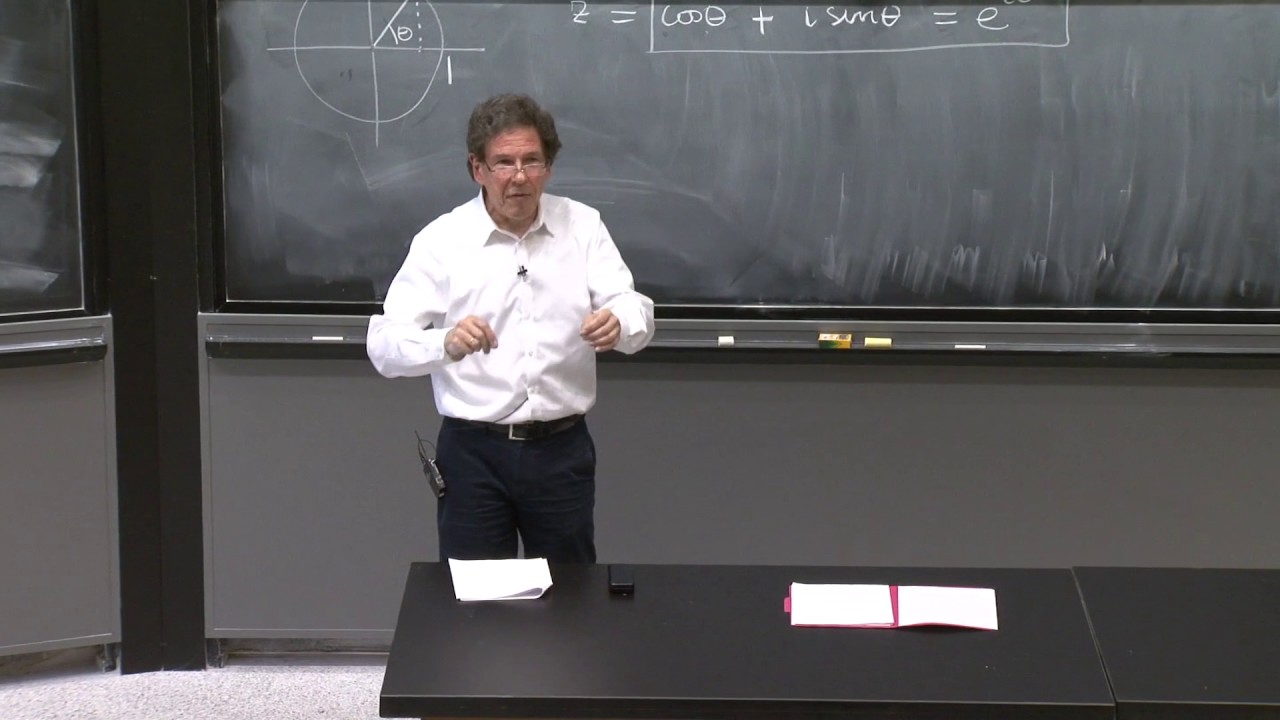
suppose I have in the complex plane an
3:19
angle
3:21
Theta and I want to figure out what is
3:24
this complex number Z here at unit
3:28
radius
3:30
so I would
3:33
know that its real part would be cosine
3:40
Theta and its imaginary part would be S
3:44
Theta it's a circle of radius
3:50
one so that must be the complex number Z
3:55
must be equal to cosine theta plus I sin
3:58
Theta because the real part of it is
4:02
cosine Theta it's indeed that horizontal
4:05
part projection and the imaginary part
4:09
is the vertical
4:11
projection well the thing that is very
4:14
amazing is that this is equal to e to
4:17
the I
4:19
Theta and that is very
4:22
non-trivial to prove it you have to work
4:25
a bit but it's a very famous result and
4:28
we'll use it
4:33
so that is complex number so
4:37
uh complex numbers you use them in
4:41
electromagnetism you sometimes use them
4:44
in classical mechanics but you always
4:46
used it in an auxiliary way it was not
4:50
directly relevant because the electric
4:55
field is real the position is real the
4:57
velocity is real everything is real and
5:00
the equations are real on the other hand
5:04
in quantum mechanics the equation
5:06
already has an I so in quantum
5:13
mechanics p is a complex number
5:18
necessarily it has to be in fact if it
5:22
would be
5:23
real you could have a you would have a
5:26
contradiction because if s is real turns
5:30
out for all physical systems we're
5:32
interested in h on py real gives you a
5:37
real thing and here if SI is real the
5:40
derivative is real and this is imaginary
5:42
and you have a contradiction so there
5:44
are no solutions that are
5:47
real so you need complex numbers they're
5:51
not auxiliary on the other hand you can
5:54
never measure a complex number complex
5:57
you measure real numbers Dieter
6:01
of position weight anything that you
6:04
really measure at the end of the day is
6:06
a real number so if the wave function
6:09
was a complex number was the issue of
6:12
what is the physical interpretation and
6:14
maxb had the idea that you have to
6:18
calculate the real number called the
6:21
norm of this square and this is
6:24
proportional to probabilities
6:33
so uh that was a great discovery and had
6:37
a lot to do with the development of
6:39
quantum mechanics many people hated this
6:42
uh uh in fact shinger himself hated it
6:46
um and uh his invention of the shringer
6:49
cat was an attempt to show how
6:51
ridiculous was the idea of thinking of
6:54
these things as
6:55
probabilities but he was wrong and
6:58
Einstein was wrong wrong in that way but
7:01
when very good physicists are wrong uh
7:05
they are not wrong for silly reasons
7:08
they are wrong for good reasons and we
7:09
can learn a lot from their thinking and
7:13
uh this epr things that we will discuss
7:16
at this at some moment in your Quantum
7:19
sequence at MIT Einstein Podolski Rosen
7:24
was a attempt to show that quantum
7:26
mechanics was wrong and led to amazing
7:29
discovery
7:30
it was the epr paper itself was wrong
7:34
but it brought up ideas that turned out
7:37
to be very important
— end of transcript —
Advertisement