Advertisement
 11:15
11:15
Transcript
0:03
Do you guys know about the Putnam?
0:05
It's a math competition for undergraduate students.
0:08
It's a six-hour long test that just has 12 questions
0:11
broken up into two different three-hour sessions.
0:14
And each one of those questions is scored 1 to 10,
0:16
so the highest possible score would be 120.
0:19
And yet, despite the fact that the only students taking this thing each year are those
0:24
who clearly are already pretty interested in math, the median score is around 1 or 2.
Advertisement
0:28
So it's a hard test.
0:31
And on each one of those sections of six questions,
0:33
the problems tend to get harder as you go from 1 to 6,
0:36
although of course difficulty is in the eye of the beholder.
0:40
But the thing about those fives and sixes is that even though they're
0:43
positioned as the hardest problems on a famously hard test,
0:46
quite often these are the ones with the most elegant solutions available,
0:50
some subtle shift in perspective that transforms it from very challenging to doable.
0:56
Here I'm going to share with you one problem that came up
0:58
as the sixth question on one of these tests a while back.
Advertisement
1:01
And those of you who follow the channel know that rather than just jumping
1:04
straight to the solution, which in this case would be surprisingly short,
1:07
when possible I like to take the time to walk you through how you might
1:10
have stumbled across the solution yourself, where the insight comes from.
1:14
That is, make a video more about the problem-solving
1:17
process than about the problem used to exemplify it.
1:20
So anyway, here's the question.
1:21
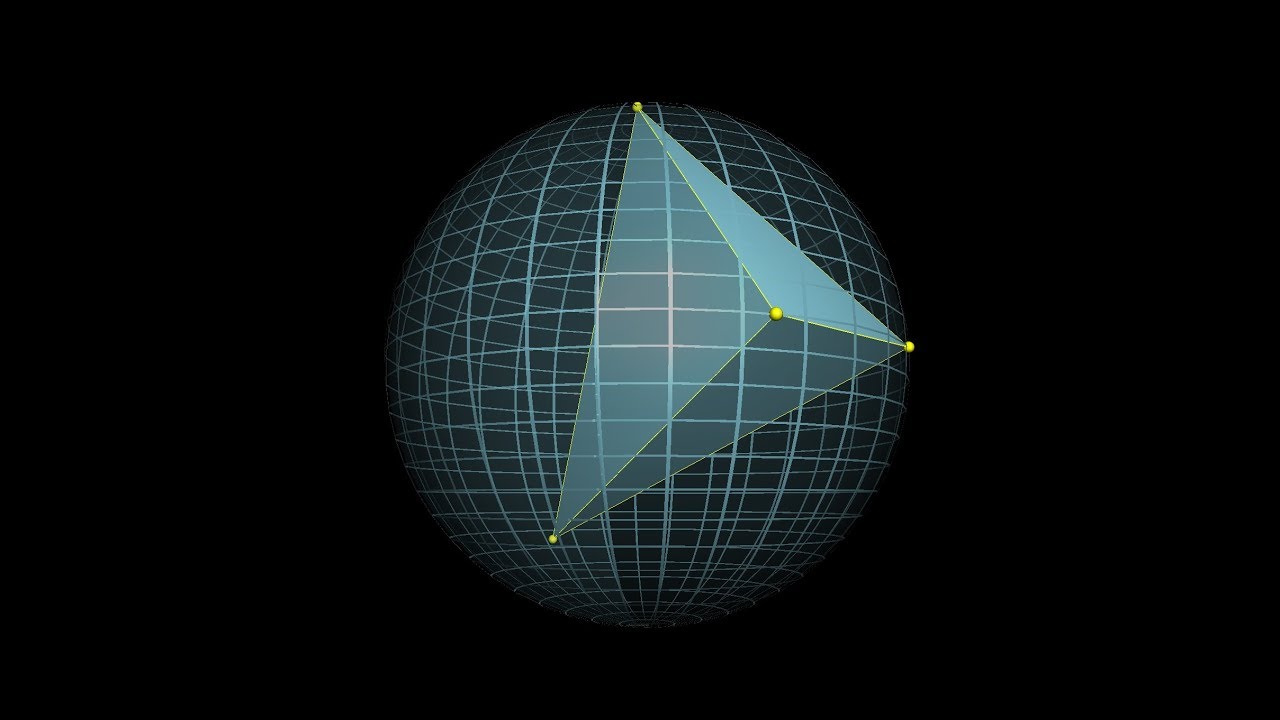
If you choose four random points on a sphere, and consider the
1:25
tetrahedron with these points as its vertices,
1:28
what is the probability that the center of the sphere is inside that tetrahedron?
1:33
Go ahead, take a moment and kind of digest this question.
1:37
You might start thinking about which of these tetrahedra contain the sphere's center,
1:42
which ones don't, how you might systematically distinguish the two,
1:45
and how do you approach a problem like this?
1:48
Where do you even start?
1:51
Well, it's usually a good idea to think about simpler cases,
1:54
so let's knock things down to two dimensions, where you'll choose three random
1:58
points on a circle, and it's always helpful to name things so let's call these guys P1,
2:03
P2, and P3.
2:04
The question is, what's the probability that the triangle
2:07
formed by these points contains the center of the circle?
2:14
I think you'll agree it's way easier to visualize now, but it's still a hard question.
2:18
So again, you ask, is there a way to simplify what's going on,
2:22
get ourselves to some kind of foothold that we can build up from?
2:25
Well, maybe you imagine fixing P1 and P2 in place, and only letting that third point vary.
2:31
And when you do this, and play around with it in your mind,
2:34
you might notice that there's a special region, a certain arc,
2:37
where when P3 is in that arc, the triangle contains the center, otherwise not.
2:42
Specifically, if you draw lines from P1 and P2 through the center,
2:46
these lines divide up the circle into four different arcs,
2:49
and if P3 happens to be in the one on the opposite side as P1 and P2,
2:53
the triangle has the center.
2:55
If it's in any of the other arcs though, no luck.
3:01
We're assuming here that all of the points of the circle are equally likely.
3:04
So what is the probability that P3 lands in that arc?
3:08
It's the length of that arc divided by the full circumference of the circle,
3:12
the proportion of the circle that this arc makes up.
3:15
So what is that proportion?
3:17
Obviously that depends on where you put the first two points.
3:20
I mean, if they're 90 degrees apart from each other,
3:22
then the relevant arc is one quarter of the circle.
3:25
But if those two points were farther apart, that proportion would be something closer
3:29
to a half, and if they were really close together, that proportion gets closer to zero.
3:34
So think about this for a moment.
3:35
P1 and P2 are chosen randomly, with every point on the circle being equally likely.
3:40
So what is the average size of this relevant arc?
3:46
Maybe you imagine fixing P1 in place, and just
3:48
considering all the places that P2 might be.
3:51
All of the possible angles between these two lines,
3:54
every angle from 0 degrees up to 180 degrees, is equally likely.
3:58
So every proportion between 0 and 0.5 is equally likely,
4:02
and that means that the average proportion is 0.25.
4:08
So, if the average size of this arc is a quarter of the full circle,
4:12
the average probability that the third point lands in it is a quarter,
4:16
and that means that the overall probability that our triangle contains the
4:20
center is a quarter.
4:26
But can we extend this into the three-dimensional case?
4:29
If you imagine three out of those four points just being fixed in place,
4:33
which points of the sphere can the fourth one be on so that the
4:37
tetrahedron that they form contain the center of the sphere?
4:41
Just like before, let's go ahead and draw some lines from each
4:44
of those fixed three points through the center of the sphere.
4:47
It's also helpful if we draw some planes that are determined by any pair of these lines.
4:53
What these planes do, you might notice, is divide the sphere into
4:56
eight different sections, each of which is a sort of spherical triangle.
5:01
And our tetrahedron is only going to contain the center of the sphere if the
5:05
fourth point is in the spherical triangle on the opposite side as the first three.
5:11
Now, unlike the 2D case, it's pretty difficult to think about the
5:14
average size of this section, as we let the initial three points vary.
5:21
Those of you with some multivariable calculus under your belt might think,
5:24
let's just try a surface integral.
5:26
And by all means, pull out some paper and give it a try.
5:28
But it's not easy.
5:30
And of course it should be difficult.
5:31
I mean, this is the sixth problem on a Putnam, what do you expect?
5:35
And what do you even do with that?
5:39
Well, one thing you can do is back up to the two-dimensional case and
5:42
contemplate if there is a different way to think about the same answer we got.
5:46
That answer, one-fourth, looks suspiciously clean,
5:49
and raises the question of what that four represents.
5:53
One of the main reasons I wanted to make a video about this particular problem is that
5:57
what's about to happen carries with it a broader lesson for mathematical problem solving.
6:01
Think about those two lines we drew for p1 and p2 through the origin.
6:05
They made the problem a lot easier to think about.
6:08
And in general, whenever you've added something to the problem
6:11
setup that makes it conceptually easier, see if you can reframe
6:14
the entire question in terms of those things you just added.
6:18
In this case, rather than thinking about choosing three points randomly,
6:23
start by saying, choose two random lines that pass through the circle's center.
6:28
For each line, there's two possible points it could correspond to,
6:31
so just flip a coin for each one to choose which of the endpoints is going to be p1,
6:35
and likewise for the other, which endpoint is going to be p2.
6:39
Choosing a random line and flipping a coin like this is the same thing as choosing
6:43
a random point on the circle, it just feels a little bit convoluted at first.
6:47
But the reason for thinking about the random process this
6:50
way is that things are actually about to become easier.
6:53
We'll still think about that third point, p3, as just being a random point on the circle,
6:58
but imagine that it was chosen before you do the two coin flips.
7:02
Because you see, once the two lines and the third point are set in stone,
7:06
there's only four possibilities for where P1 and P2 might end up,
7:10
based on those coin flips, each one being equally likely.
7:13
But one and only one of those four outcomes leaves p1 and p2 on the opposite
7:18
side of the circle as p3, with the triangle they form containing the center.
7:23
So no matter where those two lines end up, and where that p3 ends up,
7:27
it's always a 1 fourth chance that the coin flips leave us with a triangle containing
7:32
the center.
7:35
Now that's very subtle.
7:37
Just by reframing how we think about the random process for choosing points,
7:40
the answer 1 quarter popped out in a very different way from how it did before.
7:45
And importantly, this style of argument generalizes seamlessly up into three dimensions.
7:51
Again, instead of starting off by picking four random points,
7:55
imagine choosing three random lines through the center of the sphere,
7:59
and then some random point for p4.
8:03
That first line passes through the sphere at two points,
8:05
so flip a coin to decide which of those two points is going to be p1.
8:09
Likewise, for each of the other lines, flip a coin to decide where p2 and p3 end up.
8:15
There's eight equally likely outcomes of those coin flips,
8:18
but one and only one of them is going to place p1, p2,
8:22
and p3 on the opposite side of the center as p4.
8:26
So one and only one of these eight equally likely
8:29
outcomes gives us a tetrahedron that contains the center.
8:35
Again, it's kind of subtle how that pops out to us, but isn't that elegant?
8:40
This is a valid solution to the problem, but admittedly
8:43
the way I've stated it so far rests on some visual intuition.
8:47
If you're curious about how you might write it up in a way that doesn't
8:50
rely on visual intuition, I've left a link in the description to one
8:52
such write-up in the language of linear algebra, if you're curious.
8:56
And this is pretty common in math, where having the key insight and
8:59
understanding is one thing, but having the relevant background to articulate
9:03
that understanding more formally is almost a separate muscle entirely,
9:07
one that undergraduate math students kind of spend most of their time building up.
9:12
But the main takeaway here is not the solution itself,
9:14
but how you might find that key insight if it was put in front of you and you
9:18
were just left to solve it.
9:20
Namely, just keep asking simpler versions of the
9:22
question until you can get some kind of foothold.
9:25
And then when you do, if there's any kind of added construct that proves to be useful,
9:29
see if you can reframe the whole question around that new construct.
9:35
To close things off here, I've got another probability puzzle,
9:38
one that comes from this video sponsor, brilliant.org.
9:41
Suppose you have eight students sitting in a circle taking the Putnam.
9:44
It's a hard test, so each student tries to cheat off of his neighbor,
9:48
choosing randomly which neighbor to cheat from.
9:51
Now circle all of the students that don't have somebody cheating off of their test.
9:56
What is the expected number of such circled students?
10:00
It's an interesting question, right?
10:03
Brilliant.org is a site where you can practice your problem
10:05
solving abilities with questions like this and many, many more.
10:08
And that really is the best way to learn.
10:10
You're going to find countless interesting questions curated in a pretty
10:14
thoughtful way so that you really do come away better at problem solving.
10:18
If you want more probability, they have a really good course on probability,
10:21
but they've got all sorts of other math and science as well,
10:23
so you're almost certainly going to find something that interests you.
10:27
Me?
10:27
I've been a fan for a while, and if you go to brilliant.org slash 3b1b,
10:31
it lets them know that you came from here, and the first 256 of you to visit that
10:36
link can get 20% off their premium membership, which is the one I use,
10:40
if you want to upgrade.
10:42
Also if you're just itching to see a solution to this puzzle,
10:45
which by the way uses a certain tactic in probability that's useful in a lot of
10:48
other circumstances, I also left a link in the description that just jumps you
10:52
straight to the solution.
— end of transcript —
Advertisement