Advertisement
 7:26
7:26
Transcript
0:00
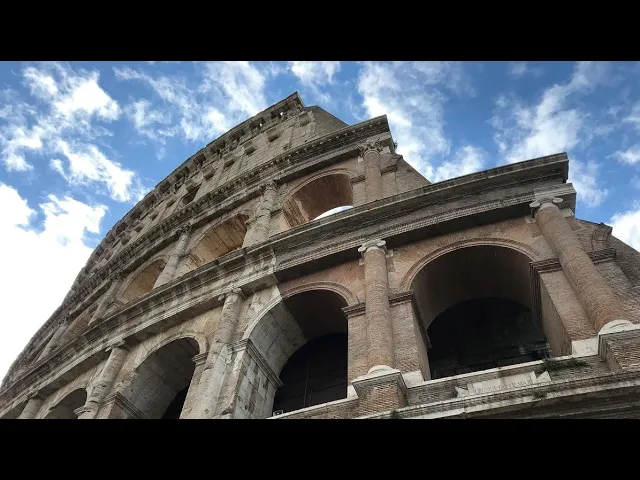
Everybody knows the Colosseum. And everyone
knows that this part of the Colosseum…looks
0:07
a lot better than this part. So what happened?
How and why did half of the greatest Roman
0:13
amphitheater vanish? Sounds like a job for…
Questions about Ancient Greece and Rome
0:19
(you were afraid to ask in school). As
usual, I’m Dr. Garrett Ryan. And today,
0:24
I’ll be talking about the history of the
Colosseum during the Middle Ages and Renaissance.
0:29
For almost 500 years, the Colosseum was
the Roman Empire’s most impressive arena.
0:34
Emperor and emperor sponsored spectacles
to astonish and delight the Roman people.
0:40
Exotic animals from the farthest reaches
of world were hunted with gilded spears.
Advertisement
0:46
Criminals were devoured by bears
in elaborate mythological charades.
0:50
The Empire’s greatest gladiators dueled
on bloodstained sands. And so on.
0:56
Over its half-millennium of use, the Colosseum
underwent a long series of renovations.
1:02
The most important took place in the early
third century, when a fire destroyed the
1:06
entire upper deck of seating. It took the
emperors five years to restore the building,
1:11
and signs of hasty repairs are still visible all
along the north wall. Later, over the course of
1:16
the fifth century, a series of earthquakes caused
serious damage that was never fully repaired.
1:21
The spectacles held in the Colosseum
also changed over the centuries.
1:25
The most impressive spectacles, unsurprisingly,
were held during the Empire’s salad days.
1:30
To celebrate his victory in Dacia, for example,
Trajan celebrated a whopping 123 days of games,
Advertisement
1:37
in the course of which 5,000 pairs of gladiators
fought and 11,000 animals were killed.
1:43
From the early mid-third century onward,
the quality of the games started to slip.
1:48
The later Roman emperors were poorer and
more distracted than their predecessors,
1:53
and tended to spend most of their time
and money far from the city of Rome.
1:58
It also didn’t help that most
of the more exciting animals
2:01
had been hunted to the point of scarcity, and
that the price of gladiators was always rising.
2:07
Eventually, the gladiatorial combats stopped
altogether. According to a later legend,
2:12
a monk leapt down to the arena, and tried to
stop a gladiator from killing his opponent.
2:18
The enraged spectators then stoned the
monk to death. Upon learning of this,
2:23
the emperors ended the combats. Or so the
legend goes. Reality was probably less dramatic.
2:31
Although Christian disapproval was
one cause of the decline in combats,
2:35
the fact that the emperors were no longer paying
for them seems to have been equally important.
2:40
Whatever the reason, the last gladiators fought in
the Colosseum sometime in the early fifth century.
2:47
The beast hunts, however, continued.
They lasted longer, in fact,
2:52
than the Western Roman Empire itself. The last
hunts were sponsored by the barbarian kings
2:57
who succeeded the emperors. These kings, however,
had little interest in the games, not least
3:04
because it was difficult to justify staging
them for Rome’s steadily shrinking population.
3:10
The final recorded hunts in the
Colosseum were held in the year 523.
3:15
Within a few centuries, all understanding
of the Colosseum’s function was lost.
3:20
Some claimed it had been a temple of the Sun, and
had originally been crowned by a vast golden dome.
3:27
Others thought that it had been a
temple dedicated to all the gods,
3:31
and that a gigantic statue of Jupiter
had originally stood in the Arena.
3:36
The strangest legends revolved around the Roman
poet Virgil, whom medieval legend transformed
3:41
into a great magician. Virgil, it was said, had
built the Colosseum with the help of his demons,
3:47
and used it as a theater for necromancy.
Part of the confusion derived from the fact
3:52
that the Colosseum was already half-ruined
at the beginning of the Middle Ages,
3:56
and steadily fell apart over the course of
the next millennium. Earthquakes were the
4:00
main natural cause. Like any tall masonry
structure, the Colosseum was susceptible to
4:06
seismic damage. And thanks to a quirk of geology,
part of the building was especially vulnerable.
4:12
The Colosseum’s massive concrete foundations
only go down to bedrock on the north side
4:18
of the building. On the south side, the foundation
rests on waterlogged sediment. This unstable
4:23
subsoil amplified seismic shocks, and gradually
brought about the collapse of half the building.
4:30
The Colosseum’s greatest enemies,
however, were the Romans themselves.
4:35
The building’s walls were built of
a fine limestone called travertine,
4:38
and its seats were made of marble. Both
stones were attractive to medieval builders.
4:44
Marble and travertine were not
only easy and attractive to re-use;
4:47
they could also both be burnt in
kilns to make lime for mortar.
4:51
Pillaging of the Colosseum’s stone began even
before the final games were staged in the arena,
4:56
and continued on a massive scale
for more than a thousand years.
5:00
The Colosseum wasn’t just a quarry. For much of
the Middle Ages, hundreds of people lived in the
5:06
ruinous vaults and passageways. There were houses
complete with courtyards and little gardens.
5:13
There were shops with wooden awnings
and storage lofts. There were stables,
5:17
there were churches, and at one point there
was even a full-blown fortified palace.
5:23
Remarkably, many of the Medieval
Colosseum’s inhabitants were lime-burners,
5:27
who spent their days tearing apart the
building in which they were squatting.
5:32
Thanks largely to their efforts, the Colosseum
became an increasingly inhospitable place to live.
5:38
Finally, in 1349, an earthquake brought down the
entire south half of the Colosseum’s circuit wall,
5:44
forming a colossal pile of rubble. Over
the next four centuries, this heap,
5:50
colloquially called the Colosseum’s Thigh,
built half the churches of Renaissance Rome.
5:56
In 1452, a single busy contractor carried
off more than 2,500 cartloads of stone
6:04
After all these centuries of earthquakes and
pillaging, it might seem surprising that anything
6:08
is left of the Colosseum. The reason so much
remains, remarkably, is that part of the building
6:13
was protected. As mentioned earlier, the north
side of the Colosseum was always less susceptible
6:19
to earthquake damage. It was kept from being
pulled apart by scavengers, however, by the popes.
6:26
The north side of the Colosseum happened to face
the processional route connecting the Lateran
6:30
Palace with the Vatican. The popes seems to have
deliberately preserved this part of the Colosseum
6:35
as a monumental backdrop for their parades.
Not that every pope agreed; as late as the
6:41
sixteenth century, Pius V proposed demolishing the
arena’s remains. But most pontiffs, fortunately,
6:48
insisted on preserving this fragment
of Rome’s greatest ancient building.
6:53
So, there you have it: we have half a Colosseum
because earthquakes and the popes spared it.
6:59
If you’d like to learn more about the Colosseum,
I now offer virtual guided tours exploring the
7:03
building and the Roman games. You can
visit toldinstone.com to learn more.
7:09
In the meantime, as always, thanks for watching.
— end of transcript —
Advertisement