Advertisement
 7:58
7:58
Transcript
0:01
For half a millennium, Rome was the biggest,
richest, and most spectacular city on Earth.
0:09
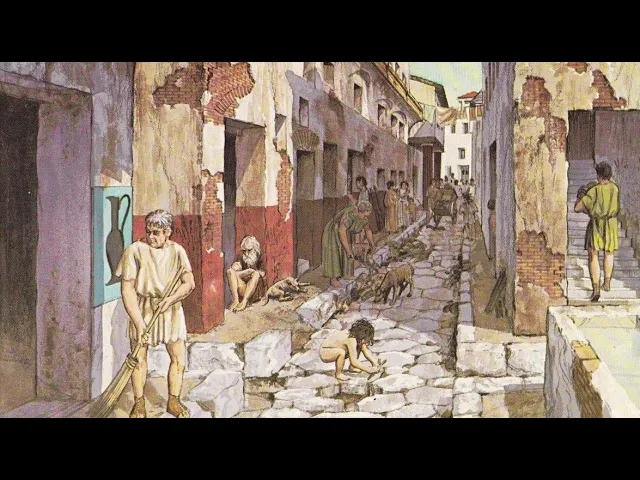
It was also the most dangerous. Every bath
and alleyway had its thieves and thugs,
0:15
and even after Augustus put a stop to the
street-fighting gangs of the late Republic,
0:21
violent crime remained a problem. Ancient
authors mention murderers, guilds of criminals,
0:28
and even a mysterious group of assassins who
killed their victims with poisoned needles.
0:35
Firemen patrolled Rome’s streets at
night, and soldiers of the urban cohorts
0:40
were stationed in public places during the day.
Neither did much to suppress the crime rate.
0:47
The urban cohorts, in fact, routinely contributed
to the problem by extorting protection money.
Advertisement
0:54
The Praetorian Guard – who were sometimes
called in as riot police – were even worse,
0:59
and became notorious for casually
beating and abusing innocent citizens.
1:05
Crime was not focused in any
one part of ancient Rome.
1:10
Although some neighborhoods, as we’ll see,
were richer than others, there was nothing like
1:14
the rigid separation of high- and low-income areas
found in many modern cities. Throughout Rome,
1:21
the mansions of the elite stood side-by-side with
low-rent apartment buildings and modest shops.
1:28
Let’s take a closer look. This is
a map of Rome around the year 300.
1:35
The outer dark line represents the Aurelian
walls, which marked the edge of the imperial city.
1:42
The inner line traces the old Republican walls,
long disused and built over by this point.
1:50
Much of the city center was off-limits to housing:
the Roman Forum and imperial Fora, the Capitoline
Advertisement
1:56
Hill with its temples, the Palatine Hill with
its palaces, the Colosseum in the valley below.
2:04
Few Romans, likewise, lived in the Campus
Martius – the low-lying area in the bend of
2:09
the Tiber – since this district was
also filled with public buildings.
2:14
The huge imperial bath complexes took
up neighborhood-size swaths of land.
2:21
So did the vast imperially-owned
gardens along the edges of the city.
2:26
In short, everyone in Rome besides the emperors
and the wealthiest aristocrats had to live in
2:31
the spaces between all those red circles.
The houses of the elite, as mentioned,
2:38
were scattered throughout the city. But there were
clusters of mansions in a few areas, usually on
2:43
the summits of hills, which were likelier to
catch a breeze during the sweltering summer.
2:49
One such cluster was on the
crest of the Quirinal Hill,
2:52
where aristocratic residences lined an ancient
thoroughfare called Alta Semita – high street.
2:59
There were other groups of mansions along
the parks of the Esquiline and Caelian
3:04
Hills. And during the first and second centuries,
in an early version of gentrification, elite
3:11
houses displaced the historically working-class
neighborhoods atop the Aventine Hill.
3:17
So, where were the less salubrious parts of
the city? Rome’s iconic “rough neighborhood”
3:24
was the Suburra, in the swampy valley
between the Esquiline and Viminal Hills.
3:30
Roman authors dwell on the neighborhood’s filthy
streets, cheap taverns, and cheaper brothels.
3:37
But as in most parts of the city,
there were pockets of affluence;
3:41
for years, Caesar himself had a house there.
The emporium, Rome’s warehouse district,
3:47
was another unsavory side of town, inhabited
mostly by dock workers and itinerant merchants.
3:55
It didn’t help that the whole neighborhood
smelled like rancid olive oil,
3:59
since it stood beside a gigantic
mound of broken oil amphorae.
4:04
Trastevere, across the river, was
a crowded working-class district,
4:09
home to many recent immigrants from the provinces.
It wasn’t an especially rough neighborhood,
4:14
but it wasn’t respectable either. Everybody who
was anybody lived on the other side of the Tiber.
4:22
The Vatican, outside the Aurelian
walls, was a patchwork of clay pits,
4:27
working-class cemeteries, and scraggly
vineyards that made the worst wine in Rome.
4:33
It wasn’t dangerous, but it
wasn’t a place linger either.
4:37
This video belongs to the “time traveler’s
guide to ancient Rome” series, which provides
4:43
advice to those hypothetically possessing means,
motive, and opportunity to visit the ancient city.
4:49
So let’s talk practicalities. If you were
to somehow time travel to ancient Rome,
4:55
which parts of the city would
you be best advised to avoid?
5:00
Obviously you’d be much more likely to be mugged
in the Suburra than on High Street. But it’s not
5:06
so much neighborhoods you’d have to watch out for,
as it is trouble spots within those neighborhoods.
5:13
Time travelers who find themselves in ancient
Rome’s seedier areas should avoid bars, barbers,
5:20
and brothels. Bars first. Roman bars – tabernae or
cauponae – were places to get a quick bite or long
5:28
drink. They served simple hot foot and cheap wine,
and were popular neighborhood watering holes.
5:36
They often doubled, however, as brothels, and were
centers of illegal gambling and other chicanery.
5:42
In a neighborhood like the Suburra, entering
one would likely attract unwanted attention.
5:49
Second, barbers. What, you ask, was wrong with
barbers? Just one thing: they talked too much.
5:59
Most Roman barbers worked outside, often
on a street corner, where they tended to
6:04
keep a steady stream of chatter going with
their clients, with neighborhood idlers,
6:09
and anybody else within earshot. Hanging out
near a barber would thus be a surefire way
6:15
to let every criminal in the neighborhood know
where to find to the confused-looking foreigner.
6:21
Finally, brothels. If you happened, purely
by accident, to stumble into a Roman brothel,
6:28
you would do best to stumble right back
out. Quite aside from the other hazards
6:34
of patronizing such places, you would
stand an excellent chance of being robbed.
6:40
If you planned to spend a substantial part of your
visit in dangerous situations, you might want to
6:46
hire a bodyguard. A good bodyguard – preferably
a retired gladiator – would deter all but the
6:52
most determined thieves. Unfortunately,
some bodyguards were thieves themselves,
6:59
so you’d have to choose your
associate very carefully.
7:02
Regardless of whether you decided to hire
a bodyguard, you could avoid most problems
7:07
simply by not drawing attention to yourself
and – above all – not venturing out at night.
7:15
Ancient Rome was a no-man’s land after dark.
You’ll find other useful tips about surviving a
7:24
hypothetical trip to ancient Rome and much more in
my forthcoming book Naked Statues, Fat Gladiators,
7:30
and War Elephants. You’ll find time travel gear
on the toldinstone Patreon page. Stay tuned
7:37
for the next installment of a Time Traveler’s
Guide to Ancient Rome, and thanks for watching.
— end of transcript —
Advertisement