Advertisement
 53:13
53:13
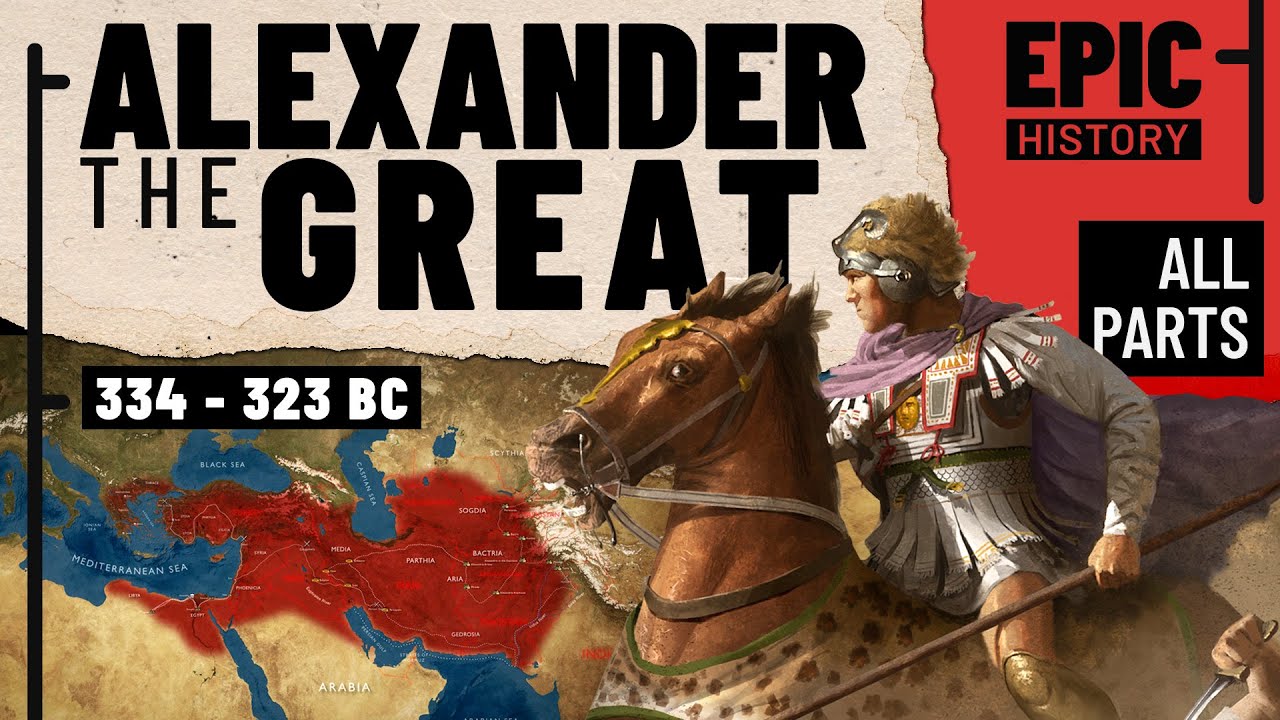
The Greatest General in History? Alexander the Great (All Parts)
Epic History
·
May 11, 2026
Open on YouTube
Transcript
0:00
Alexander the Great (All Parts)
0:01
In 334 BC, Alexander, King of Macedonia, began one of the greatest military campaigns in history
0:09
- against the superpower of the age - the Persian Empire.
0:18
Just 20 years-old, his brilliant and fearless
leadership won him battle after battle.
0:25
And in an astonishing 10 year campaign that
took him to the edge of the known world,
0:30
he carved out one of the largest empires ever known.
0:35
Few men have had such a massive impact on
the course of history.
0:41
To the Persians, he was Alexander the Accursed,
but to the west,
Advertisement
0:47
he was immortalised... as Alexander the Great.
0:53
EPIC HISTORY TV
0:55
And Invicta
0:57
Aleksander the Great Part I
1:01
Ancient Greece.
1:06
From around 500 BC, this rugged land was the
scene of remarkable developments in art, philosophy, and warfare.
1:20
Its two greatest city-states were Athens,
a naval power, where democracy, art, drama and philosophy flourished;
1:31
and Sparta, an austere, militaristic
society, famed for its formidable army.
1:40
In 480 BC, these two city-states had joined
forces
1:46
to fight an invasion by the mighty Persian Empire.
Advertisement
1:51
At the narrow pass of Thermopylae, a small
Greek force, led by 300 Spartans,
1:59
held up the enormous Persian army for three days,
before they were finally encircled and killed.
2:08
Then, in the straits of Salamis, the Greek
fleet defeated the Persian navy ...
2:17
But they couldn't prevent the Persians burning
the sacred temples of the Athenian acropolis.
2:26
The next year, at Plataea, the Greeks won
a decisive land battle against the Persians,and forced them to abandon their invasion.
2:40
The next fifty years were the golden age of
classical Greece.
2:45
But rising tension between Athens and Sparta,
and their allies, eventually led to war,
2:52
dragging the Greek world into decades of destructive
fighting.
2:57
Wars between the Greek city-states continued
for almost a century, leaving them exhausted...
3:05
and vulnerable to a new, rising power to the
north...
3:11
For centuries, sophisticated Greeks had viewed
the mountainous kingdom of Macedonia
3:16
as a backwater, hicksville - barely Greek at all.
3:23
But under King Philip II, Macedonia emerged
as a formidable military force.
3:31
His most famous reform: the introduction of
the sarissa, an 18 foot pike, twice the length of a normal Greek spear,
3:40
and wielded by trained
infantry fighting in close formation, known as a phalanx.
3:51
In 338 BC, at the Battle of Chaeronea, Philip's
army crushed the joint forces of Thebes and Athens.
4:02
Through alliance and conquest, Philip had
already gained control over most of his neighbours.
4:09
Now, following this victory, he united all
Greece in an alliance known as the Hellenic League,
4:16
or League of Corinth, with Philip
as hegemon – or supreme commander.
4:23
Only Sparta stood aside.
4:28
Philip began to plan a great campaign - a
Panhellenic, or all-Greek, war against the Persian Empire.
4:37
Their old foe was now an ailing
superpower, its great riches ripe for the taking...
4:46
But on the eve of launching his war, Philip
was assassinated by his own bodyguard
4:53
– victim of Macedonia's brutal court rivalries.
5:00
He was succeeded by his 20 year-old son Alexander:
brilliant, restless, tutored by the great philosopher Aristotle,
5:10
and already an experienced
military commander.
5:15
Alexander inherited his father's grand plan
to invade Persia, but first he had to secure his own position as king:
5:24
At home, he had potential rivals executed,
then crushed rebellions in Illyria, Thessaly, and central Greece.
5:34
He made a special example of Thebes – completely
destroying the ancient city, and selling its people into slavery.
5:44
In the spring of 334 BC, now ready to launch
his war against the Persian Empire, Alexander led his army across the Hellespont into Asia
Minor.
5:57
It was the start of one of the greatest military
campaigns in history.
6:03
The Macedonian Army
6:10
Alexander's army was about 40,000 strong,
drawn from all parts of Greece.
6:16
The infantry were commanded by the veteran
Macedonian general Parmenion.
6:23
In the front rank, 9,000 Macedonian phalangites,
armed with the 18-foot sarissa.
6:31
These were professional soldiers, well-trained
and drilled, who formed up for battle in the phalanx, 16 ranks deep.
6:39
This packed formation presented a solid wall
of iron spear-tips, and was virtually unstoppable.
6:47
But it was also difficult to manoeuvre, and
highly vulnerable to attacks on its flanks or rear.
6:55
So 3,000 elite infantry, the hypaspists, or
'shield-bearers', armed with shorter spears,
7:02
guarded its flanks. They were commanded by
Parmenion's son, Nikanor.
7:11
The second line of Alexander's army was made
up of 7,000 Greek allies and 5,000 mercenaries,
7:18
armed as hoplites. They took their name from
the hoplon, their large round shield, and carried, shorter, 8 foot spears.
7:31
A hoplite phalanx was not as effective as
the Macedonian phalangites, but still well-armed and heavily armoured for the time.
7:44
The Agrianes were the army's elite skirmishers,
expert javelin-throwers from what's now southern Bulgaria.
7:53
Other skirmishers from Thrace, and Illyria,
were armed with javelins, slings and bows.
8:04
The shock troops of Alexander's army were
the Companion Cavalry, 1,800 elite horsemen armed with spear and sword,
8:14
commanded by Philotas,
another son of Parmenion. Alexander led the royal squadron in person.
8:24
There were also 1,800 cavalry from Thessaly,
commanded by Kallas,
8:30
600 from other parts of Greece, led by Erigyius, and 900 mounted scouts from Thrace and Paeonia, under Kassander.
8:47
THE GRANICUS
8:56
The great Persian Empire was divided into
provinces, called satrapies. Each satrapy was ruled by a governor, or satrap.
9:08
Those in Asia Minor now threatened by Alexander's
invasion met to discuss strategy.
9:15
Memnon of Rhodes, a skilled Greek general
in Persian service, urged them to avoid battle with Alexander.
9:24
Instead, he advised them to
use a 'scorched earth' strategy
9:28
– to burn villages and crops, and withdraw to the interior - Alexander's army, he promised, would quickly starve.
9:38
It was good advice. But the satraps were unwilling
to lay waste to their own provinces without a fight.
9:50
So they decided to face Alexander's army at
the River Granicus.
9:59
The Persian army formed up behind the river,
which was shallow, but 60 feet wide with steep banks.
10:09
Their front line was a wall of cavalry, about
10,000 horsemen from across the empire
10:16
– Medes and Hyrcanians from modern Iran, Bactrians
from Afghanistan, and Paphlagonians from Turkey's Black Sea coast.
10:27
Behind, in reserve, were the infantry – several
thousand Greek mercenaries,
10:33
a common sight in Persian armies at this time. These men fought for Persian gold,
10:39
and were armed with the round shield and short spear of hoplites.
10:44
The Persians may have been unsure if they
could trust these men in combat against fellow Greeks, and so placed them at the rear.
10:54
Alexander, determined to attack and destroy
this Persian force before it could retreat, raced to the Granicus with his best troops.
11:04
On his left wing, he posted Thessalian, Greek
and Thracian cavalry, under Parmenion's command.
11:14
In the centre, were the massed spears of the
phalanx, its six divisions commanded by Perdikkas, Koinos, Amyntas, Philip, Meleager, and Krateros.
11:29
On the right, Alexander himself, with the
Companion Cavalry under Philotas, as well
11:35
as the elite hypaspists, the Agrianes javelin-throwers,
and the archers.
11:43
Alexander, with 13,000 infantry, and 5,000
cavalry in all, was probably slightly outnumbered.
11:52
But ignoring advice to wait until dawn to
cross the river, he ordered an immediate assault.
11:59
He sent a squadron of Companion cavalry to
ford the river, followed by a regiment of hypaspists and the Paeonian light cavalry.
12:08
Alexander, calling on his men to show their
courage, then led his right wing across the river.
12:22
As they reached the middle of the river, the
Greeks came under a hail of javelins,
12:26
darts and arrows from the Persian line. Those that
made it to the far bank were immediately charged by the Persian cavalry.
12:39
🎶
12:43
Alexander was in the thick of the fighting.
12:50
“he attacked where the whole mass of their
cavalry and leaders were stationed.
12:55
Around him a desperate conflict raged... horses were
jammed against horses and men against men,
13:04
the Macedonians striving to drive the Persians
away from the river bank, the Persians determined to prevent them crossing
13:13
and to push them
back into the river.”
13:18
🎶
13:23
Alexander's attack seemed reckless, but he
was buying time for the rest of his army to cross the river,
13:31
including the irresistible
Macedonian phalanx.
13:39
Then suddenly Alexander was fighting for his
life, charged by two Persian nobles.
13:47
“Rhoesaces rode up to Alexander and struck
him on the head with his sword,
13:52
breaking off a piece of his helmet. But the helmet broke
the force of the blow, and Alexander struck him down with his lance.
14:00
Then, from behind,
Spithridates raised his sword against the king, but Black Cleitus,
14:06
son of Dropidas,
anticipated his blow, struck his arm, and cut it off, sword and all.”
14:20
Now the Greek army was across the river, and
the Persian cavalry faced a wall of Macedonian spears. Most turned and fled.
14:35
🎶
14:38
The speed and shock of Alexander's attack
meant Persia's Greek mercenaries hadn't even had time to join the battle.
14:46
Alexander, in a blood-rage, or possibly regarding
these Greeks as traitors, ignored their appeals for mercy.
14:57
The mercenaries were surrounded
on all sides, and massacred.
15:10
Alexander had won a great victory. Asia Minor now lay at his mercy.
15:18
But the Persian Empire was still a land of
immense wealth and power.
15:24
Already it was mobilising its vast resources to face him.
15:29
If Alexander was to conquer this empire and
take his place in history, he'd next have to face Darius, King of Kings, himself...
15:44
Now, as Alexander approached Sardis, capital
of the Persian province of Lydia, its commander surrendered without a fight.
15:55
But before Alexander could advance further,
he needed to neutralise Persian naval power
16:03
Persia had a powerful fleet, with major naval
bases around the eastern Mediterranean - that
16:08
could potentially cut his lines of communication
back to Greece.
16:15
Rather than challenge the Persians at sea,
Alexander decided to attack their nearest bases:
16:22
the Greek coastal cities of Miletus
and Halicarnassus.
16:27
Both put up determined resistance, but were
taken by winter.
16:35
The following spring of 333 BC, Alexander
continued his advance into Lycia... and Phrygia.
16:45
At Gordium, he was shown the legendary 'Gordian
Knot' – a prophesy said that whoever could unpick it would rule all Asia.
16:54
Alexander simply took his sword, and sliced
it in half.
17:05
Meanwhile Memnon of Rhodes, a skilled Greek
general in Persian service, led Persian warships into the Aegean,
17:14
and captured the islands
of Chios and Lesbos.
17:18
But after Memnon's sudden death from illness,
the offensive was abandoned.
17:26
The Battle of Issus
17:33
18 months had passed since Alexander's army
crossed the Hellespont and invaded the Persian Empire.
17:40
Now Alexander led his men into Cilicia...
and was soon poised to cross the Nur Mountains into Syria.
17:50
But then the main Persian army, led by King
Darius III himself, emerged behind the Greek army, to the north.
18:01
Darius was determined to trap and destroy
Alexander's army, which he outnumbered almost 2 to 1.
18:09
So he blocked Alexander's only escape route,
by moving his army to the coastal plain near Issus,
18:15
just 6 miles wide from mountains to
sea.
18:24
The narrow battlefield would force Alexander
to fight, but it also prevented Darius exploiting his huge numerical advantage.
18:35
His army, by some estimates, was up to 100,000
strong, and contained some of the finest soldiers in his vast empire
18:43
- including 10,000 of his
own household troops, known as the Immortals.
18:51
His best cavalry were massed on his right,
towards the sea, where the ground was better for horses.
18:59
His best infantry, his Greek mercenary
hoplites, formed the centre.
19:07
Persian infantry formed his left wing.
19:14
Alexander deployed his own army for battle,
once again entrusting his left wing, nearest the sea, to Parmenion
19:22
, with the Greek cavalry
and infantry.
19:27
In the centre, as always, was the Macedonian
phalanx.
19:33
Alexander positioned himself and his best
troops on the right wing, toward the mountain slopes –
19:39
his elite Agriane javelin-throwers,
his archers, and behind them, the Hypaspists and the Companion cavalry.
19:51
When Alexander saw the strength of the Persian
cavalry facing Parmenion on the left,
19:57
he moved across his Thessalian cavalry to reinforce
him.
20:03
Despite his overwhelming numbers, Darius held
his position behind a small river, the Pinarus, and waited for Alexander to attack.
20:15
He didn't have to wait long.
20:20
Alexander called out to his men, urging them
to fight bravely, picking out some by name.
20:27
Then, at the head of his army's right wing,
he charged.
20:39
Once again, the speed and shock of the Macedonian
advance sent the enemy reeling back.
20:48
But in the centre of the battlefield, the
Macedonian phalanx was in trouble.
20:54
In its effort to keep up with Alexander, its formation
had become disordered.
20:59
Now, in fierce fighting, with Darius's Greek
mercenaries, the phalanx was slowly being driven back.
21:12
Alexander, seeing the danger, regrouped, and
led the Companions in a headlong charge straight at the Persian centre.
21:24
The Greek mercenaries,
threatened on their flank, were soon in disarray,
21:29
and the Macedonian phalanx was able to resume
its advance.
21:35
Alexander fought his way towards the Great
King, Darius himself.
21:43
Rather than face this apparently mad and fearless
Macedonian king, Darius fled the battlefield in his royal chariot.
21:55
Meanwhile the Macedonian left wing, under
Parmenion, was in a desperate fight against the best of the Persian cavalry.
22:04
If the Persians could break through here, they could envelop Alexander's army, and snatch victory from
the jaws of defeat.
22:12
But Parmenion and his troops fought doggedly,
and continued to hold the Persians at bay.
22:21
As the news that Darius had fled spread among
his troops, they abandoned the fight, and tried to save themselves.
22:37
The battle turned into a massacre.
22:43
Ptolemy, one of the Macedonian commanders,
told Alexander there were so many Persian dead,
22:50
his men had used them to fill a deep
ravine, so they could cross over it.
23:03
Son of Amun
23:12
The Battle of Issus was a stunning victory
for Alexander.
23:17
And amongst the spoils of victory, were Darius's
wife, mother, and three children, all taken alive, and well treated by Alexander.
23:30
With the Persian field army in retreat, Alexander
now turned to subduing the western territories of the Persian empire.
23:42
The next year, 332,
the coastal cities of Phoenicia submitted to Alexander
23:48
– ending Persian naval power
in the Mediterranean.
23:52
But the island-city of Tyre resisted.
23:58
Tyre's defenders fought bravely and skilfully
– even when Alexander began building a causeway to the island,
24:05
protected by two giant siege
towers... which they counter-attacked with fire ships.
24:12
But after seven months, the city walls were
breached, and Tyre fell. Most of its citizens were killed or enslaved.
24:22
Gaza too was taken by siege.
24:27
Alexander continued to Pelusium, on the Nile
Delta,
24:32
where the Persian governor of Egypt surrendered the entire province to Alexander, along with the royal treasury.
24:45
At Memphis, priests of this ancient land welcomed
Alexander as their liberator from Persian rule, and crowned him Pharaoh.
24:57
At the mouth of the Nile, he founded a new
city, Alexandria...
25:02
then travelled to the desert oracle of Siwah, where, according to some accounts, the priests welcomed
25:09
him as son of Amun, king of the gods.
25:16
Alexander returned east to Tyre... where in
331 BC, he received news of trouble back home.
25:26
Despite his great victories over the Persians,
many Greeks regarded Alexander as a tyrant.
25:33
King Agis of Sparta, with Persian support,
now launched a revolt against Macedonia.
25:41
Antipater, Alexander's commander in Greece,
was already dealing with rebellion in Thrace.
25:48
But he quickly marched south... and met Agis
in battle near the city of Megalopolis.
25:59
Even the legendary Spartans were now no match
for Macedonian military power.
26:10
The Spartan army was crushed. King Agis himself was among the fallen.
26:29
With his base in Greece secure once more,
Alexander advanced towards the Persian heartlands,
26:36
seeking a final showdown with Darius.
26:39
He received a letter from the Persian king,
offering him a fortune in gold,
26:44
his daughter in marriage, and half his empire in exchange for peace.
26:50
But Alexander's stunning victories, all the
oracles and acclamations, had now convinced him that his destiny was to rule the world...
27:00
He rejected the Persian king's offer. He didn't
want half the empire - he was coming to take it all...
27:18
In 334 BC, Alexander, 21 year-old ruler of
the small Greek kingdom of Macedonia,
27:26
led an invasion of the vast Persian Empire.
27:32
It seemed impossible odds, but thanks to Greek
military dominance, and Alexander's fearless leadership,
27:40
he won two great battles against
the Persians… at the River Granicus, and at Issus.
27:52
Having subdued Persian lands west of the Euphrates
River, he now headed east into the empire's heartlands,
28:01
seeking a final showdown with
the Persian King, Darius III.
28:09
Receiving news that a great Persian army,
led by Darius, had assembled at Gaugemela,
28:14
near modern Mosul in Iraq – he made straight
for it.
28:20
This was Darius's last chance to stop Alexander
– and Alexander's chance to smash Persian power once and for all.
28:31
The Battle of Gaugamela
28:39
Darius had chosen to fight on open ground,
where his advantage in numbers would be more telling.
28:46
His soldiers had also worked hard to clear
and flatten the terrain, to make it suitable for Persian war chariots.
28:56
By modern estimates, the Persian Army was
between 50 and 80,000 strong,
29:01
and made up of contingents from across the empire:
29:06
infantry from Syria and Babylonia...
29:12
cavalry from Armenia, India and Central Asia...
29:19
up to 200 scythed chariots... even a handful
of war elephants.
29:29
Alexander's army was smaller, and may have
been outnumbered by as much as two to one.
29:36
He deployed his units in their usual formation:
29:40
On the left flank, Thracian and Thessalian
cavalry, commanded by Parmenion.
29:49
In the centre, the Macedonian veterans of
the phalanx – each armed with their 18 foot sarissa pike.
29:59
On the right flank, Alexander with his elite
cavalry, the Companions; and his best infantry, the hypaspists.
30:09
These were the units with
which Alexander planned to launch his main attack.
30:16
Greek hoplites formed a second line, and supported
both wings – which were angled back,
30:22
to guard against encirclement by the Persians.
30:31
The battle began when Alexander led his wing
out to the right – a move that took the Persians by surprise.
30:40
Could Alexander really be trying to encircle
their huge army?
30:48
The Persians mirrored his movement, taking
troops away from their centre, to outflank Alexander,
30:55
and prevent him leaving the area
they'd cleared for the Persian chariots.
31:01
But Alexander's unusual manoeuvre was a trap
- to entice the Persians to weaken their centre.
31:08
When he saw that it had worked, he ordered
his Greek cavalry to charge, to keep the Persians fixed in position.
31:18
A giant cavalry battle developed on the right
wing.
31:24
Darius, meanwhile, judging this to be the
decisive moment, unleashed his chariots.
31:39
But expert Agrianes javelin-throwers took out
horses and crews
31:45
– while the Greek infantry opened lanes, allowing the chariots to pass harmlessly through.
31:59
Now Alexander led his Companion cavalry, and
parts of the Macedonian phalanx,
32:05
in a headlong charge straight at the weakened Persian centre, fighting his way towards Darius himself.
32:13
The sudden ferocity of Alexander's assault
threw the Persians into panic
32:18
– the centre of the army broke and ran - King Darius himself leading the rout.
32:30
But Alexander's left wing was in serious trouble
– Parmenion, facing a huge onslaught by Persian cavalry,
32:39
was virtually surrounded - Indian and Scythian
horsemen had even ridden through a gap in the Greek line
32:46
– but rather
than wheeling and attacking the Greeks from behind, they'd carried straight on to loot their camp.
32:58
Parmenion sent a desperate appeal to Alexander
for help.
33:06
The King abandoned his pursuit of Darius,
regrouped, and charged the Persian right wing.
33:22
It was the hardest and bloodiest fighting
of the battle – claiming the lives of sixty of Alexander's Companions.
33:34
Finally, as news of Darius's flight spread
across the battlefield, the last Persian horsemen turned and fled.
33:48
The Battle of Gaugamela was a stunning and
complete victory for Alexander.
33:54
According to ancient sources, he lost just
a few hundred men, while the Persians lost thousands.
34:07
Alexander had routed Darius's great army,
and now the road to Babylon – the empire's main capital - lay open.
34:18
The Macedonian king entered the great city
in triumph, recognised by Persian officials as its new rightful ruler.
34:28
So too at the city of Susa, where Alexander
ceremonially took his seat upon the royal throne of Persia.
34:38
In the Zagros mountains, at a pass known as
the Persian Gates,
34:43
a courageous Persian force held up Alexander's army for a month.
34:49
The Greeks eventually found a mountain path
that bypassed their position,
34:54
allowing them to encircle and wipe out the defenders.
34:59
In early 330 BC, Alexander reached Persepolis,
the empire's ceremonial capital.
35:07
Alexander wanted to appear as a liberator
to the Persians – as a legitimate
successor to King Darius
35:17
- but now, he ordered Persepolis
to be pillaged and burnt – retribution for the Persian invasion of Greece,
35:25
and the burning
of Athens' sacred temples in 480 BC.
35:35
Alexander now headed north into Media, where
Darius had taken refuge in the royal city of Ecbatana.
35:44
Alexander was determined to capture
Darius – but the fugitive king fled east in the hope of raising a new army
35:52
in the provinces
of Parthia, Bactria, and Sogdia.
35:58
It was not to be. As Alexander closed in,
the Persian king was murdered by one of his own governors,
36:05
Bessus, who then proclaimed
himself the empire’s new ruler.
36:13
Alexander gave orders for Darius to be buried
in the royal tombs of Persepolis, alongside his ancestors.
36:22
Then he paused to organise his vast new empire.
36:28
Alexander appointed viceroys to rule the provinces
on his behalf,
36:33
keeping several Persians - who had sworn loyalty - in their posts.
36:39
Then he resumed his march east. His goal: to find and kill the usurper Bessus...
36:47
subjugate the empire's eastern provinces... and reach the far edge of the world...
37:04
In 330 BC, Alexander continued his march east.
37:11
His goal: to find and kill Bessus - a Persian
usurper, claiming to be the rightful king
37:19
– and to subjugate the empire's eastern
provinces...
37:28
Alexander headed first for Aria, today part
of Afghanistan, where the Persian governor Satibarzanes
37:37
had launched a revolt – after
initially pretending to submit to Alexander.
37:43
The rebellion was crushed, and Satibarzanes
killed in single combat by a Greek cavalry officer.
37:52
Nearby, Alexander founded the city of Alexandria
Ariana, modern Herat – one of around a dozen cities
38:01
that Alexander would eventually found,
almost all bearing his name.
38:09
Alexander marched on to Phrada.
38:14
The Macedonian court had a long tradition
of plots and assassination.
38:20
Six years before, Alexander's own father, King Philip, had been murdered by his bodyguard.
38:28
He was now informed that Philotas, commander
of his Companion Cavalry,
38:33
had uncovered a plot to assassinate Alexander, but kept it secret.
38:40
Philotas, and his father Parmenion, were among
the most respected of Alexander's commanders,
38:46
and had played crucial roles in all his great
victories.
38:52
But when Philotas confessed under torture, Alexander had him executed.
38:58
then sent assassins back to Ecbatana, where Parmenion was governor, to kill him before he even heard of his son's death,
39:07
and had a chance to turn against Alexander.
39:12
In 329, Alexander resumed his pursuit of Bessus.
39:17
En route, he founded the city of Alexandria
Arachosia – modern Kandahar, in southern Afghanistan.
39:27
As he reached Kunduz, Bessus was betrayed
by his own men, and handed over in chains.
39:35
Alexander sent him back to Persia for execution,
as a king-slayer.
39:44
Alexander pushed on into modern Tajikistan,
where the Sogdians rose up against him.
39:53
He had to fight off attacks by local tribes,
and take several towns by assault.
40:03
On the banks of the Jaxartes River, he founded
the city of Alexandria-Eschate, meaning Alexandria 'the Furthest'
40:12
– so-named because he had,
at last, reached the limit of the Persian Empire.
40:23
This frontier was frequently raided by nomads,
known to the Greeks as Scythians.
40:30
Alexander lured them into a decisive battle
near the Jaxartes.
40:45
The result was a crushing victory for the Macedonian king, that put an end to the raids.
40:54
But fighting against Bactrian and Sogdian
tribes continued, frustrating Alexander,
41:00
and tying him down in a difficult guerilla war.
41:05
Tyrant
41:11
By now, many of the Macedonian troops were
unhappy with Alexander.
41:16
Most had not seen their homes in years, but their king seemed bent on conquest without end.
41:23
What was worse, he'd begun to adopt the rituals and dress of their defeated Persian enemy
41:30
– customs they viewed as effeminate, and decadent.
41:39
At Maracanda, modern Samarkand, after a furious,
drunken argument, Alexander killed Cleitus the Black.
41:50
Cleitus had been one of Alexander's best generals,
and the man who'd saved his life at the Battle of the Granicus.
41:59
Alexander was full of remorse, but his growing
arrogance was alienating more and more old comrades.
42:09
When he tried to make his countrymen perform
the traditional Persian ritual of proskynesis
42:15
– prostrating themselves before the king
- he crossed a line.
42:20
To Greeks this was blasphemy – only a god
was worthy of such respect - and Alexander was forced to back down.
42:33
In Bactria, another plot to assassinate Alexander
was uncovered. This time the ringleader was a royal page
42:43
– one of the sons of Macedonian
nobility who attended the king.
42:48
Hermolaus had become murderously bitter towards Alexander over a perceived injustice. He and his accomplices were tortured,
42:58
and then stoned to death.
43:02
Callisthenes, Alexander's official historian,
was also implicated in the conspiracy.
43:10
He was thrown in prison, where he later died.
43:15
That summer, in 327 - according to legend
- Alexander became captivated by the beauty of Roxana, daughter of a Bactrian lord.
43:26
Their marriage was also a sound political
move, helping to end local revolt against his rule
43:33
– and allowing him to continue
his advance... into modern Pakistan, and India.
43:44
To the Edge of the World
43:51
Alexander now prepared to subdue the Persian
Empire's most eastern provinces, which had yet to recognise his kingship.
44:04
To do so he would first have to cross the
Hindu Kush mountains and reach the Indus river valley.
44:18
Advancing in two columns, his army won a series
of skirmishes against the Aspasii and Assaceni,
44:27
as they fought their way into what's now the
Swat Valley of northern Pakistan.
44:34
After a fierce siege, Alexander took the Assacenian
capital of Massaga.
44:41
According to legend it was ruled by a beautiful
queen, Cleophis, who bore Alexander a son, and was allowed to keep her throne.
44:53
The ruler of Taxila, near modern Islamabad,
had formed an alliance with Alexander.
45:00
Together they marched to face Porus, king
of Pauravas, at the Battle of the Hydaspes.
45:11
It was Alexander's costliest battle, as Porus's
war elephants inflicted terrible casualties amongst the Greeks.
45:20
But despite Porus's fearless leadership, the
battle ended in a decisive victory for Alexander, winning him control of the Punjab.
45:32
Alexander wanted to push on into India, to
reach the great river which ancient Greek geographers said formed the edge of the world.
45:43
But at the River Hyphasis, known today as
the Beas, his army mutinied.
45:52
His men had marched thousands of miles, fought
countless battles, and not seen their homes in 8 years.
46:01
They'd heard rumours of gigantic
armies waiting for them in India.
46:07
They refused to go any further.
46:14
Alexander was furious, but had to turn the
army around.
46:20
He followed the rivers of the Punjab to the
sea – a journey that took 10 months.
46:26
On the way, he defeated the Mahlians, but while
leading the assault on their capital, was wounded in the chest and nearly killed.
46:41
After reaching the coast, part of the army under
Nearchus, she boarded and returned by sea to Persia.
46:51
sailing through the Strait
Hormuz and swam to the Persian Gulf.
46:58
It was one of the great ancient voyages of
exploration, as these waters had been previously unknown to Greeks.
47:09
Meanwhile Alexander led the rest of the army
back by land through the Gedrosian desert,
47:16
today in southern Pakistan. But extreme heat
and shortages of food and water led to terrible suffering,
47:25
and many deaths among his army.
47:30
On his return to Persia, Alexander executed
several of his viceroys and governors
47:37
- men accused of ruling unjustly, and robbing temples
and tombs, during his long absence in the east.
47:47
At Susa, he arranged a magnificent mass-marriage
of Macedonian officers to 80 Persian noblewomen,
47:55
to strengthen bonds between his two kingdoms.
47:59
Alexander himself married two Persian princesses.
48:04
He also paid all his soldiers debts, and ordered
30,000 youths from across the empire to be trained in the Macedonian art of war.
48:19
But at Opis, his Macedonian troops mutinied.
48:25
They were offended by Alexander's apparent preference for Persian advisors and Persian ways. Alexander had the ringleaders executed,
48:34
and made a speech to the men, reminding them
of the glories they'd won together,
48:39
and leading eventually to an emotional reconciliation.
48:47
At Ecbatana, Alexander's closest and most
trusted friend, Hephaestion, died of fever.
48:56
The king was grief stricken, went days without
eating, and ordered a period of public mourning across the empire.
49:10
Alexander waged a successful campaign against
the mountain raiders of Cossaea,
49:16
who not even the Persian kings had been able to subdue.
49:21
Returning to Babylon, he was met by embassies
from distant peoples,
49:26
come to recognise his greatness – Aethiopians, Libyans, European Scythians, Lucanians, Etruscans, Gauls and Iberians.
49:44
Alexander's Bactrian wife Roxana was now pregnant...
49:49
But as he planned his next campaign, to Arabia
and beyond, he developed a sudden fever,
49:57
and died days later, aged just 32.
50:05
The cause of Alexander's death has never been
established. It may have been malaria, cholera, typhus... or poison.
50:18
The Successors
50:26
Alexander died undefeated in battle. His reputation
as a brilliant, fearless and daring military commander remains undimmed.
50:37
His decade long campaign created one of the
largest empires ever known, stretching from Greece to Pakistan.
50:46
But it was vast and unstable, held together
only by his own brilliance and name.
50:53
Alexander left no plans for his succession,
and his generals soon began fighting among themselves
51:00
to carve out their own empires.
51:04
In the Wars of the Successors, Alexander's
widow Roxana and his young son were murdered.
51:13
His own gold sarcophagus, en route to Macedonia
for burial was hijacked, and ended up in Alexandria, in Egypt.
51:23
Today, it's location remains one of the world's
great unsolved mysteries.
51:31
Few men have ever had such an impact on the
course of history as Alexander the Great.
51:39
The breath-taking achievements of his short
life ushered in the Hellenistic Age,
51:45
as Greek ideas spread across the territory of his former
empire, fusing with local traditions to trigger
51:51
new developments in art, science, government
and language.
51:59
Some of the successor kingdoms to his great
empire were short-lived
52:04
– others endured for centuries.. but all, in turn, would fall to new forces... and in the west, to the rising power of Rome.
52:28
Research and artwork for this video comes
from Osprey Publishing's extensive range of books on ancient history.
52:35
Every Osprey book examines a particular battle, campaign or combat unit in authoritative,
meticulous detail.
52:43
And with more than 3,000 titles, they cover
everything from ancient warfare to modern conflict.
52:49
Visit their website to see their online catalogue.
52:53
Thank you to all the Patreon supporters who
made this video possible, and to the channel ‘Invicta’
53:00
– find out more about key
moments from the past in their ‘Moments in History’ series.
53:07
Joachim wrote and translated
53:15
He writes and translates into several languages: Joachim Moczko
— end of transcript —
Advertisement


