Advertisement
 54:23
54:23
Transcript
0:01
The following content is provided under
0:02
a Creative Commons license. Your support
0:05
will help MIT Open Courseware continue
0:07
to offer high-quality educational
0:09
resources for free.
0:11
To make a donation or to view additional
0:13
materials from hundreds of MIT courses,
0:15
visit MIT Open Courseware at
Advertisement
0:17
ocw.mit.edu.
0:22
All right. So, like I told you guys,
0:24
Friday marked the end of the hardest
0:26
part of the course and Monday marked the
0:28
end of the hardest P set. So, because
0:30
the rest of your classes are going full
0:32
throttle, this one's going to wind down
0:34
a little bit.
0:35
So, today I'd say sit back, relax, and
0:37
enjoy a nuclear catastrophe.
Advertisement
0:39
Because we are going to explain what
0:41
happened at Chernobyl. Now that you've
0:43
got the physics and uh intuitive
0:46
background to understand the actual
0:48
sequence of events.
0:50
To kick it off, I want to show you guys
0:52
some actual footage
0:54
of the Chernobyl reactor as it was
0:56
burning. So, this is the part that most
0:58
folks know about.
1:09
This is footage taken from a helicopter
1:10
from folks that were either surveying or
1:12
dropping materials onto the reactor.
1:25
That was probably a bad idea.
1:29
Over where the smoke is. We'll get into
1:31
what the smoke was.
1:51
So, that
1:52
red stuff right there, that's actually
1:54
glowing graphite amongst other materials
1:57
from the graphite fire that resulted
1:59
from the R the RBMK reactor burning
2:02
after the Chernobyl accident caused by
2:04
both flaws in the physical design of the
2:07
RBMK reactor and absolute operator
2:10
stupidity and neglect of any sort of
2:12
safety systems or safety culture. We're
2:15
lucky to live here in the US where our
2:16
worst accident at Three Mile Island was
2:18
not actually really that much of an
2:20
accident. There was a partial meltdown.
2:22
There was not that much of a release of
2:24
radionuclides into the atmosphere
2:27
because we do things like build
2:28
containments on our reactors. If you
2:31
think of what a typical reactor looks
2:32
like, like if you consider the MIT
2:35
reactor as a scaled-down version of a
2:37
normal reactor, or I
2:39
let's say a commercial power reactor,
2:41
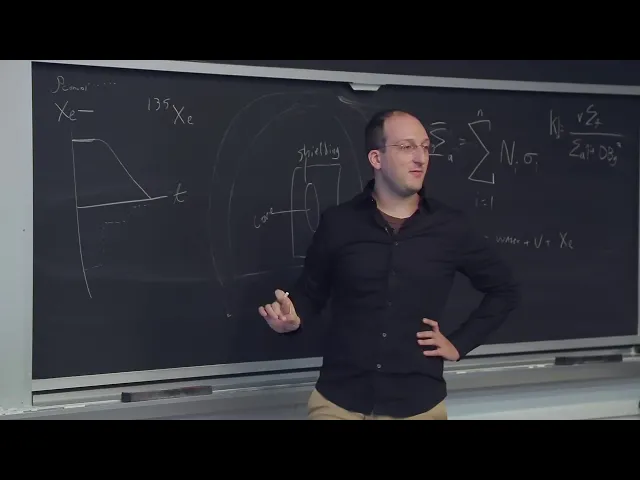
you've got the core here. You've got a
2:43
bunch of shielding around it.
2:46
And you've got a dome
2:48
that's rather thick
2:52
that comprises the containment.
2:57
That would be the core.
2:59
This would be some shielding.
3:03
So, this is what you find in US and most
3:06
other reactors. For the RBMK reactors,
3:10
there was no containment.
3:14
Because it was thought that nothing
3:16
could happen. And boy, were they wrong.
3:19
So, I want to walk you guys through a
3:21
chronology of what actually happened at
3:23
the Chernobyl reactor, which you guys
3:25
can read on the NEA or Nuclear Energy
3:28
Agency website, the same place that you
3:30
find Janice. And we're going to refer to
3:32
a lot of the Janice cross sections to
3:34
explain why these sorts of events
3:35
happened.
3:36
So, the whole point of what happened at
3:38
Chernobyl was it was desired to see if
3:41
you could use the spinning-down turbine
3:44
after you shut down the reactor to power
3:46
the emergency systems at the reactor.
3:49
Uh this would be following something
3:50
what's called a a loss of offsite power.
3:53
If the offsite power or the grid was
3:55
disconnected from the reactor, the
3:57
reactor automatically shuts down. But
3:59
the turbine, like I showed you a couple
4:01
weeks ago, is this enormous spinning
4:03
hulk of metal and machinery that coasts
4:06
down over a long period of let's say
4:08
hours. And as it's spinning, the
4:10
generator coils are still spinning and
4:13
still producing electricity, or they
4:15
could be.
4:16
So, it was desired to find out can we
4:18
use the spinning-down turbine to power
4:20
the emergency equipment if we lose
4:22
offsite power?
4:23
So, they had to simulate this event.
4:25
So, what they actually decided to do is
4:27
coast down the reactor to a moderate
4:30
power level, a very low power, and see
4:32
what comes out of the turbine itself, or
4:35
out of the generator, rather.
4:37
Um now, there were a lot of flaws in the
4:40
RBMK design. And I'd like to bring it up
4:42
here so we can talk about what it looks
4:44
like and what was wrong with it.
4:47
So, the RBMKs, unlike any of the
4:50
United States light water reactors that
4:52
you may have seen before, many of the
4:54
components are the same. There's still
4:56
uh light water reactor coolant loop
4:58
where a water flows around fuel rods,
5:01
goes into a steam separator, better
5:03
known as a big heat exchanger, and the
5:05
steam drives a turbine
5:07
which produces energy, and then this
5:09
coolant pump keeps it going, and then
5:11
the water circulates. Uh what makes it
5:13
different, though, is that each of these
5:15
fuel rods was inside its own pressure
5:18
tube. So, the coolant was pressurized,
5:21
and out here,
5:23
this stuff right here was the moderator,
5:25
composed of graphite.
5:27
Unlike light water reactors in the US,
5:29
the coolant was not the only moderator
5:31
in the reactor.
5:33
Graphite also existed, which meant that
5:35
if the water went away, which would
5:37
normally shut down a light water reactor
5:39
from lack of moderation, graphite was
5:42
still there to slow the neutrons down
5:44
into the high fission cross section
5:46
area.
5:48
And I'd like to pull up Janice
5:50
and show you what I mean with the
5:52
uranium cross section.
5:55
So, let's go again to uranium 235
5:58
and pull up its fission cross section.
6:02
Z fission.
6:08
Can make it a little thicker, too.
6:10
So,
6:12
again, the goal of the moderator is to
6:14
take neutrons from high energies, like 1
6:17
to 10 MeV, where the fission cross
6:19
section is relatively low, and slow them
6:21
down into this region where fission is,
6:23
let's say, a thousand times more likely.
6:26
And in a light water reactor in the US,
6:28
if the coolant goes away, so does the
6:30
moderation, and there's nothing left to
6:33
slow those neutrons down to make fission
6:35
more likely. In the RBMK,
6:38
that's not the case. The graphite's
6:39
still there.
6:41
The graphite is cooled by a
6:42
helium-nitrogen mixture
6:44
because the neutron interactions in the
6:46
graphite, that's slowing down,
6:49
we've always talked about what happens
6:50
from the point of view of the neutron.
6:52
But what about the point of view of the
6:53
other material?
6:54
Any energy lost by the neutrons is
6:57
gained by the moderating material. So,
6:59
the graphite gets really hot. And you
7:02
have to flow some non-oxygen-containing
7:04
gas mixture, like helium and nitrogen,
7:07
which is pretty inert, to keep that
7:09
graphite cool.
7:10
And then in between the graphite
7:12
moderator were control rods, about 200
7:15
of them or so, 30 of which were required
7:17
to be down in the reactor at any given
7:19
time in order to control power. And that
7:21
was a design rule that was broken during
7:24
the actual experiment. And then on top
7:27
of here, on top of this biological
7:28
shield, you could walk on top of it. So,
7:31
those the tops of those pressure tubes,
7:33
despite being about 350 kilo chunks of
7:35
concrete,
7:37
you could walk on top of them. It's
7:38
pretty cool.
7:40
Kind of scary, too.
7:42
So, what happened in chronological order
7:46
was around midnight the decision was
7:48
made to undergo this test and start
7:51
spinning down the turbine.
7:53
Uh but the grid operator came back and
7:55
said, "No, you can't just cut the
7:57
reactor power to nothing. You have to
7:59
maintain it at a rather high power for a
8:01
while." About 500 megawatts electric, or
8:04
half the rated power of the reactor. And
8:06
what that had the effect of doing is
8:08
continuing to create fission products,
8:11
including xenon 135.
8:13
We haven't mentioned this one yet.
8:16
You'll talk about it quite a lot
8:18
in 2205
8:20
in neutron physics.
8:22
Black shirt really shows chalk well.
8:24
Okay.
8:25
What xenon 135 does is it just sits
8:27
there. It's a noble gas. It has a
8:29
half-life of a few days, so it decays on
8:32
the slow side for,
8:34
you know, fission as fission products
8:35
go, but it also absorbs lots and lots
8:38
and lots of neutrons.
8:41
Let's see if I can find which one is the
8:42
xenon one. There we go.
8:44
So, here I've plotted the total cross
8:47
section for xenon 135 and the absorption
8:51
cross section.
8:52
And notice how for low energies, pretty
8:54
much the entire cross section of xenon
8:56
is made up of absorption. Did you guys
8:58
in your homework see anything that
9:00
reached about 10 million barns?
9:03
No.
9:03
Xenon 135 is one of the best neutron
9:05
absorbers there is, and reactors produce
9:07
it constantly. So, as they're operating,
9:10
you'll build up xenon 135 that you have
9:13
to account for in your sigma absorption
9:15
cross section.
9:17
Cuz like you guys saw on the homework,
9:20
if you want to write what's the sigma
9:21
absorption cross section of the reactor,
9:24
it's the sum
9:26
of every single isotope in the reactor
9:28
of its number density
9:31
times
9:32
its absorption cross section.
9:34
And so, that would include everything
9:36
for
9:37
water
9:39
and let's say the uranium and the xenon
9:42
that you're building up.
9:44
When the reactor starts up, the number
9:46
density of xenon is zero cuz you don't
9:48
have any anything to have produced it.
9:50
When you start operating, you'll reach
9:52
the xenon equilibrium level where it
9:55
will build to a certain level that will
9:57
counteract the reactivity of the
9:59
reactor.
10:00
And in your K effective expression
10:03
where it's sources
10:06
over
10:07
absorption plus leakage
10:11
this has the effect of rise at raising
10:13
sigma absorption and lowering K
10:15
effective.
10:17
The trick is it doesn't last for very
10:18
long. It both decays with a half-life of
10:20
about 5 days and when you try and raise
10:23
the reactor power you will also start to
10:25
burn it out. So if you're operating at a
10:27
fairly low power level, you'll both be
10:29
decaying and burning xenon without
10:32
really knowing what's going on and
10:33
that's exactly what happened here.
10:35
So an hour or so later
10:38
let me pull up the chronology again.
10:40
A little more than an hour later, so the
10:42
reactor power stabilized at something
10:43
like 30 MW.
10:45
And they were like, "What is going on?
10:47
Why is the reactor power so low? We need
10:49
to increase the reactor power." So what
10:51
did they do? Couple things. One was
10:54
remove all but six or seven of the
10:55
control rods.
10:57
Going way outside the spec of the design
11:01
uh because 30 were needed to actually
11:02
maintain the reactor at a stable power.
11:05
All the while the xenon that had been
11:07
building up is still there keeping the
11:10
reactor from going critical. It's what
11:11
was the main reason that the reactor
11:13
didn't even have very much power.
11:16
But it was also burning out at the same
11:17
time.
11:18
So all the while
11:20
let's say if we were to show a graph of
11:23
two things, time
11:25
xenon inventory and
11:29
as a solid line and let's say control
11:31
rod worth
11:35
as a dotted line.
11:37
The xenon inventory at full power would
11:39
have been at some level and then it
11:42
would start to decay and burn out. Well,
11:45
at the same time the control rod worth
11:47
as you remove control rods from the
11:49
reactor
11:51
every time you remove one you lose some
11:52
control rod worth would continue to
11:55
diminish.
11:56
Leading to the point where that stuff
11:58
was going to happen.
12:02
Let me make sure I didn't lose my place.
12:04
So at any rate as they started pulling
12:06
the control rods out a couple of
12:08
interesting quirks happened in terms of
12:10
feedback. So let's look back at this
12:11
design.
12:12
Like any reactor
12:14
this reactor had what's called a
12:16
negative fuel temperature coefficient.
12:18
What that means is that
12:20
when you heat up the fuel
12:22
two things happen. One, the
12:24
cross-section for anything absorption or
12:26
fission would go up but the number
12:28
density would also go down. As the atoms
12:31
physically spaced out in the fuel, their
12:34
number density would go down lowering
12:36
the macroscopic cross-section for
12:38
fission. And that's arguably a good
12:40
thing.
12:41
The problem is at below about 20% power
12:45
the reactor had what's called a positive
12:46
void coefficient
12:48
which meant that if you boil the coolant
12:50
you increase the reactor power.
12:53
Because the other thing that I think I
12:54
mentioned this once
12:56
and you calculated in the homework
13:00
the absorption cross-section of hydrogen
13:03
is not zero. It's small but fairly
13:06
significant. Let's actually take a look
13:08
at it cuz we can always see this in
13:11
Janus.
13:12
Go back down to hydrogen.
13:15
Hydrogen one.
13:18
And we look at the absorption
13:20
cross-section.
13:24
And of course it started us with a
13:25
linear scale. Let's go logarithmic. Ah.
13:29
So at low energies at you know, 10 to
13:32
the minus eight to 10 to the minus seven
13:33
it's around a barn.
13:35
Not super high but absolutely not
13:37
negligible.
13:39
Which meant that part of the normal
13:40
functionality of the RBMK depending on
13:43
depended on the absorption of the water
13:46
to help absorb some of those neutrons.
13:48
With those neutrons gone, I'm sorry,
13:50
with those with that water gone
13:53
there was less absorption but there was
13:54
still a ton of moderation
13:56
in this graphite moderator. So they
13:58
still could get slow but then there'd be
14:00
more of them and that would cause the
14:01
power to increase. And then that caused
14:03
more of the water the coolant to boil
14:06
which would cause less absorption which
14:08
would cause the power to increase. Yeah,
14:10
Charlie? So if they removed the water
14:12
from
14:14
They did not remove the water from the
14:16
reactor. However, as the power started
14:18
to rise some of the water started to
14:20
boil.
14:22
And so you can still have let's say
14:23
steam flowing through
14:25
and still remove some of the heat.
14:27
However, you don't have that denser
14:29
water to act as an absorber.
14:31
And that's what really undid this
14:32
reactor. In addition, they decided to
14:35
disable the ECCS or the emergency core
14:38
cooling system which you're just not
14:39
supposed to do.
14:41
So they shut down a bunch of these
14:42
systems to see if you could power the
14:43
other ones from the spinning down
14:44
turbine.
14:46
And then as they noticed that the
14:48
reactor was getting less and less stable
14:49
they had almost all the rods out. Some
14:53
of these pressure tubes started to bump
14:56
and jump. These 350 kg pressure tube
15:00
caps were just rattling. I mean imagine
15:02
something that weighs you know, 900 lb
15:05
or so rattling around and there's a few
15:08
hundred of them. So there was someone in
15:09
the control room that said, "The caps
15:11
are rattling. What the heck?"
15:14
Uh didn't quite make it down the spiral
15:16
staircase because about 10 seconds later
15:19
everything went wrong.
15:21
And so I want to pull up this actual
15:22
timeline so you can see
15:24
it splits from minutes to seconds
15:27
because the speed at which this stuff
15:29
started to go wrong was pretty striking.
15:33
So for example, the control rods raised
15:35
at 1:19 in the morning.
15:38
2 minutes later
15:40
when the power starts to become unstable
15:42
the caps on the fuel channels which
15:43
again are like 350 kg blocks start
15:47
jumping in their sockets.
15:48
And a lot of that was we go back to the
15:51
RBMK reactor.
15:53
As the coolant started to boil here,
15:55
well that boiling force actually creates
15:57
huge pressure instabilities which would
15:59
cause the pressure tubes to jump up and
16:02
down eventually rupturing almost every
16:04
single one of them with enough force to
16:06
shoot these 350 kilo caps
16:09
and still what did they what did they
16:10
say? I like the language that they used.
16:14
Jumping in their sockets.
16:16
So
16:17
50 seconds later
16:19
pressure fails in the steam drums which
16:21
means there's been some sort of
16:22
containment leak. So all the while
16:25
the coolant was boiling, the absorption
16:27
was going down, the power was going up
16:30
repeat, repeat, repeat and the power
16:32
jumped to about 100 times the rated
16:34
power in something like 4 seconds.
16:37
So it was normally a 1000 MW electric
16:39
reactor which is about 3200 MW thermal.
16:42
It was producing nearly
16:45
yeah, half a terawatt of thermal power
16:48
for a very short amount of time until it
16:50
exploded.
16:52
Now this is interesting. A lot of folks
16:53
called Chernobyl a nuclear explosion.
16:55
That's actually a misnomer. A nuclear
16:57
explosion would be a nuclear weapon.
17:00
Something set off by an enormous chain
17:02
reaction principally heated by fission
17:05
or fusion. That's not actually what
17:07
happened at Chernobyl nor at Fukushima
17:10
nor was that the worry at Three Mile
17:11
Island. Not to say it wasn't a horrible
17:14
thing but it wasn't an actual nuclear
17:16
explosion.
17:17
At first what happened was a pressure
17:20
explosion.
17:21
So there was an enormous release of
17:24
steam as the power built up to 100 times
17:27
normal operating power the steam force
17:30
was so large that it actually blew the
17:32
reactor lid
17:34
up off of the thing.
17:35
And I think I have a picture of that
17:37
somewhere here too.
17:42
Should be further down. Yeah. To give
17:44
you a little sense of scale
17:46
the reactor cover which weighed about
17:47
1000 tons launched into the air
17:50
and landed above the reactor
17:52
sending most of the reactor components
17:54
up to a kilometer up in the air.
17:56
4 seconds later
17:59
that was followed by a hydrogen
18:01
explosion.
18:02
Let me get back down to that chronology.
18:05
So yeah.
18:07
At 1:23 and 40 seconds in the morning.
18:10
Oh yeah, so I should mention why this
18:11
happened. Emergency insertion of all the
18:13
control rods.
18:15
The last part that this diagram doesn't
18:17
mention is these control rods and I'll
18:19
draw this up here were tipped with about
18:21
6 in of graphite.
18:23
So if these were two graphite channels,
18:26
let's say these are carbon
18:29
and this is your control rod the goal
18:31
was to get this control rod
18:34
all the way into the reactor.
18:37
One part they didn't mention
18:39
was they were tipped with about 6 in of
18:41
graphite which only functions as
18:43
additional moderator. Graphite is one of
18:46
the lowest absorbing materials in the
18:48
periodic table, second I think only to
18:50
oxygen.
18:51
And if we pull up graphite's
18:53
cross-sections
18:57
I've plotted here the total
18:58
cross-section
18:59
the elastic scattering cross-section and
19:01
down here in the point 001 barn level is
19:05
the absorption cross-section. About 1000
19:08
times lower than water. So you're
19:09
shoving more material in the reactor
19:11
that slows down neutrons even more
19:13
bringing them into the high fission
19:14
region without absorbing anything and
19:17
they jammed about halfway down, about 2
19:19
and 1/2 ft down leaving the extra
19:22
graphite right in the center of the core
19:24
where it could do the most damage. And
19:26
it didn't take that much time. Yeah? Um
19:28
so my understanding is that also one of
19:30
the designs was that the control rods
19:32
didn't like immediately drop down but
19:34
they were slowly lowered. Yep. Um so
19:36
They took they took 7 to 10 seconds.
19:38
Okay, if they had a system where they
19:39
did drop them would that have possibly
19:41
actually shut the system down properly?
19:43
I'm not sure. I don't know whether
19:45
lowering control rods into something
19:47
that was undergoing steam explosions
19:49
would have actually helped. I mean to me
19:51
by this point it was all over.
19:53
Um
19:54
whether or not, you know, so the extra
19:56
the extra abs- what is it? The extra
19:58
moderator that was dumped in was the
20:00
last kick in the pants this thing needed
20:01
to go absolutely insane.
20:04
And if we go back to the timeline on the
20:06
second level, control rods inserted at
20:08
1:23 and 40 seconds, explosion 4 seconds
20:12
later. Ah, to 120 times full power.
20:16
Getting towards a terawatt, so. 1 second
20:18
later, the 1,000 ton lid launches off
20:22
from the first explosion.
20:24
Very shortly after that, second
20:26
explosion. And that happened because of
20:29
this reaction.
20:32
Well, any- just about anything
20:35
corroding with water will make pretty
20:38
much anything oxide
20:41
plus hydrogen. The same chemical
20:43
explosion that was the undoing of
20:45
Fukushima and was the worry at Three
20:47
Mile Island that there was a hydrogen
20:49
bubble building because of corrosion
20:51
reactions with whatever happened to be
20:53
in the core. This happens with zirconium
20:55
pretty vigorously, but it happens with
20:57
other materials, too.
20:58
If you oxidize something with water, you
21:01
leave behind the hydrogen, and the
21:02
hydrogen in a very wide range of
21:05
concentrations in the air is explosive.
21:08
We're actually not allowed to use
21:09
hydrogen at above 4% in any of the labs
21:12
here because that reaches the
21:13
flammability or explosive limit.
21:16
So, we were doing some um for my PhD, we
21:18
were doing these experiments corroding
21:20
materials in liquid lead, and we wanted
21:22
to dump in pure hydrogen to see what
21:24
happens when there's no oxygen. We were
21:26
told absolutely not. We had to drill a
21:28
hole in the side of the wall so that the
21:30
hydrogen would vent outside. And do some
21:32
calculations to show if the entire
21:34
bottle of hydrogen emptied into the lab
21:36
at once, which it could do if the cap of
21:38
the bottle breaks off, it would not
21:40
reach 4% concentration.
21:42
So, hydrogen explosions are pretty
21:44
powerful things. Have you guys ever seen
21:46
people making water from scratch?
21:48
Mix hydrogen and oxygen in the bottle
21:50
and
21:51
light a match?
21:52
We've got a video of it circulating
21:54
somewhere around here because for RTC,
21:56
for the reactor technology course, I do
21:58
this in front of a bunch of CEOs. Watch
22:00
them jump out of their chairs
22:01
to teach basic chemical reactions, but
22:03
it's pretty loud. Enough uh about enough
22:06
hydrogen and oxygen
22:08
to just fill this cup or fill a half
22:10
liter water bottle makes a bang that
22:12
gets your ears ringing. Not quite
22:13
bleeding, but close enough.
22:16
So, that's what happened here, except on
22:17
a much more massive scale. So, there was
22:19
a steam explosion followed seconds later
22:22
by a hydrogen explosion from hydrogen
22:24
liberated from the corrosion reaction of
22:26
everything with the water that was
22:28
already there.
22:29
And that's when
22:33
this happened.
22:54
So, that smoke right there
22:57
is from the graphite fire.
22:59
Not normal smoke.
23:20
Spoke too soon.
23:53
This actually provides a perfect conduit
23:55
to transition from the second to the
23:56
third parts of this course. A lot of you
23:58
have been waiting to find out what are
23:59
the units of dose and what are the
24:01
biological and chemical effects of
24:02
radiation. Well, this is where you get
24:04
them. From neutron physics, you can
24:06
understand why Chernobyl went wrong.
24:09
With honestly, you've just been doing
24:10
this for three or four weeks, but with
24:12
your knowledge of cross sections,
24:13
reactor feedback, and criticality, you
24:15
can start to understand why Chernobyl
24:17
was flawed in its design. And what we're
24:19
going to teach you in the rest of the
24:20
course is what happens next. What
24:23
happens when radionuclides are absorbed
24:25
by animals and the human body? And what
24:27
was the main fallout, let's say, in the
24:30
in the uh
24:31
colloquial sense and the actual sense
24:34
from the Chernobyl reactor.
24:37
Let's look a bit what they did next,
24:38
though.
25:45
That's not quite true. We'll see why.
25:58
That actually did happen.
26:08
I think that pretty much summarizes the
26:10
state of things now.
26:11
They uh they built a sarcophagus around
26:13
this reactor, a gigantic tomb, which
26:16
according to some reports is not that
26:18
structurally sound and is in danger of
26:20
partial collapse.
26:22
So, yeah, more difficult efforts are
26:24
ahead. But let's now talk about
26:27
what happened next.
26:29
I'm going to jump to the very end of
26:31
this. The actual way that the accident
26:33
was noticed
26:35
was the spread of the radioactive cloud
26:37
to not so close by Sweden.
26:41
So, it was noticed that folks entering a
26:43
reactor in Sweden had contaminants on
26:45
them, which they thought was coming from
26:47
their own reactor, good first
26:48
assumption. When it was determined that
26:50
nothing was amiss at the reactor in
26:51
Sweden, folks started to analyze wind
26:54
patterns and find out what happened, and
26:55
then it was clear that the USSR had
26:57
tried to cover up the Chernobyl
26:59
accident. But you can't cover up
27:01
fallout. And it eventually spread
27:04
pretty wide
27:05
covering most of Europe and Russia and
27:08
surprisingly not Spain. Lucky them for
27:11
the wind patterns that day or those few
27:13
days.
27:14
So, what happened is a few days after
27:16
the actual accident, a graphite fire
27:19
started to break out because graphite
27:21
when exposed to air, well, you can do
27:23
the chemistry.
27:25
Add graphite plus oxygen,
27:29
you start making carbon dioxide.
27:32
So, graphite burns when it's hot. And as
27:34
you could see from the video,
27:39
where is that nice still of
27:42
mol- burning graphite? Yeah. That
27:44
graphite was pretty hot. So, a lot of
27:45
that smoke included burning graphite and
27:48
a lot of the materials from the reactor
27:50
itself.
27:51
Now, when you build up fission products
27:53
in a reactor and they get volatilized
27:55
like this, the ones that tend to get out
27:57
first would be things like the noble
27:58
gases. So, the whole xenon inventory of
28:00
the reactor was released. It's estimated
28:03
about 100%.
28:05
And I can actually pull up those figures
28:08
when we talk about how much of which
28:10
radionuclide was released.
28:12
Uh that's also a typo. If somebody wants
28:14
to call in, there's no 33 isotope of
28:17
xenon. It's supposed to be 133.
28:20
Um that would be interesting if someone
28:21
wants to call in and say the NAA's got a
28:23
mistake.
28:24
So, 100% of the inventory released. That
28:27
should be pretty obvious because it's a
28:28
noble gas and it just kind of floats
28:30
away.
28:31
The real dangers, though, came from
28:33
iodine 131,
28:35
about 50%
28:37
of a three exabecquerel activity.
28:41
So, we're talking like megacuries or
28:43
might be giga. I can't do that math in
28:45
my head. Lot a lot of radiation. And the
28:47
problem with that is iodine behaves just
28:49
like any other halogen. It forms salts.
28:52
It's rather volatile. Have any of you
28:54
guys played with iodine before?
28:57
Uh no one does Oh, you have. Okay. What
28:59
happens when you play with it? I mean,
29:01
it just
29:02
absorbs the stuff like
29:04
for instance, everything
29:07
and it just reacts with like acids and
29:10
stuff. I haven't done very much with it,
29:12
so. Okay.
29:13
I happen to have extensive practice
29:15
playing with iodine in my home cuz I did
29:17
all the stuff you're not supposed to do
29:18
as a kid. Going to build your own
29:19
chemistry stuff, things that somehow,
29:21
you know, leak out of your local high
29:22
school, somehow.
29:24
Iodine's pretty neat.
29:27
Yeah, it happens sometimes. Um if you
29:29
put iodine in your hand, it actually
29:31
sublimes. The heat from your hand is
29:33
enough to directly go from solid to
29:35
vapor. And so, the iodine was also quite
29:39
volatile. Some of it may have been in
29:40
the form of other compounds, some of it
29:42
may have been elemental, probably not
29:44
likely, but there was certainly some
29:45
iodine vapor, and about half of that was
29:47
released. The problem is then it
29:50
condenses out and falls on anything
29:53
green, anything with surface area. So,
29:56
the biggest danger to the folks living
29:57
nearby was from eating leafy vegetables
30:01
because the the leaves that leaves got
30:03
lots of surface area, iodine deposits on
30:05
them, and it's intensely radioactive for
30:07
a month or so or depositing on the grass
30:10
that cows eat, which led to the problem
30:12
of radioactive milk.
30:14
And so, that's why milk in the Soviet
30:16
Union was banned for such a long time
30:17
because this was one of the major
30:19
sources of iodine contamination.
30:22
The other one which we're worrying about
30:23
now from Fukushima as well is cesium
30:27
which has similar chemistry to sodium
30:29
and potassium, again a rather salty
30:31
compound
30:33
or rather salty element, but it's got a
30:34
half-life of 30 years.
30:37
And if we look it up in the table of
30:38
nuclides
30:40
we'll see what it actually releases. Oh,
30:42
good. It's back online.
30:45
Anyone else notice this broken couple
30:47
days ago?
30:48
Yeah.
30:50
Well, luckily Brookhaven National Lab
30:52
has a good version up, too. But, let's
30:54
grab cesium.
30:57
Yeah, there's plenty out there.
31:00
Cesium 137
31:02
beta decays to barium, but also gives
31:04
off gamma rays, and most of the decays
31:07
end up giving off one of those gamma
31:10
rays. Let's say a 660 keV gamma ray. So,
31:13
it's both a beta and a gamma emitter.
31:15
Now, which of those types of radiation
31:17
do you think is more damaging to
31:18
biological organisms?
31:20
The beta or the gamma?
31:24
You say the gamma. Why do you say so?
31:27
Doesn't beta get stopped by like skin or
31:28
clothing? It does.
31:30
But, if cesium is better known as
31:33
Yes.
31:35
That's right. So Did I get to tell you
31:37
guys this question, the four cookies
31:39
question?
31:41
Yeah.
31:42
You eat the gamma cookie because most
31:44
gammas that are emitted by the cookie
31:46
simply leave you and irradiate your
31:47
friend, which is going to be the topic
31:48
of piece at number eight.
31:51
You'll see. That's why you guys are
31:52
getting your whole body counts. Speaking
31:54
of, who's who's gotten their whole body
31:56
counts at DHS?
31:58
Awesome. So, that's almost everybody.
32:00
You will need that data for problem set
32:02
eight. So, do schedule it soon.
32:04
Preferably before Thanksgiving so that
32:06
you'll be able to take a look at it. Has
32:08
anyone found anything interesting in
32:09
your spectra?
32:12
Good.
32:14
Glad to hear that.
32:15
But, you do see a potassium peak that
32:18
you can probably integrate and do some
32:20
problems with, right?
32:22
Yeah, cuz you will. Okay.
32:24
Anyway, yeah, it's the betas. That's the
32:27
real killer. The gammas are going to
32:29
leave the cesium, enter your body, and
32:31
most likely come out the other side.
32:33
Because the mass attenuation coefficient
32:37
of six What is it? Water for 660 keV
32:41
gammas, let's find that.
32:44
Table three.
32:46
Let's say you're made mostly of water.
32:53
Water, liquid. That's pretty much
32:55
humans.
32:56
660 keV is right about here leading to
32:59
about 0.1 cm squared per gram, and with
33:03
a density of 1 g, that's a pretty low
33:06
attenuation of gammas. So, this chart
33:08
actually shows why most of the cesium
33:10
gammas that would be produced from
33:12
ingestion just get right out, but it's
33:13
the betas that have an awfully short
33:15
range.
33:17
Anyone remember the formula for range
33:20
in general?
33:22
Cuz it's going to come back up in our
33:23
discussion of dose and biological
33:25
effects.
33:29
Integral of
33:32
Yep, of stopping power to the negative
33:33
one.
33:36
And that stopping power
33:38
is this simple formula.
33:49
Let's see. What did that come out as?
33:57
log minus beta squared. Ah, simple
34:00
little formula.
34:01
Which I'm not going to expect you guys
34:03
to memorize, so don't worry about it.
34:05
But
34:06
if you integrate this, you find out that
34:07
the range of electrons, even 1 MeV
34:09
electrons in water, is not very high.
34:11
So, most of them are stopped near or by
34:14
the cells that absorb them doing quite a
34:17
bit of damage to the DNA, which is
34:19
eventually what causes mutagenic
34:21
effects, cancer, cell death what we're
34:24
going to talk about for the whole third
34:25
part of the course.
34:28
There's also
34:29
a worry about which organs actually
34:32
absorb these radionuclides, and iodine
34:35
in particular is preferentially absorbed
34:38
by the thyroid.
34:39
So, when we started looking at the
34:40
amount of radioactive substances
34:43
released, remember they said, "Okay, at
34:44
the round
34:46
26th of April or the 2nd of May or so,
34:48
the release was stopped." Not according
34:50
to our data. That's when the graphite
34:52
fire picked up again. In addition, the
34:55
core of Chernobyl which had undergone a
34:58
mostly total meltdown
35:01
was sitting in a pool
35:04
on top of this concrete pad.
35:07
So, let's just call this liquid stuff
35:09
The actual word that we use in parlance
35:11
is called corium.
35:13
It's our tongue-in-cheek word for every
35:15
element mixed together in a hot
35:17
radioactive soup.
35:19
It's First of all, it started to
35:20
redistribute reacting with any water
35:22
that was present, flashing it to steam,
35:24
and the steam caused additional
35:26
dispersion of radionuclides, and
35:28
eventually
35:29
it burrowed its way through and into the
35:31
ground
35:32
releasing more. You know, it's it's uh
35:35
it's the worst nuclear thing that's ever
35:37
happened in the history of nuclear
35:38
things.
35:40
Quite a mess.
35:42
And luckily, it did sort of taper off
35:44
after this.
35:46
But, let's now look into
35:48
what happens next. And this is the nice
35:51
intro to the third part of the course.
35:53
Iodine is is preferentially uptaken by
35:55
the thyroid gland somewhere right about
35:57
here.
35:58
Um so, has anyone ever heard of the idea
36:00
of taking iodine tablets in the case of
36:02
a nuclear disaster?
36:04
Anyone have any idea why?
36:09
If you saturate your thyroid with
36:11
iodine, then if you ingest radioactive
36:13
iodine, it's less likely to be
36:15
permanently uptaken by the thyroid. So,
36:18
this actually provided some statistics
36:21
on the probability of getting thyroid
36:23
cancer from radioactive iodine
36:26
ingestion.
36:27
Luckily, the statistics were quite poor,
36:29
which means that not many people were
36:31
exposed. It was somewhere around 1,300
36:34
or so.
36:35
Not like millions. Yeah, 1,300 people
36:38
total.
36:39
But, what I want to jump to is the dose
36:42
versus risk curve. And this is going to
36:44
apply all of our discussion about the
36:47
biological long-term effects of
36:49
radioactivity.
36:50
What's the most striking thing you see
36:53
as part of this curve?
36:56
That's That's right. That's the first
36:58
thing I saw.
37:00
There are six different models for how
37:03
dose and increased risk of cancer
37:05
proceeds, and they all fall within
37:07
almost all the error bars of these
37:09
measurements.
37:11
I'll say again, thank God that the error
37:13
bars are so high because that means that
37:15
the sample size was so low.
37:17
So, when folks say we don't really know
37:19
how much radioactivity causes how much
37:22
cancer, they're right because luckily,
37:24
we don't have enough data from people
37:26
being exposed to know that really,
37:28
really well.
37:29
So, some folks say we should be
37:31
cautious. I kind of agree with them.
37:33
Some folks say the jury's still out. I
37:35
also agree with them.
37:37
But, you can start to estimate these
37:39
sorts of things by knowing how much
37:41
radiation energy was absorbed and to
37:44
what organ.
37:45
So, I think the only technical thing I
37:47
want to go over today
37:49
is the different units of dose because
37:51
as you start to read things in the
37:52
reading, which I recommend you do if you
37:54
haven't been doing yet, you're going to
37:55
encounter a lot of different units of
37:57
radiation dose ranging from things like
38:00
the roentgen
38:04
which responds to a number of
38:06
ionizations.
38:10
You won't usually see this one
38:12
given in sort of biological parlance
38:15
because it's the number of ionizations
38:17
detected by some sort of gaseous
38:19
ionization detector. So, the dosimeters
38:21
that you all put on the Did you guys all
38:23
bring these uh
38:25
these like brass
38:27
pen dosimeters into the reactor? Anyone
38:29
look through them to see what the unit
38:30
of dose was?
38:33
It's going to be in roentgens cuz that's
38:34
directly correlatable to the number of
38:37
ionizations that that dosimeter has
38:39
experienced. You'll also see four dose
38:42
units, two of which are just factors of
38:44
100 away from each other. There is
38:46
what's called the rad and the gray
38:49
and there's what's called the rem
38:52
and the sievert.
38:57
You'll see these approximated as gray.
39:00
You'll see these as R, and these are
39:03
just usually written as rem.
39:05
So, a rad is simple.
39:08
Let's see.
39:10
100 rads
39:13
is the same as 1 gray.
39:15
And 100 rem
39:17
is the same as 1 sievert. And for gamma
39:20
for the case of gamma radiation
39:23
these units are actually equal.
39:26
I particularly like this set of units
39:28
because
39:30
this is the kind of SI of radiation
39:32
units because it comes directly from
39:34
measurable, calculatable quantities.
39:36
Like the gray, for example, the actual
39:38
unit of gray
39:40
is joules absorbed
39:42
per kilogram of absorber.
39:45
It's a pretty simple unit to understand.
39:47
If you know how many radioactive
39:49
particles or gammas or whatever that you
39:52
have absorbed, you can multiply that
39:54
number by their energy, divide by the
39:56
mass of the organ absorbing them, and
39:59
you get its dose in gray.
40:01
Sievert
40:02
is gray
40:04
times some quality factor for the
40:07
radiation
40:10
times some quality factor
40:14
for the specific type of tissue.
40:17
What this says is that some types of
40:20
radiation are more effective at causing
40:22
damage than others, and some organs are
40:25
more susceptible to radiation damage
40:27
than others. Does anyone happen to know
40:29
some of the organs that are most
40:31
susceptible to radiation damage?
40:38
Soft tissues like what? Cuz there's lots
40:40
of those.
40:43
Stomach lining, yep. Yep. Huh?
40:46
Lungs? Yep. What else?
40:51
Thyroid. Yep, there there is definitely
40:53
one for thyroid.
40:55
Bone marrow.
40:57
What other ones?
41:00
Y'all,
41:01
brain actually not so much. Eyes.
41:05
And where else do you find rapidly
41:07
dividing cells in your body?
41:10
Skin? Yep, the dermis.
41:14
I don't know about the liver. I would
41:16
assume so. Yeah, it's a pretty active
41:17
organ.
41:19
But when folks are worried about birth
41:20
defects
41:22
reproductive organs.
41:24
The link here that for some reason is
41:26
not said in the reading and I've never
41:28
figured out why is the more often a cell
41:30
is dividing the more susceptible it is
41:33
to gaining cancer risk because every
41:35
cell division is a copy of its DNA.
41:38
And anytime that radiation goes in and
41:41
damages or changes that DNA by either
41:44
causing what's called a thymine bridge
41:45
where two thymine bases get linked
41:47
together or damaging the structure in
41:49
some other way, that gene is then
41:52
replicated and the faster they're
41:54
replicating the more likely cancer is
41:56
going to become apparent.
41:59
I guess that this brings up a question,
42:01
when does a rapidly dividing cell become
42:03
cancer? Is it division number one or is
42:05
it when you notice it?
42:07
I guess I'll leave that question to the
42:08
biologists.
42:10
But if you notice in the reading you'll
42:12
see a bunch of different tissue
42:13
equivalency factors.
42:15
And you'll just see them tabulated and
42:17
say there they are, memorize them. I
42:19
want you to try and think of the pattern
42:21
between them. The tissues that basically
42:23
don't matter like the non-marrow part of
42:26
the bone, dead skin cells, muscles,
42:29
things that basically aren't listed that
42:31
much, they're not dividing very fast.
42:33
But anywhere where you find stem cells,
42:35
the lining of your intestine, your lungs
42:38
which undergo a lot of environmental
42:40
damage need to be replenished, gonads,
42:42
dermis, what was the other one that we
42:44
said? Eyes.
42:46
These are places that are either
42:47
sensitive tissues or they're rapidly
42:49
dividing.
42:51
And so the sievert is kind of an a unit
42:54
of increased equivalent risk. So that if
42:57
you were to absorb one gray of gamma
42:59
rays versus one gray of alphas, you'd be
43:03
about 20 times more likely to incur
43:05
cancer from the alphas than the gammas
43:07
because the amount of localized damage
43:09
that they do to cells. And we'll be
43:10
doing all this in detail pretty soon.
43:13
And then for tissue equivalency factor,
43:15
if you absorb one gray in your whole
43:18
body, which means one joule per kilogram
43:20
of average body mass
43:22
versus one gray directly to the lining
43:24
of your intestine by let's say drinking
43:27
polonium-laced tea
43:29
like happened to a poor ex was it
43:32
current or ex-KGB guy? One of the
43:34
Russian fellows?
43:35
No, it's the KGB guys that poisoned him,
43:37
right?
43:38
Yeah, you guys remember back in 2010 or
43:40
so?
43:41
There was a Russian
43:43
Was he a journalist?
43:46
Ex-KGB. So the current KGB somehow got
43:49
into London and slipped polonium into
43:51
his tea at a Japanese restaurant.
43:56
Uh, really?
44:01
What was his name?
44:04
Let's see.
44:08
Then polonium
44:12
poisoning. Did he actually die?
44:14
Poisoning of Alexander Litvinenko.
44:23
He's not doing too well.
44:27
Illness and poisoning, death and last
44:29
statement.
44:32
At the hospital in London. So, yeah.
44:37
Well
44:39
interesting. That probably has something
44:42
to do with it.
44:44
Yeah? Well
44:46
all right, we're not going to comment on
44:48
the politics, but the the radiation
44:49
effect worked clearly, unfortunately. So
44:53
polonium is an alpha emitter and that
44:55
caused a massive dose of alphas to his
44:58
entire gastrointestinal tract. And that
45:00
caused a whole lot of damage to those
45:02
cells. No time for cancer. It actually
45:04
killed off a lot of those stem cells.
45:06
And the way that radiation poisoning
45:08
would work is that if you kill off the
45:10
stem cells, the villi in your intestine
45:12
die which are responsible for absorbing
45:14
nutrition. You can't uptake nutrition.
45:17
You basically starve. Doesn't matter
45:19
what you eat. It's messed up.
45:22
Yeah.
45:24
That's a really bad way to go. It's
45:26
called gastrointestinal syndrome. And
45:27
we'll be talking about the progressive
45:30
effects of acute radiation exposure
45:33
where you have immediate effects mostly
45:35
relating to the death of some organ that
45:38
is responsible for either cell division
45:40
to keep you alive or in extreme cases
45:43
your neurological system and nerve
45:45
function just stops at the highest
45:46
levels of dose. And that corresponds to
45:48
doses of around 4 to 6 gray. 4 to 6
45:53
joules per kilogram of villi or body
45:56
mass will kill you pretty quickly with
45:59
very little chance of survival as what
46:00
happened here.
46:02
And so this was the problem with all the
46:03
folks living around and near Chernobyl
46:06
and Ukraine and Belarus and everywhere
46:09
was the contamination was pretty
46:11
extensive. Uh, about 4,000 people are
46:14
estimated to have died or contracted
46:16
cancer from this. I can't believe how
46:18
low that number is, but it's still 4,000
46:20
people that it should never happen to.
46:22
And effects were felt far away in towns
46:25
like Gomel and I can't read that one cuz
46:27
there's not enough pixels. Um, because
46:29
of the way that let's say rainwater
46:32
whisked or let's say um, the vapor cloud
46:34
from the reactor was whisked away,
46:36
rainwater caused it to fall on certain
46:37
places which still to this day can have
46:40
a really large contamination area.
46:42
And this brings me a little bit into
46:44
what should we be worried about from
46:46
Fukushima? A whole lot less than
46:48
Chernobyl. And the reason why is
46:51
Fukushima did undergo a hydrogen
46:53
explosion and did and still continues to
46:55
release cesium 137 into the ocean.
46:59
Luckily for us the ocean is big.
47:01
And except for fish caught right near
47:04
around Fukushima, even though
47:05
concentrations can be measured at
47:08
hundreds to thousands of times normal
47:10
concentrations, they can still be
47:12
hundreds to thousands of times lower
47:14
than the safe consumption. So a lot of
47:17
the problems you see in the news today,
47:20
I'm not going to call them lies, but I'm
47:21
going to call them half-truths. Folks
47:23
will show the radiation plume of cesium
47:26
137 escaping from Fukushima and that's
47:28
true. There is radiation escaping. The
47:31
question is is it high enough to cause a
47:34
noticeable increased risk of cancer?
47:38
That's the question that reporters
47:40
should be asking themselves. When they
47:42
only tell the half of the story that
47:43
gets them viewers and they don't tell
47:45
the half of the story to complete the
47:46
story
47:47
and tell you should you be afraid or not
47:49
cuz unfortunately fear brings viewers.
47:52
This is the problem and I'm happy to go
47:54
on camera saying this. This is the
47:56
problem with the media today
47:58
is with a half-truth and with a
48:00
half-story you can incite real panic
48:03
over non-physical issues that may not
48:05
actually exist. And so it's important
48:08
that the media tell the whole story.
48:10
Yes, it's true that Fukushima's leasing
48:12
releasing cesium 137.
48:15
How much though is the question that
48:17
people and the media should be asking
48:18
themselves.
48:20
And in the rest of this course we're
48:21
going to answer the question how much is
48:23
too much.
48:25
So I'm going to stop here
48:26
since it's 2 of 5 of and ask you guys if
48:28
you have any questions on
48:30
the whole second part of the course or
48:31
what happened in Chernobyl.
48:37
Yeah. Yeah, uh, could you explain the
48:39
quality factor or determine how you find
48:41
that? Yep, the quality factor Well,
48:43
there's two quality factors. There's the
48:45
quality factor for radiation which will
48:47
tell you how much let's say how much
48:49
more cell damage a given amount of a
48:52
given type of radiation of the same
48:54
energy will deposit into a cell.
48:57
And the tissue equivalency factor tells
49:00
you, well, what's the added risk of some
49:03
sort of defect leading to cell death or
49:05
cancer or some other defect
49:07
from that radiation absorption.
49:10
So to me the tissue equivalency factor
49:12
is roughly but not completely
49:14
approximated by the cell division rate
49:17
and the radiation quality factor is
49:20
going to be quite proportional to the
49:21
stopping power.
49:23
You'll see a term called the linear
49:27
energy transfer or LET.
49:29
This is the stopping power unit used in
49:32
the biology community. It's stopping
49:34
power. And luckily the Turner reading
49:36
actually says it somewhere buried in a
49:38
paragraph. LET is stopping power. So, if
49:41
you start plotting these two together,
49:43
you might find some striking
49:44
similarities.
49:45
I saw two other questions up here.
49:47
Yeah. Can I ask uh
49:49
Why is Chernobyl still considered like
49:51
off-limits if most of the half-lives of
49:53
these things were like
49:55
on the range of like days to
49:57
like 2 years? I mean, it happened in
49:59
Let's answer that with numbers. So, most
50:01
of the half-lives were on the range of
50:03
days to hours.
50:05
But, still, cesium 137 with a half-life
50:08
of 30 years released a third of an
50:10
exabecquerel. That's one of the major
50:12
sources of contamination still out
50:14
there. In addition, if we scroll down a
50:16
little more,
50:19
there was quite a bit of plutonium
50:20
inventory with a half-life of 24,000
50:23
years.
50:24
So, on on Friday, we're going to have
50:26
Jake Heckler come in and give his
50:28
Chernobyl travelogue, cuz one of our
50:29
seniors has actually been to Chernobyl.
50:32
And his boots were so contaminated with
50:34
pluto- with plutonium that he can never
50:36
use them again. They got to stay wrapped
50:37
up in plastic. So, some of these things
50:39
last tens of thousands of years. And
50:42
even though there weren't a lot of
50:44
petabecquerels of plutonium released,
50:47
they're alpha emitters. And they're
50:48
extremely dangerous when ingested.
50:51
So,
50:52
uh greens and things that uptake
50:54
radionuclides from the soil, like moss
50:56
and mushrooms, are totally off-limits in
50:59
a large range of this area.
51:02
You will find a video online, if you
51:04
look, of a mayor from a nearby town
51:06
saying, "Oh, they're perfectly safe to
51:07
eat. Look, I eat them right here." And I
51:09
just say read the comments for what
51:11
people have to say about that.
51:13
Not too smart.
51:14
Yeah. So, what what's like the process
51:16
now for like taking care of Chernobyl?
51:18
Like, what do they
51:19
do there?
51:21
The so so the sarcophagus around the
51:22
reactor has got to be shored up to make
51:24
sure that nothing else gets out, cuz
51:26
most of the reactor is still there.
51:28
And let's say rainwater comes in and
51:29
starts washing away more stuff into the
51:31
ground or whatever. We don't want that
51:33
to happen. Soil replacement and disposal
51:36
as nuclear waste is still going on.
51:39
Uh removal of any moss, lichen,
51:40
mushrooms, or anything with a sort of
51:42
radiation exposure has got to keep
51:44
going. But, this the area that it covers
51:47
is enormous. I don't know if we're ever
51:49
going to get rid of all of it. The
51:51
question is, how much do we have to get
51:53
rid of to lower our risk of cancer in
51:55
the area to an acceptable rate? There
51:57
will likely be parts of this that are
51:59
inaccessible for thousands to tens of
52:01
thousands of years, unless we hopefully
52:03
get smarter about how to contain and
52:05
dispose of this kind of stuff.
52:06
We're not there yet. So, right now, the
52:08
methods are
52:09
kind of simple. Get rid of the soil.
52:12
Fence off the area.
52:14
Some folks have been returning, and they
52:16
do get compensation and free medical
52:18
visits because the background levels
52:20
there are elevated, but not that high.
52:23
So, folks have started to move back to
52:25
some of these areas,
52:27
but there's a lot that are still
52:28
off-limits.
52:30
Any other questions?
52:33
Yeah. It's like way worse than the
52:36
atomic bombs dropped on Hiroshima and
52:38
Nagasaki, because those are like fully
52:40
functioning cities at at this point.
52:43
Yeah, the number of deaths from the
52:45
atomic bombs way outweighed the number
52:47
of deaths that will ever happen from
52:49
Chernobyl. But, like, why is the
52:50
radiation from those bombs not
52:54
Oh, not that much of an issue? Yeah.
52:55
There wasn't that much material. The not
52:57
There wasn't that much nuclear material
52:59
in an atomic bomb.
53:00
What did you guys get for the radius of
53:02
the critical sphere of plutonium?
53:04
4.7
53:06
cm.
53:06
Centimeters? Yeah. Yeah.
53:08
Doesn't take a lot. It takes, you know,
53:10
10, 20 kilos to make a weapon.
53:14
Now, we're talking about tons or
53:16
thousands of tons of material released.
53:18
So, an atomic weapon doesn't kill by
53:20
radiation. It kills by pressure wave,
53:23
the heat wave.
53:25
The fallout is not as much of a concern.
53:27
And we'll actually be looking at the
53:29
data from Hiroshima and Nagasaki
53:31
survivors to see who got what dose, what
53:33
increased cancer risk did they get, and
53:36
is this the
53:37
is the idea that every little bit of
53:39
radiation is a bad thing actually true?
53:41
The answer is, you can't say yes or no.
53:44
No one can say yes or no, because we
53:46
don't have good enough data.
53:48
The error bars support either
53:49
conclusion.
53:51
So, I'm not going to go on record and
53:52
say a little bit of radiation is okay.
53:54
The data's not out yet.
53:56
Hopefully, it never will be.
54:00
Any other questions?
54:03
All right. I'll see you guys on
54:05
Thursday.
— end of transcript —
Advertisement
More from MIT OpenCourseWare
 41:21
41:21
Lecture 2: Basic Macroeconomic Concepts
MIT OpenCourseWare
 48:17
48:17
Lecture 19: The Goods Market in the Open Economy
MIT OpenCourseWare
 29:30
29:30
Lecture 1: Introduction to 14.02 Principles of Macroeconomics
MIT OpenCourseWare
 1:02:03
1. Introduction for 15.S12 Blockchain and Money, Fall 2018
MIT OpenCourseWare


